
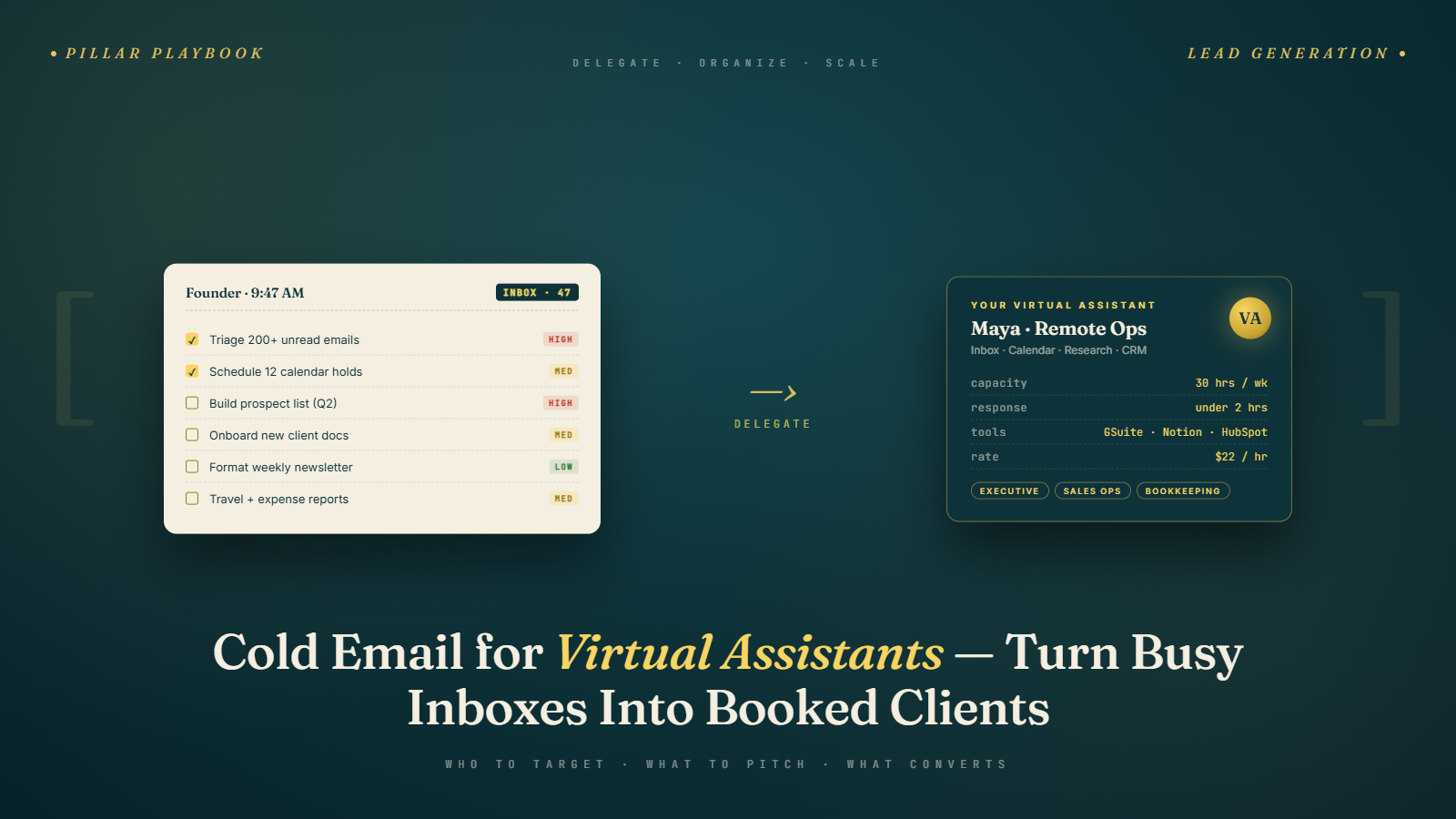
What Most Virtual Assistants Get Wrong About Finding Clients
Most VAs I have hired or trained were great at the work and bad at the selling. They posted on Upwork, joined a Facebook group, maybe asked for referrals once a quarter, then wondered why they were stuck at twenty-two dollars an hour while their friend who quit teaching last spring was clearing six thousand a month with two retainer clients.
The difference is almost never skill. It is almost always who they reach out to and what they say. The market for virtual assistants is enormous and growing, and most of the buyers in it have never been pitched directly by a VA. They get pitched by recruiters, by staffing firms, by EOR companies. They almost never get a clean, well-written email from a real person who has spent fifteen minutes on their website and noticed the specific thing eating their week.
This guide is the system I wish someone had handed me when I was running a one-person VA operation in 2019 and pricing by the hour. It covers twelve specific buyer types. For each one I will tell you who they are, where to find them, what they actually want help with, and the email I would send today. The structure is the same one I run for the agency I now manage; the templates have been pressure-tested across roughly nine thousand cold emails in the last eighteen months.
If you are brand new to cold email mechanics, read the cold email funnel explained and is cold email legal first. The rest of this assumes you can send a deliverable email and follow up four times without ending up on a blocklist.
A Quick Note on Pricing and Pitching Before the Personas
A solo VA running this system can comfortably bill three to six thousand dollars a month per client on a flat retainer (twenty to forty hours of work, depending on the scope). A small two-or-three-person agency runs five to twelve thousand a month per client. Specialized VAs (real estate transaction coordinators, podcast producers, ecommerce customer support) bill higher because the buyer cannot get the work done by anyone walking in off the street.
Two things matter more than rate. First, the buyer is not paying for hours. Hours are commodity. They are paying for a specific recurring problem to disappear. Pitch the problem and the disappearance, not the time card. Second, your reply rate lives or dies on whether the prospect believes you actually looked at their business before you wrote to them. Five honest minutes of research per email is the difference between "deleted unread" and "send me a Loom."
With that out of the way, here are the twelve buyer types I would build a list around tomorrow.
Buyer 1: The Solo Executive Coach or Fractional CFO
This is the cleanest entry point for most VAs because the buyer has budget, makes the decision themselves, and reorders monthly. Think executive coaches charging six hundred dollars an hour, fractional CFOs billing forty thousand a quarter, leadership consultants who run group cohorts. Their hours are precious and their inbox is the bottleneck on every revenue dollar.
Where to find them. The ICF Credentialed Coach Finder for PCC and MCC level coaches in your country. Marshall Goldsmith Stakeholder Centered Coaching network and the MG100 alumni list. Maven course rosters (instructors are almost always coaches). Reboot.io coach pages. Chief network spotlights (the membership directory is private but speaker rosters and event pages are public). On LinkedIn Sales Navigator filter for "Executive Coach" or "Fractional CFO" with no employees beyond the founder and at least five years of tenure in the current role.
The angle. Inbox triage and calendar defense. They are losing eight to twelve hours a week to scheduling, follow-ups, and email they should not be reading. The pitch is "you only see the emails that need you, the rest get handled or filed before you wake up."
Email template.
Subject: Inbox triage for the 200 unread before noon
Hi James,
Read your post on Tuesday about hitting two hundred unread emails before lunch. The line about "the inbox is now my full-time job and the coaching is a side project" is the reason I am writing.
I run inbox triage and calendar defense for three other executive coaches, all in your billing tier (six hundred plus an hour). The output is straightforward. You only see the messages that actually need you. Everything else gets handled, filed, or scheduled before you open Gmail in the morning.
Last client moved her inbox time from eleven hours a week to ninety minutes. Same number of replies sent. She kept the extra ten hours and added two new clients in the quarter that followed.
Worth a fifteen-minute call to look at your current inbox flow? I can put together a one-page audit first if it helps you decide.
— Maya
Buyer 2: The Top-Producing Real Estate Agent
A residential agent doing thirty to a hundred transactions a year is one of the most reliable VA clients in the market. Each closed deal is roughly thirty hours of paperwork, follow-up, and MLS coordination, almost none of which uses the agent's actual selling skill. They cannot keep doing both. The good ones already know they need help; they have just never been pitched by a VA who knows the difference between a transaction coordinator and an inbox manager.
Where to find them. RealTrends 1000 list of top-producing teams (public, sortable by region and volume). Zillow Premier Agent leaderboards by metro area. Inman Connect speaker rosters from the last two years. Tom Ferry coaching program alumni (the alumni list is partially public and the coach call recordings on YouTube give you names). Local MLS top-producer awards (most boards publish them). Anyone running ads as a "team lead" on Facebook with a website that lists more than five agents on the team.
The angle. Transaction coordination. Listing coordination. CRM hygiene and follow-up sequences for cold leads. Most agents will tell you they need an "assistant" but what they actually need is a TC who can chase signed disclosures and an email-discipline person who calls every cold lead at the sixty-day and ninety-day mark.
Email template.
Subject: TC support for the next 40 closings
Hi Daniela,
Saw the RealTrends listing showing your team closed eighty-seven transactions last year in the Phoenix metro. The growth chart on your website looks like the next twelve months are aiming at a hundred and twenty.
That math is the reason I am writing. A hundred and twenty closings is roughly thirty-six hundred hours of TC work — disclosures, MLS updates, lender chase, escrow follow-up, post-close paperwork. That is two full-time TCs, not one assistant. Every agent I have worked with at your volume eventually realizes this and either hires it in-house or outsources it. In-house adds W-2 overhead. Outsourced TC support sits between fourteen hundred and twenty-two hundred a month per agent on the team.
I run TC support for two teams in Arizona and one in Texas, all licensed (CAR, AAR forms). Last team I picked up last September: zero missed closing dates in seven months across forty-one transactions.
Open to a twenty-minute call this week? I will come with a sample weekly TC checklist tailored to your forms.
— Maya
Buyer 3: The Real Estate Investor or Short-Term Rental Operator
Different buyer than the agent above. Investors with ten to two hundred doors, or Airbnb operators running five to fifty units, are running an operations company without an operations team. They get late-night tenant calls, vendor scheduling chaos, listing turnover, guest messaging at all hours. They tend to be more frugal than agents but they pay reliably once they are convinced.
Where to find them. BiggerPockets Pro members (search the forums by post count for active landlords with public profiles). DealMachine and PropertyRadar customer testimonials. NARPM (National Association of Residential Property Managers) member directory. Local landlord associations (almost every state has one with a member directory). For short-term rental operators, AirDNA and Rabbu host listings, the Hospitable customer page, and Get Paid for Your Pad podcast guest archives. Sub40 and Cohostmarket are gold for STR co-hosts who already understand the model.
The angle. Tenant or guest communication. Vendor coordination. Listing turnover for vacancies. The pitch is responsive, off-hours coverage. "You stop answering tenant messages at 11pm" is a more compelling line than any list of services. For STR operators specifically, a five-minute response time on inquiries is the conversion lever; pitch that.
Email template.
Subject: 11pm tenant messages stop landing on your phone
Hi Marcus,
Saw your BiggerPockets thread last month about the tenant in unit 7B and the late-night plumbing call. The reply where you said "I am the landlord, the leasing agent, the maintenance coordinator, and I have not eaten dinner with my kids on a weeknight in six months" is the reason I am sending this.
I run tenant communications for three small landlord operations (between twelve and forty-five doors). The setup is simple. Every tenant message routes to me first. I handle anything that is not a habitability emergency. Habitability emergencies route to you and your on-call vendor list, which I keep updated. Vendor scheduling, rent reminders, lease renewals, move-out coordination — all handled in the system you already use, not a new one I sell you.
Last operator I onboarded cut his "landlord hours" from roughly thirty a week to four. Rent collection actually went up because the reminder cadence got consistent.
Worth a twenty-minute call? I will come ready to look at how your current system handles a 11pm message.
— Maya
Buyer 4: The Shopify or Ecommerce Founder
Direct-to-consumer ecommerce founders running one to ten million in annual revenue are a great target because the work is unglamorous, recurring, and obvious. Customer service tickets, supplier follow-up, returns and exchanges, product listing maintenance, fulfillment troubleshooting. They cannot grow past three or four million without help, and they almost never want to hire a domestic full-timer.
Where to find them. BuiltWith and Wappalyzer filtered to Shopify with revenue range estimates. Foundr Magazine course alumni (Foundr Plus members run public podcasts and Substacks). Triple Whale public customer spotlights. The 2x eCommerce podcast guest archive. Drop Ship Lifestyle alumni for the dropship-end. Klaviyo customer case studies (Klaviyo customers are the right revenue band almost by definition). Reviewer profiles on the Shopify App Store with three or more reviews from a real store URL.
The angle. Customer service ticket queue. The pitch is response time and CSAT, not "I can do customer service." For more advanced operators, supplier follow-up and listing maintenance. Pitch the metric, not the function.
Email template.
Subject: 47 unanswered customer tickets going into the weekend
Hi Lena,
Looked at the customer reviews on Black Forest Chocolate this morning and noticed three reviews in the last week mentioning "no response from support" before they got resolved. That is almost always a queue depth problem, not a product problem.
I run customer service for two Shopify operators in your revenue band (between two and four million annual). Median response time is under three hours. CSAT is currently sitting at 4.7 out of 5 across three thousand tickets in the last quarter. Setup uses your existing Gorgias or Zendesk; I do not sell you a new tool.
Most ecom founders at your stage assume customer service is a hire-in-house problem. The economics rarely work out. A trained outsourced ticket agent runs about twenty-two hundred a month for one shift coverage. A US in-house hire is closer to fifty-five hundred plus benefits.
Worth fifteen minutes to look at the queue? Happy to send a screenshot of the workflow first.
— Maya
Buyer 5: The Podcast Host
Podcasters with steady release cadence and over five thousand downloads per episode are the lowest-friction VA buyers in the entire market. The work is well-defined, repeatable, weekly. Show notes, transcription, social clips, guest research briefs. They mostly pay between fifteen hundred and three thousand a month and stay for years if you do not screw it up.
Where to find them. Listen Notes, sortable by review count and episode count (filter to active shows in your niche). Podchaser top podcasts in any category. Apple Podcasts top charts in narrow niches (parenting, finance, fitness, productivity). Riverside.fm featured creators. Podscribe and Magellan AI advertiser data for shows that take ads (which means budget). Anyone who has been a guest on a top-twenty business podcast in the last twelve months has their own show or is about to launch one.
The angle. Show notes plus social clip packaging. Pitch the workflow ("episode drops Monday, full notes plus three social clips live by Wednesday morning") not the activity ("I write show notes"). Most hosts who reply will already have a freelance editor; you are not pitching to replace the editor, you are pitching everything around the editor.
Email template.
Subject: Show notes for episodes 47 to 50
Hi Marcus,
Listened to your conversation with Dr. Andresen last Wednesday. The twelve-minute segment on glucose response in the late afternoon is the clearest version of that idea I have heard on a podcast in two years.
Noticed the last four episodes have shipped without show notes posted on the site. For a thirty-minute interview format, that is roughly four thousand words of ungated SEO content sitting on the table every week, plus three social clips per episode you are not running.
I run show notes for three other podcasts in the health and longevity space. Workflow: episode drops, notes plus three social clips plus a pull-quote graphic live within twenty-four hours. Most recent client (Brian at Coaches Corner) added forty-two thousand monthly visitors to his show site in five months from the SEO recap pages alone.
Want a ninety-second Loom showing exactly what the deliverable looks like for your show?
— Maya
Buyer 6: The YouTuber or Video Creator
YouTube creators with audiences between a hundred thousand and two million subscribers are some of the most unglamorous, profitable VA clients in the market. The work is operational, not creative. Comment moderation, sponsor outreach support, brand-deal pitch deck packaging, end-card and metadata management, member-tier community moderation, podcast feed conversion. They tend to pay well because they understand creator economics; one sponsor deal at thirty thousand pays for a VA for the year.
Where to find them. Spotter library of creator deals. Patreon top creators with a thousand or more patrons (the public stats are searchable). Creator Now alumni roster. Colin and Samir guest archives. ChannelMeter and VidIQ public rankings. For business creators specifically, the Modern Wisdom and Diary of a CEO guest archives are gold. For finance creators, the Compound and Friends and Animal Spirits guest lists. Anyone who has been featured in the Tubefilter "Top 50 Creators" lists in the last two years.
The angle. Comment moderation and sponsor pipeline support, not "I help with your channel." The specific work that consumes creator weeks is the business of the channel, not the videos themselves.
Email template.
Subject: Sponsor inbox audit for the 30K deal you are leaving in drafts
Hi Sam,
Subscribed since the Coastline Studios buyout video last fall. The series you ran on creator economics in November is the most useful thing I have seen aimed at people running channels in the half-million subscriber range.
I work with creators at your tier on the operational side of the channel. Specifically: sponsor inbox triage, brand-deal package assembly, comment moderation, member-tier community moderation. The pitch is not "I will do your editing" — your editor is fine. The pitch is the unglamorous business of the channel that eats your week and pays the bills.
Last creator I picked up last spring (audience around three hundred thousand) closed forty-two thousand in sponsor deals in the first ninety days, mostly because the inbox stopped being a graveyard. Median time-to-respond on a brand inquiry went from nine days to six hours.
Open to a twenty-minute call? Happy to send a Loom of the sponsor pipeline workflow first.
— Maya
Buyer 7: The Online Course Creator and Cohort Operator
Course creators running cohort-based programs three to five times a year are buying VA support in cycles. Each cohort is roughly eighty hours of student-facing operations; pre-launch is another forty. They tend to know exactly what they need and pay quickly when they find someone competent.
Where to find them. Maven course catalog, sorted by upcoming cohort and instructor reputation. Teachable Showcase. Kajabi Heroes pages. Podia featured creators. Skool community owners (the leaderboard is public and the top hundred almost all run cohorts). Circle community owners with three-figure monthly memberships. Paid Substack writers who have launched a cohort in the last twelve months. The "What's New" and "Now Enrolling" sections on every course platform are a live who-needs-help feed.
The angle. Cohort operations. Student onboarding emails, Slack or Discord moderation, office-hours calendar coordination, refund handling, tech setup for live sessions. Pitch the cohort, not "online course support."
Email template.
Subject: Cohort ops for the June Strategic CFO launch
Hi Devon,
Saw the registration page for your June cohort of "The Strategic CFO" opens next week. The waitlist count on your landing page is sitting just over four thousand, which based on similar Maven launches should run to a roughly two hundred and forty student cohort.
That is a lot of student-facing operations for one founder. Onboarding emails, Slack moderation, office-hours calendar, refund and policy questions, recording cleanup, tech support for the live sessions. Roughly eighty hours of work in the four weeks of the cohort, almost none of which uses your time well.
I run cohort operations for two other Maven instructors. Most recent one shipped at a 4.8 student CSAT and a refund rate under two percent across three cohorts. Setup uses the same Slack and Maven dashboards you already use.
Worth a fifteen-minute call before the launch to scope what cohort one looks like? I can put together a one-page workflow first if it helps you decide.
— Maya
Buyer 8: The Author or Speaker on the Circuit
Authors and professional speakers with twelve or more paid stages a year, or active book tours, run on chaos. They are simultaneously trying to land the next keynote, ship the next book, manage podcast booking, coordinate with their bureau, and stay sane on planes. They tend to value the assistant role highly because it is one of the few things between them and a missed flight.
Where to find them. Speaker bureau rosters: BigSpeak, AAE Speakers, WSB, Lavin Agency, Stern Speakers, Gotham Artists. Conference speaker pages from the last two years (any conference of size publishes its lineup). TED speaker public profiles. Penguin Random House author pages and Reedsy author profiles. Anyone who has been a guest on the Tim Ferriss or Steven Bartlett podcast in the last three years has a platform that needs operations support.
The angle. Travel and tour logistics. Podcast booking outreach (this is the high-value piece for newer authors). Bureau coordination. Fan email triage. Pitch the platform, not the assistant role. For active book tour seasons, scope the tour as a project and the ongoing as a retainer.
Email template.
Subject: Tour ops for the fall keynote schedule
Hi Dr. Reyes,
Saw the lineup of fall dates on your speaker page. Fourteen stages between September and December, three international, two on the same week as your book launch. That is a lot of moving parts on one calendar.
I run tour operations for three speakers and authors on the circuit. Setup is unglamorous and repeatable: travel coordination across the bureau and direct bookings, AV requirements memo for every venue, on-site schedule, podcast pre-launch booking outreach (which is the piece most speakers leave to publicists who do not actually do it), fan email triage, social posts off the keynote video clips.
Most recent client (a New York Times bestseller in your topic adjacency) booked thirty-one podcast appearances in the launch quarter from cold outreach I ran during the tour. Net new audience reach roughly four point three million.
Worth a twenty-five-minute call? Happy to put together a one-page tour ops draft for the fall before we talk.
— Maya
Buyer 9: The Small Law Firm Partner
Two to ten attorney firms, especially in plaintiff personal injury, family law, and estate planning, are perpetual VA buyers. The bottleneck is intake. Every missed intake call is a case worth twenty-five thousand dollars or more walking to the firm down the street. The partner knows it; the receptionist who already wears three hats cannot fix it.
Where to find them. Avvo top-rated lawyers by practice area and metro. Super Lawyers and Rising Stars annual lists (state by state, fully public). Martindale-Hubbell AV-rated attorneys. Lawmatics and Clio public customer testimonials and case studies. State bar speaker rosters from CLE events. Anyone running TV ads in personal injury already has a budget to spend on intake support and is the warmest audience in this entire list.
The angle. Intake. Specifically, after-hours intake and lead-to-consultation conversion. Pitch the metric: "you stop missing intake calls after 5pm." For estate planning specifically, the angle is document chase and signing logistics.
Email template.
Subject: After-hours intake for the calls you are missing now
Hi Patricia,
Saw the Super Lawyers feature for the firm last month. Congratulations on the recognition.
The reason I am writing is that the firm's TrustPilot reviews show a pattern most personal injury practices have, and most cannot fix without help: roughly one in five reviews mentions "took a week to call back" before the case was eventually picked up. For PI specifically, every twenty-four hours between accident and signed retainer is roughly a thirty percent reduction in conversion. Calls that come in after 5pm and on weekends are the largest leak.
I run after-hours intake support for two PI firms (one in Charlotte, one in Atlanta). Setup uses your existing intake software (Captorra, Lawmatics, or whatever the firm runs on). After-hours calls route to me, get qualified, and a signed engagement letter is in the prospective client's inbox before the partner walks into the office in the morning.
Last firm I onboarded last summer added eleven new cases per month to the docket from after-hours conversion alone. Average case value sat at thirty-eight thousand.
Open to a twenty-five-minute call to scope it?
— Maya
Buyer 10: The Boutique Bookkeeping or Accounting Practice
Bookkeepers and CPAs running practices with ten to two hundred clients are ideal VA buyers because the work is recurring, structured, and seasonal. The pain is concentrated in document chasing (the eternal friction of accounting) and intake during tax season. The buyer knows their hours-per-client number to the penny, which makes them easy to sell to with concrete math.
Where to find them. AICPA member directories (state by state). QuickBooks ProAdvisor finder, sorted by elite tier and practice size. Xero advisor directory, filtered to gold and platinum partners. Bookkeeper Launch alumni community (Ben Robinson's program). NACPB member directory. Anyone running a podcast or Substack on small business accounting (most boutique practices market through content these days). The CPA Academy speaker roster has a couple thousand active practitioners.
The angle. Client document chase and intake during tax season. Specifically, the recurring "we still need your 1099s" workflow that eats a partner's December and January. Pitch the bottleneck week.
Email template.
Subject: Document chase for the next tax season
Hi Eleanor,
Saw the QuickBooks ProAdvisor Elite listing for Maple Leaf Bookkeeping. The growth chart on your "About" page suggests the firm went from forty-eight clients in 2022 to roughly a hundred and fifteen now.
That growth is the reason for this email. A hundred and fifteen clients in tax season means roughly fourteen hundred document requests in January and February, almost all of which require two or three follow-ups. Most boutique practices solve this by burning the partner's evenings or by hiring a seasonal in-house chase person at thirty-five dollars an hour. There is a third option.
I run document chase and intake support for two CPA practices. Setup uses your existing TaxDome or Karbon. Median client response time on document requests went from eleven days to four. Late filings dropped by roughly seventy percent at the practice I picked up last January.
Worth a twenty-minute call before tax season ramps? Happy to send the chase workflow first.
— Maya
Buyer 11: The B2B SaaS Founder Post-Seed
Seed and Series A B2B SaaS founders are inbox-bound and meeting-bound. They have just raised, they are trying to ship product, hire, and present to a board, and the operational fabric of the company runs on their personal calendar. They tend to be the most price-sensitive buyers in this list (ironically, despite having the most money), but they reorder when they find someone good.
Where to find them. Crunchbase, filtered to Seed and Series A B2B SaaS, two hundred employees or fewer. Y Combinator company directory by latest batch. Pavilion membership (referral-only). Demand Curve alumni lists. ProductHunt monthly top fifty for the last twelve months. On LinkedIn, founders posting about hiring in the last sixty days have just raised. Founders posting about board meetings in the last thirty days are right at the budget for an EA.
The angle. Board prep and investor update support. Hiring loop scheduling. Customer call notes and CRM hygiene. Pitch the board cycle, not the EA role; founders have a complicated relationship with the word "EA" because they associate it with bigger companies than theirs.
Email template.
Subject: Board prep ops for the Series A cadence
Hi Priya,
Saw the Series A announcement on TechCrunch last week. Congratulations on the round.
The next ninety days post-raise is when most founders lose ten to fifteen hours a week to operational work that should not be on the founder's calendar. Press requests, investor intros, customer escalations, hiring loops, weekly investor update prep, board prep packets every six weeks. None of it requires founder skill; all of it currently lives in your inbox.
I run founder ops for three post-seed and Series A founders. Setup is unglamorous and recurring. Hiring loop scheduling, customer call note cleanup, weekly investor update first draft from the metrics dashboard, board packet assembly. Last founder I onboarded after his Seed close last fall reclaimed eleven hours a week in the first month.
Want a twenty-minute scoping call this week or next? Happy to come ready with a draft thirty-day workflow.
— Maya
Buyer 12: The Newsletter Operator on Substack or Beehiiv
Paid newsletter operators with five thousand or more paid subscribers are some of the cleanest buyers in the entire market right now. Their audience is paying. The operator is trying to write, sell sponsorships, run the referral program, manage churn, and answer subscriber emails with the same hands. The bottleneck is everything except the writing.
Where to find them. Substack leaderboard by category (business, parenting, finance, health). Beehiiv referral leaderboard. Letter.so curated lists by niche. Inboxreads category pages. SparkLoop public partner directory. Anyone who has been a featured operator on Beehiiv's "Operator Spotlight" or on Newsletter Operator podcast.
The angle. Sponsor coordination and paid subscriber operations. Pitch the editorial calendar, the sponsor inbox, and the churn save flow. For free-tier-only newsletters, the angle shifts to growth ops (referral program management, cross-promotion booking).
Email template.
Subject: Sponsor inbox and paid sub ops for The Margin
Hi Sam,
Subscribed since issue 14. The series you ran in October on private credit pricing is the best primer on that topic outside an industry conference.
You have eleven thousand paid subscribers and what looks like one part-time editor. The writing is fine; everything around it is the problem. Sponsor inbox queue, ad inventory calendar, paid subscriber onboarding emails, churn save flow, archive maintenance, cross-promotion booking. Roughly fifteen hours a week of operations that does not use your time well.
I run newsletter ops for two Substack operators (both in the same paid-subscriber band as yours). Setup uses your existing Substack and any inbox forwarding rules; I do not sell you a new tool. Most recent operator added forty-two thousand a quarter in sponsor revenue from inbox triage alone, mostly because outbound responses to inbound sponsor inquiries went from "in three weeks" to "in three hours."
Open to a twenty-minute call this week?
— Maya
Step 3: Where to Find Their Data Without Paying for a Bloated Lead List
You do not need a ten-thousand-dollar Apollo seat to run this system. You need two hundred well-researched contacts a week. Quality crushes quantity at the deal sizes VA work commands. Here is the data stack I actually use.
- LinkedIn Sales Navigator (one-month trial, then ninety-nine dollars per month). The single best source for filtering by industry, headcount, geography, and seniority. Build one saved search per ICP segment. The exact filters are in LinkedIn prospecting step-by-step guide.
- Apollo.io (free tier gives fifty emails a month, paid starts at forty-nine dollars). Pulls verified emails from LinkedIn URLs. Good for solo VAs starting out.
- Hunter.io and Snov.io. Domain-based email finders. Paste a company website, get the founder's email pattern. Best for ecommerce stores and small agencies.
- Crunchbase and PitchBook. Recent funding rounds under two million; almost every founder on this list is about to need help and has the budget to pay for it.
- BuiltWith and Wappalyzer. Filter sites by tech stack. "All Shopify stores in Texas with under ten employees" is a perfectly targeted list.
- Podcast directories (Listen Notes, Podchaser). Search shows in your niche, pull the host name, find their email. Almost every podcast host needs show note help.
- Substack and Beehiiv directories. Newsletter operators outsource everything that is not writing.
- Real estate directories (Realtor.com, Zillow agent finder, RealTrends 1000). Filter by transaction volume, not by name recognition.
- Local Chambers of Commerce and SBA directories. Underused goldmine for service-based local businesses.
- State bar and CPA directories for the legal and accounting personas.
For paid tools, sources, and scraping tactics, see best data sources for cold email outreach and email finder tools for lead generation.
Verify every email before you send. Cold lists are dirty. Even paid sources are fifteen to thirty percent stale. Sending to bad addresses tanks your sender reputation and gets you flagged before the campaign ever produces a reply. Read how to verify emails and reduce bounce rate for the workflow.
Step 4: The Follow-Up Sequence That Wins Most of Your Replies
Single-touch cold email is dead. Roughly seven in ten replies on a campaign that converts come from emails two through five, not the first message. Stopping after one send is the single biggest error I see new VAs make.
Here is the four-touch sequence I run.
- Day 0. The persona-tailored email above.
- Day 3. Soft bump. One sentence. "Did this land okay?" or "Want me to resend with the Loom attached?"
- Day 7. Value drop. Send a specific free resource. A one-page audit of their podcast feed. A Loom walking through their inbox setup. A checklist relevant to their niche. No ask.
- Day 14. Breakup email. "I will stop bumping after this. Leaving the door open if timing improves. In the meantime here is the SOP I use for inbox triage in case it helps." Attach a real document.
The breakup email frequently outperforms the original pitch. The reason is psychological. It removes pressure. People reply because they feel guilty, curious, or relieved.
For sequence design fundamentals, read follow-up emails timing and structure and building your first cold email sequence.
Step 5: Sending Setup So Your Emails Actually Get Delivered
The best ICP and the best copy in the world land in spam if your sending setup is wrong. Three tasks before you send a single email.
- Buy a secondary domain dedicated to outreach. Never send cold from your client-facing domain. If something goes wrong with reputation you do not want it touching your transactional email. Buy yourname-mail.com or getname.io and forward it to your main brand.
- Configure SPF, DKIM, and DMARC on the secondary domain. Required by Gmail and Yahoo policy. Without them, deliverability collapses.
- Warm up the domain for fourteen to twenty-one days before sending real campaigns. Mailwarm, Warmup Inbox, and Instantly handle this. See email warm up why it matters and how to do it.
Send volume should start at twenty emails per day per inbox and ramp to forty or fifty over four weeks. Beyond that, add inboxes; never push a single inbox past fifty a day if you want to stay out of spam folders.
For deliverability deep-dives, read avoiding spam filters in 2026 and avoiding spam trigger words.
Step 6: Pricing, Positioning, and Closing the Deal
When you get a reply, the call is yours to lose. Three rules.
Rule 1. Never lead with hourly rates on the first call. Hours invite negotiation and shrink your perceived value. Lead with a flat-rate retainer that covers a defined scope. "Twelve hundred a month for inbox triage, calendar management, and the weekly briefing, capped at thirty hours" anchors the buyer on the outcome.
Rule 2. Ask three questions before you pitch. What is currently eating their time? What have they tried? What does success look like in ninety days? The answers tell you which retainer tier to propose and what to put in the first thirty days of the engagement.
Rule 3. Send a one-page proposal within twenty-four hours of the call. Most freelancers lose deals to slow follow-up, not to better competitors. The proposal does not need to be elaborate. Scope, deliverables, schedule, fee, fifty percent up front. A 4-x-6 grid on one page closes deals faster than a five-page Notion doc.
For handling "you are too expensive" and other common objections, read handling objections in cold email replies. For getting from a reply to a booked call, booking meetings from cold emails is the operating manual.
A Repeatable Weekly Workflow
The system runs on roughly five hours of your week once it is in place.
- Monday morning, two hours. Build a fresh list of one hundred prospects from one of the twelve persona buckets. Verify the emails.
- Monday afternoon, one hour. Personalize the first line on each (one specific sentence pulled from the prospect's LinkedIn or website).
- Tuesday through Thursday. The sequence drips out automatically. You handle replies as they come in.
- Friday, ninety minutes. Review metrics. Open rate target sits over fifty percent. Reply rate target three to seven percent. Booked-call rate one to two percent. Iterate on whichever number is weakest.
Over three months, this system reliably produces eight to fifteen booked discovery calls per week for a solo VA with a sharp niche. That is enough to fill a five-thousand-a-month roster and have a waitlist. For the metrics framework, read cold email metrics to track. For scaling personalization without burning out, personalization at scale best practices is the next layer.
Common Mistakes That Kill VA Cold Email Campaigns
Even with a clean list and good copy, most new senders sabotage themselves with avoidable errors. The seven I see most often.
Sending from a Gmail address with no custom domain. "yourname.va@gmail.com" looks amateur and lands in spam more often than authenticated business mail. Always send from a custom domain with proper DNS records.
Listing services in bullet points. "I help with email management, calendar management, social media, bookkeeping, travel planning..." This is the death pitch. It signals generalist, low rate, commodity. Pick one specialty and lead with the outcome it produces.
Asking for too much in the first email. "Can we hop on a thirty-minute call this week?" is a heavy ask from a stranger. Use micro-CTAs first: "Want me to send a ninety-second Loom?" or "Should I put a one-page audit together?" Get a yes on something small before you ask for time.
Following up with "just bumping this up" and nothing else. Every follow-up needs to add value. A new angle, a free resource, a relevant data point. Pure pings train the prospect to ignore you.
Treating every reply as a closed deal. A reply is not a contract. Half of replies are "thanks but not now" or "send me more info." Build a nurture sequence for warm-but-not-ready leads. Most VA agencies recover twenty to thirty percent of cold replies into paying clients within six months through patient follow-up.
Pricing by the hour on the discovery call. Hourly invites the negotiation "can you do it in fewer hours?" Flat-rate retainer flips it: the buyer focuses on the outcome, not your time card. You make more, they get clarity, everyone wins.
Pitching outside your demonstrable competence. If you have never touched bookkeeping, do not pitch bookkeeping services. The first project where you fail to deliver costs you more than ten campaigns of slow, honest growth in a niche you actually own.
For deeper dives on segmenting your list intelligently, read segmenting your email list for better results.
The Bottom Line
Lead generation for VA services is not about working harder, posting more on LinkedIn, or paying for ads. It is about a tight ICP, clean prospect data, a pitch that names the specific recurring problem the buyer is bleeding hours on, a sequence that follows up four times, and a sending setup that lands in the inbox.
Pick three of the twelve personas above. Build a list of fifty verified prospects per persona. Send the templates above with the personalization the prospect deserves. Follow up four times. Move every reply to a call. Refuse to discount. Charge fifty percent up front.
Run that system for ninety days. The question stops being "where do I find clients." It becomes "which client do I take next."