
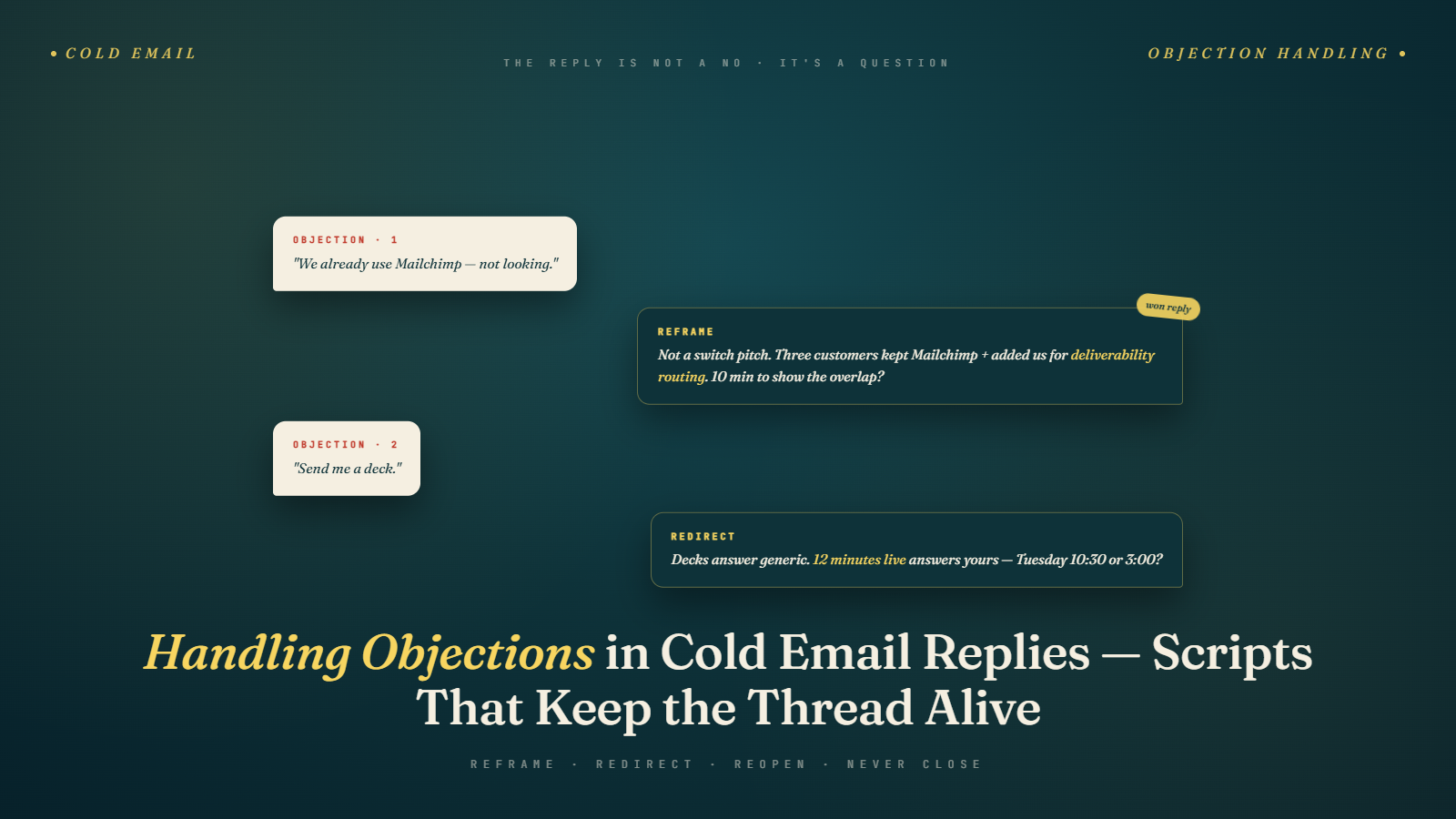
Objections Are Information, Not Dead Ends
When a prospect replies to a cold email with "we're already using a solution for this," most salespeople's first instinct is either to give up or to immediately counter with features and comparisons. Both responses miss the point.
An objection reply is more valuable than silence. The prospect engaged. They read enough to form an opinion. They felt moved enough to write back. That's a lot more than the majority of the people on your list did — and it means there's something here worth exploring.
Objections in cold email replies are almost never the full picture. "We already have a solution" often means "I haven't thought critically about whether that solution is actually working." "Not the right time" often means "I'm not the right person, and I don't want to say that." "We don't have budget" often means "I don't have the authority to allocate budget, and I'm not sure if this is worth escalating to someone who does." Understanding what's beneath the surface objection is the actual skill.
This article covers the most common cold email objections, what they usually mean beneath the surface, and how to respond in a way that's honest, non-pushy, and genuinely useful to both parties.
This article is part of the Phase 6 series on converting cold email replies. The broader context is in Turning Replies into Conversations — the pillar article for this phase. For the mechanics of what happens after you've moved past the objection, see Booking Meetings from Cold Emails.
The Fundamental Rule: Acknowledge Before You Counter
Every objection response should begin with acknowledgment, not rebuttal. This sounds obvious but it's violated constantly in practice. The reflex is to immediately push back, correct, or offer a counter-argument. The result is a response that feels defensive — because it is.
Acknowledgment doesn't mean agreement. "That makes total sense — most teams in your space are already running some version of this" is not conceding the point. It's demonstrating that you're listening, that you understand their situation, and that you're not just trying to bulldoze through to a meeting.
Once you've acknowledged, you can then ask a clarifying question or offer a reframe. But the sequence matters: acknowledge first, then explore.
The Most Common Objections — And How to Handle Each
"We already have a solution for this."
This is the most common cold email objection in B2B, and it's almost always worth exploring rather than accepting at face value.
What it usually means: One of three things. First, they genuinely have a solution and are satisfied with it — in which case there's nothing here right now. Second, they have a solution but have doubts about it and are using the objection to test whether you'll push back. Third, someone in the organization made a decision to use a different tool, and the person replying to you isn't invested in defending that decision.
What not to do: Immediately launch into a comparison of your solution vs. the incumbent. This positions you as combative and requires the prospect to defend their current vendor, which makes them feel defensive rather than curious.
What to do instead:
Acknowledge and ask a specific question: "Completely understand — most companies I speak to have something in place. Out of curiosity, are you satisfied with the results you're getting from it, or is there anything it doesn't do well that's been on your radar?"
This question does several things at once. It doesn't challenge their decision. It opens a door for genuine dialogue. And if they are genuinely satisfied, you'll know quickly and can close gracefully rather than wasting both parties' time.
If they name a frustration with the current tool, you have a real conversation to have. If they say everything's great, thank them for their time and move on.
"Not the right time / We're focused on other priorities right now."
This is the most ambiguous objection because it could mean anything from "genuine timing constraint" to "polite no." Your job is to distinguish between the two without being pushy.
What it usually means: Often there's a real timing constraint — a budget cycle, a major project, a reorg. Sometimes it means the person doesn't have the authority to act and doesn't want to say so directly. Occasionally it's a soft brush-off.
What not to do: Push back on the timing directly ("I'm sure we can work around your schedule") or try to manufacture urgency that doesn't exist. Both feel manipulative and damage the relationship.
What to do instead:
Acknowledge and clarify the timeline: "Completely fair. Is this more of a Q3/Q4 conversation when [context], or is the timing genuinely uncertain from your end?"
If they give you a specific window, offer a concrete re-engagement: "Got it — would it make sense to put something on the calendar for mid-Q3 so we can pick up the conversation then? That way it's not on you to remember."
The specific calendar hold is key. "I'll follow up in a few months" results in no one following up. A calendar invite or a CRM task with an actual date results in an actual conversation three months later.
If the timeline is genuinely uncertain, accept that gracefully and ask for permission to check in periodically: "I won't flood your inbox — would it be okay if I sent a note every few months to see if the situation has changed?"
"We don't have budget for this right now."
Budget objections in cold email are tricky because they frequently aren't really about budget. They're about prioritization and authority.
What it usually means: Either the budget genuinely doesn't exist (uncommon for products in the right price range), the budget exists but hasn't been allocated to this category, the person you're talking to doesn't have the authority to allocate budget without a business case, or "budget" is being used as a proxy for "this isn't a priority."
What not to do: Immediately offer a discount or a "we can make it work" framing. This devalues your product before you've established any real value and trains the prospect that budget objections get rewarded with price reductions.
What to do instead:
Probe the nature of the constraint: "Understood — is this more of a 'this category isn't in the budget at all' situation, or 'we'd need to build the case to get it prioritized'? Trying to understand whether this is a conversation worth having now or later."
If it's an authority issue — they'd need to build a case for their manager — offer to help them do that: "I'm happy to put together a quick ROI breakdown or a one-pager that makes it easy to get the right people aligned. Sometimes that's the most useful first step."
Helping someone build an internal business case is often more productive than trying to close them directly. If they're not the decision-maker, your real job is to give them the tools to become your internal champion.
"Send me more information."
This one looks like a positive response but often isn't. An information request can mean genuine interest, or it can mean "I don't want to have a conversation but I'll give you a low-commitment ask to get you off my back."
What it usually means: Sometimes real curiosity. More often, a way to defer making a decision about whether a conversation is worth it.
What not to do: Send a comprehensive information dump — a PDF, a deck, a case study, a one-pager, and a follow-up email three days later asking if they've had a chance to review it. This creates a homework assignment for someone who was already hesitant.
What to do instead:
Ask a clarifying question before sending anything: "Happy to — what's the most useful context for you right now? Are you evaluating specific capabilities, or is it more about understanding the general approach?"
Their answer tells you a lot. A specific, informed question signals genuine interest. Vagueness signals the brush-off. Either way, you've gotten useful information before investing effort in a response they may not read.
If they name a specific thing they want to understand, answer that specific thing briefly and move toward a conversation: "The fastest way to show you that is probably a 15-minute call where I can walk through it live — does that work, or would a written breakdown be more useful for you right now?"
"We tried something like this before and it didn't work."
This objection is actually one of the more valuable ones, because it tells you exactly where the skepticism comes from. Bad experience with a previous vendor or approach is a real barrier — but it's also an opportunity to differentiate.
What it usually means: Genuine skepticism rooted in a specific past experience. The prospect is willing to tell you about it, which means they haven't fully closed the door.
What not to do: Dismiss their experience ("That vendor is known for poor service — we're different"), immediately claim your solution doesn't have those problems, or try to convince them without understanding what specifically went wrong.
What to do instead:
Ask about the failure: "That's useful context — can I ask what specifically didn't work? Was it the implementation, the results, the support, something else?"
Understanding the specific failure lets you do one of two things: demonstrate that your approach is genuinely different in the relevant way, or honestly acknowledge that you have the same limitations and this probably isn't a fit. Both outcomes are better than selling someone into a situation that's likely to end the same way.
If their failure was in an area where you're genuinely differentiated, you can make that case concisely: "The failure point you described is actually where most teams get stuck with [that approach] — what we do differently is [specific thing]. I'd be curious whether that changes the picture at all."
"I'm not the right person for this."
A potentially valuable reply that most cold emailers handle incorrectly.
What it usually means: Exactly what it says — and it comes with a gift if you handle it right. The person is telling you someone else in the organization is the decision-maker, which means you have an internal reference point.
What not to do: Immediately ask "Can you forward this to the right person?" This is a lazy redirect that rarely works and makes you seem uninterested in the relationship with the person you're already talking to.
What to do instead:
Ask for context and a warm introduction: "Appreciated — who would be the right person? And would you be comfortable making an introduction, or would it be better if I reached out to them directly mentioning our conversation?"
A warm introduction from someone internal — even someone who isn't the decision-maker — dramatically increases your reply rate and credibility with the real buyer. Don't waste this by asking for a blind referral.
The Art of Knowing When to Stop
Not every objection warrants a counter. Some objections are genuine rejections, and the professional move is to recognize them and exit gracefully.
The signals that an objection is final rather than exploratory: extreme brevity with no opening for dialogue ("Not interested, please stop emailing me"), repeated objections across multiple follow-ups with no engagement, or a clear statement that the category itself is simply not relevant to their business.
The graceful exit: "Completely understand — I appreciate you taking the time to respond. I won't follow up again. If circumstances change, my contact is [email] and I'm happy to pick up the conversation whenever it makes sense."
This response is professional, non-resentful, and leaves the door genuinely open. It also keeps your sending reputation clean — a prospect who explicitly declines and then continues to receive emails is someone who files spam complaints.
Written vs. Spoken Objection Handling
Cold email objections arrive in writing, which creates a dynamic that's different from handling objections on a phone call or in person. You can't read body language. You can't hear tone of voice. You don't know if the objection was written in irritation, genuine curiosity, or casual indifference. And your response — unlike a spoken reply — is a permanent written record that the prospect can re-read and forward.
This changes the calculus in a few important ways:
Be more deliberate with tone. A conversational push-back that sounds fine out loud can read as combative in writing. Read your response out loud before sending. If it sounds defensive or dismissive at any point, rewrite it. The written version should be warmer and more curious than you might naturally be in a verbal conversation.
Shorter responses land better. On a call, you can spend two minutes addressing a concern with context and nuance. In email, a two-paragraph objection response often feels like an argument. Aim for 3–5 sentences: acknowledge, ask one clarifying question or offer one specific reframe, propose a concrete next step. If the objection genuinely requires more context than that, save it for a call — not the email thread.
Leave room for them to respond. An objection response that closes every angle and leaves the prospect nothing to do except say yes or no has eliminated the conversation. Your goal in an objection email is not to win the argument — it's to continue the dialogue. End with an open question, not a closed pitch.
Don't match negativity. If someone replies with a slightly terse "we don't need this," a terse response in kind is a bad idea. The emotional register of your reply should be neutral to warm regardless of how the objection was delivered. You're a professional who isn't rattled by pushback. That confidence, expressed without defensiveness, is itself a form of credibility.
Timing Your Objection Response
Speed matters in objection handling, but not at the expense of quality.
A warm reply deserves a fast response — within a few hours if possible, definitely within 24 hours. The longer you wait, the colder the prospect becomes and the less momentum carries from the original reply. An objection that arrives on a Tuesday morning and gets a thoughtful response on Wednesday afternoon is manageable. An objection that arrives on Tuesday and gets a response the following Monday is functionally a new cold outreach — the context has gone stale.
At the same time, a rushed objection response that misreads the situation or comes across as defensive is worse than a slightly delayed but genuinely good one. If a complicated or emotionally charged objection arrives and you need 30–60 minutes to think about how to respond well, take the time. A considered reply at 3 PM is better than a reflexive reply at 9 AM.
The exception: explicit rejection replies ("please remove me," "not interested, stop emailing"). These should be acted on immediately — remove from the sequence, add to suppression list, don't delay. The prospect's explicit request to stop receiving email should never sit in an inbox waiting for someone to "handle it."
The Objection Handling Mindset
The broader principle behind all of this: approach objection replies with genuine curiosity rather than predetermined counter-arguments.
The best objection response isn't the cleverest comeback — it's the response that reveals the real situation clearly enough that you can make a genuine call about whether there's a fit here. Sometimes there isn't. That's fine. A quick, graceful exit from a non-fit saves time that could be spent on prospects where there is a real match.
The teams with the best cold email conversion rates aren't the ones with the sharpest rebuttal scripts. They're the ones who listen carefully, ask the right questions, and focus effort on prospects where both sides can genuinely benefit from a conversation.
Common Objection-Handling Mistakes
Mistake 1: Using a Script That Sounds Like a Script
If your response to "we already have a solution" is clearly the same five sentences you send everyone, the prospect will feel it. Personalize your objection responses at least enough to reference what they actually said.
Mistake 2: Pushing Too Hard After a Soft No
Getting two replies from a prospect who has already said "not right now" twice is usually not persistence — it's pestering. Know when the conversation has run its course.
Mistake 3: Discounting Before You've Established Value
Offering price concessions as a response to budget objections before you've demonstrated any value is a habit that trains prospects to use budget as a negotiating lever. Handle value first.
Mistake 4: Ignoring the Emotional Subtext
Sometimes "not the right time" is code for "I got burned by a vendor like you before and I don't want to go through that again." Reading the emotional register of the reply — not just the literal words — helps you respond to what's actually being communicated.
Mistake 5: Not Asking the Clarifying Question
Most objections contain ambiguity that one good question can resolve. Skipping the clarifying question in favor of immediately making your case leaves you arguing against a position you may have misunderstood.
Next up: Booking Meetings from Cold Emails — once you've moved past the objection, how to actually get the conversation on a calendar.