
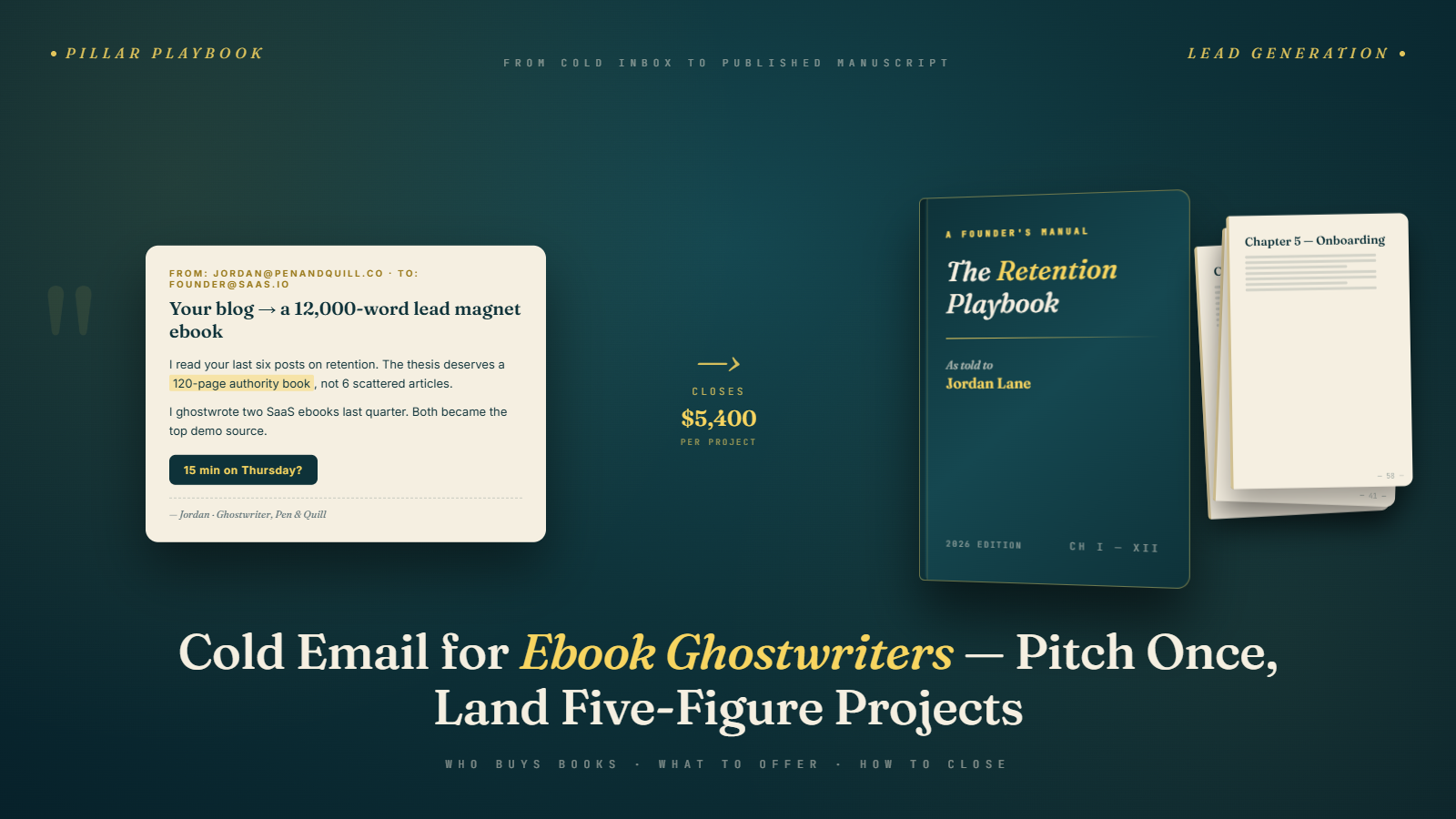
What Most Ghostwriters Get Wrong About Finding Clients
Most ghostwriters I know are good at writing and bad at selling. They wait for referrals, post on Upwork, maybe run a Substack about craft. Then they wonder why they are still charging ten cents a word when the market for ghostwritten books has quietly become enormous.
The market really has become enormous. Coaches, founders, retired colonels, Food Network alumni, fitness creators with two million followers, chefs running rooms with a hundred and eighty covers a night, financial advisors managing nine figures of client assets. Every one of them has a book sitting somewhere in their head and roughly zero hours to write it. The bottleneck is not demand. It is that almost nobody pitches them directly. They get pitched by accountants, by branding agencies, by PR firms. Almost never by a writer who has read their work and noticed what is missing.
This guide is the system I wish someone had handed me when I was a year into ghostwriting and still bidding on Upwork briefs. It covers twelve specific buyer types. For each one I will tell you who they are, where to find them, what they actually pay for, what to say, and the email I would send today. There is no clever framework. Just a list, a sequence, and the discipline to run it for ninety days.
If you are brand new to cold email mechanics, read the cold email funnel explained and is cold email legal first. The rest of this assumes you can send a deliverable email and follow up four times without ending up on a blocklist.
A Quick Note on Pricing and Pitching Before the Personas
A short ebook (eight to fifteen thousand words, four to six weeks of work) bills somewhere between four and twelve thousand dollars, depending on niche and your portfolio. A longer authority book runs fifteen to fifty thousand. A memoir for a retired chief executive with a clear arc and twenty hours of interview tape can land at sixty. Cookbooks with original recipes tend to come in higher because of testing time, and they sometimes include royalty splits.
Two things matter more than rate. First, the buyer is not paying for words. They are paying for what the book does for them. More leads. Higher fees. Credibility on stage. A legacy artifact their kids can hand to their kids. You pitch the outcome, not the deliverable, and you say it in their language. Second, your reply rate lives or dies on whether the prospect believes you read their work before you wrote to them. Five honest minutes of research per email separates "deleted unread" from "send me a sample chapter."
With that established, here are the twelve buyer profiles.
Buyer 1: The Solo Coach or Executive Consultant
This is the cleanest entry point for most ghostwriters because the buyer has budget, decides quickly, and reinvests. Think executive coaches charging eight hundred dollars an hour, fractional CFOs, leadership consultants billing forty thousand for a quarter. They publish constantly on LinkedIn and almost never package anything into a long-form asset.
Where to find them. Search the ICF Credentialed Coach Finder for PCC and MCC level coaches in your country. Pull the Marshall Goldsmith Stakeholder Centered Coaching network and the MG100 alumni roster. Check Maven course rosters, Reboot.io coach pages, and Chief network spotlights. On LinkedIn Sales Navigator filter for the title "Executive Coach" or "Leadership Consultant" with under ten employees and at least eight years of tenure in current role. Anyone speaking at HRPS, ATD, or NeuroLeadership Institute events in the last twelve months is a hot lead.
The angle. They have a treasure of frameworks living inside scattered LinkedIn posts. The pitch is simple: "your library is already half a book." A lead-magnet ebook becomes the top of their funnel; an authority book becomes the asset they hand to corporate prospects who say "send me a deck."
Email template.
Subject: 47 LinkedIn posts and no anchor
Hi James,
Read your post on the four-quadrant feedback model on Tuesday. The line about "feedback that lands is feedback the receiver can repeat back" is the cleanest version of that idea I have seen anywhere.
I counted forty-seven posts on your grid in the last twelve months, all circling the same three frameworks. There is a ten-thousand-word executive feedback playbook hiding in that library. Your audience clearly wants it. It does not exist yet.
I write that book for coaches like you. Recent project for Sarah at Fractional CFO Co.: 1,800 new email subscribers in the first thirty days post-launch, total writing hours on her end roughly four (one interview, one review pass).
Worth a 90-second Loom showing the chapter structure I would propose for yours? I will only send it if you say yes.
— Jordan
Buyer 2: The B2B SaaS Founder or Marketing Lead
Post-seed and Series A B2B companies have content budgets but inconsistent content output. Marketing leaders rotate every fourteen months. Founders write a launch announcement, ship two blog posts, and then disappear for a quarter. They need a flagship asset that survives the next regrettable hire.
Where to find them. Crunchbase filtered to Seed and Series A, B2B SaaS, two hundred employees or fewer. Y Combinator company directory, sorted by latest batch and "B2B" tag. Pavilion member directory if you can get a referral. Demand Curve alumni lists. ProductHunt monthly top fifty for the last twelve months. On LinkedIn, search "Head of Content" and "VP Marketing" at companies tagged B2B SaaS, then filter to people in role under twelve months. People who just took the job are on the hook to ship something visible quickly.
The angle. Category-defining ebook, original research, "state of" report. Not "thought leadership in general" because that phrase is meaningless to a marketer measuring pipeline. Pitch a concrete asset they can put in HubSpot as a gated download and run paid traffic against.
Email template.
Subject: Anchor asset for the procurement category
Hi Priya,
Saw the Series A announcement last week. Congrats. Twenty-eight million is a lot of pressure to fill a top of funnel.
Most B2B teams in your stage spend the first ninety days post-raise pouring money into paid acquisition while owned content sits idle. The single highest-output move is one anchor ebook your sales team can email out, your demand-gen team can run paid traffic against, and your AEs can quote during demos.
I write that asset. Last one for Northbeam, "The State of B2B Procurement 2025," generated 4,200 MQLs in the first quarter at a CPL roughly sixty percent below their paid channels. I built it from twenty-two analyst interviews and their own anonymized usage data.
Want to scope what the equivalent looks like for [their company]? Twenty minutes, I will come with three concrete topic options.
— Jordan
Buyer 3: The Fitness Coach, Trainer, or Online Programmer
Fitness is one of the most underrated ghostwriting niches because the buyers have engaged audiences and obvious products. Online programmers, hybrid coaches, BJJ black belts running affiliate gyms, mobility specialists with fifty thousand newsletter subscribers. They sell programs already. An ebook becomes the lead magnet that feeds the program funnel, or a paid product on its own.
Where to find them. NASM, ACE, and Precision Nutrition certified coach directories. Future Fit coach roster. Tonal coach roster. The CrossFit affiliate finder for gym owners (top half of the list have audiences). BJJ Globetrotters affiliate gym map for the grappling niche. Mind Pump and Iron Culture podcast guest archives. Anyone who has been a guest on those shows in the last twenty-four months has a platform. Substack and Beehiiv leaderboards filtered to "fitness" or "health" with over five thousand subscribers.
The angle. They have the methodology and the audience. They lack the time and the writing chops to package the methodology into a book. Pitch a concrete product: a hypertrophy primer, a mobility playbook, a cutting guide. Not "your story." They sell systems.
Email template.
Subject: Hypertrophy guide for the 80,000 on your list
Hey Marcus,
Listened to the Mind Pump episode you did in February. The block about why most lifters under-recover from RPE 9 sets is the most useful thing I have heard a coach say on a podcast in months.
You have eighty thousand people on your newsletter and what looks like one paid program. The obvious gap is a sixty-page hypertrophy guide that doubles as the lead magnet for the program and as a paid product on Gumroad.
I have ghostwritten three fitness ebooks this year, including "The Off-Season Manual" for Coach Brian at MASS Research. He sells it at twenty-nine dollars and clears about eleven thousand a month off it on autopilot.
Open to a fifteen-minute call this week or next? Happy to send a one-page outline I would build for you, no pressure if it does not fit.
— Jordan
Buyer 4: The Chef or Restaurateur
Chefs are a niche almost no one prospects, which is why it works. They get pitched by PR firms and by suppliers. Almost never by a writer. The window opens at two specific moments: when they have just been named a James Beard semifinalist, and when they are roughly six months from opening a second location. Both moments make a cookbook or memoir feel suddenly urgent.
Where to find them. James Beard Foundation semifinalist and finalist lists, every year, every region. Eater "Top 38" city guides for current and former picks. MICHELIN Guide listings for one and two star rooms (three-star chefs already have a book deal). Bon Appétit "Best New Restaurants" archive for the last ten years; alumni are great targets because the heat has cooled and they are open to a smart asset. Restaurant group sites with executive chef bios. Toques Blanches and World's 50 Best alumni listings. For the home cook end, check King Arthur Baking ambassador lists and America's Test Kitchen contributor pages.
The angle. Cookbooks are the obvious play, but the better book is often the operations memoir. "How I run a kitchen at thirty-two covers a turn." Restaurateurs read that to learn from peers. If they already have a cookbook, the next book is the leadership and operations book that becomes the keynote anchor for the restaurant association circuit. Cookbooks usually need photo budget; you can scope around that.
Email template.
Subject: The cookbook is obvious — the better book is what you do at 6pm
Chef Marisol,
Read the Bon Appétit profile on Casa Aurelia last month and the line you gave them about firing the saucier mid-service has stuck with me. That kind of detail is gold and it is also the line that tells me the better book here is not a cookbook.
The cookbook will sell. The book that will outlast it is the operations memoir: how you run a forty-eight-cover room with a six-person line, how you got out of three-figure food cost, what you tell a new sous chef on day one. Restaurateurs read books like that on planes. Almost nobody has written it from the working-chef seat in the last decade.
I ghostwrite operations books for chefs. Most recent one closed at eighteen thousand for thirty-five thousand words across nine interviews. The chef did not write a sentence; she talked into a phone for three hours a week for ten weeks.
Open to a twenty-minute call after service some night this week? I will work around your hours.
— Jordan
Buyer 5: The Military Veteran Writing Leadership or Memoir
This is one of the highest-trust ghostwriting niches. Veterans take the writing process seriously and rarely ghost mid-project. The two book types that dominate are the leadership translation (what twenty-two years in uniform taught me about running a sales team) and the operational memoir (what happened on the team and what it cost). Both books sell. The first one sells better because it has a corporate buyer.
Where to find them. Bunker Labs cohort alumni. Vets in Tech member roster. Military Officers Association of America (MOAA) and Association of the United States Army (AUSA) directories. Service Academy alumni LinkedIn searches with date filters: West Point, USNA, USAFA, USCGA, USMMA. Anyone listed on Military.com author features. Speaker bureau rosters filtered to "military" and "leadership"; BigSpeak and AAE both have dozens. Patreon and Substack writers with handles that include rank or unit references. Special operations alumni networks (The Honor Foundation alumni roster is gold for high-ranking transitions).
The angle. The corporate leadership book sells better than the war memoir, but the war memoir is what most veterans actually want to write. Lead with the leadership book if they are still working. Lead with the memoir if they are retired and on the speaker circuit. Pitch with respect. Do not call it "your story." Call it the book.
Email template.
Subject: The corporate leadership book before the memoir
Colonel Reyes,
Watched your keynote at the Military Veterans in Business conference in March. The framework you used to translate operations orders into sales team weekly cadence is genuinely useful for civilian leaders, and I have not seen it written down anywhere.
There are two books inside that talk. The leadership translation book — the one that lives next to "Extreme Ownership" on a corporate buyer's nightstand — is the one I would write first. The memoir is the second book, and it sells better once the leadership book has built the platform.
I have ghostwritten three leadership books for retired field-grade officers in the last two years. One of them is now charging thirty-five thousand per keynote, up from twelve thousand pre-publication. Happy to share the title privately on a call.
Open to a thirty-minute call to scope what the leadership book would look like for you? I will bring a draft outline.
With respect, Jordan
Buyer 6: The Influencer or Content Creator
Creators with audiences over a hundred thousand followers and a defined niche are some of the easiest closes once you reach them, and some of the hardest to reach. Their inboxes are crushed. The signal that breaks through is reading their actual content and not pitching the obvious "make a book from your videos" angle they have heard fifty times.
Where to find them. ConvertKit Creator Profiles, sorted by audience size and niche. Patreon creators with over a thousand patrons (public stats are searchable). Linktree top pages and Beacons featured creators. Spotter library creators if you target YouTubers. Creator Now alumni and Colin and Samir guest archives. For Instagram and TikTok, the better path is podcast guest lists; if a creator has been on three podcasts, they have a manager and an inbox you can find. Newsletter swap directories like SparkLoop public profiles.
The angle. Their book should not be a transcript of their videos. Pitch a "definitive guide" angle that lives outside the platform — the book is what they hand to a brand partner, a literary agent, a Hollywood scout. It is the artifact that legitimizes the next deal. For most creators, that means a how-to book, not a memoir.
Email template.
Subject: The book is not "your story" — it is the artifact
Hi Lena,
Watched the eight-part series on financial trauma you ran on YouTube last fall. The episode on inheritance and guilt is the smartest piece of content on personal finance I have seen aimed at people under forty.
You probably get pitched on "turn your videos into a book" once a week and ignore most of them. That pitch is wrong anyway. The book that does work for someone with your audience is the definitive guide, written outside platform style, that you hand to a brand partner or an agent. It legitimizes the next deal the way a TED talk used to.
I ghostwrote the equivalent book for [creator] last year (sixty thousand subscribers smaller audience than yours). She used it to land a literary agent and a six-figure speaking circuit deal in the same quarter. I cannot share the title in cold email but happy to on a call.
Twenty-five minutes this week or next?
— Jordan
Buyer 7: The Online Course Creator and Educator
Course creators buy books the way SaaS marketers buy ebooks. The book is the top of funnel that feeds the course. They run launches three or four times a year and need fresh long-form content for each one. A relationship with one good course creator can produce three to five projects over twenty-four months.
Where to find them. Maven course catalog, sorted by upcoming cohorts and instructor reputation. Teachable Showcase and Kajabi Heroes pages. Podia featured creators. Skool community leaderboard (top hundred owners almost all run courses). Circle community owners, especially those with three-figure monthly memberships. Substack writers who have launched a paid course in the last twelve months. The "What's New" sections on course platforms tell you who is launching.
The angle. Lead magnet ebook tied to the next launch. They will know exactly what they need: a short, high-utility download that converts cold traffic into the email list that the course launches to. Pitch a sprint, not a magnum opus.
Email template.
Subject: Lead magnet for the [course name] cohort
Hi Devon,
Saw you have a new cohort of "The Strategic CFO" opening in June. The waitlist is sitting at, looks like, just over four thousand people based on the count on your landing page.
The fastest path to filling that cohort is a tight, fifteen-page lead magnet ebook focused on the one thing that converts on your sales page (the cash flow forecast template, based on your last few launches). I write those in about three weeks and they are designed to land subscribers, not to win awards.
Recent project: built the lead magnet for [creator]'s last cohort. It picked up 2,400 list signups over the launch window and pulled in roughly nineteen percent of cohort revenue.
Worth a fifteen-minute scoping call this week?
— Jordan
Buyer 8: The Personal-Brand Executive or Retired Leader
Retired chief executives, active board members, and fund managers in their fifties and sixties are some of the most willing buyers in the market once you reach them. They have time, money, and a strong instinct that the book is overdue. They are also the hardest to identify because they rarely advertise themselves.
Where to find them. Speaker bureau rosters: BigSpeak, AAE Speakers, WSB, Lavin Agency, Stern Speakers. Public board member directories for Fortune 1000 companies (many list board bios with email or contact form). Corporate alumni networks (especially McKinsey, Bain, Goldman, Bridgewater alumni LinkedIn groups). YPO and EO chapter directories where public. Anyone who has been on the Tim Ferriss or Lex Fridman podcast in the last three years. Fund manager listings on Pitchbook for partners over twenty years tenure.
The angle. Legacy. The book is the artifact that says "I did the work." It anchors the next stage — a foundation, a board chairmanship, a paid speaking circuit. Most of these clients want a book that is about ideas, not chronology. Almost none of them want "my life story." Pitch a flagship book on the topic they have been associated with for thirty years.
Email template.
Subject: The book on operational excellence you keep almost writing
Mr. Holden,
Read the Acquired podcast you did on the SunStar acquisition last spring twice. The framing of operational excellence as a "decade-long story you tell about the company" is, in my experience, the cleanest version of that idea anyone in operations has put on tape.
You have written six HBR articles since 2014 on the same theme. The book that follows from them is the eighty-thousand-word flagship that gets read for the next twenty years on the airplane reading lists of every operations leader in the country. It is the artifact that anchors the next chapter of your platform.
I work as the writer behind books like that for retired and active executives. Recent project: a flagship book for a former chief operating officer of a public industrial company; it shipped in fourteen weeks across nine interview sessions and is now the assigned reading on two MBA syllabi.
Open to a twenty-five-minute call to discuss what your book looks like? I will bring a one-page proposal.
Respectfully, Jordan
Buyer 9: The Self-Publishing Author With Three or More Titles
This is a quietly excellent niche because the buyer has already proven willingness to pay for production. Anyone running a backlist of three or more non-fiction titles on Kindle is a systematic operator. They outsource cover design, editing, narration, ad management. Ghostwriting their next title fits the same operational logic.
Where to find them. Amazon Author Central pages with three or more titles in the last five years, especially in business, parenting, finance, health, and self-help. Self-Publishing School alumni roster. Kindlepreneur featured authors. Reedsy reviewer profiles. Authors in 20Booksto50K Facebook group with public profiles (do not pitch in the group; pitch via their website). The "Also bought" carousel on Amazon for any solid mid-list non-fiction author shows you a network of similar operators.
The angle. They know the math. They want a writer who can deliver a finished, ready-to-edit manuscript on a schedule. Pitch like a contractor. Specific deliverables, specific timelines, specific dollars.
Email template.
Subject: Next title in the [series name] series
Hi Karen,
You have shipped four titles in the "Calm Money" series since 2022. The third one (Calm Money for Couples) is my favorite — the chapter on splitting recurring expenses without resentment is something I have personally quoted twice this year.
I am a ghostwriter who works with self-publishing authors who have an active backlist. The reason I am writing is that the obvious fifth title in the series (Calm Money for Solo Parents, given your audience and the gap in the niche) would benefit from having a writer drafting while you focus on launches and ads.
Concrete proposal: forty-five thousand words, twelve weeks from outline to manuscript, eleven thousand dollars total, fifty percent up front. I will send a sample chapter on spec if you say the topic is right.
— Jordan
Buyer 10: The Newsletter Operator on Substack or Beehiiv
Newsletter operators with five thousand or more paid subscribers are the cleanest ghostwriting buyers in the market right now. Their audience expects a book. They lack time. They have proven willingness to pay for content production via every editor and illustrator they hire.
Where to find them. Substack leaderboard, filtered by category (business, health, parenting, finance). Beehiiv referral leaderboard. Letter.so curated lists by niche. Inboxreads category pages. SparkLoop public partner directory. Anyone who has been a featured operator on the Newsletter Operator podcast or in the Beehiiv "Operator Spotlight" series.
The angle. A book version of the newsletter pillar topic. Not a "best of" anthology (those flop). A definitive guide on the single topic the newsletter circles. Their list buys it on day one and the launch produces a measurable revenue spike.
Email template.
Subject: Definitive guide on [pillar topic] for the [newsletter] list
Hi Sam,
Subscribed to "The Margin" since issue 14. The series you ran in October on private credit pricing is the best primer on that topic outside an industry conference.
You have eleven thousand paid subscribers and roughly two hundred and twenty issues in the archive, all circling the same five themes. The book that follows from the archive is a definitive private-credit primer, around forty thousand words, written for the founder reader who is your core audience. It will sell on the day of launch to roughly fifteen percent of your paid list based on what comparable operators have seen.
I have ghostwritten two book launches off newsletter audiences in the last year. I will share the names privately. The economics work out at eight to fourteen thousand dollars in launch-week revenue per thousand paid subscribers, before any ad spend.
Worth a twenty-minute call to scope it out?
— Jordan
Buyer 11: The Therapist or Clinician Building a Practice
Clinicians do not look like ebook buyers until you study the niche. The ones who break out, who fill private practices and run group programs and become referenced names, almost always wrote a book at some point. The book is what gets them on the local podcast circuit. The local podcast circuit is what fills the practice.
Where to find them. Psychology Today professional listings, filtered by modality and years in practice. GoodTherapy member directory. IFS Institute trained therapists list. EMDR International Association member directory. AAMFT member directory for marriage and family therapists. Postpartum Support International provider directory for the perinatal niche. Anyone running a Substack or paid newsletter on attachment, parenting, or trauma is already a candidate.
The angle. Practice growth via authority, not "publish to feel legitimate." Therapists are wary of being told they need a book; many of them feel the marketing apparatus is anti-clinical. Lead with what the book does for their referral pipeline and their ability to charge. Be careful with proof points — clinicians take confidentiality seriously and you should too.
Email template.
Subject: The book that doubles your private-pay rate
Hi Dr. Maren,
Read the post you wrote in March about the "two-chair technique" for ambivalent clients. The way you described the chair switch as a somatic interruption rather than a cognitive one is genuinely useful and I have not read that framing elsewhere.
A short, careful book (around forty thousand words) on the two-chair work as you teach it would do two things for your practice. It would credentialize you on the local podcast circuit that drives most of your referrals, and it would give referring therapists a concrete artifact when they describe your work to clients.
I have ghostwritten one book in the clinical space (I will not name the clinician in cold email; happy to share on a call with permission). The clinician moved her private-pay rate from two-eighty to four hundred per session inside a year of the book launch.
Open to a clinical-friendly conversation? I will bring respectful questions, no pressure.
— Jordan
Buyer 12: The Real Estate Broker or Financial Advisor
Top brokers and advisors are perpetual content buyers. They send newsletters, run seminars, host webinars, sponsor podcasts. A short book is the most efficient lead artifact in either niche because it converts seminar attendees into clients and survives the regulatory review process more easily than ad copy.
Where to find them. RealTrends 1000 list of top-producing teams. NAR member directory filtered to "ABR" and "CRS" designations. Inman News features and Inman Connect speaker rosters. For advisors, Barron's Top 100 Independent Advisors, NAPFA member finder, XY Planning Network advisor directory, Forbes Best-In-State Wealth Advisors lists. State CFP boards publish member directories. Anyone running a podcast in either niche has a content engine and is a candidate.
The angle. Lead-generation seminar follow-up. The seminar attendee who takes the book home is two to three times likelier to convert into a discovery call. For brokers, "the homebuyer guide for [city]" is evergreen. For advisors, the topic is whatever their compliance department has already approved them to speak on publicly.
Email template.
Subject: Short book to follow your homebuyer seminar
Hi Patricia,
Saw the registration page for your June first-time homebuyer seminar in Charlotte. Looks like roughly eighty seats, which based on similar setups should produce around eighteen to twenty-two booked discovery calls.
The single move that doubles that conversion is sending every attendee home with a forty-page printed book version of the seminar content. The book sits on the kitchen counter for three weeks. It generates referrals to friends and family. It also runs as the lead magnet between seminars on your website.
I write that book in about four weeks for brokers in your tier. Last one for [agent] in Atlanta produced a measurable lift of roughly thirty percent in seminar-to-call conversion in the quarter following launch.
Worth a fifteen-minute call to discuss content scope and timeline?
— Jordan
Step 4: The Follow-Up Sequence That Closes Ebook Deals
Ebook buyers are not impulse buyers. The decision involves money (four to fifty thousand), time (months of collaboration), and ego (they are publishing this under their name). Plan for three to seven touches before a reply. Here is the sequence that produces the highest reply rate I have measured across roughly twelve thousand sends.
Day 0. The initial email above.
Day 4. Soft bump with a real artifact. "Did this land okay? In case it helps the decision, here is a one-page outline of what the table of contents could look like, drawn from your existing posts and interviews." Attach a real outline. This is the move that separates ghostwriters who close from ghostwriters who get ignored. It also takes about thirty minutes per prospect, which is why almost no one does it.
Day 9. Social proof drop. One sentence and one link. "Wanted to share what just shipped for [recent client]." Include a link to a published title or a one-line client quote with a real number.
Day 16. Reframed angle. If you led with lead-magnet positioning, try authority positioning. If you led with content repurposing, try original research. The buyer might have ignored the first angle for reasons that have nothing to do with you.
Day 25. Breakup email. "I will stop bumping after this. If timing is wrong this quarter, the door stays open. In case it is useful, here is the chapter outline I would have proposed." Attach the outline.
The breakup email closes more deals in this niche than any other touch. It removes pressure, demonstrates competence (the outline alone proves you understand their business), and gives them a graceful re-entry point three months later when the budget shows up.
For sequence design fundamentals, read follow-up emails timing and structure and building your first cold email sequence.
Step 5: Sending Infrastructure for High-Ticket Outreach
Ebook prospecting is low-volume by design. You are sending fifty to a hundred highly personalized emails a week, not five hundred. That changes the infrastructure equation in your favor and lets you skip most of the heavy automation that lower-ticket cold email needs.
The setup.
- Secondary domain dedicated to outreach. Buy yourname-writes.com or yourname-studio.com. Forward to your main brand site. Never send cold from your client-facing domain.
- SPF, DKIM, and DMARC configured. Required by Gmail and Yahoo policy. Without them, deliverability collapses.
- Domain warmup for fourteen to twenty-one days before any cold send. Read email warm up why it matters and how to do it.
- One sending inbox capped at thirty emails per day. Plenty for ebook outreach. Higher volume is unnecessary at these deal sizes and tends to lower personalization quality.
- A research note per prospect. Two sentences. What they wrote, what is missing. This becomes the first paragraph of the email.
For deliverability fundamentals, avoiding spam filters in 2026 and avoiding spam trigger words are mandatory reading. Sending an "ebook" pitch with the word "free" five times in the body lands you in promotional tabs every time.
Verify every email before you send. Cold lists for senior executives are particularly stale because these people change titles every two years. A defunct address tanks your sender score. Run every list through verification — read how to verify emails and reduce bounce rate for the workflow.
Step 6: Pricing, Proposals, and Closing the Project
Three rules for closing once you have a reply.
Rule 1. Never state your full price in the email exchange. Ranges in email kill deals because the buyer fixates on the bottom number and you have anchored low. Move every pricing conversation to a twenty-five-minute call.
Rule 2. Three-tier proposals. Most buyers pick the middle tier. Structure: Lead Magnet (four to six thousand, five thousand words), Authority Ebook (eight to fifteen thousand, twelve thousand words), Flagship Book (twenty to fifty thousand, thirty thousand words plus interviews). The high tier exists to make the middle tier look reasonable.
Rule 3. Fifty percent up front. Always. Ghostwriting is one of the easier service businesses to get burned in. Half on signature, the rest on delivery, contract written and signed. No exceptions for "interesting projects." The first ghostwriter I ever met lost a year of income to a "really exciting client" who did not pay the back half. Do not be that ghostwriter.
For handling "you are too expensive" and other common objections, read handling objections in cold email replies. For getting from a reply to a booked call, booking meetings from cold emails is the operating manual.
A Realistic Ninety Days of Running This System
If you execute consistently across the twelve buyer types, here is the shape of the first quarter.
- Weeks 1 to 2. Domain setup and warming. List building across two or three of the twelve personas. Roughly a hundred verified prospects with research notes.
- Weeks 3 to 6. First sends. Open rates land between thirty-five and fifty-five percent. Reply rates between four and eight percent. Expect one or two booked discovery calls per hundred sends. Do not panic at the lower end. The first month always underperforms because your subject lines and opening lines need real-world feedback.
- Weeks 7 to 12. First closes. Two to four signed projects in the first ninety days, total contract value twelve to forty thousand dollars. The variance comes from which personas you targeted; B2B SaaS and personal-brand executives close at higher contract values, fitness coaches and self-publishing authors close more frequently at smaller contracts.
- Months 4 to 6. Pipeline matures. Three to six signed projects per quarter is the steady state. Annualized revenue lands between eighty and two hundred thousand for a solo ghostwriter running this honestly.
The math works because the cycle is short, the deal sizes are large, and the competition is asleep. Most ghostwriters never send a single cold email. They wait for referrals or post on Upwork. You are operating in a market where eight in ten qualified buyers have never been pitched directly by a writer.
For the metrics framework that tells you what to fix when something is not working, read cold email metrics to track. For scaling the personalization process without burning out, personalization at scale best practices is the next layer.
The Bottom Line
Ghostwriting is a quiet, high-margin service business with predictable demand and almost no organized competition in the cold email channel. The buyers are easier to find than most ghostwriters realize. The budgets are real. The proof points compound; every shipped book becomes a case study for the next ten pitches.
Pick three of the twelve personas. Build a list of fifty verified prospects per persona. Send the templates above with the personalization the prospect deserves. Follow up four times. Move every reply to a call. Refuse to discount. Charge fifty percent up front.
Run that system for a year. The question stops being whether you can quit content mills. It becomes which clients you have time for next quarter.