
Most people think cold email works like this: you write an email, you send it to a bunch of people, and then you hope someone writes back. If you've run a few campaigns and gotten mediocre results, this might be exactly how it felt — random, unpredictable, and heavily dependent on luck.
Here's the thing: that mental model is the problem.
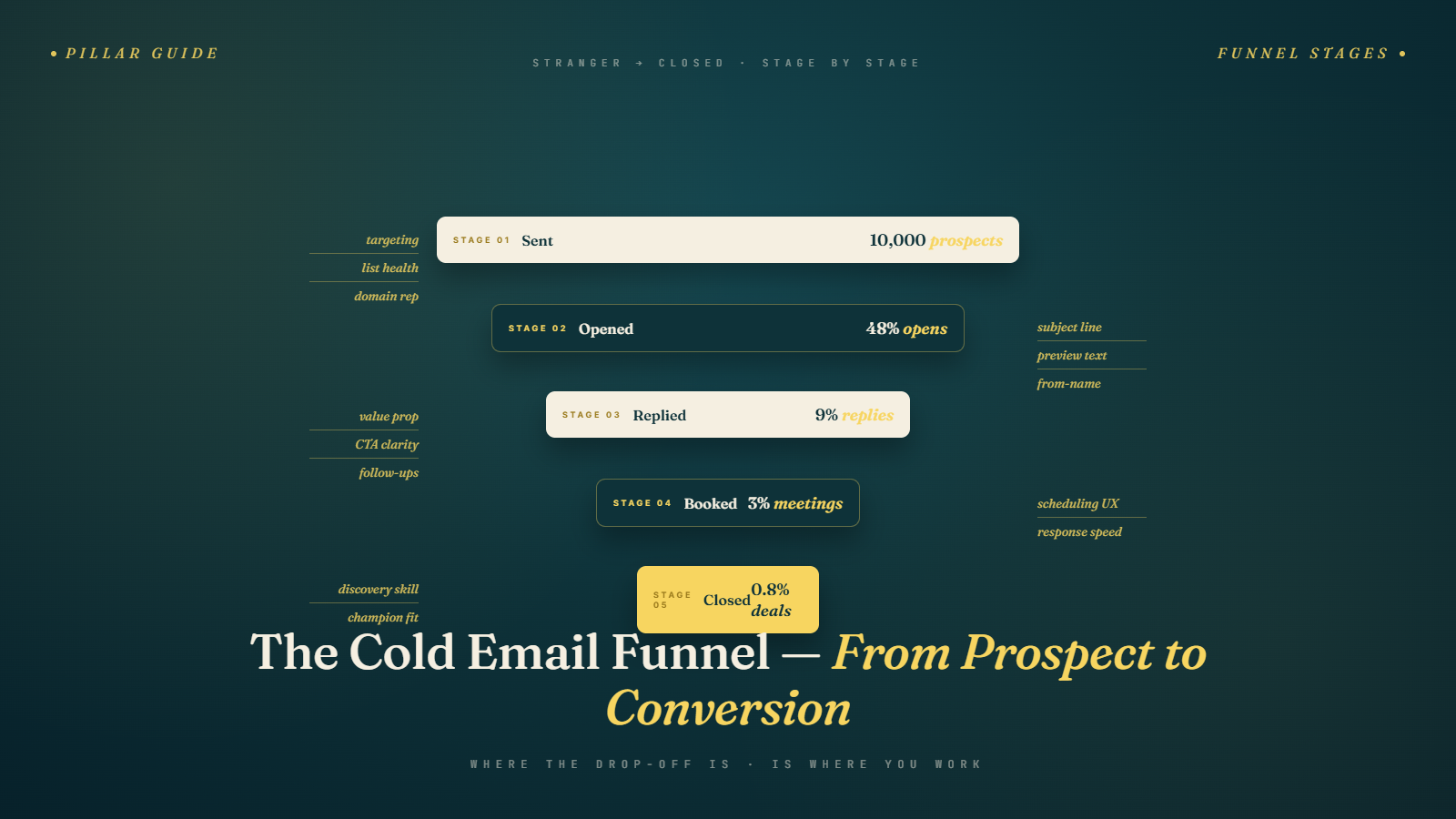
The teams running cold email programs that generate consistent, predictable pipeline aren't hoping. They're operating a funnel. They know that for every 1,000 prospects they identify, roughly 400 will open their emails, maybe 60 will reply, 20 will book a meeting, and 8 will eventually become customers. Those numbers shift depending on your industry, offer, and execution — but they shift in predictable ways. When a number drops unexpectedly, they know exactly which stage broke down and exactly what to fix.
That's the difference between cold email as guesswork and cold email as a revenue system. This post is about building the second version.
What Is a Cold Email Funnel?
A cold email funnel is the structured, deliberate sequence of steps that moves a complete stranger — someone who has never heard of you, your company, or your product — through a journey that ends with them becoming a customer.
The word "funnel" is intentional. At the top, you have a large pool of prospects. At each subsequent stage, some percentage of that pool advances while others drop out. By the time you reach the bottom, you're working with a small, highly qualified group of people who have demonstrated genuine interest and fit.
What makes the funnel concept powerful isn't the metaphor — it's the mindset shift it creates. When you think in funnels, you stop asking "why didn't this email work?" and start asking "at which stage did my conversion rate drop, and why?" That question has an answer. The vague one doesn't.
A few important notes about how cold email funnels actually behave in practice:
They are not strictly linear. Some prospects reply to your first email without ever opening it (mobile preview text), some open seven emails before replying to none, and some go cold for three months and then re-engage out of nowhere. The funnel gives you a framework, not a guarantee of order.
They are not binary. A "no" reply isn't necessarily the end of the relationship. A prospect who goes cold after a positive first reply isn't lost. The funnel has re-entry points, and the best cold email operators build them intentionally.
They are measurable at every stage. This is the most important property. Every stage produces data. Every stage can be optimized independently. And improving one stage compounds with improvements at every other stage.
Let's walk through each stage in detail.
Stage 1 — Prospect Identification (Top of Funnel)
Everything starts with your list. Not your email copy. Not your subject line. Your list.
This is the most underappreciated truth in cold email: a mediocre email to a perfectly targeted list will outperform a perfectly written email to a mediocre list every single time. Because no amount of copywriting skill can compensate for emailing people who have no reason to care about what you're selling.
Prospect identification starts with a precise Ideal Customer Profile (ICP). Not "mid-market B2B SaaS companies" but "VP of Sales at US-based B2B SaaS companies with 50—250 employees, raising or post-Series A, using Salesforce as their CRM, and actively hiring SDRs." The more specific your ICP, the higher your conversion rates at every subsequent stage.
The primary data sources for building cold email prospect lists in 2026 include:
LinkedIn Sales Navigator — still the gold standard for B2B contact identification, especially for role, seniority, and company attribute filters
Apollo.io, Clay, and ZoomInfo — for enriched contact data including email addresses, direct dials, and technographic data
Intent data platforms — G2, Bombora, and similar tools that surface companies actively researching solutions like yours
Manual research — for high-value, highly targeted campaigns, sometimes the best list is 50 companies you've identified by hand
The quality of your targeting at this stage has a multiplicative effect on everything downstream. A 10% improvement in targeting quality — meaning a higher percentage of your list genuinely fits your ICP — will typically produce a 20—30% improvement in reply rates, because your email will resonate with more of the people who receive it.
Before a single email gets sent, every address on your list needs to be verified. Invalid, outdated, and catch-all email addresses destroy your sender reputation and inflate your bounce rate to levels that can permanently damage your domain. For list verification at scale, see our guide on unlimited email verification — it covers the tooling and workflow you need before any send.
Stage 2 — List Verification and Deliverability Setup
Most people treat email verification as an afterthought — something you maybe do if you remember, or something you do once and assume is good forever. This is a mistake that costs real pipeline.
List verification and deliverability setup deserve their own stage in the funnel because without them, your emails don't reach inboxes. And if your emails don't reach inboxes, none of the stages that follow matter at all. You can have the best copy in the world and it won't help you if it's sitting in someone's spam folder.
This stage has three components:
Email verification. Before sending, run your entire list through a verification tool. Remove hard bounces (invalid addresses), flag risky addresses (catch-all domains, role-based emails like info@ or support@), and only send to addresses that verification flags as valid. A clean list should have a bounce rate below 3%. Above 5% and your domain reputation starts to suffer. Above 10% and you're in emergency territory. For a comparison of enterprise-grade verification services, see our bulk email verification services guide.
Domain warm-up. If you're sending from a new domain — or even an established domain that hasn't been used for cold outreach — you need to warm it up before ramping to volume. Start with 20—30 emails per day, increase by 10—15% per week, and use a warm-up tool to generate positive engagement signals. Skipping this step and blasting 500 emails on day one is how domains get blacklisted. Our complete guide to warming up an email domain covers this in detail.
Authentication setup. SPF, DKIM, and DMARC records are not optional. SPF tells receiving servers which IP addresses are authorized to send on behalf of your domain. DKIM adds a cryptographic signature that proves the email wasn't tampered with. DMARC tells receiving servers what to do when either of those checks fails. Without all three correctly configured, your emails will land in spam — or not be delivered at all. Set these up before you send a single email.
Think of this stage as the foundation of your funnel. You build it once, you maintain it regularly, and its quality determines whether everything above it has any chance of working.
Stage 3 — The Initial Email (First Touch)
This is the stage most cold email guides treat as the whole game. It isn't — but it matters enormously, and getting it right is the difference between a funnel that moves and one that stalls at the very first step.
The goal of your initial email is not to make a sale. It is not even to book a meeting. The goal is to earn a reply. That's it. Everything else is premature.
This framing matters because it changes what you write. An email trying to close a deal explains your product, lists your features, includes testimonials, and asks the prospect to "schedule a 30-minute demo." An email trying to earn a reply identifies a specific problem the prospect has, demonstrates that you understand their world, and asks a single low-friction question that it would feel strange not to answer.
The anatomy of a high-converting first touch cold email typically looks like this:
Subject line: Short (3—7 words), specific to them, not a pitch. Questions and references to their company or role work well.
Opening line: About them, not you. A specific observation, a shared connection, a relevant pain point — not "My name is X and I work at Y."
Body: 3—5 sentences maximum. Name the problem, hint at the solution, establish credibility briefly.
CTA: One question or one simple next step. "Would it make sense to chat?" outperforms "Book a 30-minute call using my Calendly link."
Total length: Under 150 words. Under 100 is better.
In terms of benchmark conversion rates at this stage: a well-targeted campaign with solid copy will see 35—55% open rates (caveat: open rates are increasingly unreliable due to email privacy protections, which we'll address later). Crucially, a strong initial email to a qualified list should generate a 5—12% reply rate on the first touch alone. If you're below 3%, something is wrong — either with your targeting, your copy, or both.
Stage 4 — The Follow-Up Sequence
Here is perhaps the most important data point in all of cold email: the majority of positive replies do not come from the first email. Research across thousands of cold email campaigns consistently shows that 60—70% of all responses come from follow-up emails, not the initial send.
Read that again. If you send one email and give up when you don't hear back, you are walking away from most of your potential responses. The follow-up sequence isn't an optional extra — it's where most of your funnel lives.
The most effective follow-up cadence for B2B cold email in 2026 looks like this:
Email 1 (Day 0): The initial email
Email 2 (Day 2—3): A brief, non-pushy nudge. Not "just bumping this up" — add a single sentence of new value or context.
Email 3 (Day 7): A different angle entirely. If your first email focused on a pain point, this one might lead with a short case study or a surprising stat.
Email 4 (Day 14): Try a different framing — maybe a different pain point, a different stakeholder's perspective, or a reference to something recent (a funding announcement, a product launch, a public statement).
Email 5 (Day 21): The breakup email. Light, honest, slightly humorous. "I'll take your silence as a 'not right now' — completely understood. I'll stop reaching out unless something changes on your end."
Each follow-up should be shorter than the one before it. Brevity signals confidence. Length signals desperation.
What you should never write in a follow-up: "Just wanted to touch base," "Following up on my previous email," "Did you get a chance to look at this?" These phrases broadcast that you have nothing new to say. If you have nothing new to say, add something — a relevant article, a brief stat, a one-line observation — before you hit send.
A well-executed five-touch sequence will typically generate 2—3x the replies of a single email alone.
Stage 5 — The Reply and Qualification
A reply lands in your inbox. Now what?
This stage is where a lot of cold email programs leak value, because they haven't thought through what happens after the reply. Speed matters more than almost anything else here: research consistently shows that response time within the first hour dramatically improves the chance of booking a meeting. A reply that sits for 24 hours often means a cold lead again.
Replies come in three categories, and each needs a different response:
Positive replies ("Yes, I'd be interested in learning more," "Can you send me some info?", "Let's find time to talk") require an immediate, warm, low-friction response. Your job is to get to a calendar as fast as possible. Don't send a long email with more information. Send a short message with two or three specific time slots, or a Calendly link with a brief, friendly framing sentence.
Negative replies ("Not interested," "We already have a solution," "Wrong person — please contact X") are valuable data. Don't argue, don't pitch harder, and don't take it personally. Thank them briefly and move on. If they've redirected you to another contact, follow up with that person immediately and mention the redirect.
Neutral/delayed replies ("Timing isn't right," "Reach out in Q3," "Send me something and I'll take a look") are the trickiest category. These are warm leads in a dormant state. The mistake is treating them as won business. The right move is to add them to a long-term nurture sequence — low-frequency, high-value emails over the next 3—6 months — and flag them in your CRM with a specific follow-up date. Many of these prospects become customers; they just need more time.
Quick qualification happens here. Before you book a meeting, it's worth knowing if this prospect actually fits. Two or three brief questions in your reply — about team size, current process, timeline, or budget — can save you from booking meetings with prospects who will never buy.
Stage 6 — The Meeting / Discovery Call
This is where cold email's job ends and sales begins.
Your cold email sequence has done its work: it identified a qualified prospect, got them interested, and secured a commitment to a conversation. What happens on that discovery call is a sales problem, not a cold email problem. But there are two things you can do in your final pre-meeting email that dramatically improve how the call goes.
First, set context. A brief email the day before the meeting that reminds them who you are, what you discussed, and what the call is meant to accomplish reduces no-shows and improves the quality of the conversation on both sides.
Second, send them something useful. Not a pitch deck — something genuinely valuable for them. A short piece of research relevant to their situation, a case study from a similar company, or a one-page document that outlines what you'll cover and what they can expect to take away. This signals professionalism and starts the trust-building process before you've said a word.
After the call, your CRM takes over. The prospect is now in your active pipeline, and the metrics that matter are sales metrics, not cold email metrics.
Stage 7 — Nurture and Conversion
Not every positive reply turns into a booked meeting. Not every booked meeting turns into an active opportunity immediately. And not every active opportunity closes on the first follow-up.
The transition from cold email to CRM-based nurture is where many deals are either won or permanently lost, depending on how intentional you are about it.
For prospects who replied positively but went cold before booking a meeting, a re-engagement sequence is essential. This is different from your original cold email sequence — these people already know who you are and already expressed interest. Your re-engagement emails should acknowledge the previous conversation, reference whatever context you have from it, and offer something new: a relevant case study, a product update, a useful insight related to their business.
For prospects who booked a meeting but didn't convert to an active opportunity, the long-game approach is to add them to a low-frequency value-add sequence. One email per month, no pitch, just genuinely useful content relevant to their role and industry. When the timing is right for them — and that might be six months from now — you'll be the first person they think of.
This is also where the distinction between cold email and email marketing becomes important. Cold email got the relationship started. Email marketing — newsletters, nurture sequences, product updates — is what maintains and deepens it over time. For a full breakdown of how these two channels complement each other, see our piece on cold email vs. email marketing.
Cold Email Funnel Benchmarks — What Good Looks Like
Numbers without context are meaningless. Here's what a well-run B2B cold email campaign looks like at each funnel stage, with realistic ranges that account for industry variation:
| Stage | Metric | Poor | Decent | Good | Excellent |
|---|---|---|---|---|---|
| Deliverability | Bounce rate | Over 8% | 5—8% | 2—5% | Under 2% |
| Awareness | Open rate | Under 20% | 20—35% | 35—50% | Over 50% |
| Interest | Reply rate | Under 2% | 2—5% | 5—10% | Over 10% |
| Meeting | Booked rate | Under 0.5% | 0.5—1% | 1—3% | Over 3% |
| Revenue | Close rate | Under 10% | 10—20% | 20—35% | Over 35% |
Let's run a worked example. You start with 1,000 verified, well-targeted prospects:
1,000 emails sent
420 opened (42% open rate)
65 replied (6.5% reply rate)
40 positive replies (62% of total replies)
22 meetings booked (55% of positive replies convert to meetings)
6 deals closed (27% close rate from meeting to close)
Six deals from 1,000 emails. If your average deal value is $5,000, that's $30,000 in revenue from a single campaign that took a few days to build and a few weeks to run. Scale that across quarterly campaigns and the math becomes compelling quickly.
When your funnel underperforms, you diagnose by stage:
Low open rate â†' Subject lines, sender domain reputation, or list freshness
Low reply rate despite good open rate â†' Copy, personalization, CTA, or targeting mismatch
Low meeting rate despite replies â†' Response speed, qualification process, or calendar friction
Low close rate despite meetings â†' Sales process issue, not a cold email issue
Common Funnel Mistakes
Building the list last. Many people write their emails first and then figure out who to send them to. This produces generic emails because there's no specific audience in mind. Build your ICP and list first, then write copy that speaks directly to that specific group.
Stopping at one touch. Already covered above, but worth repeating: single-email campaigns leave the majority of potential responses on the table. Always run a sequence.
Treating every reply the same. Positive, neutral, and negative replies each require completely different responses. A templated "thanks for your reply!" that goes to everyone destroys the personalization you worked hard to establish.
Optimizing the wrong metric. A 60% open rate with a 1% reply rate is a failure, not a success. Open rate is a directional signal, not a goal. Reply rate is your primary conversion metric at the top of the funnel.
Skipping verification. A list that hasn't been verified will bounce at rates that damage your sender reputation and reduce deliverability for every future campaign you run from that domain. Verify before every send, not once.
No handoff process. When someone replies positively, what exactly happens? If the answer is "someone checks the inbox eventually," you have a leaky funnel. Build a clear, fast process for handling positive replies before you launch any campaign.
Ignoring the re-engagement pool. "Not right now" replies are a gold mine if you treat them as such. Most cold email programs throw them away. The best programs put them in a nurture sequence and convert them over time.
Practical Takeaways
The cold email funnel isn't complicated. It's just structured. Here's the short version of everything we covered:
Define your ICP tightly before you build any list. Targeting quality is the single highest-leverage variable in the entire funnel.
Verify your list and configure your domain before you send a single email. No shortcutting this step.
Write first emails that earn replies, not emails that try to close deals. One goal, one CTA, under 150 words.
Run a 4—5 touch sequence with a different angle at each step. Most conversions come from follow-ups.
Respond to replies within the hour. Speed matters more than polish at this stage.
Build a re-engagement process for neutral replies. "Not right now" is not the same as "never."
Track each stage independently. When the funnel breaks, you need to know exactly where and why.
Hand off warm prospects to your CRM and nurture them long-term. Cold email starts the relationship; it doesn't have to end it.
Cold email done right isn't spray-and-pray. It's a system with defined inputs, predictable conversion rates, and specific levers you can pull when any stage underperforms. Every stage of the funnel we walked through today is measurable, improvable, and compound.
If you want to understand the psychological mechanics behind why certain emails move people through the funnel faster than others, read our post on the psychology behind cold emails. And in our next post in this series, we go deep on the metrics you need to track at every stage of this funnel — the numbers that tell you, with precision, what's working and what needs to change: cold email metrics to track.
New to cold email entirely? Start with our primer: what is cold email outreach.