
Why One Email Is Almost Never Enough
There's a persistent belief among people new to cold email that if the first email doesn't get a reply, it means the prospect isn't interested. So they move on.
This belief misses something important about how busy people actually behave with their inboxes.
A senior VP at a growing company might receive 200 emails a day. On the day your cold email arrives, they might be dealing with a quarterly board presentation, a key hire who just gave notice, and three product issues. They see your email, it looks interesting, but they don't have the bandwidth to engage right now. They mentally flag it as "look at this later" and it gets buried.
Three days later, you send a short follow-up. They see it — now they're between meetings, the urgent fires have calmed down, and they remember that the first email was relevant. They reply.
That pattern plays out constantly. In most well-run cold email campaigns, 40–60% of replies come from follow-up emails, not the first email. A team that sends one email and moves on is leaving the majority of its potential pipeline behind.
The sequence — a structured series of touchpoints over days or weeks — is the mechanism that captures this latent interest. Building it correctly is what separates sporadic, inconsistent results from a repeatable, predictable outbound pipeline.
This is the Phase 5 pillar article. It maps the full sequence architecture and connects to every other article in this phase:
- Cold Email Automation Tools — the platforms that run your sequences
- Follow-Up Emails: Timing & Structure — the detailed craft of writing each follow-up step
- When and How to Use AI in Cold Email — where AI fits in sequence building
- Scaling Without Losing Personalization — how sequences maintain quality at volume
- A/B Testing Your Cold Emails — how to iterate and improve sequences over time
The foundations — ICP, list quality, deliverability — are all covered in Phases 2, 3, and 4. This phase is about putting it all in motion.
What a Sequence Is
A cold email sequence is a pre-planned series of emails (and optionally, other touchpoints) sent to a prospect over a defined period, with the goal of moving them from "never heard of you" to "interested in learning more."
Each step in the sequence has a purpose. Together they tell a story — one that respects the prospect's time, adds value at each touch, and escalates toward a clear ask only after demonstrating relevance and earning credibility.
A sequence is not:
- The same pitch sent repeatedly with minor variations
- A newsletter masquerading as personal outreach
- A series of increasingly desperate "just following up" emails
The difference between a good sequence and a bad one is largely whether each step has a distinct purpose and distinct content — or whether it's just recycling the same message with different subject lines.
The Architecture: How Many Steps, How Long
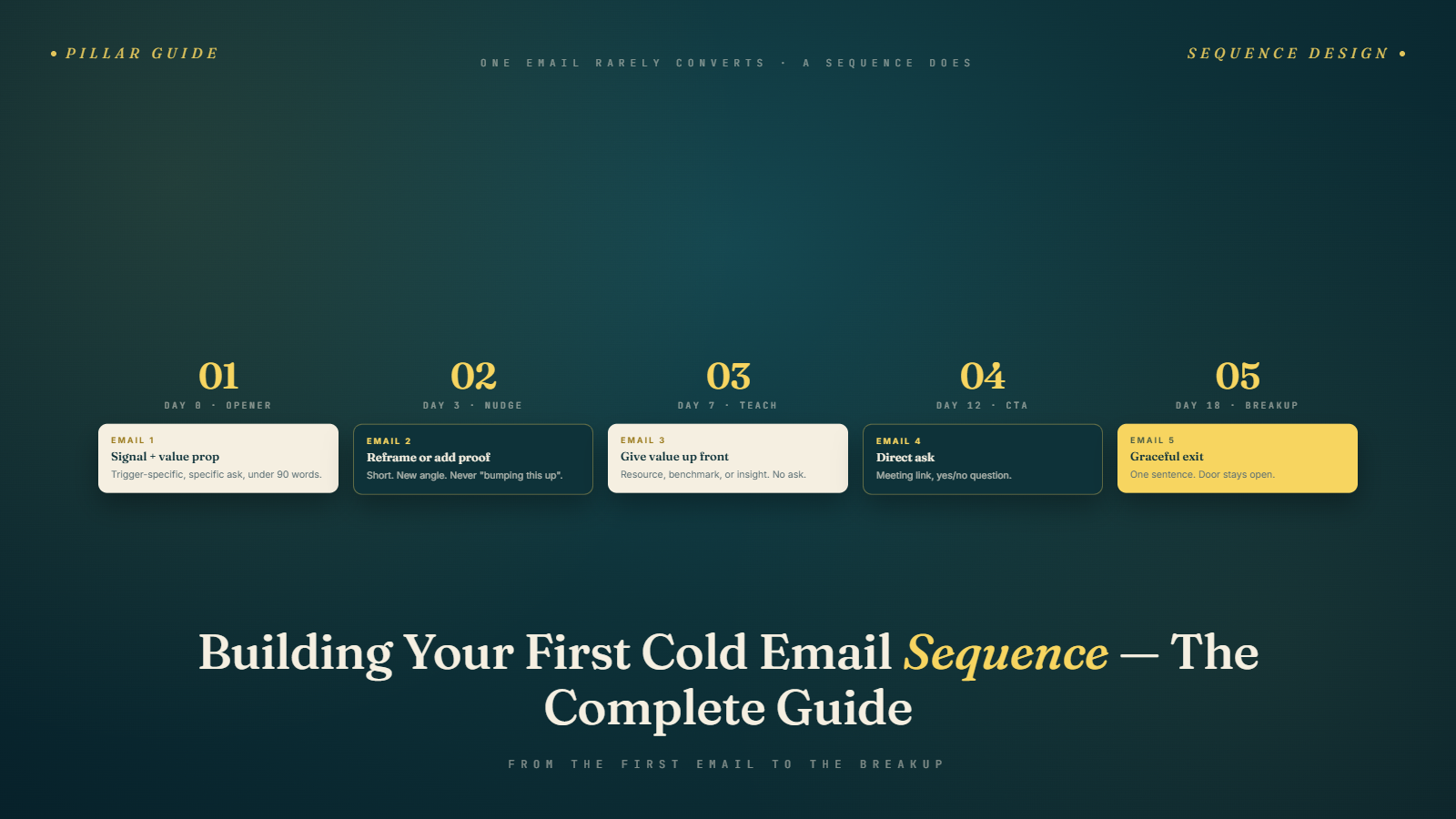
The data on optimal sequence length has been reasonably consistent across most practitioners: 4–6 steps over 2–4 weeks is the sweet spot for B2B cold email.
Fewer than 4 steps means you're leaving a significant portion of late-responders behind. More than 6 steps — without a compelling reason to continue — starts to feel like harassment and increases spam complaint risk.
The timing between steps matters as much as the content. Too close together and you feel like you're flooding their inbox; too far apart and the thread loses continuity and context.
Standard sequence timing:
- Email 1 (Day 1): The cold open
- Email 2 (Day 3–4): First follow-up
- Email 3 (Day 7–8): Second follow-up — new angle
- Email 4 (Day 12–14): Value-add or case study
- Email 5 (Day 18–20): Direct pivot or final ask
- Email 6 (Day 25–28): The breakup email
This spacing gives the prospect breathing room between touches without letting the sequence drag on indefinitely. The total duration is 4 weeks — long enough to reach most people at a point where they're ready to engage, short enough to keep the sequence feeling current and relevant.
For higher-ticket, enterprise-focused outreach, sequences sometimes extend to 8–10 steps over 6–8 weeks, with more deliberate value-building at each step. For high-volume SMB outreach, a tighter 4-step sequence over 2 weeks is often more efficient.
Step-by-Step: What Goes in Each Email
Email 1: The Cold Open
This is your most important email and the one that gets the most attention in most cold email guides. We've covered its anatomy in detail in the Phase 3 pillar article.
Purpose: Establish relevance, introduce the value proposition, earn the reply — or at minimum, plant a seed of interest.
Structure:
- Personalized opening line (specific trigger, LinkedIn reference, company news, or sharp insight)
- Problem statement — the pain your ICP has that you solve, stated in their language
- Brief outcome/proof point — the result, not the features
- Low-friction CTA — a simple yes/no question or a short-meeting ask
Length: 75–125 words. This is where brevity most directly signals confidence and respect.
Tone: Conversational, direct, human. No marketing language, no corporate hedging.
This email does the heavy personalization lifting. If you have individual research — a LinkedIn post they wrote, a company trigger, a recent announcement — it goes here.
Email 2: The Short Follow-Up (Day 3–4)
Purpose: A brief, friendly nudge that acknowledges the silence without pressure and adds one more hook.
What it's not: "Just following up on my last email." This adds nothing. The prospect knows you're following up. The question is whether this follow-up gives them a new reason to engage.
What works:
- A one-sentence new angle: "Thought of another reason this might be relevant — you're hiring for [role], which usually signals [connected pain point]."
- A brief piece of social proof you didn't include in Email 1: "One thing I didn't mention — we worked with [similar company] who had almost the exact same setup. Happy to share how it went."
- A simpler reframe of the core ask: "Worth a quick 10-minute call sometime this week?"
Length: 30–60 words. This email should be shorter than Email 1. Brevity signals that you're not going to pester them with long pitches at every touch.
Email 3: New Angle / Alternative Frame (Day 7–8)
Purpose: Come at the value proposition from a completely different direction. If Email 1 led with the problem, Email 3 might lead with an outcome or a case study. If Email 1 focused on the individual's challenge, Email 3 might focus on a team-level or company-level implication.
This email should not repeat Email 1. Prospects who didn't reply to the first email have had a chance to read it. Sending the same pitch again with a different subject line doesn't give them a new reason to engage — it just confirms that you're on a template.
What works:
- A mini case study format: "A company similar to yours — [type], [size], [stage] — was dealing with [specific problem]. Here's what happened after they addressed it: [specific outcome]."
- A contrarian take: "Most companies in your space approach [problem] by doing [common approach]. In practice, we've found that [alternative approach] consistently produces better results."
- A direct question that invites a response even if the answer is no: "Is [specific challenge] on your radar right now, or are there bigger priorities?"
Length: 75–100 words.
Email 4: Value-Add Touch (Day 12–14)
Purpose: Give before you ask again. This email provides something useful to the prospect regardless of whether they ever buy from you — a resource, an insight, a piece of research, a relevant piece of content.
Why this works: It shifts the relationship frame from "vendor trying to sell me something" to "source of interesting and useful information." Even if the prospect isn't ready to engage commercially, a genuinely useful email earns goodwill and increases the chance that the final emails in the sequence get engagement.
What works:
- "We published a short guide on [topic directly relevant to their role]. No pitch — just thought it might be useful given what you're working on."
- "Came across this piece on [industry trend] — it maps pretty directly to something I mentioned in my first email. Worth 5 minutes."
- "One thing I've seen work for teams at your stage: [specific tactic or approach]. Sharing in case it's useful regardless of whether our timing ever lines up."
Length: 60–80 words. Keep the resource link optional — offer to share it rather than always including it directly, which adds links and can trigger spam filters.
Email 5: The Direct Ask / Pivot (Day 18–20)
Purpose: By this point, you've sent four emails. If the prospect hasn't replied, they either haven't seen your emails, aren't interested, or the timing is wrong. Email 5 can be more direct about the ask, or it can pivot to a completely different angle — sometimes even a different offer or a different next step.
What works:
- A direct, honest acknowledgment: "I've reached out a few times without hearing back — I want to respect your time, so I'll be straightforward: is [core problem] something worth a conversation, or is the timing just not right?"
- A pivot to a lower-commitment offer: "Rather than a call, would it be useful if I put together a quick breakdown of [specific relevant analysis] for your situation? That might make it easier to evaluate whether it's worth a conversation."
- A question about timing: "Is this something that's more of a Q3 priority, or is it on the radar now?"
Length: 50–80 words. This email should feel honest and direct, not persistent in a desperate way.
Email 6: The Breakup Email (Day 25–28)
Purpose: Close the loop graciously. Tell the prospect you're not going to follow up anymore, make it genuinely easy for them to re-engage if timing changes, and leave the door open without pressure.
The breakup email is one of the most underestimated emails in the sequence. It consistently generates a disproportionate number of late replies — because removing all pressure suddenly makes replying feel easy.
What works:
"I'll stop reaching out after this one — I don't want to keep filling your inbox if the timing isn't right. If [core problem] ever becomes a priority, I'd genuinely enjoy the conversation. Good luck with [specific thing you know about their company]."
What to avoid: Passive-aggressive breakup language. "I guess you're not interested" or "Since I haven't heard from you, I'll assume this isn't relevant" are off-putting. The tone should be warm and genuinely no-pressure — not punishing the prospect for not replying.
Length: 40–60 words. Shorter than any other email in the sequence.
Multichannel Sequences: Adding LinkedIn Touches
Pure email sequences are standard. Adding LinkedIn touchpoints — a connection request, a comment on their post, a direct message — makes the sequence multichannel and can increase response rates meaningfully, particularly for senior buyers who are active on LinkedIn.
A multichannel sequence structure:
- Day 1: Email 1 (cold open)
- Day 2: LinkedIn connection request (no pitch in the note — just a simple connection)
- Day 4: Email 2 (follow-up)
- Day 6: LinkedIn message (brief, references the email, adds a new piece of value)
- Day 9: Email 3 (new angle)
- Day 14: Email 4 (value-add)
- Day 20: Email 5 (direct ask)
- Day 28: Email 6 (breakup)
This structure is more operationally complex than pure email but makes the overall sequence feel less like email automation and more like genuine, multi-platform relationship building. Tools like Reply.io, Lemlist, and LaGrowthMachine support multichannel sequences natively.
One important rule: keep LinkedIn touches genuinely human. A LinkedIn DM that reads exactly like an automated email template is immediately identifiable and damages the relationship. LinkedIn messages should be shorter, more conversational, and reference the specific context of the LinkedIn platform.
Sequence Personalization: Where It Lives
A well-structured sequence has personalization built into its architecture:
Email 1: Fully personalized (Tier 1 or Tier 2 personalization, as covered in Personalization at Scale)
Email 2: Semi-personalized — possibly references something specific, or uses a segment-level hook
Emails 3–5: Segment-personalized — the core content is tailored to the segment, individual details are minimal
Email 6: Minimal personalization — one or two words acknowledging something specific about their company is sufficient
This is the tiered approach in practice. Deep personalization investment in Email 1, where it has maximum impact, fades gracefully toward segment-level content in later touches. This is both more efficient and more natural — by Email 5, the prospect knows you've reached out multiple times, and trying to inject fresh research-based personalization into every touch can feel forced.
Testing and Iterating Your Sequence
A sequence isn't static. It's a living system that improves through iteration.
The key metrics to watch per step:
- Email 1: Open rate and reply rate. The baseline for your sequence.
- Email 2: Incremental reply rate (replies that come specifically from this email). Measures whether the follow-up is adding value.
- Email 3: Incremental reply rate. If this is significantly lower than Email 2, the "new angle" may not be landing.
- Email 4: Engagement with the value-add (did people click the link, reply to the insight?). A strong Email 4 often unlocks replies to Email 5.
- Email 5: Incremental reply rate. If this is near zero, the sequence may be running too long.
- Email 6: The "breakup reply" rate. Surprisingly high in well-written sequences — often 0.5–2% even from people who ignored everything before.
Track these metrics per step, not just overall. A sequence where Email 1 drives 5% replies but Emails 2–6 add nothing collectively is a 1-email sequence that you're paying the infrastructure cost to run as 6. A sequence where Emails 2–4 drive another 4–6% combined is producing nearly double the output for minimal additional cost.
Full testing methodology is covered in A/B Testing Your Cold Emails.
Common Sequence Mistakes
Mistake 1: Every Email Is Just "Following Up"
If your follow-up emails literally just say "following up on my last email" with no new content, you're not running a sequence — you're pestering. Every step needs its own purpose and its own content.
Mistake 2: Too Many Steps, Too Close Together
A 10-step sequence with daily sends isn't persistence — it's harassment. Give prospects breathing room. The cadence matters as much as the content.
Mistake 3: Not Stopping on Reply
If a prospect replies — positively or negatively — they should immediately exit the automated sequence. A prospect who replied "not right now, try me in Q3" and then receives Email 4 of the same sequence three days later is annoyed, not followed up with properly.
Mistake 4: Identical Value Props Across Every Step
Each email in the sequence should come at the problem from a different angle, lead with a different proof point, or ask a different question. Repetition signals laziness and automation — not genuine interest in the prospect's situation.
Mistake 5: Building the Sequence Before Validating Email 1
If your first email isn't generating any replies, extending the sequence won't fix it. Validate Email 1 first — get it to a 3–5%+ reply rate — before investing in building out the full sequence structure.
Next up: Follow-Up Emails: Timing & Structure — a deep dive into what makes follow-up emails work, what makes them annoying, and how to write each step of the sequence.