
The Follow-Up Nobody Wants to Receive
Open your inbox right now and count how many follow-up emails you've received in the last week that say some version of: "I just wanted to follow up on my last email and see if you had a chance to review it."
Meaningless. These emails exist purely because the sender knows they should follow up but hasn't thought about what to actually say. The prospect reads it, recognizes it as filler, and either ignores it or marks it as spam.
Now think about the rare follow-up email that actually made you want to reply — even when you'd ignored the first one. What made it different?
Almost certainly, it did one or more of these things: it referenced something new that the first email didn't include, it came at the problem from an angle that resonated more clearly, it gave you something useful regardless of whether you converted, or it was honest and direct in a way that felt different from the usual formula.
That's the difference between a follow-up that adds to the conversation and one that just adds noise. This article is about building the former.
This builds directly on the sequence architecture from Building Your First Cold Email Sequence. If you haven't read that yet, it gives you the full multi-step framework that context makes this article most useful.
The Psychology of Why Prospects Don't Reply to Email 1
Before we talk about how to write follow-ups, it's worth understanding the range of reasons why someone might not reply to an email that was genuinely relevant to them.
They were busy when it arrived. The timing was wrong. They saw it, mentally flagged it, and it got buried in the day's volume. This is probably the most common situation — and it's one a well-timed follow-up directly addresses.
They weren't sure if it applied to them. The first email was interesting but they weren't confident enough in the relevance to spend 10 minutes figuring out if a conversation was worth their time. A follow-up that adds specificity or social proof can push them over the threshold.
They needed more context before engaging. Some buyers are cautious about replying to cold email until they have some validation that you're legitimate and the solution is real. A case study follow-up or a value-add email can provide that validation passively.
They're interested but the timing is wrong. They have a budget conversation happening in Q3, or they're in the middle of an integration project, or their team structure is changing. The interest is genuine but the action needs to wait. A follow-up that acknowledges timing ("Is this a Q3 priority, or is it relevant now?") can generate a "circle back in 3 months" reply — which is valuable intelligence.
They simply missed it. Inboxes are chaotic. The email exists somewhere in their email client but they genuinely haven't seen it. A follow-up surfaces it again.
Understanding which of these is likely true for your specific ICP and segment shapes how you write your follow-ups — and which angles you lead with.
The Cardinal Rule: Every Follow-Up Needs a New Reason to Exist
This bears repeating because it's the single most violated principle in cold email follow-up: do not send a follow-up that contains nothing new.
"Just checking in" is not new. "Wanted to see if you had a chance to look at my last email" is not new. "Did you get my previous message?" is not new (and slightly passive-aggressive).
A follow-up earns its place in the prospect's inbox by adding something. That something can be:
- A new angle on the value proposition
- A specific proof point or case study not included in Email 1
- A piece of genuinely useful content related to their problem
- A reference to something new you noticed about their company or situation
- An honest, direct acknowledgment of the situation and a simplified ask
The question to ask before sending any follow-up: "If the prospect has already read my previous email and is on the fence, does this give them a new reason to say yes?"
If the answer is no, revise until it does.
Timing: The Data and the Reality
The question of how long to wait between follow-up steps doesn't have a single universal answer, but the data points toward some practical ranges.
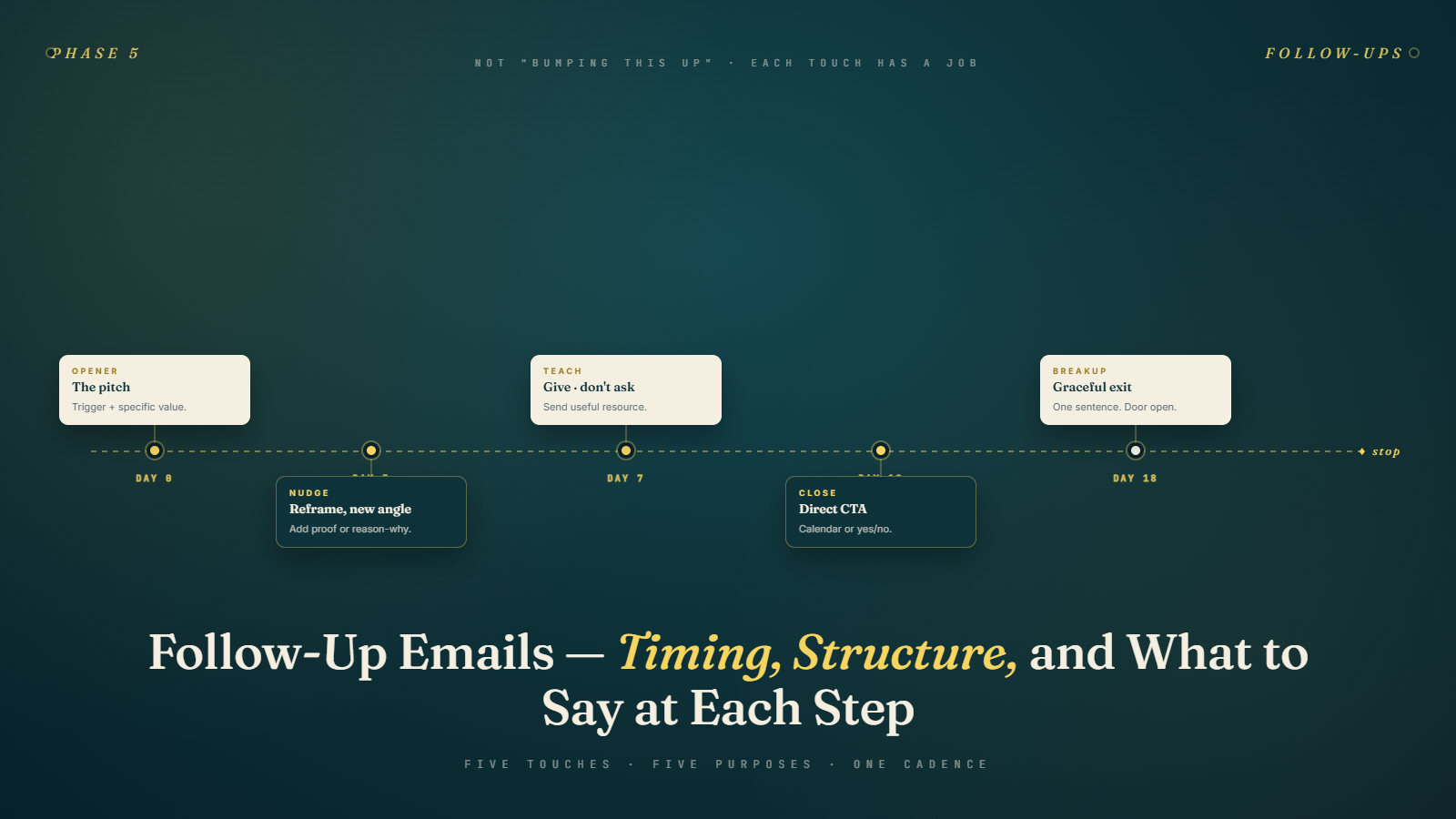
Between Email 1 and Email 2: 2–4 days. Short enough that the context of the first email is still fresh, long enough to not feel like you're flooding their inbox. Most practitioners land around 3 days.
Between Email 2 and Email 3: 3–5 days. The cadence starts stretching slightly as the sequence progresses.
Between Email 3 and Email 4: 4–7 days. By this point, the prospect has had a meaningful amount of time to engage if they're going to. Later follow-ups should be more spaced.
Between Email 4 and Email 5: 5–7 days.
Between Email 5 and Email 6 (breakup): 7–10 days. The final email in a sequence benefits from some distance — it feels more like a genuine "wrapping up" and less like another automated step if there's been some time since the last touch.
Day of week effects: Research and practitioner experience both suggest mid-week sends (Tuesday–Thursday) tend to outperform Monday and Friday for B2B cold email. Mondays are often consumed by planning and catching up. Fridays are mentally occupied by the weekend. The Tuesday–Thursday window is when most professionals are most focused and inbox-ready.
Time of day effects: For B2B outreach, early morning (7–9 AM in the recipient's timezone) and early afternoon (1–3 PM) tend to perform best. These are windows when people are often checking email outside of meetings. Midday and late afternoon are generally noisier.
Most modern sending platforms allow you to configure timezone-aware delivery, which means your email can land at 8 AM for a prospect in New York and 8 AM for a prospect in Berlin, regardless of when you scheduled the campaign.
Writing Each Follow-Up Step: A Framework
Here's the practical writing framework for each position in a standard 5–6 email sequence:
Follow-Up 1 (Email 2): The Brief Continuation
Goal: Resurface the first email for people who missed it; add one new hook for people who saw it but weren't compelled.
Structure:
[Brief acknowledgment that this is a follow-up — but not the opening line]
[New hook — one specific thing not in Email 1]
[Simple re-ask of the CTA]
Example: "Wanted to add one thing I left out of my last note — one of the companies we've helped with this is [relevant company name or type], who were in a very similar situation to where [their company] is right now. Curious if that context changes whether a quick call makes sense."
What makes it work: It doesn't start with "following up." It leads with the new piece of content. The acknowledgment of the prior email is implicit in the context, not stated explicitly.
Length: 40–60 words.
Follow-Up 2 (Email 3): The New Angle
Goal: Reframe the entire value proposition from a different perspective. If Email 1 focused on a pain point, Email 3 leads with an outcome. If Email 1 used a SaaS company example, Email 3 uses a different, perhaps more directly relevant comparison.
Structure:
[Open with a different framing — a different problem dimension, a different proof, a contrarian observation]
[Connect it to the core value proposition briefly]
[CTA — can be the same ask or a slightly different entry point]
Example: "Most teams that reach out to us come because of bounce rate problems. The ones who get the most out of working with us are usually dealing with something a level up — their domain reputation is quietly eroding and they don't catch it until it's already affecting opens on warm campaigns, not just cold. Is that something on your radar, or are you primarily focused on [original pain point]?"
What makes it work: It introduces a new dimension of the problem that might land differently for different readers. It's also a genuine question, not just a re-pitch.
Length: 60–80 words.
Follow-Up 3 (Email 4): The Value-Add
Goal: Give without immediately asking for anything back. Provide a resource, an insight, or a piece of genuinely useful information related to the problem you solve.
Structure:
[Brief transition — acknowledge you've been in touch]
[The value-add — specific, genuinely useful, not a thinly veiled sales pitch]
[Optional soft offer to connect — no pressure]
Example: "One last thing before I stop filling your inbox — I wrote a short breakdown last month of how teams at Series B stage can audit their email infrastructure without needing a dedicated ops person. No pitch in it, just a walkthrough. Happy to send it over if that'd be useful regardless of our timing."
What makes it work: It gives the prospect permission to engage without committing to a conversation. Receiving something useful for free often triggers the reciprocity instinct — they feel some social pull toward replying even to just say "thanks, send it over."
Length: 50–70 words. The shorter and less promotional this email is, the more effectively it works.
Follow-Up 4 (Email 5): The Direct Ask
Goal: Be honest about the situation and ask a direct question about whether the timing is right or whether there's any point in continuing the conversation.
Structure:
[Direct acknowledgment — you've reached out multiple times]
[Honest ask — is there interest? Is the timing off? Is there something preventing engagement?]
[Clean close — no pressure either way]
Example: "I've reached out a few times now and I want to be respectful of your time. Two honest questions: is [core problem] actually a priority for your team right now, and if not, is there a point in the quarter where it would be worth revisiting? Either answer is useful — just want to make sure I'm following up at the right time rather than the wrong one."
What makes it work: It's honest and direct in a way that most cold email isn't. It asks the prospect to do something easy — answer a yes/no timing question — rather than committing to a meeting. And it gives them a dignified out ("timing isn't right") rather than forcing them to choose between engaging and ignoring.
Length: 60–80 words.
The Breakup Email (Email 6): The Clean Close
Goal: Close the loop graciously, remove all pressure, and leave the door genuinely open.
Key elements:
- Clear signal that you're not going to follow up again (unless they re-engage)
- Warmth — no frustration or passive aggression
- Optional: a final useful reference, a brief mention of something specific about their situation
- A genuinely easy re-engagement path
Example: "This will be my last note — I don't want to keep landing in your inbox if the timing isn't there. If [core problem] ever becomes a priority, I'd be happy to pick up the conversation. Good luck with [something specific you know about their company or role]."
What makes it work: The warmth is genuine. The specific reference at the end proves you were actually paying attention — not just running a sequence. And the "last note" framing removes the pressure that makes replying feel like agreeing to something.
Length: 30–50 words. The shortest email in the sequence.
Tone Progression Across the Sequence
One of the subtler elements of a well-crafted sequence is the tone progression. The sequence should feel like a natural conversation that evolves over time — not a series of independent pitches.
Emails 1–2: Professional, warm, confident. You're introducing yourself and your value clearly.
Emails 3–4: Slightly more casual, more curious. You're learning about their situation and sharing things you find genuinely interesting. The "follow-up mode" starts to relax into something more conversational.
Emails 5–6: Direct and honest. By this point in the sequence, the formality of "let me present my value proposition" has passed. You're just two professionals having an honest exchange about whether there's a fit here.
This progression feels natural because it mirrors how real relationships develop. The initial formal introduction, the slightly warmer follow-up exchanges, and the eventual direct conversation are how business relationships actually begin when they work.
Handling Replies Mid-Sequence
When a prospect replies — to any email in the sequence, with any kind of response — the sequence should stop immediately and permanently. From that point on, every interaction is human-to-human, not automated.
This seems obvious, but it's violated regularly in automated sequences. A prospect who replied "I'm on parental leave until June" and then receives Email 4 of the automated sequence three weeks later is someone you've just annoyed at a vulnerable moment.
Most sending platforms support "stop sequence on reply" as a setting — always have it on. And for any reply that isn't a clear "not interested" or automatic out-of-office, take the time to respond personally and thoughtfully within 24 hours.
The reply is the moment everything that came before the sequence — the ICP definition, the list building, the personalization, the copy — was designed to create. Treat it accordingly.
Common Follow-Up Mistakes
Mistake 1: The Subject Line Reset
Changing the subject line on each follow-up breaks the email thread in most clients. This makes each email look like a new, unrelated email — which loses the context of the prior conversation. Keep the same subject line (most platforms do this automatically for sequence replies).
Mistake 2: Apologizing for Following Up
"Sorry to bother you again" or "I apologize for the multiple emails" — don't do this. It signals insecurity and implicitly validates the prospect's decision to ignore you. Be confident. You're reaching out because you have something genuinely relevant.
Mistake 3: Every Email Gets Longer
Follow-up emails should generally get shorter as the sequence progresses, not longer. If you're adding more content to each step because you feel like the earlier ones "didn't say enough," that's usually a sign the first email needs refinement, not that the follow-ups need more volume.
Mistake 4: Waiting Too Long
A follow-up sent 3 weeks after the first email has lost the thread of the conversation. The prospect has moved on mentally. Follow-ups need to be close enough together to feel like a continuous conversation.
Mistake 5: Stopping the Sequence on Out-of-Office but Not Removing from List
When someone sends an automatic out-of-office, they haven't replied to your email — their email server has. Most platforms handle this correctly (don't mark it as a reply, don't exit the sequence). But if your platform treats OOO as a reply and exits the sequence, you'll miss a significant portion of your list. Configure this carefully.
Next up: When and How to Use AI in Cold Email — where AI genuinely helps in sequence building and personalization, and where it makes your outreach worse.