
The One-Size-Fits-All Problem
Imagine you walk into a meeting with two potential clients back to back. The first is a scrappy startup founder with 12 employees, bootstrapped, moving fast, making decisions alone. The second is a VP of Operations at a 400-person manufacturing company, dealing with procurement processes, multiple stakeholders, and quarterly budget cycles.
You wouldn't deliver the same pitch to both of them. You'd speak to the founder about speed, cost, and quick wins. You'd speak to the VP about process, scalability, compliance, and ROI over quarters.
The same logic applies to cold email — yet most people write one sequence and blast it to their entire list. The result is a message that sort of works for some people and really doesn't work for most. Average open rates, mediocre reply rates, and the nagging feeling that something about the messaging is off.
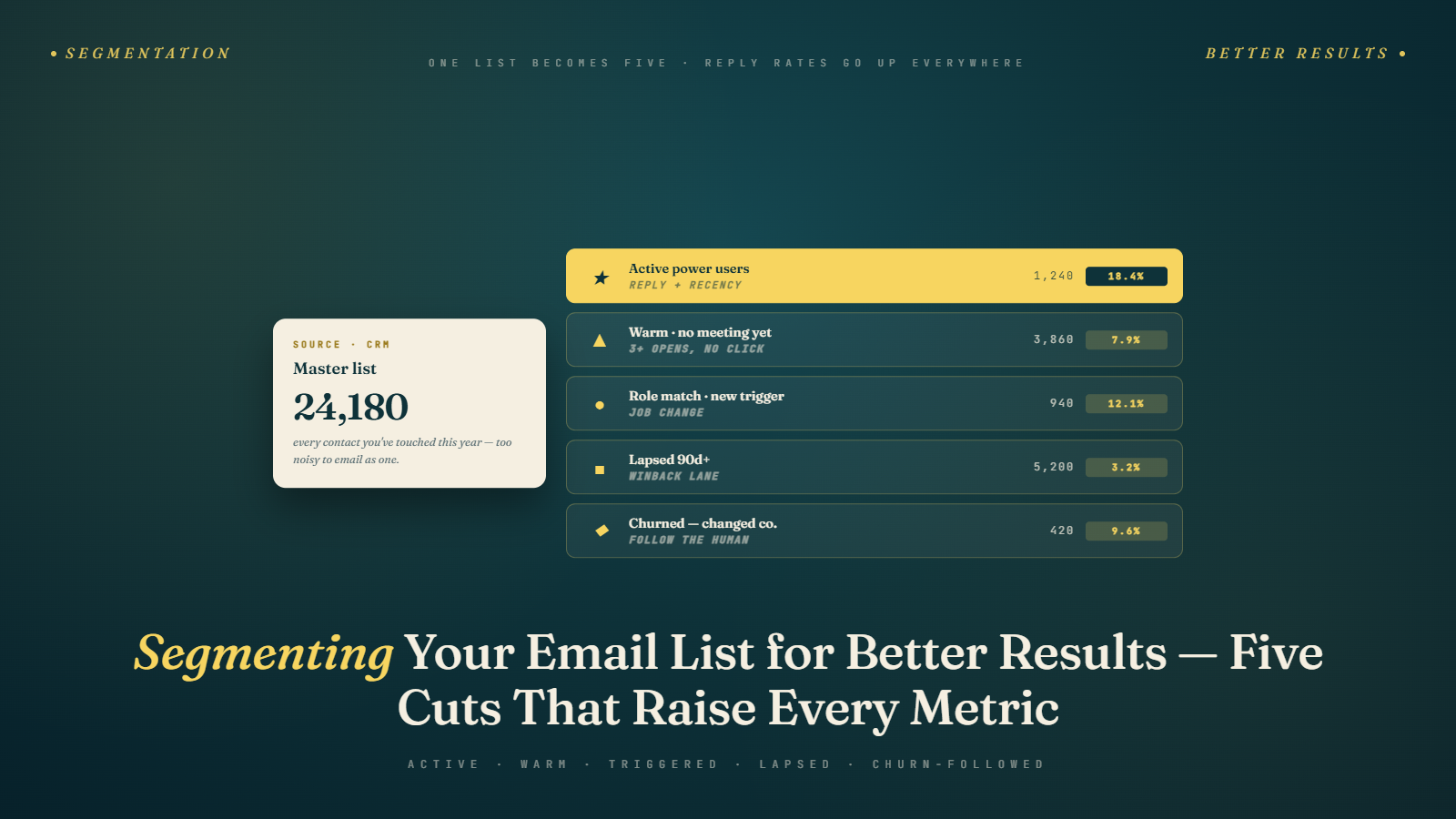
Segmentation is the solution. It means dividing your prospect list into groups that share meaningful characteristics, then writing sequences tailored to each group. When done well, segmentation transforms a generic campaign into a series of highly relevant, personalized outreach efforts — each of which feels like it was written specifically for that reader.
This article builds on everything we've covered so far in Phase 2 — your ICP definition, your prospect list, your data sources, and your verified email list. Segmentation is how you organize all of that groundwork before it goes into a sending sequence.
Why Segmentation Improves Cold Email Performance
Before getting into the how, let's be clear about the why.
Relevance is the primary driver of cold email reply rates. People reply to emails that feel relevant — that speak to a pain point they actually have, in language they actually use, at a time when the topic is on their radar. Generic emails fail because they try to be relevant to everyone and end up being truly relevant to no one.
When you segment your list:
- Your value proposition can be tailored to specific pain points by segment
- Your subject lines can reference segment-specific language or triggers
- Your social proof can feature case studies from the same industry or company size
- Your CTA can match the urgency level and decision-making style of that segment
Even small, meaningful differences in messaging between segments — a different first line, a different case study, a different framing of the problem — can double your reply rate. It sounds dramatic, but it's consistently what outbound teams find when they run the experiment.
The Four Core Segmentation Dimensions
There's no single right way to segment a list. The best segmentation dimensions are the ones that actually affect what your prospects care about and how they buy. Here are the four most consistently useful:
1. Industry / Vertical
Industry is often the most obvious and most impactful segmentation variable. The language, pain points, regulatory context, competitive pressures, and buying triggers differ significantly between a B2B SaaS company, a professional services firm, an e-commerce retailer, and a healthcare organization.
If you're selling a data enrichment tool, the SaaS segment cares about improving CRM data quality for sales reps. The e-commerce segment cares about improving personalization for customer marketing. The professional services segment cares about better target account intelligence for business development.
Same product. Very different conversations. Very different emails.
How to use this dimension: Create one sequence per major vertical. Even changing the industry-specific pain point language and swapping in a vertical-relevant case study can make a meaningful difference.
2. Company Size
Headcount (or revenue) affects the buying process, the decision-maker's priorities, the budget cycle, and even the language your prospect uses to describe their problems.
A 15-person startup founder is worried about cost, implementation speed, and whether the tool will actually save them time. A VP at a 300-person company is worried about how the tool integrates with their existing stack, whether the vendor has a track record, and whether they can get it through procurement.
How to use this dimension: At minimum, split your list into SMB (typically under 100 employees) and mid-market/enterprise (100+). If your product spans a very wide range of company sizes, you might go three ways: SMB, mid-market, and enterprise.
3. Seniority and Role
The right message for a founder is different from the right message for a VP, which is different from the right message for a Manager or individual contributor.
- Founders and C-suite want to hear about strategic impact, business outcomes, and competitive advantage. They don't want feature lists.
- VPs and Directors want to understand ROI, team efficiency, and how this makes them look good to their boss and their board.
- Managers and individual contributors want to understand how this fits into their workflow, what the onboarding is like, and whether it will actually make their day easier.
The level of specificity and the frame of value should change based on seniority.
How to use this dimension: Write different opening lines and different pain-point framings for each seniority level. The core offer stays the same; the language and frame change.
4. Buying Stage / Trigger Signal
Not all ICP-matching prospects are ready to buy at the same time. Segmenting by buying stage or situational trigger lets you match your messaging to where they are in the journey.
Examples of trigger-based segments:
- Recently funded: Raised a round in the last 90 days. They have budget, they're in growth mode, and they're likely evaluating tools actively.
- Recently hired decision-maker: A new VP or Director just started. They're reviewing existing tools and processes and want to make an impact.
- Actively hiring in the relevant function: A company hiring 5 SDRs is scaling their sales team — a strong signal for sales tools.
- Recently launched a new product or entered a new market: Growth mode, new challenges.
- Competitor of a current customer: You have a case study from their direct competitor. That's a highly relevant pain point.
How to use this dimension: Build separate sequences for trigger-based segments with customized opening lines that reference the trigger. "I noticed you recently raised your Series B — congratulations" is a far more effective opener than anything generic.
Practical Segmentation: A Step-by-Step Approach
Here's how to actually implement segmentation for a real campaign:
Step 1: Audit Your List for Segmentation Signals
Open your prospect list and look at what data you have. What columns do you have for each contact? You can segment by:
- Industry (if your data source included it)
- Headcount (if your data source included it)
- Title / seniority (you have this from your prospecting)
- Technology used (if you enriched with technographic data)
- Trigger events (if you tracked funding dates, hiring activity, etc.)
Only segment on dimensions you actually have data for. Don't create an "e-commerce" segment if you don't know which of your prospects are e-commerce companies.
Step 2: Choose Your Primary Segmentation Dimension
You don't need to segment on all dimensions at once. Pick the one that creates the most meaningful difference in your messaging.
For most campaigns, industry is the first cut. Then within each industry segment, you might further split by company size or seniority if the list is large enough to justify it.
Rule of thumb: A segment needs to be large enough to justify writing a separate sequence for it. If you only have 15 prospects in a particular industry vertical, the time cost of writing a separate sequence probably isn't worth it. Combine that vertical with the closest adjacent vertical.
Step 3: Write Segment-Specific Messaging
For each segment, customize at minimum:
- Email 1, Opening line: Reference something specific to the segment (industry context, company stage, trigger signal)
- Pain point framing: State the problem in language that resonates with this specific segment
- Social proof: Reference a case study or client name from the same industry or similar company type if possible
- CTA: Adjust urgency and specificity based on the segment's typical buying timeline
You don't need to rewrite everything from scratch for each segment. Often, the core body of the email can stay similar while the opening lines, subject lines, and pain point framing change. That small delta in relevance often makes a big difference in results.
Step 4: Create Separate Campaigns in Your Sending Tool
In whatever platform you're using (Instantly, Lemlist, Smartlead, etc.), create a separate campaign for each segment. This is important for two reasons:
- You can track metrics by segment — if one segment has a 20% reply rate and another has 2%, you want to know that
- You can A/B test within segments without muddying the data across your whole list
Step 5: Measure, Compare, and Refine
After running segmented campaigns for a few weeks, compare performance across segments:
- Which segments have the highest open rates? (Subject line / relevance)
- Which segments have the highest reply rates? (Whole message / value prop / timing)
- Which segments book the most meetings? (ICP fit / messaging quality)
- Which segments don't respond at all? (Wrong target / wrong message / wrong timing)
Use these insights to refine both your ICP definition and your segmentation strategy. Sometimes a low-performing segment reveals that a certain company type just isn't a great fit, and you should deprioritize it. Other times, it reveals a messaging problem — the segment is a great fit but the email doesn't speak to them correctly.
Advanced Segmentation: Behavioral and Intent-Based Segments
Beyond the core four dimensions, advanced outbound teams layer in behavioral signals to create even more targeted sub-segments.
Intent-based segments: Using intent data from Bombora or G2 (as covered in Best Data Sources for Cold Email Outreach), you can identify companies that are actively researching topics related to your solution. These companies get a different message than cold-ICP companies — they're already in-market, so your email can be more direct about the solution rather than needing to establish the problem.
Engagement-based segments: Once you've run campaigns, you can segment based on engagement behavior:
- Opened but didn't reply: These people saw the email. They might need a different angle or a follow-up that addresses a potential objection.
- Clicked a link but didn't reply: They were interested enough to investigate further. A highly targeted follow-up that picks up the thread can work well here.
- Previously replied "not now": These are warm leads who weren't ready. Time-based follow-up in 3–6 months with a new angle is worth doing.
How Segmentation Affects Your Email Copy
This deserves its own moment because it's where segmentation actually pays off — in the writing.
When you know you're writing to one specific segment, your copy becomes sharper. You're not hedging your language to try to be relevant to multiple different people. You're speaking directly to one type of buyer with one set of problems.
The most visible difference shows up in three places:
The opening line: Instead of "I help companies like yours improve their sales efficiency" (vague, could apply to anyone), you write "I've been working with a lot of Series B SaaS companies over the past 12 months, and almost all of them hit the same ceiling around SDR ramp time..." That second version is only relevant to Series B SaaS companies — which is exactly the point. The people who aren't Series B SaaS companies never see it.
The pain point description: Different segments feel pain differently, even if the underlying problem is the same. A startup founder experiencing cash flow pressure describes it differently than a VP of Finance at a mid-market company presenting to a board. Speaking in your prospect's language — using the words and framing they'd use internally — is what makes a cold email feel like it "gets" them.
The social proof: If you're writing to e-commerce brands, drop an e-commerce case study. If you're writing to professional services firms, reference a professional services client. Prospects default to dismissing generic claims — "we've helped hundreds of companies" means nothing. "We helped a 60-person DTC brand increase their email deliverability rate from 78% to 96% in 60 days" is specific and credible.
None of this is possible without segmentation. When you're writing to "everyone on the list," none of the above specificity can exist.
Segmentation vs. Over-Segmentation
There's a real risk here that's worth naming: over-segmentation. Creating 15 different segments for a list of 200 contacts doesn't make sense. You'll spend all your time writing custom sequences and have no time to actually build the pipeline.
The goal of segmentation is meaningful differences in messaging that correspond to meaningful differences in your prospects. If two segments would get essentially the same email, they should be one segment.
For most small and mid-sized outbound operations, 2–4 core segments per campaign is the sweet spot. Start simple, measure results, and add more nuance as you learn what makes a difference.
Common Segmentation Mistakes
Mistake 1: Segmenting Without Data
You can't segment by industry if you don't know what industry each prospect is in. Make sure your list has the data you need before you try to split it.
Mistake 2: Creating Segments That Are Too Small
A segment of 20 people doesn't justify a completely bespoke sequence unless the deal size is very large. Use a practical threshold based on your cost per email and expected conversion rates.
Mistake 3: Segmenting but Not Changing the Messaging
The whole point of segmentation is different messaging for different people. If you create three segments but send them all the same email with only the {{company_name}} variable changed, you haven't actually segmented — you've just created organizational overhead.
Mistake 4: Not Tracking Segment-Level Metrics
Sending to segments without tracking which segment each email came from defeats the purpose of the exercise. Your sending platform should let you organize campaigns by segment so you can compare performance.
Mistake 5: Ignoring the Timing Dimension
Industry and company size matter. But timing often matters more. A company that perfectly matches your ICP but has no current trigger is less likely to buy than a company that's a decent ICP match but just raised a round and is actively looking for tools. Layer trigger signals into your segmentation when you have the data.
From Segments to Sequences
Once your segments are defined and your messaging is tailored, you're ready to build your sending sequences. Each segment gets its own campaign with its own cadence and copy.
But before the copy is about the sequence structure, it's about the individual email. And the most important element of any individual cold email — the thing that gets it opened and responded to — is personalization. Not just {{first_name}} at the top, but genuine, specific, thoughtful personalization that makes the prospect feel like you actually know something about them.
That's exactly what we cover in the next and final article of Phase 2.
Up next: Personalization Data: What to Collect and Why — the specific data points you should gather before writing a cold email, and how to use them to craft opening lines and messages that actually get replies.