
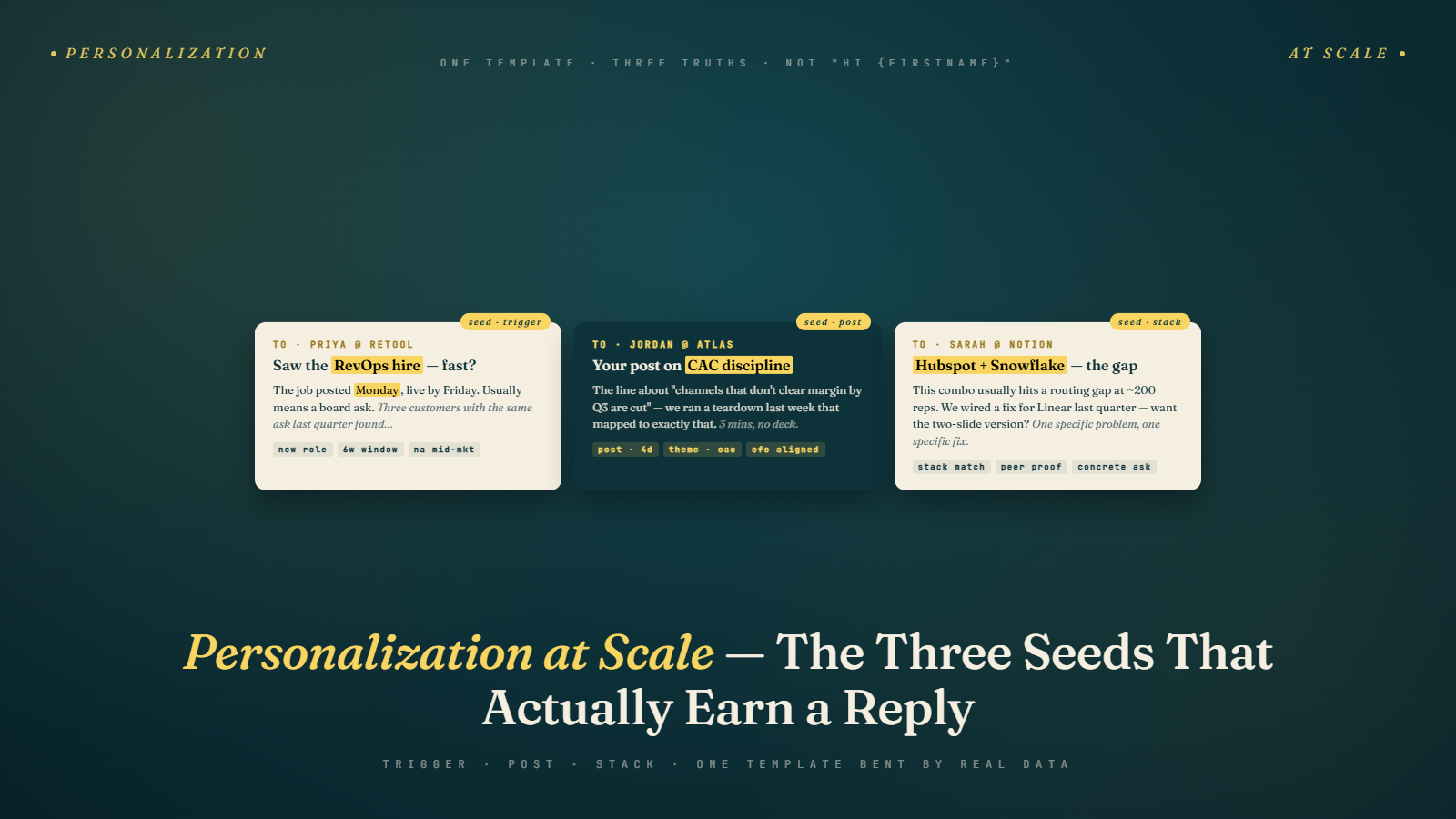
The Personalization Paradox
There's a real tension at the heart of cold email: the emails that get the best results are the ones that feel the most personally written — but cold email is, by definition, done at scale.
A fully bespoke email crafted after 30 minutes of research per prospect will almost always outperform a template. But no sales team on earth can write 300 truly original emails a week without collapsing. So either you sacrifice quality for scale or you sacrifice scale for quality. Right?
Not quite. The mistake is treating personalization as a binary — either you research everything and write a unique email, or you use a template with token substitutions. The reality is more nuanced, and the most effective cold email practitioners have figured out a middle path: a tiered personalization system that allocates research effort based on deal potential, and uses structural templates where templates won't compromise quality.
This article is about building that system. We touched on the data side of this in Personalization Data: What to Collect and Why. This is the execution side — how you actually turn that data into emails at volume without losing what makes personalization work in the first place.
Why Fake Personalization Is Worse Than No Personalization
Let's establish this clearly before we get into the how.
Fake personalization — substituting {{first_name}} and {{company_name}} into a generic template and calling it "personalized" — is not neutral. It actively damages your results compared to a well-written generic email.
Here's why: when a prospect opens an email that's clearly a template, they don't just feel unimpressed. They feel mildly deceived. The attempt at personalization signals "I want you to think I wrote this for you" — but the generic body signals "I clearly didn't." That combination is worse than just sending a clean, honest, well-framed generic message.
The other issue is that fake personalization is extremely easy to spot. Lines like "I was impressed by [Company]'s work in the [Industry] space" or "As a [Job Title], I thought you'd find this relevant" are transparent shells. Anyone who receives more than a handful of cold emails — and senior buyers receive a lot of them — can identify a mail merge at 20 paces.
The bar for what counts as "real" personalization has risen. What passed for personalized in 2018 (just including someone's name and company) reads as lazy today. To actually stand out, personalization needs to reference something specific and true about the person or their company.
The Three Tiers of Personalization
The right personalization system starts with triage. Not every prospect deserves the same level of research effort. Here's a practical tiering framework:
Tier 1: 1-to-1 Personalization (High-Value Targets)
When to use: Enterprise deals ($20K+ ACV), strategic accounts, highly competitive targets where you know they're being reached by multiple vendors.
Research investment: 15–30 minutes per prospect.
What you're looking for:
- Recent LinkedIn posts or articles they've written
- Company news in the last 60 days (funding, product launches, expansions, leadership changes)
- Specific pain points visible in their public communications
- Mutual connections or shared contexts
- Their career history and how it shapes their perspective
What it looks like in the email: An opening line that could only have been written for this person — something specific enough that it would be meaningless in any other email. The rest of the email may still use a semi-templated structure, but the hook is fully custom.
Example first line: "Your LinkedIn post on PLG vs. sales-led at Series B stage made me think of something we've seen consistently with our clients going through the same debate..."
Tier 2: Segment-Level Personalization (Mid-Tier Volume)
When to use: Mid-market deals, defined ICP segments, campaigns to 50–500 prospects in a specific vertical or company stage.
Research investment: Segment research upfront (1–2 hours to understand the segment deeply), then 3–5 minutes per prospect to add one or two individual data points.
What you're looking for (segment level):
- The specific language this segment uses to describe their problems
- The metrics they care about
- The tools they typically use
- The objections they most commonly raise
What you're looking for (individual level):
- One or two quick signals: recent job change, company news, LinkedIn activity
What it looks like in the email: A segment-specific framing and pain point language throughout, with a quick personalized hook in the first 1–2 sentences based on the individual data point.
Example first line: "Congrats on joining [Company] as VP of Sales — curious how you're thinking about outbound infrastructure as you settle into the role."
The rest of the email speaks specifically to the challenges a new VP of Sales at a scaling company would recognize — not to "companies in general."
Tier 3: Persona-Level Personalization (High-Volume)
When to use: SMB outreach, high-volume SDR campaigns, low ACV products where individual research isn't economically justified.
Research investment: Segment and persona research upfront. Very minimal per-contact.
What you're doing: Writing email copy that resonates so specifically with the persona's reality that it feels personalized even without individual research. This requires investing serious time in understanding the segment — more so than most people do.
What it looks like: No individual hook (or a very lightweight one pulled from available data like industry or company size). Instead, the pain point and framing are so specific to this type of person that they feel seen.
Example first line: "Most e-commerce founders I talk to hit the same wall around $5M ARR — email deliverability starts getting inconsistent right when you're scaling ad spend. Is that familiar?"
That's not personalized to one person. But it's specific enough to one type of person that it reads as relevant — and the right person will nod and keep reading.
The Architecture of a Scalable Personalized Email
Understanding the tiers is the strategic layer. The tactical layer is understanding where in an email structure you can scale and where you can't.
The structure:
[Opening line — this is where personalization lives most powerfully]
[Pain point / problem statement — can be semi-templated per segment]
[Solution / value prop — mostly templated, segment-adjusted]
[Proof / social proof — templated but should reference relevant examples]
[CTA — templated, tested variant per segment]
The opening line is the personalization apex. This is where the most individual research goes and the most impact is created. Everything after it can be more systematized — as long as it's written for the segment, not for "everyone."
This means your investment of research time should be front-loaded: spend most of it crafting the right opening, then let a well-crafted segment-specific template carry the rest.
Using Custom Variables Effectively
Modern cold email platforms — Instantly, Lemlist, Smartlead, Reply.io — support custom variables beyond just first name and company. This is where the mechanics of personalization at scale come from.
Instead of relying on {{first_name}} and {{company_name}} only, build a richer variable set:
{{personalized_opening}}— your custom first line, researched individually{{trigger_event}}— the specific trigger (funding round, new hire, job change){{pain_point}}— the specific problem you're addressing for this segment{{relevant_case_study}}— a client reference relevant to this prospect's vertical{{icebreaker}}— a quick observation about something specific to their company
You prepare this data in your prospect spreadsheet before uploading to the sending platform. Each row has a different value for {{personalized_opening}}, and the platform substitutes it in.
The workflow looks like this:
- Build your prospect list in a spreadsheet
- Add your custom variable columns alongside name, company, and email
- Fill in the variables — either manually for Tier 1, or with a combination of manual and tool-assisted for Tier 2/3
- Upload to your sending platform
- Build your email template using those custom variables
The key is that the template structure stays consistent, but the variables inject real, researched personalization at the moments it matters most.
AI-Assisted Personalization: What Actually Works
AI writing tools have made personalization at scale more accessible — but with real caveats.
What AI does well:
- Summarizing a LinkedIn profile or company page into a personalized opening line
- Generating variations of a templated message across different personas
- Researching company news and formatting it into a concise personalization hook
- Suggesting relevant pain points based on job title and industry
What AI doesn't do well:
- Authentic-sounding observations that feel human (AI openings often have a particular flatness that experienced buyers recognize)
- Nuanced judgment about what's actually interesting vs. what's trivially true
- Catching outdated information (AI training cutoffs mean it may surface stale context)
The best use of AI in personalization at scale is as a research assistant and first-draft generator, not as the author. Use it to surface the raw material — the LinkedIn post, the company news, the recent announcement — then write the actual opening line yourself. Or at least edit the AI output until it sounds like you'd actually write it.
If you're seeing tools that claim to fully automate hyper-personalized emails at scale with no human review — be skeptical. The outputs are often detectable as AI-generated, and getting caught using obviously AI-written "personalization" is arguably worse than using a clean template.
Personalization Across the Sequence, Not Just the First Email
A mistake many people make: they invest in personalizing the first email and then revert to completely generic follow-ups.
Your follow-up emails should reference the previous email and build on it. If your first email mentioned their Series B, your follow-up should pick up that thread. If your first email referenced a LinkedIn post they wrote, your follow-up could reference a different aspect of the same topic.
The sequence should feel like a connected conversation, not a series of independent pitches. This requires a bit more thought in the follow-up structure, but it pays off in reply rates — because the follow-up doesn't feel like the same email on repeat, it feels like a persistent (but polite) attempt to continue a specific conversation.
One practical approach: in your follow-up sequences, include a variable like {{follow_up_context}} that you can populate with a brief reference to why you're following up specifically — "Still thinking about what you mentioned in your post on outbound efficiency..." — that ties it back to the original hook.
Measuring the Impact of Personalization
Personalization investment should produce measurable returns. If it doesn't, you're either personalizing on the wrong dimension or your audience isn't responding to that type of relevance.
Metrics to track by tier:
- Open rate: Driven primarily by subject line and from name — less affected by body personalization
- Reply rate: The primary measure of whether personalization is working — are people replying to your personalized openers more than generic ones?
- Meeting booked rate: Does deeper personalization correlate with better meeting quality?
- Response quality: Are personalized emails generating engaged, substantive replies vs. one-word "not interested" responses?
A simple experiment: run the same email to a similar segment, with one group getting Tier 1 personalization and one group getting Tier 3. Compare reply rates. If the difference doesn't justify the research time investment at that deal size, optimize accordingly.
Common Personalization-at-Scale Mistakes
Mistake 1: Over-Relying on Name and Company
Name and company are the floor of personalization, not the ceiling. If those are your only custom variables, your emails will feel like templates even to people who've never read about cold email best practices.
Mistake 2: Personalizing the Wrong Things
Personalizing the company's founding year or the number of employees they have isn't impressive or relevant — it's trivial data that anyone with internet access could find. Personalize on things that require judgment: what their situation means, what challenge they're likely facing, why this moment specifically is relevant for them.
Mistake 3: Using the Same Personalization Hook for Everyone in a List
If your "personalization" is one sentence about their industry that you copy-paste for every company in a vertical, that's not personalization — it's a longer segment tag. True personalization at the individual level requires individual signals.
Mistake 4: Letting the Personalization Feel Forced
Sometimes a personalization hook doesn't naturally connect to your pitch. When that happens, people often force the connection with awkward transitions like "...which made me think you might be interested in our solution." If the connection isn't natural, skip the hook and lead with a strong segment-level opener instead.
Mistake 5: Not Verifying Personalization Data Before Sending
AI can hallucinate. Data sources can be outdated. Someone's LinkedIn might say they're at a company they left six months ago. Before you send a personalized email referencing someone's specific role or company news, verify it's still accurate. A personalization error is more damaging than no personalization — it shows you didn't actually do the research properly.
The Diminishing Returns of Over-Personalization
There's a ceiling on personalization impact that's worth understanding — not to give you an excuse to cut corners, but to help you allocate effort correctly.
At some point, adding more personalization detail per email stops generating proportionally better results. A deeply researched email with 5 personalization hooks doesn't reliably outperform a well-researched email with 2 good hooks. In fact, over-personalized emails can read as surveillance-adjacent — "you know a lot about me" isn't always flattering.
The sweet spot is usually one strong, specific hook that establishes genuine relevance, plus the segment-level framing that shows you understand their broader world. Beyond that, you're in diminishing-returns territory.
Where over-personalization specifically backfires:
When the hooks feel forced. Referencing someone's college graduation year, their hometown, or a personal social media post that has nothing to do with their professional situation isn't personalization — it's creepy. Keep personalization anchored in their professional world and business situation.
When the personalization contradicts the brevity principle. An email with a well-researched opener, three separate personalization references in the body, and a personalized sign-off might be 300 words of very relevant content — but it's still 300 words, and that's often too long. If deep personalization is making your emails longer, prioritize the best hook and cut the rest.
When research time exceeds the lifetime value of the deal. If a deal is worth $2,000, spending 45 minutes of research and writing time per prospect isn't economically rational. Scale research investment to deal value. This is fundamentally a resource allocation problem.
The goal of personalization is not to show off how much research you did. It's to make the email feel relevant to the specific person reading it. One precisely targeted hook often does that better than five scattered references.
The Standard to Aim For
The test I use for any cold email I review: could this exact email have been sent to 100 other people on the list?
If yes — if the opening line, the pain point framing, and the reference could apply equally to anyone in the segment — the personalization isn't doing its job. Something needs to make the recipient feel that this particular email, at this particular moment, was written with them in mind.
That feeling is what drives the reply. Not the length, not the formatting, not the CTA phrasing. The sense of relevance. And at scale, that's what your personalization system needs to produce — reliably, repeatably, and without burning out your team.
Next up: Writing the Perfect Opening Line — the single most impactful sentence in your cold email, and how to write one that stops the delete reflex.