
The Measurement Problem in Cold Email
Most cold email programs are measured in a way that looks comprehensive but actually tells you very little about whether the program is working.
Teams track open rates. They track reply rates. They track click rates. They run weekly reports with charts showing how these numbers trend over time. And then someone asks the obvious question — how much revenue has cold email actually generated? — and the answer is either a rough estimate, a guess based on attribution that no one has really validated, or a blank stare.
The metrics that most teams track are activity metrics. They tell you how your emails are performing technically — whether they're getting opened, whether they're generating responses. What they don't tell you is whether those opens and replies are translating into meetings, whether those meetings are turning into pipeline, whether that pipeline is closing, or what the total revenue return is on the entire program's investment.
That gap between "we're getting a decent reply rate" and "we know exactly what this program is worth to the business" is where a lot of cold email investment goes undefended, underinvested, or quietly cancelled because the business can't see the ROI clearly.
This article is about closing that gap. It gives you the full measurement framework — from top-of-funnel activity metrics all the way through to revenue attribution — and explains how to build reporting that tells the actual story of your cold email program.
This is the final article in Phase 6. The pillar article for this phase is Turning Replies into Conversations. For the foundational program architecture that this measurement layer sits on top of, see Building Your First Cold Email Sequence, What Is Email Deliverability, and A/B Testing Your Cold Emails.
The Metric Stack: From Activity to Revenue
Cold email metrics exist in a hierarchy. The further down the stack you measure, the closer you are to actual business outcomes — and the more useful the number is for understanding whether the program is working.
Level 1: Deliverability Metrics (Are Emails Reaching Inboxes?)
These are the foundation. If emails aren't landing in the inbox, nothing else matters.
Inbox placement rate: The percentage of your emails that land in the primary inbox rather than spam or the Promotions tab. The ideal is 90%+. Below 80% and you have a serious deliverability problem that's silently undermining every other metric. Tools like GlockApps and Mailreach let you test inbox placement before campaigns go live.
Bounce rate: Hard bounces (addresses that don't exist) should be under 2%. Above that, your list quality is degrading your sender reputation. Ongoing verification with BulkMailVerifier keeps this number in check.
Spam complaint rate: Should stay below 0.1%. Above 0.08%, Google Workspace starts applying reputation penalties. This metric comes from Google Postmaster Tools — it's worth checking monthly even if you're not seeing obvious problems.
These metrics tell you whether the infrastructure layer is healthy. They're diagnostic, not outcome-oriented. A good complaint rate doesn't mean your program is generating revenue — it means the platform is functioning correctly.
Level 2: Engagement Metrics (Are Emails Getting Read?)
Open rate: Useful as a relative measure — for comparing subject line A vs. subject line B, or the same sequence this month vs. last month. Less useful as an absolute benchmark, because tracking pixel accuracy has degraded significantly with Apple Mail Privacy Protection and similar changes across email clients. An open rate of 45% doesn't mean 45% of recipients actually read the email — it means 45% triggered the tracking pixel, which can happen from preview panes, email clients that auto-load images, and security filters.
Use open rate for relative comparison and directional diagnostics. Don't put too much weight on the absolute number.
Click rate: Relevant if your email contains a link. For most cold email approaches, click rate is a secondary signal — the goal is a reply, not a click. If you're testing content offers or resource links as part of your sequence (as covered in Follow-Up Emails: Timing & Structure), click rate measures engagement with that content.
Level 3: Reply Metrics (Are Emails Generating Responses?)
Total reply rate: Replies as a percentage of delivered emails. This is the metric most cold email practitioners focus on, and it's a legitimate primary measure of copy and targeting quality. Industry benchmarks vary by market, but for well-targeted B2B outreach: 3–5% is respectable, 5–8% is strong, above 8% is excellent.
Positive reply rate: This is more important than total reply rate and is tracked far less often. Positive reply rate is the percentage of delivered emails that generate a genuinely interested response — not "remove me," not out-of-office, not "we're not interested." Just the replies that indicate real curiosity or intent.
The gap between total reply rate and positive reply rate tells you something important about targeting quality. If total reply rate is 6% but positive reply rate is 2%, 4% of your replies are negative responses — which suggests targeting issues (reaching people outside your ICP) or copy issues (creating responses based on confusion or irritation rather than genuine resonance).
Reply-to-open rate: Among people who opened the email, what percentage replied? This metric isolates copy quality from deliverability and subject line quality. If open rates are healthy but reply-to-open is low, the body copy isn't converting readers into responders.
Level 4: Meeting Metrics (Are Replies Turning Into Conversations?)
This is where most measurement frameworks break down. Teams track reply rate and then have a rough sense of meetings booked, but the specific conversion rate from positive reply to meeting booked is rarely tracked with precision.
Positive reply to meeting booked rate: Of all the replies that expressed genuine interest, what percentage resulted in a confirmed meeting on the calendar? This metric reveals how well your reply handling process works — which is exactly what Phase 6 is focused on. A positive reply rate of 3% means nothing if only 20% of those replies convert to meetings. Fix the reply handling and you've effectively tripled your output without changing anything about the cold email itself.
Meeting booking rate: Meetings booked as a percentage of contacts enrolled in a sequence. This is your primary conversion metric — it collapses the full funnel (delivery → open → reply → meeting) into a single number. For well-run B2B cold email programs, 1–3% meeting booking rate is a reasonable target. Below 0.5% and something in the funnel has a serious problem. Above 3% and you have a highly efficient program.
Time to meeting booked: How long, from initial send to calendar confirmation, does the process take on average? Longer cycles mean more revenue delay and higher risk of leads going cold. Tracking this metric and working to reduce it (through faster response times, better scheduling workflows, earlier CTAs) compounds pipeline velocity.
Level 5: Pipeline Metrics (Are Meetings Turning Into Opportunities?)
Meeting to opportunity rate: Of all the first calls booked from cold email, what percentage convert to qualified pipeline opportunities in your CRM? A high meeting booking rate with a low meeting-to-opportunity rate usually indicates targeting quality issues — you're booking meetings with people who were never really going to buy. The fix is upstream, in the ICP definition and list quality stages covered in How to Define Your Ideal Customer Profile and How to Build a High-Quality Prospect List.
Pipeline generated (dollar value): The total dollar value of opportunities in your CRM that originated from cold email. This requires accurate CRM attribution — every opportunity needs a clear source tag. If your CRM doesn't track lead source at the opportunity level, fix that before anything else in your measurement framework.
Time from first touch to opportunity created: How long does it take for a cold email sequence to generate a qualified pipeline opportunity? This metric matters for forecasting and for understanding how long the cold email investment takes to show returns.
Level 6: Revenue Metrics (Is Pipeline Closing?)
Close rate on cold email pipeline: Of the opportunities that originated from cold email, what percentage close? Compare this to your close rate on inbound pipeline. If cold email pipeline closes at a significantly lower rate, it suggests either targeting quality issues (weaker ICP fit in cold outreach) or post-meeting handling issues (the discovery and sales process isn't converting cold-sourced leads as effectively).
Average deal size from cold email: Compare average ACV on cold-sourced deals vs. inbound deals. If cold email is generating a lot of small deals while inbound generates the large ones, that's useful intelligence for how you prioritize and target cold outreach.
Revenue attributed to cold email: The total closed revenue that originated from cold email sequences. This is the number that answers "is this program worth it?" It requires accurate attribution — which we'll address in the attribution section below.
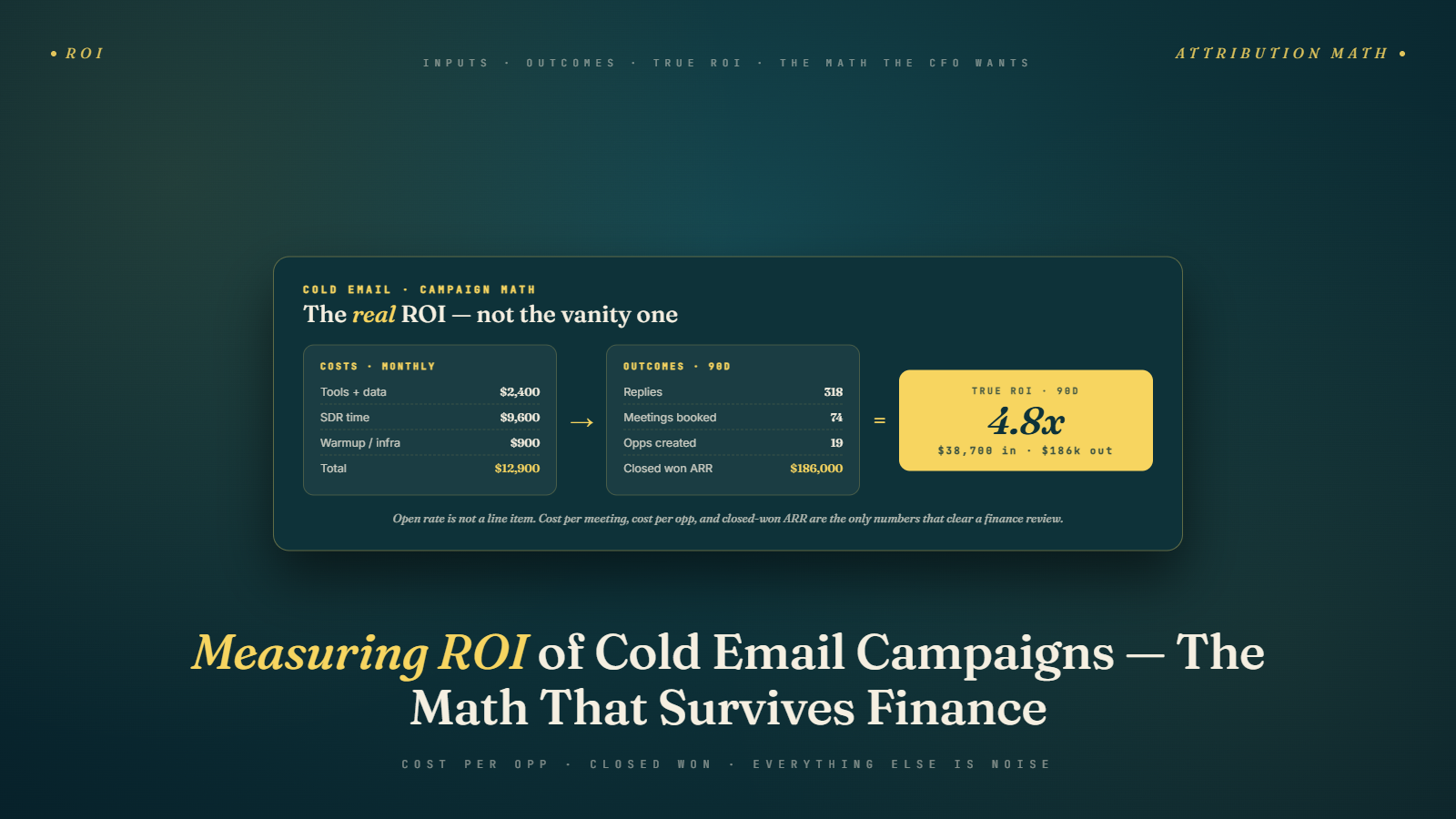
Pipeline ROI: Revenue attributed to cold email divided by total investment in the program (team time, tool costs, infrastructure costs). A cold email program that costs $8,000/month in total loaded costs and generates $50,000/month in pipeline (at your close rate) is clearly worth it. One that costs $8,000/month and generates $12,000/month in pipeline is barely breaking even and needs serious review.
Attribution: The Hard Part
Revenue attribution is the part of cold email measurement that almost everyone handles poorly. The problem is that B2B sales cycles are long, multi-touch, and involve multiple people — and cold email is usually one of several influences on a closed deal, not the sole driver.
A prospect might receive your cold email, not reply, then encounter you at a conference, then find your content through a Google search, then come inbound. Which channel gets credit for the closed deal? Strictly first-touch attribution says cold email. Strictly last-touch says inbound. Neither tells the full story.
The practical approaches:
First-touch attribution: Cold email gets credit if it was the first touchpoint with the prospect. Simple to implement, tends to overvalue top-of-funnel channels, undervalues later nurture touches. Good for understanding which channels are introducing you to new prospects.
Last-touch attribution: Cold email gets credit if it was the most recent touchpoint before conversion. Simple to implement, tends to overvalue bottom-of-funnel activities. Good for understanding which channels are closing deals but misses the channels that opened the door.
Multi-touch attribution: Credit is distributed across all touchpoints in the customer journey. More accurate but significantly more complex to implement — requires tracking every touchpoint, which requires CRM hygiene that many teams don't maintain.
The practical recommendation: Use first-touch attribution as your primary cold email attribution model, with a tracking field in your CRM that captures if cold email was ever in the sequence regardless of what touchpoint converted. This gives you two data points: how often cold email initiates a relationship (first-touch) and how often it's present in a won deal even when it's not the last touch (contribution tracking). Together, these two numbers tell a much more complete story than either alone.
Building the Measurement Dashboard
The metrics above are only useful if they're tracked consistently and reviewed regularly. A measurement dashboard that consolidates the key numbers across the funnel lets you see the program's health at a glance and identify where problems are occurring.
What the dashboard should show:
- Weekly sends and sequence enrollment
- Delivery rate and bounce rate (deliverability health)
- Open rate (week-over-week trend, not absolute)
- Positive reply rate (the key engagement metric)
- Meetings booked (the primary conversion metric)
- Pipeline generated (dollar value, weekly and rolling 90-day)
- Revenue closed (with attribution tag)
- Total program cost (to calculate ROI)
Review cadence:
- Weekly: Delivery, open, reply, and meeting booked metrics. These are operational — they tell you if something is broken and needs immediate attention.
- Monthly: Pipeline generated, meeting-to-opportunity rate, close rate trends. These are strategic — they tell you if the program is generating business value.
- Quarterly: Full program ROI review. Compare revenue attributed to cold email against total program cost. Review ICP targeting effectiveness (are the deals closing?). Assess where the biggest optimization opportunities are in the funnel.
Diagnosing Where the Funnel Is Broken
The funnel metrics above aren't just for reporting — they're for diagnosis. When results are below expectations, the specific position in the funnel where performance drops off tells you exactly where the problem is.
Deliverability problem: Low open rates that can't be explained by subject line testing, rising bounce rates, increasing spam complaint rate. The fix is upstream — domain setup, warm-up, list quality, authentication. Covered in the Phase 4 articles starting with What Is Email Deliverability.
Targeting problem: Open rates are healthy but reply rates are very low. People are opening the email but not responding, which suggests the content isn't resonating — usually because you're reaching the wrong people. Review your ICP definition and list quality.
Copy problem: Reply rates are low despite good delivery and decent open rates. The body copy isn't connecting. Review the value proposition, opening lines, and CTA using the testing methodology from A/B Testing Your Cold Emails.
Reply handling problem: Reply rates look fine, but the conversion from positive reply to meeting booked is low. Responses are slow, the CTA is unclear, the scheduling process has too much friction, or objections aren't being handled effectively. The fix is in how replies are managed — covered in Turning Replies into Conversations and Handling Objections in Cold Email Replies.
Discovery problem: Meetings are being booked but meeting-to-opportunity conversion is low. Either targeting quality is loose (you're booking meetings with non-buyers), the discovery call isn't uncovering real need, or the offer doesn't match what prospects actually want. Review ICP targeting and first-call processes.
Close rate problem: Pipeline is being generated but deals aren't closing at the expected rate. This is usually a sales process or product-market fit issue — not specifically a cold email problem, though cold email targeting quality contributes.
Following the funnel to find the bottleneck is the most efficient way to improve program performance. Optimizing your copy when the real problem is deliverability wastes time. Improving your close rate conversation when the problem is that you're booking meetings with the wrong people wastes time. Find the actual bottleneck first.
Benchmarks: What Good Looks Like
Benchmarks in cold email are tricky because performance varies enormously by industry, ICP, price point, and offer. A 5% reply rate in enterprise SaaS is excellent; a 5% reply rate in low-ticket e-commerce might indicate a problem with targeting precision.
That said, some useful general benchmarks for well-run B2B cold email programs:
| Metric | Below Average | Average | Strong | Excellent |
|---|---|---|---|---|
| Inbox placement rate | under 75% | 75–85% | 85–92% | over 92% |
| Bounce rate | over 5% | 3–5% | 1–3% | under 1% |
| Open rate | under 20% | 20–35% | 35–50% | over 50% |
| Positive reply rate | under 1% | 1–3% | 3–6% | over 6% |
| Meeting booking rate | under 0.5% | 0.5–1.5% | 1.5–3% | over 3% |
| Meeting-to-opportunity rate | under 20% | 20–40% | 40–60% | over 60% |
Use these as rough orientation, not hard targets. Your specific numbers will vary based on your market. More useful than hitting any absolute benchmark is tracking your own program's trends — are each of these metrics improving over time, holding steady, or declining? A program improving across the funnel is healthier than one hitting an arbitrary benchmark while stagnating.
Phase 6 Complete
With this article, you have the complete measurement framework that closes the cold email loop — from infrastructure and targeting all the way through to revenue attribution.
The full series now covers:
- Phase 2: Targeting & List Building — ICP definition, prospect lists, data sources, verification, segmentation
- Phase 3: Writing High-Converting Emails — subject lines, opening lines, value propositions, CTAs, length, personalization
- Phase 4: Deliverability & Infrastructure — domains, warm-up, authentication, spam filters, sending limits, multi-account management
- Phase 5: Automation & Scaling — sequence architecture, follow-ups, AI integration, scaling, testing
- Phase 6: Conversion & Sales — reply handling, objections, meeting booking, discovery calls, ROI measurement
Cold email at its best is a system — each component reinforcing the others. Strong targeting makes copy easier to write. Clean infrastructure ensures copy actually reaches people. Well-structured sequences generate replies. Effective reply handling converts replies into meetings. Good discovery converts meetings into pipeline. And rigorous measurement tells you where to invest your optimization effort next.
The programs that compound are the ones that treat all of these as interconnected, continuously improving, and measurable end-to-end. The ones that stagnate are the ones that fix one piece and assume the job is done.
Common ROI Measurement Mistakes
Mistake 1: Measuring Only Activity Metrics
Open rates and reply rates are useful signals, not outcomes. Build reporting that goes all the way to revenue.
Mistake 2: No CRM Source Attribution
If deals in your CRM don't have a reliable source tag, you can't attribute revenue to cold email. Fix CRM hygiene before you build the ROI model.
Mistake 3: Ignoring the Cost Side of the Equation
Pipeline generated is only half the ROI calculation. Account for all program costs: team time, platform subscriptions, data costs, domain/inbox infrastructure, verification tools. A program generating $100K in pipeline on $5K of investment is very different from one generating $100K on $90K of investment.
Mistake 4: Using Benchmarks From the Wrong Context
A reply rate benchmark from a mass-market SaaS blog doesn't apply to enterprise outreach targeting CFOs at Fortune 500 companies. Calibrate your expectations to your specific market.
Mistake 5: Reviewing Too Infrequently
A quarterly ROI review alone doesn't catch operational problems fast enough. Weekly operational metrics plus monthly strategic reviews plus quarterly ROI reviews gives you the right frequency at each level.