
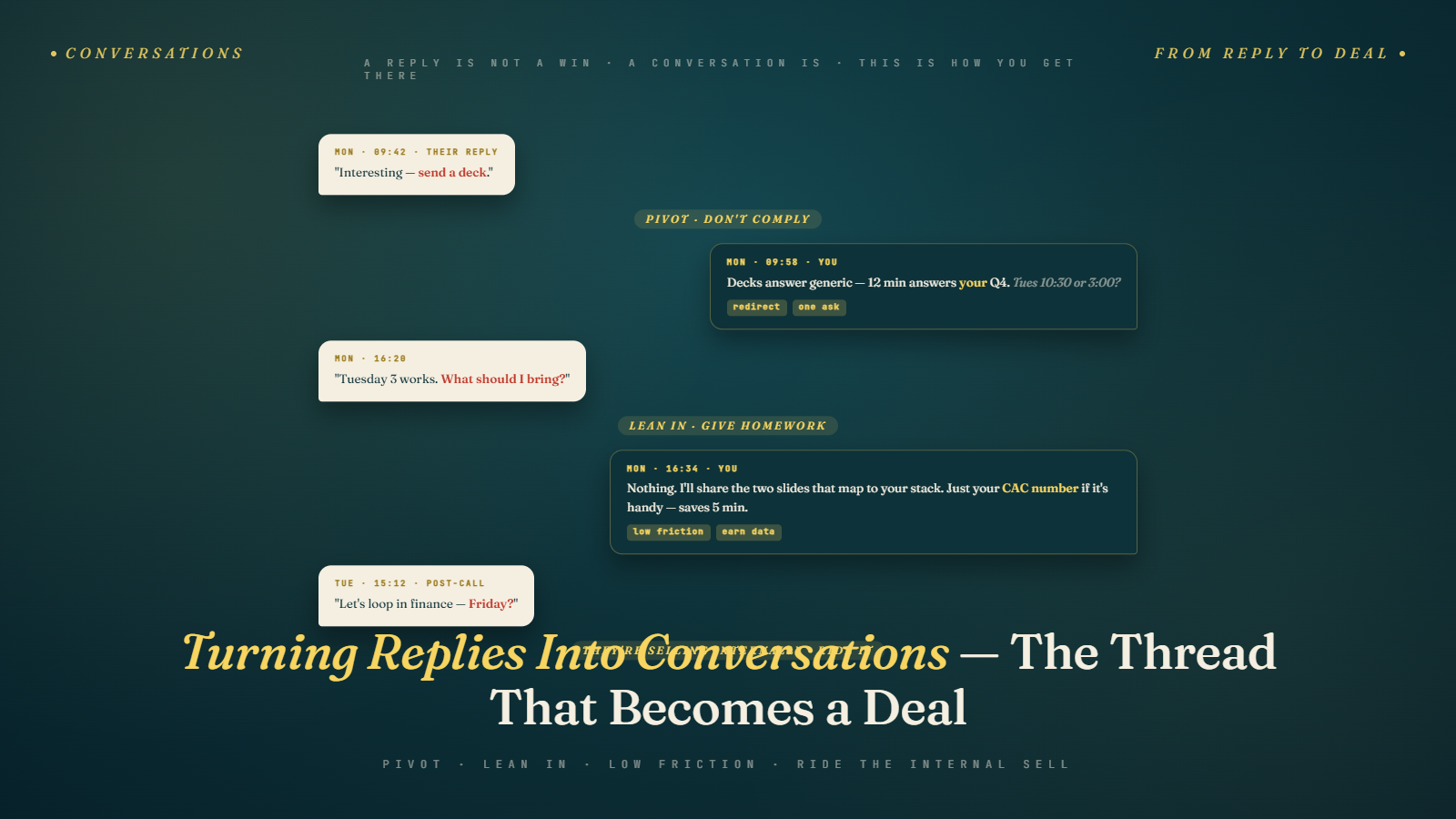
The Reply Is Not the Win
Most cold email guides treat the reply as the finish line. Get a reply, declare victory, move on to the next campaign metric.
That framing is wrong, and it causes real damage to programs that should be converting better than they are.
A reply is not a conversion. It's an opening. The work that produced the reply — the ICP definition, the list quality, the deliverability infrastructure, the copywriting, the sequence architecture — was all designed to create this moment. But what you do with the moment determines whether that upstream investment pays off.
A poorly handled reply turns a warm prospect cold again. A well-handled reply turns a cold stranger into an active sales conversation. The difference is rarely about luck. It's about having a clear framework for how to respond, when to respond, what to say, and how to move the conversation forward.
This is the Phase 6 pillar article. Everything in this phase is about what happens after the reply arrives — the conversion layer that sits between a prospect's first response and a meeting on the calendar.
The Phase 6 articles:
- Handling Objections in Cold Email Replies — what to do when the reply isn't a "yes"
- Booking Meetings from Cold Emails — the specific mechanics of getting to a calendar invite
- Sales Scripts After Cold Email Response — how to handle the first call once you've booked the meeting
- Measuring ROI of Cold Email Campaigns — the metrics that actually tell you if the whole system is working
The foundations this phase builds on: Building Your First Cold Email Sequence covers the sequence architecture that generates the reply. Follow-Up Emails: Timing & Structure covers what each step in the sequence is designed to accomplish. A/B Testing Your Cold Emails covers how to iterate and improve the upstream system.
A Taxonomy of Replies
Not all replies are the same, and treating them the same is one of the most common mistakes in cold email response handling. Before you can respond well, you need to classify accurately.
The Genuine Interest Reply
"This is actually relevant — we've been thinking about this exact problem. When are you free to chat?"
Or a lower-engagement version: "Tell me more."
These replies are warm. The prospect has identified relevance, signaled intent, and is inviting a next step. Your job is simple: respond fast, confirm the interest, and move directly toward a meeting. Don't over-explain. Don't re-pitch. You've already earned the conversation — just get it on the calendar.
The Soft Interest Reply
"Interesting — we're not looking at this right now but keep me posted."
This is more ambiguous. It's not a "yes" and it's not a real "no" — it's a timing issue. The prospect sees relevance but isn't ready to act. Your goal here is to understand the timeline and either set a specific re-engagement date or accept that this is a longer-cycle lead and tag them accordingly.
The wrong response to a soft interest reply: immediately send more information or re-pitch. They don't want more information — they want to not be on a live sequence right now. Respect that, but keep the door open.
The Objection Reply
"We already use a solution for this" or "We don't have budget right now" or "We tried something like this before and it didn't work."
This is not a rejection — it's an objection. There's a critical difference. A rejection means there's no potential here. An objection means there's a barrier that needs to be addressed. Objections are often masking genuine interest. How to respond to the most common cold email objections is covered in detail in Handling Objections in Cold Email Replies.
The Information Request
"Can you send me more details about how this works?"
On the surface this seems positive, but the information request reply is actually a mixed signal. Some prospects genuinely want to evaluate before committing to a conversation. Others are giving you a graceful brush-off that keeps the door open without requiring them to take any action. Your job is to distinguish between the two — and in either case, to not just dump information into an email.
The right response to an information request is to send a tight, focused response that answers the specific question and then redirects toward a conversation: "Happy to walk you through this in more detail — would 15 minutes this week be useful?" Information without a next-step ask often goes into a void.
The Referral Reply
"I'm not the right person for this, but you should talk to [name]."
This is genuinely useful. A referral reply tells you two things: the person you emailed is not your buyer, and there's someone in the organization who is. Respond warmly, thank them for the redirect, ask for an introduction if it's appropriate, and reach out to the referred contact with the original person's name as context.
"[Name] suggested I reach out to you — I'd been in conversation with them about [topic]..." is a warm opening that the referred contact will actually respond to.
The Unsubscribe or "Not Interested"
"Please remove me from your list."
Respect this immediately and permanently. Remove the contact from your sequences, add them to your suppression list, and do not contact them again. This is both a legal obligation in most jurisdictions and a basic respect issue. A follow-up to someone who has explicitly asked to be removed is the fastest way to generate a spam complaint.
The 24-Hour Rule — And Why It Matters More Than You Think
Timing is the underrated variable in reply conversion. The longer you wait to respond to a warm reply, the colder the prospect gets.
The research on response time in sales contexts is consistent and somewhat brutal: responding within an hour dramatically outperforms responding within 24 hours, which dramatically outperforms responding after 24 hours. A prospect who replied to your cold email at 10 AM on Tuesday and hears back from you on Thursday afternoon has had 48+ hours to move on mentally. The relevance that made them reply has faded. Other priorities have reasserted themselves. The reply that felt urgent on Tuesday now feels like a distant email thread.
The 24-hour rule is the minimum standard: any reply that indicates genuine interest should receive a response within 24 hours. The better standard, if your team's capacity allows it, is within 2–4 hours during business hours.
This matters more for cold email than for inbound sales because the prospect was not actively seeking you out. They were in their inbox, something resonated, and they replied in the moment. That moment is perishable. Your response needs to arrive while the relevance is still fresh.
Practically, this means someone needs to be responsible for monitoring and triaging cold email replies — not leaving them to be caught whenever a team member happens to check their shared inbox. For teams running significant volume, a dedicated reply-handling workflow (or at minimum a designated person responsible for same-day response) is worth the operational overhead.
The First Response Framework
When a warm or soft-interest reply comes in, your response has four jobs:
1. Acknowledge their reply warmly but without being effusive. "Thanks for responding" and "Great to hear from you!" are both slightly off. The former is baseline courtesy; the latter oversells the reply as extraordinary. A simple "Glad this resonated" or diving straight into substance is usually better.
2. Confirm or clarify the specific relevance. You want to know: what specifically made them reply? This isn't always obvious from the reply itself. A brief, direct question ("Was it the [specific problem] angle that caught your attention, or something else?") surfaces useful context and signals that you're listening, not just running a script.
3. Propose a clear next step. Don't ask an open-ended "What would you like to do?" — suggest the next step directly: "Worth a 15-minute call this week to compare notes? I'm free Tuesday at 2 PM or Thursday morning." Specificity here is useful. A concrete time invitation is easier to say yes to than an abstract "let's talk."
4. Keep it short. Your first response to a warm reply should be shorter than the cold email that generated it. The prospect already knows what you do and has signaled interest. You don't need to re-pitch. Three to five sentences that acknowledge, confirm, and propose is sufficient.
Calibrating Tone: The Cold-to-Warm Transition
One of the subtler skills in handling cold email replies is calibrating the tone shift correctly. Your cold emails are, by necessity, somewhat formal and structured — you're a stranger making a case for relevance. Once someone replies, the relationship has changed. They're no longer a prospect you're trying to engage; they're a person you're in conversation with.
The mistake most teams make is treating the reply thread like an extension of the cold email sequence — maintaining the same structured, slightly formal tone. This feels mechanical. The person on the other end notices, even if they can't articulate why.
The right move: let the tone relax naturally. Use their name. Reference something specific they said. Write the way you'd write to a warm contact, not the way you write cold prospecting copy. The formal professionalism of the cold email was a means to an end — getting the reply. Now that you have it, the goal is rapport.
This doesn't mean becoming casual to the point of unprofessionalism. It means sounding like a real person who is genuinely interested in what this specific prospect has to say — because you should be.
Managing Multi-Thread Replies
As cold email volume grows, replies come in across multiple email accounts, sequences, and platforms. Without a deliberate system for managing this, warm replies get missed, response times slip, and meetings don't get booked.
The common failure mode: a warm reply sits in an inbox that someone checks twice a week, and by the time it gets a response, the prospect has moved on. The reply generated by all that upstream effort just... disappeared into an unmanned inbox.
A few infrastructure approaches that prevent this:
Unified reply inbox: Tools like Instantly, Smartlead, and Reply.io offer consolidated reply views across all inboxes in your system. All replies, regardless of which sending account they came from, surface in one place. This is the minimum viable setup for teams running multi-account operations.
CRM integration with reply alerts: When a prospect replies to a cold email sequence, that event should auto-populate in your CRM and trigger a notification to the responsible SDR or AE. A Slack notification or email alert that fires the moment a reply comes in keeps response times fast without requiring someone to manually monitor every inbox.
Reply triage ownership: Someone specific needs to own reply triage at any given moment. Whether that's an SDR, an AE, or the founder depends on your team structure — but "everyone is responsible" effectively means no one is responsible. Assign it.
The Longer-Arc Play: Replies That Aren't Ready Now
Not every reply converts to a meeting immediately. Some replies come from genuinely interested prospects who have real timing constraints — a budget cycle that opens in Q3, a platform migration that needs to complete first, a hiring freeze that's blocking new vendor evaluation.
These are not failures. They're future pipeline — but only if you manage them deliberately rather than letting them fall through the cracks.
The right response to a timing-constrained reply:
- Acknowledge the constraint genuinely (don't minimize it or immediately try to push through it)
- Ask for a specific re-engagement date: "Would it make sense to reconnect in Q3 when the budget cycle opens? I can put something on the calendar now so we don't lose the thread."
- If they agree to a date, actually put it on your calendar as a task and a calendar invite. Don't rely on memory or a CRM note that no one reviews.
- Send a brief check-in or useful piece of content 2–3 weeks before the re-engagement date to warm up the conversation again
Prospects who gave you a clear "not now but later" are some of your highest-value leads — they've self-identified as interested and given you a timeline. The only way to lose them is to not follow through.
When to Let a Conversation Go
Not every replied thread needs to be pursued indefinitely. Some conversations stall not because of timing but because the fit genuinely isn't there — the use case doesn't match, the budget is structurally too small, the decision-making process is too complicated to navigate without an internal champion.
Recognizing when to gracefully exit a conversation is a skill. The signals: multiple replies with no movement toward a meeting, increasing vagueness about next steps, the prospect consistently deflecting the calendar ask without giving a reason.
The clean exit: "I don't want to keep taking up your time if the timing genuinely isn't there. Happy to reconnect whenever the situation changes — I'll leave it with you." This is honest, non-pushy, and leaves the door open. Sometimes it generates a "wait, actually let's talk" response. More often, it closes the thread cleanly and lets you redirect effort toward more productive leads.
Common Mistakes in Reply Handling
Mistake 1: Re-Pitching Someone Who Already Replied
When someone responds positively, sending them more pitch content is a mistake. They've already signaled interest — they don't need to be convinced again. Move toward the meeting, not toward more selling.
Mistake 2: Waiting More Than 24 Hours
Covered above, but worth repeating: warm replies are perishable. A response that arrives two days later is dramatically less likely to convert than one that arrives within a few hours.
Mistake 3: Sending Generic Information Dumps
When someone asks for more information, sending a PDF attachment, a 500-word email breakdown, and a product brochure is not "giving them what they asked for" — it's giving them a reason to feel overwhelmed and disengage. Give the essential context and move toward a conversation.
Mistake 4: Treating All Replies the Same
A "tell me more" reply and a "we already have a vendor" reply require completely different responses. Classify before you respond.
Mistake 5: No System for Managing Replies at Scale
As volume grows, ad-hoc reply management breaks down. Build the infrastructure — unified inboxes, CRM alerts, designated ownership — before the volume makes the problem visible.
Continue to Handling Objections in Cold Email Replies — the specific frameworks for responding when the reply isn't a straightforward yes.