
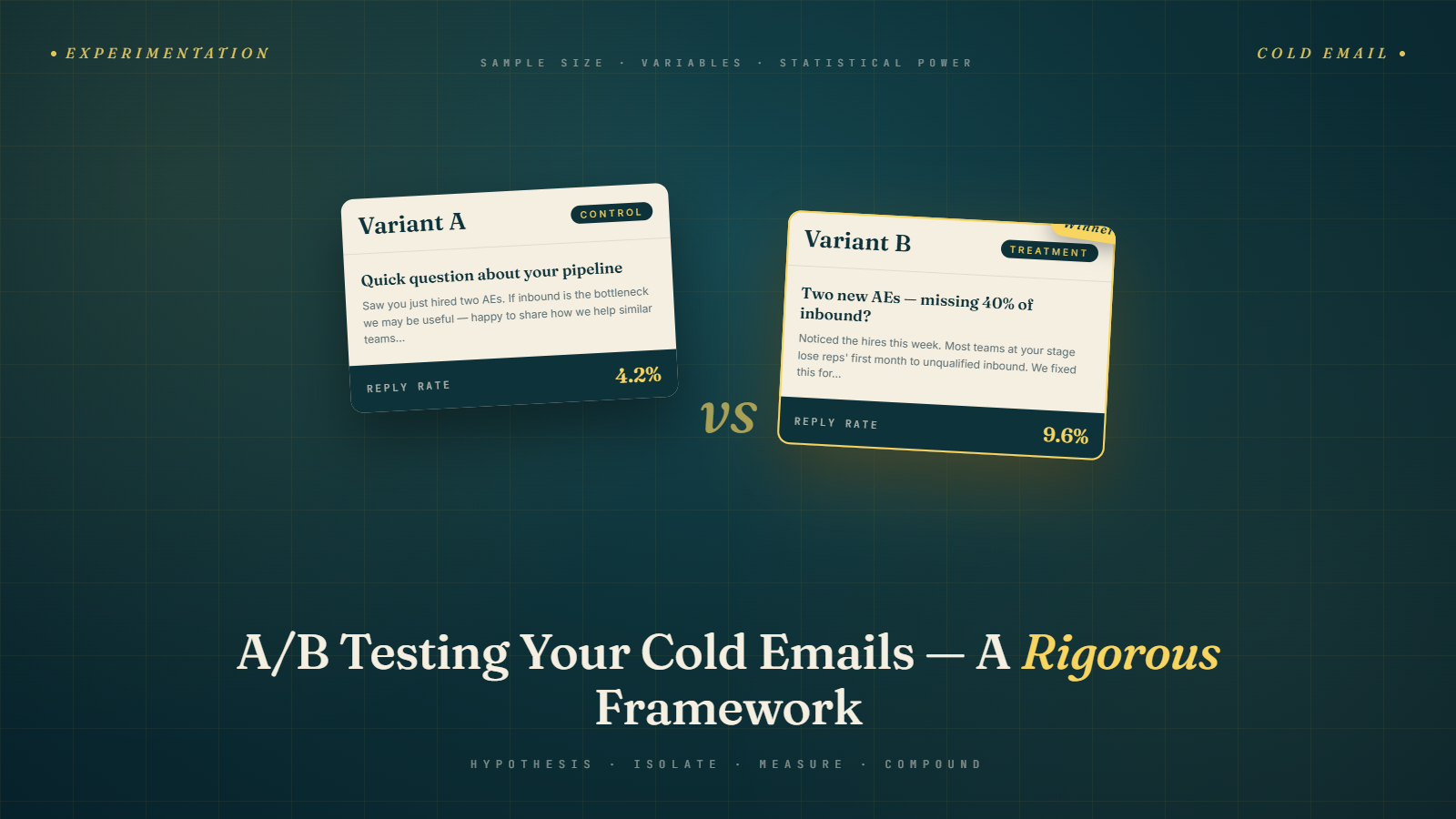
Most A/B Tests Are Invalid Before They Start
Cold email practitioners test constantly — but most of what passes for "A/B testing" in cold email wouldn't hold up to any meaningful scrutiny.
Here's a typical scenario: a team writes two subject lines, splits their 40-person list 50/50, waits 24 hours, sees that variant B got 3 more opens, and concludes "variant B wins." They roll it out as the new standard.
What actually happened: they got a statistically meaningless result from a tiny sample and made an infrastructure decision based on it. Variant B might have "won" entirely due to randomness in which 20 people happened to be more likely to open email that particular day.
This is everywhere in cold email. It's one of the reasons teams iterate constantly without learning much — their tests are structured in ways that produce noise rather than signal.
Good A/B testing in cold email is rare precisely because it's less intuitive than it seems. You need a meaningful sample size. You need to test one variable at a time. You need to measure the right metric for the right test. You need to run the test to completion before calling a winner. And you need to build institutional memory from what you learn, not just apply the winner and forget the test.
This article gives you the framework to do all of that correctly.
The Foundational Rules
Rule 1: One Variable Per Test
The most important rule, and the most commonly violated. If you change your subject line and your opening line at the same time, and one variant outperforms the other, you don't know which change drove the difference. That information is worthless for learning.
Every A/B test should isolate exactly one variable: the subject line, the opening line, the value proposition frame, the CTA phrasing, the email length, the proof point used. Everything else stays identical.
This feels slow when you have many things you want to improve. It's not. One well-designed test that produces a clear, valid result teaches you something you can apply to every future campaign. Ten poorly designed simultaneous tests teach you nothing reliable.
Rule 2: Sample Size Before You Start
You need to define your minimum sample size before the test begins — not after you see the results.
The required sample size depends on:
- Your expected baseline metric (say, 25% open rate)
- The minimum lift you want to be able to detect reliably (say, 5 percentage points)
- Your desired statistical confidence level (80% is usually sufficient for cold email; 95% for high-stakes decisions)
The practical rough guide for cold email testing:
- For open rate tests (subject lines): minimum 200 recipients per variant. Preferably 400+.
- For reply rate tests (email body, CTA, opening line): minimum 300 recipients per variant. Reply rates are lower, requiring larger samples to detect meaningful differences reliably.
- For click rate tests (link tests): minimum 400+ per variant, as click rates are typically even lower than reply rates.
If your list is 50 people per campaign, you can't run a proper A/B test on that campaign. Pool several campaigns before running the test, or accept that results will be directional rather than conclusive.
Rule 3: Run the Test to Completion
Checking results after 48 hours and declaring a winner is called "peeking" — and it inflates the false positive rate significantly. When you repeatedly check a running test and stop it when it looks like one variant is winning, you're not testing — you're finding random variation and calling it signal.
Let sequences run to completion before comparing variants. For cold email, "completion" typically means the full sequence has run for both variants — all 5–6 emails, all send dates, the full duration.
Rule 4: Test the Right Metric for the Variable
Different email components affect different metrics:
- Subject lines affect open rate
- Opening lines affect reply rate (and sometimes open-to-reply conversion)
- Value propositions / body copy affect reply rate
- CTAs affect reply rate and meeting booked rate
- Email length affects reply rate
- Sending time / day of week affects open rate
Testing a subject line against reply rate doesn't give you useful signal about the subject line specifically — too many other variables affect reply rate between subject line and reply. Match your test variable to the metric it most directly affects.
What to Test: The Priority Stack
Not all variables are equal. Some have a far higher potential impact on results than others. Here's a priority order for cold email testing:
Priority 1: Subject Line (Highest Impact)
Subject lines directly control whether emails get opened. The range between a weak and a strong subject line for the same campaign to the same list can easily be 15–25 percentage points in open rate. This is the highest-leverage variable in the entire email.
What to test:
- Framework type: Personalized reference vs. direct question vs. outcome-based vs. curiosity-gap
- Length: Short (3–5 words) vs. medium (6–8 words)
- Presence/absence of the prospect's company name or role
- Question vs. statement format
Run subject line tests early and often. They're relatively fast to write and produce clean, interpretable data.
Priority 2: Opening Line (High Impact on Reply Rate)
The opening line determines whether someone who opened the email reads past the first sentence. It's the primary driver of the "open-to-reply conversion" rate — the percentage of people who opened the email and then replied.
What to test:
- Personalized individual hook vs. segment-level insight opener
- Trigger-based opener vs. problem-assumption opener
- Question format vs. statement format
- Compliment-based vs. observation-based
Priority 3: CTA (High Impact on Reply Rate)
The CTA is the moment of conversion — or not. Small differences in how the ask is framed can dramatically change the response rate.
What to test:
- Low-friction yes/no question vs. explicit meeting request
- "15-minute call" vs. "quick conversation"
- Calendly link (high friction, direct conversion) vs. soft question (low friction, requires additional step)
- CTA at end of first paragraph vs. CTA as its own closing paragraph
Priority 4: Value Proposition Frame (Medium-High Impact)
Different frames for the same underlying value can resonate very differently with the same audience.
What to test:
- Problem-led vs. outcome-led framing
- Pain avoided vs. gain achieved framing
- Company-level ROI vs. individual-level impact
- Different proof points (different client reference, different metric)
Priority 5: Email Length (Medium Impact)
Worth testing, but the effect size is usually smaller than the above variables, and the results are often segment-specific. Short works better in some markets; slightly longer works better in others.
What to test:
- Sub-100 words vs. 125–175 words
- With vs. without the value-add proof paragraph
- Single case study reference vs. aggregate claim
Priority 6: Sending Time and Day (Low-Medium Impact)
Timing tests are useful for optimization after you've maximized higher-leverage variables. They rarely produce dramatic differences but can produce meaningful incremental improvements.
What to test:
- Day of week: Tuesday vs. Wednesday vs. Thursday
- Time of day: Early morning (7–9 AM) vs. midday vs. early afternoon
- Week of month: Early month vs. mid-month
Designing a Test: Step by Step
Step 1: Define what you're testing. "We want to test whether a trigger-based subject line outperforms our current insight-based subject line for our SaaS VP of Sales segment."
Step 2: Define the metric. Subject line test → open rate.
Step 3: Define minimum sample size. Current open rate is ~28%. We want to detect a 6 percentage point difference. Minimum 250 recipients per variant (use a sample size calculator for precision).
Step 4: Create variants. Control: "Your SDR ramp time" (current) Variant B: "Saw you're hiring 5 AEs"
Everything else in the email is identical.
Step 5: Randomly assign prospects. Most sending platforms have built-in A/B test features that handle random assignment automatically. If yours doesn't, use a spreadsheet to randomly assign contacts before uploading.
Step 6: Run the test. Both variants run simultaneously — same time window, same sending infrastructure, same sequence structure. Let the full sequence complete before evaluating.
Step 7: Evaluate and record. Compare open rates between variants. Calculate statistical significance if using a calculator (there are free online tools). Record the result — both the winner and the context (which segment, which period, what the hypothesis was).
Step 8: Apply the winner and plan the next test. Roll out the winning variant as your new control. Immediately define the next test — don't let the testing cadence lapse.
Building an Institutional Testing Culture
The highest-performing cold email programs aren't the ones with the best initial creative instincts. They're the ones that have been testing and iterating longest — because testing compounds.
A team that runs one solid A/B test per month for a year has 12 validated learnings about what works for their specific ICP in their specific market. A team that trusts gut instinct for a year has zero.
Practical habits that build a testing culture:
- Always have an active test. At any given time, at least one variable should be in an active A/B test. When a test concludes, the next one begins.
- Maintain a test log. A shared document that records every test — what was tested, what the hypothesis was, what the result was, what was decided. This document becomes your institutional knowledge base.
- Share results with the team. When a test produces a clear result — especially a counterintuitive one — share it in a team meeting or Slack channel. Test results that are understood by everyone on the team are more useful than results that live only in one person's head.
- Test across different segments. A subject line framework that works for VP of Sales at SaaS companies may not work for Head of Marketing at e-commerce brands. Test your controls across different segments, not just within one.
When Testing Doesn't Produce Clear Results
Not every test produces a meaningful difference between variants. Sometimes both variants perform nearly identically. This is useful information too — it means that particular variable doesn't materially affect performance for this audience, and you can stop spending mental energy on it.
The lesson from an inconclusive test: this variable doesn't matter much — move on to testing something else.
The mistake from an inconclusive test: assuming the test was too small, running it again with the same variants hoping for a different result. If the test was properly sized and run to completion, accept the result and move on.
Common Testing Mistakes
Mistake 1: Testing Too Many Variables Simultaneously
Some teams run what they call "multivariate tests" — testing multiple variables at once — without the statistical expertise to interpret multivariate results correctly. For most cold email teams, stick to single-variable A/B tests. The data is interpretable and the lessons are clear.
Mistake 2: Using Different List Segments as Variants
If Variant A goes to your e-commerce contacts and Variant B goes to your SaaS contacts, you're not running an A/B test — you're sending different emails to different audiences. Any difference in results reflects the audience difference, not the copy difference.
Mistake 3: Calling Winners Too Early
Open your sending platform after 2 days, see that Variant B has a higher open rate, and declare it the winner. Three days later, Variant A would have caught up. Patience is a feature of good testing, not just discipline — results in the first 48 hours of a multi-week sequence are not representative.
Mistake 4: Not Learning From Losses
When a variant loses, that's information. "The direct outcome subject line underperformed the trigger-based subject line for VP Sales" is a data point that should update how you think about subject lines for this persona. Losers teach as much as winners — but only if you're paying attention to them.
Mistake 5: Stopping Testing After Good Performance
A sequence generating 10% reply rates feels like it's working — and it is. But is there a version that generates 15%? Without testing, you'll never know, and the gap compounds over time.
The strongest programs treat "working well" as a reason to keep testing, not as a reason to stop.
How to Use Your Test Results Across Campaigns
A single A/B test produces a result about one variable, for one audience, in one time period. That's a narrow finding on its own — but with the right documentation and application discipline, it compounds into a real institutional advantage.
The key is distinguishing between findings that are narrow (specific to one campaign or segment) and findings that are generalizable (applicable across your broader program).
Narrow findings: "Trigger-based subject lines outperformed insight-based subject lines for VP Sales at Series B SaaS companies in Q1 2026." This is interesting, but it doesn't automatically mean trigger-based subject lines win everywhere. Apply the finding to its specific context first, then test it in adjacent segments to see if it holds.
Generalizable findings: After running the same test across three different segments and seeing consistent results, the finding upgrades to a working principle: "For senior B2B buyers at growth-stage companies, trigger-based subject lines tend to outperform insight-based subject lines." This gets written into your copy guidelines as a standing recommendation — not a rule, but a useful prior for future work.
The documentation system that enables this: a shared test log with columns for what was tested, the segment, the hypothesis, the result, the sample size, and the generalizability assessment. Over time, this log becomes a searchable knowledge base of what has been validated to work for your specific market.
Practically, this means that when a new SDR writes their first set of subject line variants, they have access to 12 months of validated findings about what has worked before. They're not starting from zero. The institutional knowledge is explicit and accessible, not locked in the head of the most experienced person on the team.
This is what separates programs that test and compound from programs that test and forget.
Knowing When to Pivot vs. When to Keep Testing
Not every problem is a testing problem. There's a specific failure mode where teams respond to poor campaign performance by running more A/B tests — when the actual issue is something testing can't fix.
Testing is the right tool when: you have a working campaign and want to improve a specific metric, you have a reasonable hypothesis about which direction a change would move results, and you have sufficient volume to detect meaningful differences.
Testing is the wrong tool when: your fundamental ICP is wrong (no amount of subject line testing will generate good reply rates if you're reaching the wrong people), your offer isn't compelling in your market (messaging optimization can't create value that isn't there), or you have a severe deliverability problem (email that's landing in spam won't benefit from better copy).
Before launching a new test, run through this quick diagnostic:
- Is the underlying issue a quality problem with a specific email component? → Test it.
- Is the issue that reply rates have always been low from the start? → Check ICP and offer first.
- Is the issue a sudden drop from a previously strong baseline? → Check deliverability before copy.
- Is the issue that the business outcome (meetings, pipeline) isn't converting even when reply rates look okay? → Look at targeting quality and ICP fit, not copy.
Testing is a precision tool. Use it on the components it can actually improve, and address structural problems through different means.
Phase 5 Complete
A/B testing closes the Phase 5 loop. You now have:
- Automation tools and strategies — the platform layer
- Sequence architecture — the structural framework for multi-touch outreach
- Follow-up craft — writing each step with purpose
- AI integration — using AI where it helps, not where it hurts
- Scaling systems — maintaining quality as volume grows
- Testing methodology — a compounding improvement system
Combined with the targeting foundations from Phase 2, the copywriting craft from Phase 3, and the infrastructure discipline from Phase 4, you now have a complete, end-to-end cold email system built on principles that actually hold up at scale.
Phase 5 complete. The series continues with Phase 6: Responses, Objections & Conversations — how to handle replies, overcome objections, and turn cold conversations into warm pipeline.