
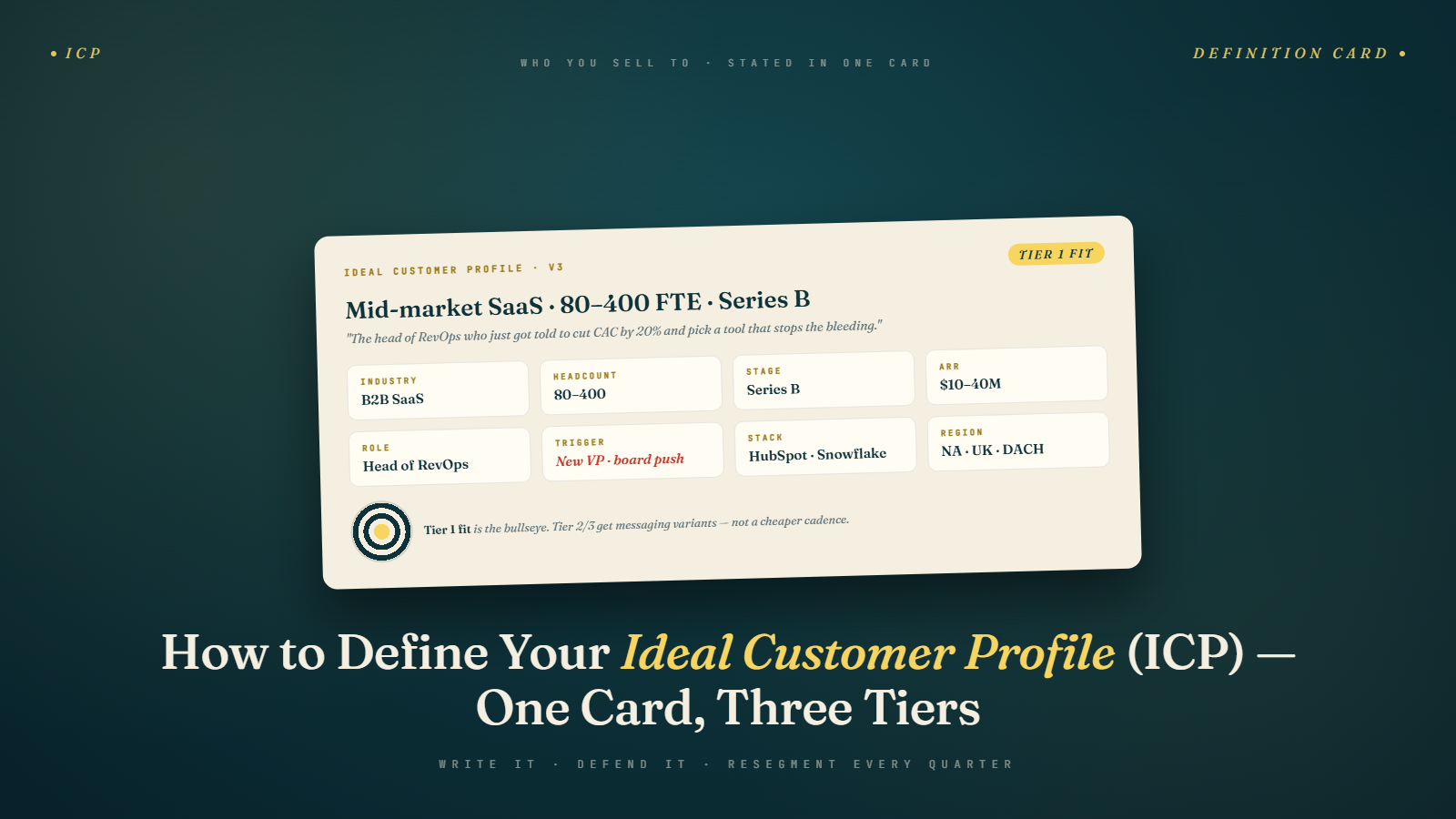
Why Most Cold Email Campaigns Fail Before They Even Start
Picture this: you've written a sharp, personalized cold email. The subject line is solid. The copy flows well. You've got a clear call to action. You hit send on 500 prospects and wait.
Crickets.
A reply here, a bounce there, and a handful of unsubscribes. You tweak the subject line, try a different CTA, maybe adjust the tone — but the results don't really move. Sound familiar?
Here's the uncomfortable truth most people don't want to hear: the problem isn't the email. It's who you're sending it to.
If you haven't nailed your Ideal Customer Profile (ICP) before building your outreach list, everything downstream is flawed. Your personalization is off because you're personalizing for the wrong person. Your value proposition doesn't land because it wasn't written for a specific type of buyer. Your open rates, reply rates, meeting booked rates — all of it suffers.
This is the first and most foundational step of the entire cold email process. In this blog, we're going to break down what an ICP actually is, how to build one that's grounded in reality rather than assumptions, and how to use it as the filter for every prospect list you ever build.
The rest of this Phase 2 series — covering list building, data sources, LinkedIn prospecting, and email verification — all starts here. Get this wrong and the whole machine breaks down.
What Is an Ideal Customer Profile (ICP)?
An Ideal Customer Profile is a description of the type of company (in B2B) or person (in B2C) that gets the most value from your product or service and, in return, provides the most value to your business.
Notice two things about that definition:
- It's about mutual value — not just who you can sell to, but who you can genuinely help and who will generate strong revenue, retention, and referrals for you.
- It's specific — it's not "any company that could use email marketing." It's "Series A–C SaaS companies with 20–200 employees who are scaling their outbound sales team."
The ICP exists at the company or account level (in B2B). It answers the question: What kind of organization is the best fit for what we offer?
ICP vs. Buyer Persona — What's the Difference?
People mix these up constantly. Here's the distinction:
ICP = the company (What type of organization should we target?) Buyer Persona = the individual (Who within that organization do we reach out to?)
You define the ICP first. Then, within that ICP, you identify the specific roles and titles you'll contact — those are your buyer personas or target personas.
Example: Your ICP might be "e-commerce companies with $1M–$20M in annual revenue using Shopify." Your buyer persona within that ICP might be "the Head of Marketing or CMO who owns their email channel and is frustrated with deliverability issues."
If you're doing cold email, you need both. But you can't get to the persona until you've got the ICP locked in.
The Four Dimensions of a Strong ICP
When I help founders or sales teams define their ICP, I always push them to think across four dimensions. Surface-level answers don't work. You need to go deep.
1. Firmographics
These are the hard, descriptive attributes of the company:
- Industry / vertical — Are you targeting SaaS, fintech, healthcare, e-commerce, logistics? The more specific, the better.
- Company size — Headcount and revenue are both useful. A 50-person company and a 5,000-person company have entirely different buying processes, budgets, and pain points.
- Geography — Are you targeting US only? EMEA? APAC? Language and timezone matter more than people realize.
- Stage — Are they bootstrapped, Series A, enterprise? Growth stage signals budget availability and urgency.
- Business model — B2B vs. B2C, SaaS vs. services, transactional vs. subscription. This affects their problems and the language they use.
2. Technographics
This is the technology stack the company uses. It's underrated as an ICP signal.
If you sell a sales tool that integrates with HubSpot, targeting companies that already use HubSpot is a far better starting point than targeting everyone. If you sell email deliverability consulting, targeting companies running on Mailchimp or Klaviyo already signals they're doing email at scale.
Tools like BuiltWith, Clearbit, and Apollo give you technographic data. We'll cover those in detail in the best data sources guide.
3. Behavioral and Situational Signals
This is where a lot of ICP definitions fall flat — they describe what a company looks like but not when they're most likely to buy.
Think about triggers:
- They just raised a funding round (budget available, scaling mode)
- They just hired a new VP of Sales (wants to make an impact, reviewing tools)
- They're actively hiring SDRs (building an outbound motion)
- They recently posted about a pain point on LinkedIn
- Their competitor just launched a new feature
These signals tell you the timing is right. A company that matches your ICP firmographics but has no trigger may not be ready. The same company experiencing a relevant trigger is a hot prospect.
4. Psychographics and Values
This one's harder to quantify but matters for how you craft your messaging. What does this type of company care about? What do they value?
Are they metrics-obsessed? Do they care about brand? Are they process-driven or move-fast-break-things? Are they risk-averse or willing to try new approaches?
This dimension shapes the tone of your outreach more than any other. A scrappy startup founder responds to very different language than a Risk & Compliance officer at a Fortune 500.
How to Actually Build Your ICP (Not Just Guess at It)
Here's where most companies go wrong: they define their ICP based on who they think is a good fit rather than who has actually been a good fit. The result is an ICP that sounds reasonable but doesn't hold up in practice.
Here's the process I recommend:
Step 1: Look at Your Best Existing Customers
Start with your top 10–20 customers. "Best" here means:
- High lifetime value (LTV)
- Low churn risk
- Short sales cycle (they converted quickly)
- High engagement (they actually use the product)
- Good relationship (they refer others, give testimonials, respond to feedback requests)
List them out. Now look for patterns. What industries are they in? What size are they? What tools do they use? What was the trigger that made them buy? What outcome are they getting?
If you don't have customers yet, look at your best prospects — the ones who engaged most, asked the right questions, or were closest to converting.
Step 2: Interview Your Best Customers
Surveys are okay, but direct conversations are far better. Get on a 20-minute call with 5–10 of your best customers and ask:
- What was happening in your business that made you start looking for a solution like ours?
- What did you try before us?
- What specifically made you choose us over alternatives?
- What would you say to someone who's on the fence about working with us?
- What would make you leave us? (This one reveals the fragile points)
You'll start hearing the same language, the same frustrations, the same triggers over and over. That's your ICP talking to you directly.
Step 3: Analyze Your Lost Deals
Go back through your CRM. Look at deals you lost — not the ones where price was the only issue, but the ones that seemed promising and then went cold or went to a competitor.
Ask: what did those companies have in common? Were they too early-stage? Wrong vertical? Different decision-making process? Did they churn quickly when you did close them?
Your ICP isn't just about who's a good fit — it's also about understanding who's not a good fit, so you stop wasting time on them.
Step 4: Validate with Outreach Data
Once you have a hypothesis for your ICP, test it. Build two lists — one that tightly fits your ICP definition and one that's looser. Run a small outreach experiment. Which list responds better? Which books more meetings? Which closes faster?
Your ICP should always be refined by actual outbound data. It's never fully finished.
Building Your ICP Document
Your ICP isn't just a mental model — it needs to be documented and shared with everyone involved in prospecting, copywriting, and sales. Here's a simple template:
ICP Name: (Give it a nickname — "Mid-Market SaaS" or "Growth-Stage E-com" — to make it easy to reference)
Company Attributes:
- Industry:
- Revenue range:
- Headcount:
- Geography:
- Business model:
- Growth stage:
Tech Stack Signals:
- Must use: [tools that indicate fit]
- Red flags: [tools that indicate poor fit]
Situational Triggers:
- Hiring signals:
- Funding signals:
- Behavioral signals:
Why They're a Good Fit:
- The problem we solve best for them:
- The outcome they get:
- The ROI they typically see:
Why They Buy (in their words):
- [Quotes or paraphrases from customer interviews]
Disqualifiers:
- Signs this company is not a good fit (even if they look good on paper):
If you can fill this out based on real data rather than assumptions, you have a working ICP.
Common Mistakes When Defining Your ICP
Mistake 1: Making It Too Broad
"Any company with a sales team" is not an ICP. The broader your definition, the less targeted your outreach will be, and the more generic your messaging will sound. Specificity is not limiting — it's what makes your emails actually relevant.
Mistake 2: Defining It Once and Forgetting It
Your ICP should evolve as your product evolves and as you learn more about what works. If you defined it 18 months ago and haven't revisited it, there's a good chance it's out of date.
Mistake 3: Confusing ICP with TAM
Total Addressable Market (TAM) is every company that could buy from you. Your ICP is the subset that should buy from you right now — based on fit, readiness, and mutual value. These are not the same thing. Building your prospect list from your TAM instead of your ICP is one of the fastest ways to destroy your deliverability.
Mistake 4: Ignoring the Negative ICP
Just as important as knowing who you're targeting is knowing who you're not targeting. Document your disqualifiers clearly. It'll save your SDRs hours every week.
Mistake 5: Never Testing It
An ICP hypothesis that's never tested is just a guess. The whole point of outbound is that you can run experiments quickly. Build a list that tightly matches your ICP, send some emails, see what happens. If it's not working, revisit your assumptions.
Your ICP When You Have Multiple Segments
One thing worth addressing: what if your product genuinely serves multiple distinct types of customers? This is common for horizontal tools — a project management platform, for example, might work well for agencies, software teams, and marketing departments.
The answer isn't to pick one and ignore the rest. It's to build multiple ICPs — one for each segment — and treat them as separate outreach motions.
Each ICP needs its own:
- Prospect list built with its own specific filters
- Messaging tailored to that segment's specific pain points and language
- Success metrics tracked separately so you know which segment is responding
What you want to avoid is blending these segments together in the hope that one message covers everyone. It won't. The agency owner cares about client management and billing. The software team lead cares about sprint planning and engineering velocity. The marketing VP cares about campaign coordination and asset management. These are different people with different problems — they need different emails.
Start with your single best ICP. Get that one working. Then expand to the second, and the third. Trying to run multiple ICP-based campaigns simultaneously before you've validated even one is a recipe for spreading yourself too thin.
ICP and Timing: The Dimension Everyone Forgets
Most ICP frameworks focus on static company attributes — size, industry, stage, tech stack. But there's a dynamic dimension that's just as important: timing.
A company that perfectly matches your firmographic ICP might be completely wrong to contact right now if:
- They just went through a major leadership change and everything is on hold
- They're in the middle of a platform migration and can't take on new tools
- They just signed a 2-year contract with a direct competitor
Conversely, a company that's slightly outside your typical ICP might be a high-priority prospect right now if:
- They just raised a round and are actively buying
- Their team lead just left and the new person is re-evaluating everything
- They just hit a specific growth milestone that creates the pain point you solve
This is why trigger signals — funding rounds, hiring patterns, leadership changes, product launches — are so important to layer into your ICP definition and your prospecting process. Timing doesn't replace fit, but fit without timing is just potential. Fit plus timing is a real opportunity.
What a Good ICP Does for Your Cold Email Campaign
Once you have a real ICP, everything else in your cold email process gets sharper:
Your list is smaller but better. You're not chasing 10,000 marginal prospects — you're building a precise list of 500 companies that genuinely need what you offer. We'll walk through exactly how to do that in the next article on building a high-quality prospect list.
Your copy resonates. When you know exactly who you're talking to, you can reference specific pain points, use industry-specific language, and make your email feel like it was written for them specifically — not a generic template. That's what we cover later in the series when we get into personalization data.
Your outreach scales intelligently. With a defined ICP, you can build repeatable processes for finding prospects, enriching data, and running campaigns. Without it, every campaign is a one-off scramble.
Your close rate improves. Prospects who match your ICP don't just reply more — they convert better, churn less, and become your best case studies.
The Bottom Line
You can have the most beautifully written cold email in the world, but if it's going to the wrong person at the wrong company, it doesn't matter. Defining your ICP isn't glamorous work — there's no shortcut, no template you can fill out in 10 minutes. It requires real customer data, honest introspection about who you can genuinely help, and a willingness to say "no" to a lot of people who seem like they could be customers.
But when you get it right? Everything else in your cold email operation gets easier. Your list is better. Your copy is sharper. Your results are more predictable.
Start here. Get this right. The rest of Phase 2 builds directly on top of it.
Next up: How to Build a High-Quality Prospect List — once you know who your ICP is, this is how you actually find them at scale.