
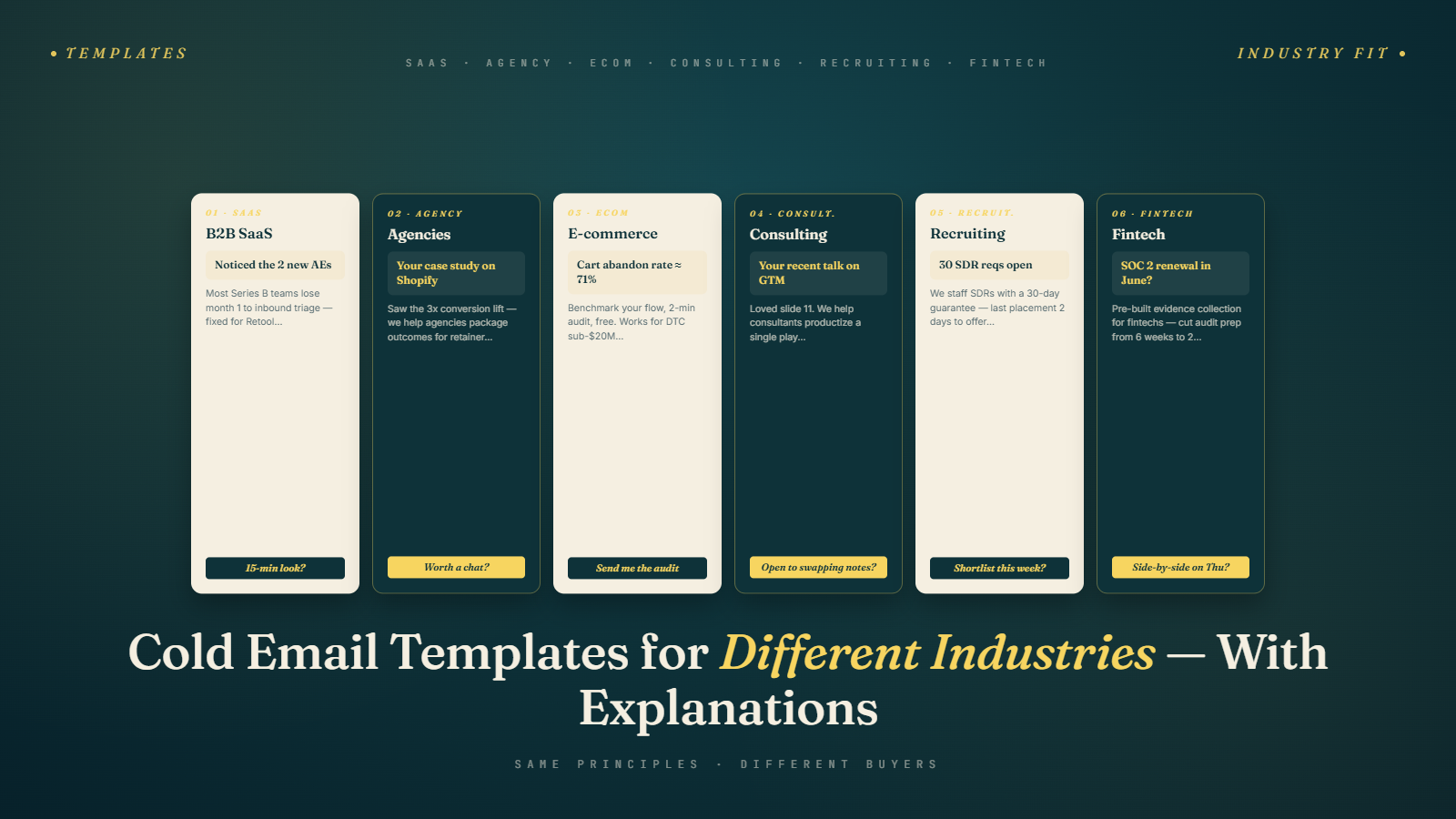
Templates Are Starting Points, Not Finished Products
Before we get into the templates, a necessary caveat: a cold email template is a framework, not a finished email. Copying a template verbatim and sending it at scale defeats the purpose of everything covered in Phase 3 — the personalization principles, the opening line research, the value proposition sharpening.
What templates give you is a proven structure for each industry — a tested architecture where the right elements are in the right places, the tone matches the buyer type, and the value proposition frame is appropriate for that vertical. From that foundation, you customize: swap in your specific offer, add real proof points, write a personalized opener based on your research.
These templates are also grounded in the segmentation work from Phase 2. Each vertical gets a different framing because each vertical's buyer has different pain points, metrics, and expectations. If you haven't segmented your list by vertical yet, these templates are one more reason to do it.
With that said — let's get into it.
How to Read These Templates
Each template has three parts:
- The email itself (subject line + body)
- Annotations explaining why each element is written the way it is
- Customization notes for how to adapt it to your specific offer
Template 1: B2B SaaS (Selling to Growth-Stage SaaS Companies)
Target persona: VP of Sales, Head of Revenue, or Founder at a Series A–C SaaS company with a growing outbound motion.
Subject: SDR ramp time at [Company]
Email:
Hey [First Name],
Saw you're building out your SDR team — you've posted a few roles in the last month.
Most teams at your stage tell me the same thing: new reps take 5–6 months to become fully productive, and at least one in three churns before they're fully ramped. The fix most people try first (more enablement, better scripts) usually isn't the real lever.
We work with Series A/B companies like yours to structure the first 90-day SDR period in a way that cuts average ramp to under 10 weeks — with 40+ teams in the last 18 months.
Would it be worth a 15-minute call to see if the approach makes sense for your setup?
[Signature]
Why it works:
- Subject line: References their specific situation (SDR hiring) without giving away that it's a cold email
- Opening line: Acknowledges a specific, visible trigger (job postings) — shows real research
- Problem statement: Validates a pain they've heard from other founders ("at your stage...") — peers as social proof
- Solution framing: Outcome-focused ("cuts average ramp") not feature-focused
- Proof: Specific claim (10 weeks, 40+ teams) — plausible and referenced without overstating
- CTA: Low-friction, 15 minutes, framed as "see if it makes sense" not "let me pitch you"
Customization: Replace the SDR ramp example with your specific problem/outcome. Keep the peer validation framing ("most teams at your stage...") — it works well for SaaS founders who measure themselves against peers.
Template 2: Agency (Selling to Marketing or Creative Agencies)
Target persona: Agency owner, CEO, or Managing Director at a 10–100 person digital marketing, creative, or PR agency.
Subject: Client email deliverability at [Agency Name]
Email:
Hey [First Name],
Quick question — are you still handling email deliverability as part of your client services, or is that something clients are expected to manage on their own?
Reason I ask: we work with a handful of agencies who've started offering deliverability audits and list verification as a billable line item. It's become a genuinely sticky retention play — clients who get the service renew at about 20% higher rates because the results on their campaigns are more consistent.
Happy to share how one agency in the [industry] space packaged it if that's interesting.
[Signature]
Why it works:
- Subject line: References their client service area specifically — not generic
- Opening: Opens with a genuine question — invites them into a conversation rather than presenting a pitch
- Problem framing: Uses their business model (client services, billable items, retention) not your product features
- Proof: Specific retention metric (20% higher renewal rates) — outcome they care about
- CTA: Permission-based — "happy to share how one agency did it" — low friction, offers a concrete next step
Customization: Adapt the specific service area to match what you're selling. The "peer agency" reference is particularly effective for agency owners who benchmark against similar agencies — keep that framing.
Template 3: E-Commerce (Selling to DTC or Online Retail Brands)
Target persona: Head of Email, Email Marketing Manager, or CMO at a DTC brand with $2M–$20M in revenue.
Subject: Email deliverability at [Brand Name]
Email:
Hey [First Name],
Not sure if you've noticed, but [Brand]'s email deliverability has some patterns worth looking at — specifically a few high-risk domains in your subscriber base that could be dragging down inbox placement on your broadcast sends.
We work with DTC brands to clean their lists before major campaign periods (Black Friday, product launches, seasonal pushes) to protect sender reputation and keep revenue-per-send consistent. One brand we worked with last Q4 recovered about $45K in email revenue in their first campaign post-cleanup that was previously landing in spam.
If it's relevant, I can put together a quick audit — takes about 10 minutes on our end. Worth a look?
[Signature]
Why it works:
- Subject line: Direct and brand-specific — not generic
- Opening: Implies you've done some research on their domain (even a basic observation signals you looked) — creates mild urgency without fabricating a crisis
- Problem framing: Directly relevant to a DTC email marketer's world (broadcast sends, inbox placement, seasonal campaigns)
- Proof: Specific dollar amount tied to a recognizable event (Q4/Black Friday) — highly relevant to DTC brands
- CTA: Specific, low-commitment, time-bounded ("takes about 10 minutes on our end") — reduces the perceived cost of saying yes
Customization: The audit CTA works especially well when you can do a lightweight genuine audit quickly. If you can't, swap for a case study share or a direct question about their current bounce rates.
Template 4: Consulting / Professional Services (Selling to Consulting Firms)
Target persona: Partner, Principal, or Practice Lead at a strategy, management, or specialized consulting firm.
Subject: Business development at [Firm Name]
Email:
[First Name],
Two years ago I talked to a partner at a mid-sized strategy firm who was doing business development almost entirely through conferences and referrals. Good network, good reputation — but no predictable pipeline outside of those channels.
They've since built a cold outreach program that now generates 30–40% of their new client conversations without relying on any single relationship or event. The shift was less about the outreach itself and more about how they thought about targeting.
Given [Firm]'s footprint in [industry/niche], I have a sense of where the highest-signal targeting opportunities might be. Worth a 15-minute conversation?
[Signature]
Why it works:
- Subject line: Speaks to their function (BD) not your product category
- Opening: Leads with a mini story — a recognizable character (partner at a mid-sized firm) in a familiar situation — before any pitch
- Outcome framing: Pipeline share percentage (30–40% of new client conversations) — a metric consulting partners care about deeply
- Personalized bridge: "Given [Firm]'s footprint in [industry/niche]" signals you know their specific practice area — requires a small amount of research but pays off
- CTA: Frames the call as a conversation, not a sales process — appropriate for the consulting register which values intellectual exchange
Customization: The BD-through-referrals-only pattern resonates broadly in consulting. If your offer is something other than outbound BD, replace the story with one that maps to your specific solution.
Template 5: Recruiting / Talent Acquisition (Selling to In-House Recruiting Teams)
Target persona: Head of Talent, VP of People, or Senior Recruiter at a scale-up with a growing hiring need.
Subject: Outreach to passive candidates at [Company]
Email:
Hey [First Name],
Most recruiting teams I talk to at companies your size are dealing with the same tension: the roles that matter most (senior engineers, product leads) are almost never filled through inbound. The best candidates are passive — and the best way to reach them is outreach that doesn't look like recruiting outreach.
We help talent teams build contact lists for hard-to-reach technical candidates with verified emails — so your outreach lands in the inbox instead of bouncing or hitting a stale alias.
For one Series C company, this cut their time-to-fill on senior engineering roles from 90 days to 45. Happy to share how we built their sourcing pipeline if it's useful.
[Signature]
Why it works:
- Subject line: Speaks to their core challenge (passive candidates) not your product
- Opening: Insight-led, validates a real recruiting pain — sounds like someone who talks to recruiters regularly, not a vendor
- Solution: Framed around their workflow and their problem (verified emails for passive candidates) not your product features
- Proof: Specific, recognizable metric (time-to-fill, 90 to 45 days) for a Series C company — signals you work with similar teams
- CTA: Low-friction, value-forward — offer to share the pipeline approach
Customization: Adjust the role type and metric to match your ICP's typical profile. For non-technical roles, swap "senior engineering roles" for the roles your prospects struggle to fill most.
Template 6: Fintech / Financial Services
Target persona: Head of Growth, VP Marketing, or CMO at a fintech startup or challenger bank.
Subject: Email compliance and deliverability at [Company]
Email:
[First Name],
Financial services companies are in a bit of a unique position with cold email — higher compliance scrutiny, stricter blacklist risk, and regulators who watch bounce rates and complaint rates more closely than they do in most sectors.
We work specifically with fintech and financial services teams to run email outreach that's both high-performing and defensible — clean lists, verified contacts, documented verification workflows that hold up if compliance ever asks.
One lending platform we worked with had their entire outreach program paused by their compliance team over deliverability concerns. We rebuilt their verification stack in 30 days and got them back to running campaigns with a documented audit trail. Happy to share how we set it up.
[Signature]
Why it works:
- Subject line: Speaks to a compliance-sensitive area they actually worry about
- Opening: Demonstrates sector-specific understanding — compliance and regulatory exposure are top-of-mind for fintech buyers in a way they're not for other industries
- Differentiation: Positions the solution around their specific context (compliance-defensible, documented workflows) not generic features
- Story: Highly credible — compliance pausing an outreach program is a real and scary scenario in fintech. Specific recovery timeline (30 days) adds credibility.
- CTA: Offers to share the setup — educational, low-friction
Customization: Adjust the compliance framing to match the specific sub-sector (lending, payments, investment, insurance all have different regulatory contexts). The more sector-specific you can be, the better.
The Multi-Touch Follow-Up Framework
Every one of these templates is a first email. The first email rarely closes — it starts a conversation. Here's how the follow-up sequence should look:
Email 2 (3–4 days after Email 1): Short. Acknowledge the silence without pressure. Add a small new piece of value — a relevant article, a case study, a question that invites engagement. "Circling back on this — came across a case study from a similar company that might be relevant."
Email 3 (5–6 days after Email 2): Even shorter. Direct and honest. "Happy to take this off your list if timing is off — no pressure." This is the breakup tease — it often generates replies from people who were interested but hadn't gotten around to responding.
Email 4 / Breakup email (5–7 days after Email 3): The actual breakup. "I'll stop following up — if anything changes and this becomes relevant, happy to reconnect." Clean close. Delivered without frustration or passive aggression. This one converts surprisingly often because it removes all pressure.
Adapting Templates for Your Specific Offer
Every template in this article references email verification and deliverability because that's the relevant context for BulkMailVerifier. When you adapt these for your own offer:
- Replace the pain point with the specific problem your product solves
- Replace the proof point with a real result from a real customer
- Replace the CTA with whatever is the appropriate next step for your sales process
- Keep the structural logic — opener tied to a real signal, problem before solution, outcome before feature, low-friction ask
The structure is the template. The content is yours.
What Good Template Customization Looks Like
Let's take one of the templates — the B2B SaaS template — and show what good customization looks like step by step.
The original template (as written above) references SDR ramp time and uses a LinkedIn hiring signal as the opener. Now imagine you're not selling an SDR enablement product — you're selling email verification and deliverability software. Here's how you'd adapt it:
Original opener: "Saw you're building out your SDR team — you've posted a few roles in the last month."
Adapted opener: "Saw you're scaling your outbound motion — you've been building out the SDR bench for the last few months."
(Same structural logic — LinkedIn hiring signal — just pivoted to the relevant context.)
Original problem statement: "Most teams at your stage tell me the same thing: new reps take 5–6 months to become fully productive..."
Adapted: "Most teams scaling outbound at your stage tell me the same thing: reply rates start declining around the 3-month mark even when messaging is getting better. The culprit is almost always list quality degrading as the team scales."
Original proof: "40+ teams in the last 18 months"
Adapted: "We've helped 30+ Series A/B teams stabilize deliverability mid-scale"
CTA stays the same — low friction, 15 minutes, framed as fit-check.
The skeleton is identical. The content maps to a completely different offer. That's what good template adaptation looks like — you're swapping the substance, not the structure.
The Full Phase 3 Picture
This template article is the culmination of Phase 3. Every element in these templates is grounded in the principles we've covered:
- The anatomy — the blueprint for structure
- Subject lines — getting the open
- Personalization at scale — making it feel real without burning your team
- Opening lines — earning the read
- Value propositions — making the case
- CTAs — earning the reply
- Length calibration — knowing when to expand or compress
- Storytelling — using narrative to create connection
- Spam avoidance — making sure it actually arrives
You now have both the principles and the practical examples. The next step is getting these into sequences — which is exactly what Phase 4 covers.
Phase 3 complete. Coming up in Phase 4: Sequences, Follow-Ups, and Timing — how to structure a multi-touch campaign that stays persistent without becoming annoying.