
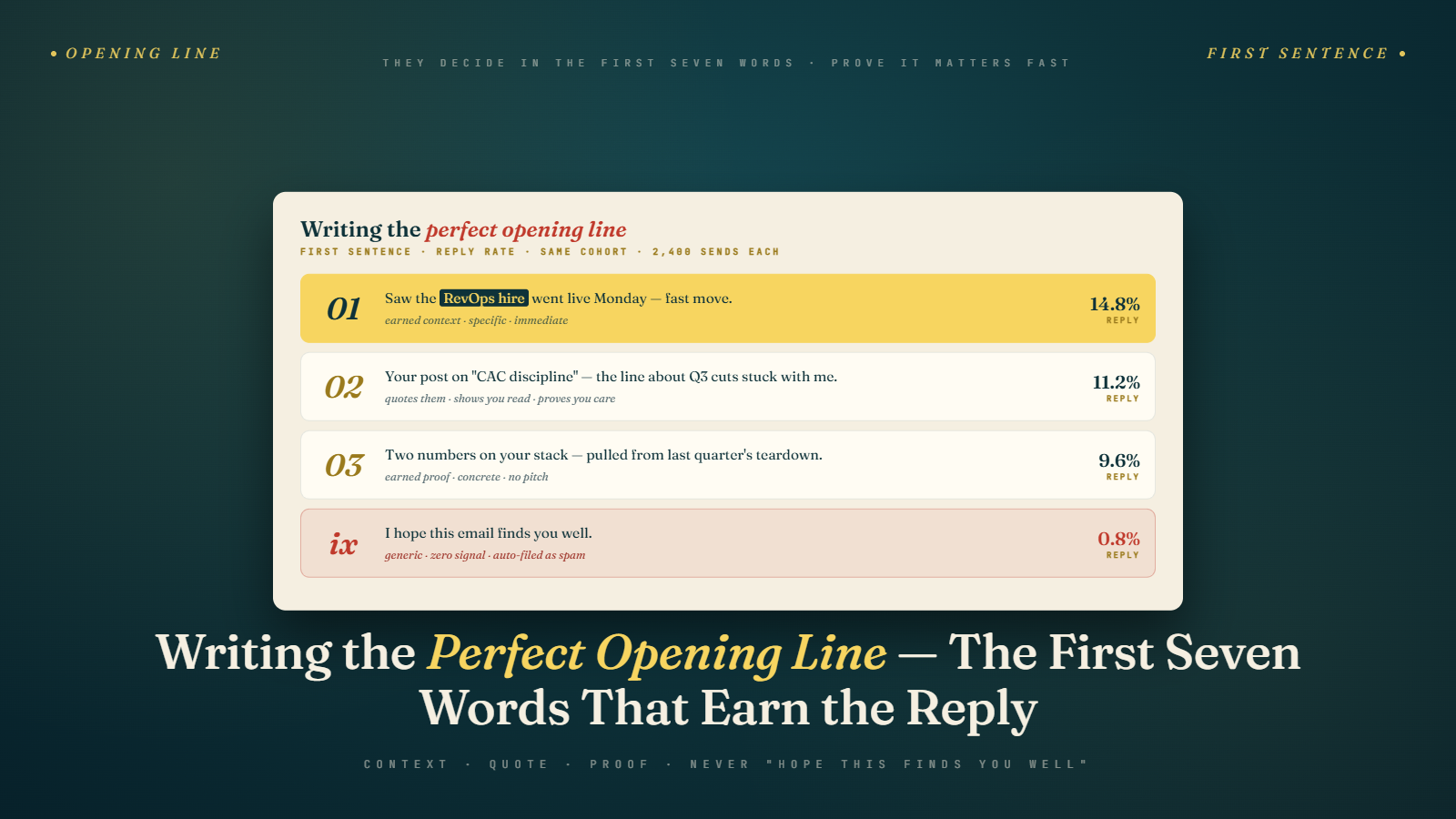
The Three Seconds After the Open
Your prospect opened the email. You won the subject line battle. Now you have about three seconds.
They scan down the email body. Their eye lands on the first line. If that line gives them a reason to keep reading, they do. If it doesn't, the email gets closed — maybe archived, maybe deleted, maybe shifted to a "reply later" folder they'll never actually open.
This happens faster than conscious decision-making. It's a pattern-recognition reflex: "Is this for me, or is this for everyone?" If the answer is "everyone" — if the opening line could have been written by anyone to anyone — it gets dismissed. If the answer is "this looks specific," curiosity wins and the reading continues.
The opening line is the most high-stakes sentence in your cold email. Not the subject line (which lives in the inbox, before the email is open) — the first line of the actual body. Get it right and you've earned the rest of the email. Get it wrong and everything you built in your research process and your list building is wasted.
This article is entirely about that first sentence.
The Cardinal Sin: Starting With Yourself
Let's clear this out of the way first because it's the most common and most destructive opening line mistake in cold email.
"My name is [X] and I work at [Y] and we help companies like yours with [Z]..."
This is the default opener that appears in the majority of cold emails sent today. It's natural — you want to introduce yourself. It's polite. It's how you'd start a conversation at a networking event.
But in email, it's backward. The reader doesn't care who you are yet. They haven't decided whether this email is worth their time. Leading with your name and company forces them to read about you before you've given them any reason to be interested in you.
The rule: your opening line should not be about you. It should be about them — their situation, their world, a problem they have, an observation about something they've done or said. You earn the right to introduce yourself after you've demonstrated relevance.
What Makes an Opening Line Work
Two ingredients: specificity and relevance.
Specificity means the line could only have been written for this person. It references something true about them — not something true about everyone in their segment or everyone with their job title. A specific opening line passes the "could this have gone to 100 other people" test: if the answer is no, it's specific enough.
Relevance means the line connects to something the person cares about right now. Specificity without relevance is trivia. "I noticed your company was founded in 2019" is specific but irrelevant. "I noticed you've grown from 12 to 80 people in two years — the scaling challenges at that inflection point are usually pretty predictable" is both specific and relevant.
Both ingredients together create the feeling that this email was written for them, right now, by someone who actually looked at their situation.
The Seven Types of Opening Lines That Work
Type 1: The Trigger-Based Opener
Reference a specific, recent event or trigger at the company or in the person's career.
Examples:
- "Congrats on the Series A — you're about to hit a hiring pace most early-stage teams aren't ready for."
- "Saw you just promoted three ICs to manager roles — that's a big step for a team your size."
- "Noticed you're actively building your SDR bench — 6 open roles on LinkedIn right now."
Why it works: It signals you did real, current research. It's time-specific. It creates a natural bridge to the problem your product solves.
How to research: LinkedIn announcements, Crunchbase, the company's own blog and press, LinkedIn Sales Navigator's "Spotlight" filters for job changes and company news.
Type 2: The LinkedIn Content Opener
Reference something the person recently wrote, posted, or commented on.
Examples:
- "Your post last week on why most outbound playbooks fail resonated with something I see constantly with our clients."
- "Read your article on reducing sales cycle length — the bit about discovery qualification actually mirrored what we've been testing."
- "Your comment on the data enrichment thread got me thinking — do you find that most vendors overstate accuracy claims?"
Why it works: It's the most genuinely personal opener available because you're referencing something they created. It's hard to fake. It also positions you as someone who's engaged with their thinking, not just their professional profile.
How to research: Check their LinkedIn profile directly for recent posts and comments. Sales Navigator's "Posted on LinkedIn in last 30 days" filter helps you find active posters.
Type 3: The Shared Context Opener
Reference a mutual connection, shared experience, or shared event.
Examples:
- "We're both connected to Sarah Chen at Acme — I know she's consulted with your team before."
- "We met briefly at SaaStr last year — you were on the panel on sales velocity."
- "Noticed you went through YC W22 — we've worked with several companies from that cohort."
Why it works: Shared context creates proximity. It shrinks the psychological distance of "stranger." Even a tenuous shared thread changes the email from cold to slightly warm.
How to research: LinkedIn mutual connections, event attendee lists, community memberships. Be accurate — never fabricate shared context.
Type 4: The Insight-Led Opener
Lead with a sharp, specific observation about the person's situation, industry, or likely challenge — something they'd recognize as true from their own experience.
Examples:
- "Most sales leaders I talk to at your stage say the same thing: SDR productivity plateaus right around month four, and the usual fixes don't work."
- "There's a consistent pattern in e-commerce brands around the $10M mark — ROAS starts compressing just as you're pushing more into paid. Familiar?"
- "When a company goes from 30 to 100 people, the informal processes that used to work start becoming the bottleneck. Usually shows up in ops and customer delivery first."
Why it works: This opener demonstrates expertise and empathy simultaneously. If the observation is accurate and resonates, the prospect feels understood — which is a powerful precursor to trust. It also opens a conversational frame rather than a pitch frame.
How to research: This requires segment-level understanding more than individual research. It's the result of knowing your ICP well — what do people at this stage consistently deal with? What observations would resonate with this specific type of buyer?
Type 5: The Compliment with Substance
A specific, earned compliment — not generic flattery, but acknowledgment of something real.
Examples:
- "The way you've built your content engine is genuinely impressive — I've been referencing your approach on distribution as a benchmark for clients."
- "Your onboarding flow is one of the cleaner ones I've seen in this space — curious if that was built in-house or something you brought in."
- "Your G2 reviews are notably more consistent than your competitors' — whatever you're doing in CS is working."
Why it works: Specific, earned compliments signal genuine attention. They're different from hollow flattery because they reference something verifiable and show the person you actually investigated their work.
What not to do: "I love what you're doing at [Company]" — vague, obviously not researched. "Your company has been doing really well lately" — not specific enough to be credible.
Type 6: The Question That Assumes a Problem
Lead with a direct question that assumes the prospect is experiencing a specific challenge.
Examples:
- "Is deliverability still a problem as you scale your outbound sequence cadence?"
- "How are you currently handling lead enrichment when Apollo data comes back incomplete?"
- "Have you figured out a clean way to track SDR attribution in Salesforce yet, or is that still a spreadsheet?"
Why it works: A good assumptive question implies you understand the person's world well enough to know they're probably dealing with this. If they are, it creates an immediate connection. If they're not, they'll often reply to say so — which is still a reply.
How to get it right: The problem in your question needs to be one your ICP actually has, not one you imagine they have. This goes back to the ICP research work from Phase 2 — customer interviews, win/loss analysis, and firsthand knowledge of what your best-fit customers struggle with.
Type 7: The Contrarian or Unexpected Angle
Open with an observation that goes against conventional wisdom or acknowledges the awkwardness of cold email directly.
Examples:
- "Most cold emails you get are probably terrible. I'll try to do better."
- "I know you get a lot of outreach about sales tools. I'll skip the part where I claim we're different and instead just tell you specifically what I think might be relevant for where [Company] is right now."
- "This might be off-base, but hear me out."
Why it works: These disarm the standard cold email defense mechanism. By acknowledging the context — this is a cold email, I know — you show self-awareness and a willingness to cut the usual pretense. For certain buyer types (skeptical, senior, seen-it-all), this registers as refreshing.
When it backfires: If the rest of the email doesn't deliver on the implied promise of being different — if it's just a regular pitch after a self-aware intro — the effect is worse than no setup at all.
How Long Should the Opening Line Be?
One to two sentences. Sometimes three if the setup requires it.
The opening is not the place to introduce your company, list your features, or tell a story. Those live in the body. The opening has one job: get the reader to the second line.
A common trap is over-loading the opener with context — "I came across your LinkedIn profile and noticed you've been in your role at [Company] for about 18 months which is interesting because..." — by the time you get to the point, they've already skimmed ahead or closed the email.
Short, specific, pointed. Then transition.
Transitioning From the Opener to the Body
The opener hooks. The body delivers. The transition between them needs to be natural and logical.
The cleanest transitions:
The implicit connection: The opener is clearly related to what follows and no explicit bridge is needed. "Saw your post on outbound challenges. Here's something we've seen consistently with companies at your stage:" — the reader knows why you're connecting these things.
The "which is why I'm reaching out": Classic but effective. "We've worked with 40+ teams going through that same inflection point — which is why I thought it was worth a quick note." Slightly formulaic but it's clear and functional.
The direct pivot: "Anyway — the reason I'm reaching out:" Brief, honest, moves things forward.
What doesn't work is a jarring or illogical jump: opening with a personal reference to their LinkedIn post and then pivoting immediately to a price-focused feature list. The reader spent the opening line in a conversational, personal register — suddenly shifting to a pitch register breaks the mood and feels manipulative.
Research Process for Opening Lines
Here's the practical workflow for researching and writing opening lines:
For Tier 1 targets (high-value, individual research):
- Open their LinkedIn profile
- Scroll through recent posts, comments, and activity (last 30 days)
- Check the company page for recent news and announcements
- Google "[Person Name] [company]" for press mentions, podcasts, speaking engagements
- Note 2–3 specific, potentially relevant things
- Pick the most relevant one and write an opening that connects it to your pitch
For Tier 2 targets (segment-level with individual signal):
- Check their LinkedIn for recent activity (2 minutes)
- Look for a quick individual signal: recent job change, company news
- If something is there, use it for the opener
- If nothing stands out, fall back to an insight-led or assumptive question opener tailored to their segment
For Tier 3 targets (high-volume, persona-level):
- No individual research — rely on segment knowledge
- Write 2–3 insight-led or question-based openers that are highly specific to the persona's typical situation
- A/B test these across the campaign to find what resonates
Opening Lines to Avoid Completely
- "I hope this email finds you well." (Filler — says nothing, signals template)
- "My name is X and I work at Y." (Wrong direction — about you, not them)
- "I came across your profile and was impressed." (Vague and hollow)
- "I'll keep this brief." (Just keep it brief — don't announce it)
- "I know you're busy, so I'll get to the point." (Same issue)
- "We're a [category] company that helps teams like yours." (Pitch before interest is earned)
- "Have you heard of [Product]?" (Sets up a no)
- "Did you get my last email?" (First email opener — also passive-aggressive as a follow-up)
The Opening Line and Its Relationship to the Rest of the Email
One more thing worth naming: the opening line creates expectations. If your opener is highly personal and empathetic, the rest of the email needs to maintain that register. If you open with a sharp business insight, the body should deliver depth to match.
Mismatches between the tone of the opener and the tone of the body are jarring. They signal that the opener was an engineered hook and the rest of the email is the "real" generic pitch — which destroys the goodwill the opener built.
Think of the email as a single continuous conversation. The opener is the first sentence that person. Every sentence after it should feel like it came from the same person, in the same conversation, with the same genuine intent.
Get that right and the rest of the email becomes much easier to write — and much easier for the recipient to read.
Next up: Crafting Value Propositions That Resonate — once you've earned their attention with the opener, this is how you make the case for why they should reply.