
Where Most Cold Emails Lose the Reader
You wrote a solid subject line. Your opening line was personalized and relevant. The prospect is reading. You're past the hardest part — or so it seems.
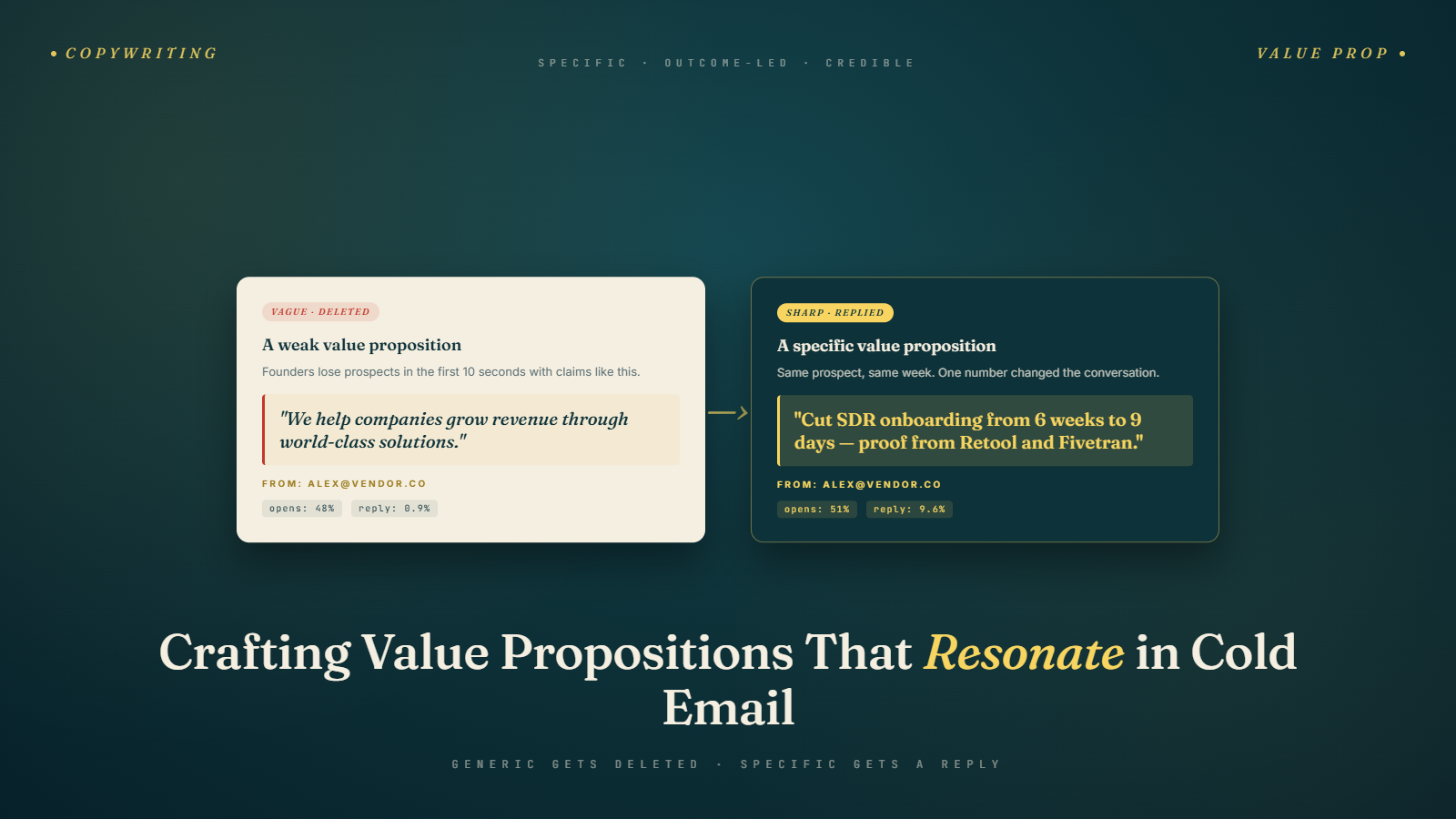
Then they hit the body of the email: "We're a leading provider of AI-powered sales intelligence that helps teams like yours accelerate pipeline growth and drive revenue with actionable insights."
And they stop reading.
Not because the product is bad. Not because the timing is wrong. But because that sentence — and the ones like it — says nothing. It sounds exactly like every other cold email. "AI-powered" — everyone is. "Accelerate pipeline" — everyone claims to. "Actionable insights" — every software company alive. These phrases are so overused they've become invisible. They slide off the brain without registering.
This is the value proposition problem. Most cold email body copy falls into one of two failure modes: it's either too vague (buzzwords and category claims with no specificity) or too detailed (a feature dump that reads like a product spec sheet). Neither one converts.
What works is specific, outcome-focused, credible framing — the kind that makes a prospect think "that's actually relevant to what we're dealing with." This article is about how to get there.
What a Value Proposition Is (in Email Context)
Before we talk about how to write one, let's be clear about what it needs to do.
In cold email, your value proposition is not a positioning statement or a company mission. It's a concise answer to the question that's running in the back of every prospect's mind as they read your email: "So what — why does this matter to me, right now?"
That question has three parts embedded in it:
- What — what do you actually do?
- For whom — is this for someone in my situation?
- Why now — is this relevant to what I'm dealing with currently?
A value proposition that answers all three clearly and specifically will almost always outperform one that leaves any of those questions unanswered.
The Problem-Outcome-Proof Framework
The most reliable structure for a cold email value proposition has three beats:
Problem → Outcome → Proof
Problem
Start with the specific problem your ICP faces — not a general category of problem, but the exact version of the pain that the person reading this email is likely experiencing.
Generic version: "Many companies struggle with email marketing performance."
Specific version: "Most e-commerce teams scaling past $5M in revenue find their email deliverability starts degrading right as they're pushing harder on campaigns — open rates drop, revenue per send falls, and it's not clear what changed."
The second version is specific enough that the right reader will recognize it as their situation. The first version could apply to everyone and therefore connects with no one.
The more precisely you've done your ICP work from Phase 2, the better your problem framing will be. You're pulling from real customer interviews, real win/loss analysis, real conversations with people in your target market. If you haven't done that work, your problem framing will be guesswork.
Outcome
After you've articulated the problem, describe the outcome your solution produces — not the features, not the technology, not the process. The result they'll see in their world if they work with you.
Feature-focused (wrong): "Our platform uses machine learning to analyze your email list hygiene and automatically tag high-risk addresses before send."
Outcome-focused (right): "Teams typically see bounce rates drop from 4–5% to under 1% within their first two campaigns, and deliverability scores stabilize enough that they stop getting flagged by Google and Outlook."
The feature-focused version describes what the product does. The outcome-focused version describes what the customer experiences. Your prospect cares about the second one. They'll care about the first one later — in a demo, in a sales conversation, in the technical evaluation phase. In a cold email, lead with the result.
Proof
A cold email value proposition without proof is just a claim. Claims are cheap — everyone makes them. Proof gives your claim weight.
In a cold email, you don't have room for a detailed case study. What you can do is:
- Drop a specific metric: "Helped one team cut their ramp time from 5 months to 7 weeks"
- Reference a recognizable client: "We work with teams like Acme, Intercom, and Gong" (if you do)
- Cite a trend across clients: "Across 50+ customers, we've seen average bounce rates cut by 70% within the first 60 days"
- Reference the relevant segment: "Worked with 12 Series B SaaS companies in the last year going through the same scaling challenges"
You don't need all of these. One or two specific proof points woven naturally into the body is usually enough to make the claim credible.
Writing for the Right Frame: Their World, Not Yours
One of the most common mistakes in cold email body copy is writing from your own perspective — describing your product the way your team talks about it internally, using your own category language, framing problems the way you see them from your side.
Your prospect doesn't see the world from your side. They see it from their own.
The practical implication: write every sentence in terms of their world. Their metrics. Their tools. Their team dynamics. Their pressures.
Inside-out framing (your world): "Our email verification API integrates with your existing tech stack and provides real-time validation at the point of capture."
Outside-in framing (their world): "If you're seeing bounce rates creep up on campaigns sent to leads from ZoomInfo or Apollo, the issue is almost always catch-all addresses — they look valid but don't deliver. We catch those before they hit your ESP and ding your domain reputation."
The second version meets the prospect where they are. It uses the names of tools they actually use. It describes the problem in terms of how they experience it, not how your product addresses it technically.
This is hard to write well if you don't know your customer deeply. But it's the difference between a value proposition that lands and one that doesn't.
The Role of Specificity (And Why Vagueness Kills Credibility)
Specific claims are more credible than general ones, counterintuitively. This is because specificity implies firsthand experience — you can only be specific about something if you've actually observed it.
Compare these two sentences:
Vague: "We help sales teams improve their outreach performance and close more deals."
Specific: "Most SDR teams we work with see reply rates double from around 2% to 4–5% within 6–8 weeks of restructuring their sequence."
The vague version could have been written by someone who's never spoken to a customer. The specific version implies real data from real customer work. The specificity itself is the credibility signal.
This means your proof points need to be real. Don't fabricate metrics. Don't inflate results. If you don't have strong numbers yet because you're early-stage, use directional language and relative framing: "Teams typically see significant improvement in..." or reference the outcome qualitatively: "Our last three customers told us the biggest change was..."
What you can't do is be vague and expect the prospect to fill in the specifics themselves. They won't. They'll move on.
Length and Format of the Value Proposition Section
Your value proposition in a cold email body should be 3–5 sentences. Not three paragraphs. Not a bullet-point list of ten features. Three to five sentences that cover the problem, the outcome, and a proof point.
Here's why brevity matters here:
Attention is limited. The prospect is still deciding whether this is worth their time. Every sentence is another opportunity for them to decide it's not.
Compression signals confidence. A value proposition that needs 10 sentences to make its case feels uncertain, over-explained. A tight 4-sentence version feels confident — you know what you're saying and you trust the reader to get it.
You're not selling the product in one email. The goal of the cold email isn't to close the deal. It's to earn a conversation. You don't need to cover every angle of your offering — you need to make one compelling case for why a conversation might be worth their time.
What about bullets? Occasionally, a brief bulleted list (2–3 items) can add clarity if you're citing multiple relevant outcomes. But this only works if the bullets are genuinely distinct and specific. "Increase revenue, improve efficiency, and reduce costs" is three clichés wearing bullet clothes.
Adapting the Value Proposition by Segment
A strong value proposition for one segment can be completely wrong for another — even if you're selling the same product.
Let's say you sell email verification and deliverability software. Here's how the value proposition shifts by segment:
For e-commerce brands: Focus on revenue impact and sender reputation. "When your email deliverability degrades, the revenue hit is direct — promo campaigns that used to hit $80K in 24 hours start bringing in $40K. We work with DTC brands to stabilize deliverability so campaign performance stays predictable at scale."
For B2B SaaS outbound teams: Focus on bounce rate and domain health. "If you're running cold email sequences from Apollo or ZoomInfo data, you're probably seeing 4–6% bounce rates even on 'verified' lists. We cut that to under 1% and protect your sending domain so your whole sequence doesn't get flagged."
For agencies managing client campaigns: Focus on client reporting and accountability. "We give agencies verified, auditable deliverability data for every client campaign — so when a client's results dip, you have the data to show whether it's list quality, domain health, or content, not just a guess."
Same product. Three very different value propositions — each one specific to that segment's world, metrics, and concerns. This is what segment-based email list segmentation makes possible.
Using Social Proof Strategically
Social proof is most powerful when it's specific and relevant. A generic "we've helped over 500 companies" is close to meaningless. A specific client name or metric that the prospect can relate to is worth ten times more.
Highest impact: A client name your prospect will recognize or aspire to. "We work with teams at Intercom, Greenhouse, and Rippling" — if you actually do. This is powerful but only true for a small number of companies. Don't name-drop clients you don't have.
Strong impact: A data point from a segment-similar company. "We helped a 60-person Series B SaaS team cut bounce rates from 5% to 0.8% and recover their domain reputation in 30 days." This is specific, credible, and relevant to a particular type of prospect.
Moderate impact: A category claim with specificity. "We've verified over 50 million addresses for outbound sales teams across 40+ countries." Not about one client, but specific enough to imply real scale and experience.
Low impact: "We've helped hundreds of companies achieve their email goals." Vague, sounds like every vendor, zero credibility signal.
Choose social proof that matches the segment's frame of reference. A mid-market SaaS company isn't particularly impressed by agency references. An e-commerce brand doesn't care about B2B SDR teams. Relevance of the proof matters as much as the strength of it.
Common Value Proposition Mistakes
Mistake 1: Leading With Features
"Our platform uses AI to automatically clean your email list, score contacts, and generate personalized outreach suggestions." This is a feature list. Your prospect hasn't agreed that they have a problem that needs solving yet. Features before problem framing is like giving someone the solution before you've established that they have the problem.
Mistake 2: Category Language That Means Nothing
"We're a next-generation sales enablement platform." What does that mean? Nothing. Categories like "AI-powered," "data-driven," "holistic," and "end-to-end" have been applied so broadly they've lost meaning. Avoid them entirely or follow them immediately with specifics.
Mistake 3: The Passive Benefit Claim
"Our customers see improved results." Improved compared to what? By how much? When? Vague benefit claims feel like marketing copy — which is precisely the register you want to avoid in a cold email.
Mistake 4: Writing for the Product Rather Than the Person
Your internal language — the way your team describes the product in Slack or in a sales deck — is often not the language your customers use to describe their own problems. The vocabulary gap between "how we describe what we do" and "how our customers describe what they need" is often large. Bridge it.
Mistake 5: Asking the Reader to Do Too Much Work
Your value proposition should be self-evident. The reader shouldn't need to think hard about why this is relevant to them — they should feel it in the first read. If your copy requires the prospect to mentally connect several dots before the relevance lands, you've lost them.
How to Handle Competitive Context in Your Value Proposition
Most cold email value propositions completely ignore the competitive landscape. They write as if the prospect has no current solution and is waiting for yours. In reality, most buyers have already tried something — a tool, a process, a vendor — and either it didn't fully solve the problem or they've found workarounds they're living with.
Addressing competitive context in your value proposition — carefully — can be a powerful differentiator.
The wrong way: Direct competitor attacks. "Unlike [Competitor], we actually do X correctly." This is defensive, looks insecure, and often triggers loyalty to the product you're attacking even if the prospect isn't particularly happy with it.
The right way: Acknowledge the category reality and differentiate on the specific dimension where you're better.
Example: "Most teams we talk to have tried some form of email verification before. The gap is almost always the catch-all problem — most tools tell you those are unverifiable and leave it there. We handle that specific category differently, and it's usually where the biggest improvement in deliverability comes from."
This approach:
- Validates that the prospect has probably already done something about the problem (doesn't make them feel behind)
- Identifies a specific differentiation point without attacking a named competitor
- Implies you've talked to many companies in similar situations (social proof through expertise)
You don't need to address competition in every email. But if you know your ICP has likely already tried a competitor or is currently using one, a brief acknowledgment of the competitive context can pre-empt the "we already have something for that" objection.
The One-Sentence Test
Here's a useful test: can you articulate your entire value proposition in a single, plain-English sentence?
Not a mission statement. Not a category description. A sentence like: "We help [specific type of company] solve [specific problem] so that [specific outcome] — [typical companies] typically see [specific result] within [timeframe]."
If you can't pass this test, your value proposition isn't sharp enough yet. The cold email will expose this mercilessly — vague thinking produces vague copy, and vague copy doesn't convert.
Get the one-sentence version locked in first. Then expand it into the 3–5 sentence cold email body, adding the proof and the context. But start with the core.
Next up: CTA Strategies That Increase Replies — you've made a compelling case. Now here's how to ask for the next step in a way that actually gets a yes.