
The Last Step That Breaks the Most Campaigns
You did everything right. Your subject line was personalized. Your opening was specific. Your value proposition was tight, outcome-focused, and credible. The prospect is still reading. They're interested.
Then they get to your CTA.
"Book a 45-minute product deep-dive using the link below."
And they close the email.
Not because they weren't interested. Not because your product wasn't relevant. But because that ask — for a 45-minute commitment from a stranger who's been reading your email for 30 seconds — is too much. It requires them to open their calendar, assess a significant chunk of time, mentally commit to sitting through a sales demo, and make a scheduling decision on the spot. That's a high-friction decision, and high-friction decisions get deferred, and deferred decisions become forgotten emails.
The CTA is the final moment in the cold email conversion path. You've earned attention with the subject line, earned interest with the opener and value prop, and now you need to earn the reply. A good CTA makes it easy to say yes. A bad CTA makes it easier to not respond at all.
This article covers the psychology of CTAs, the types that work, how to structure your ask, and how to test variants to find what converts for your specific audience.
The Psychology of the Cold Email Ask
Before we get into tactics, it's worth understanding why certain CTAs work better than others.
Commitment escalation is real. When you ask for a big commitment early in a relationship, the other person has to weigh not just the practical cost (time, calendar space) but also the relational cost (am I committing to a vendor process I can't easily exit? Will this feel like I'm "in the funnel"?). High-friction requests trigger this calculus and most people resolve it by doing nothing.
Low-friction asks break the pattern. When you ask for a small, low-stakes commitment — "Is this relevant to you?" or "Would it be worth a 10-minute call?" — the cognitive weight is minimal. The prospect only needs to decide whether they're interested enough to type a few words back. Most people who made it to the CTA in your email are curious enough for that.
The principle of reciprocity. Your email has given them something — a relevant observation, an interesting insight, a specific piece of social proof. A CTA that's proportionate to what you gave them feels fair. A CTA that asks for an hour of their time in exchange for one email feels like an imbalanced trade.
Social norms around email. When someone receives a question via email, there's a mild social pressure to reply — especially when the question is direct and easy to answer. CTAs framed as questions leverage this norm. Statements ("Schedule time here") don't.
One CTA Per Email, Every Time
Before we talk about types of CTAs, let's address a common mistake: multiple CTAs in one email.
"You can book a demo using this link, or reply to set up a call, or check out our case study at [URL], or visit our website to learn more."
This is analysis paralysis in email form. When you give someone multiple options, the cognitive effort required to choose between them becomes a reason to do nothing. Decision fatigue is real. The more choices, the more energy required, the higher the chance of inaction.
One email, one CTA. Pick the most important next step. Make it clear and easy. Remove everything else.
The Spectrum of CTA Friction
CTAs exist on a spectrum from low-friction to high-friction. The right friction level depends on the deal size, the warmth of the relationship, and where the prospect is in their awareness of your solution.
Low-Friction CTAs
These ask for minimal commitment and can typically be answered with a one-sentence reply.
The Yes/No question:
- "Is deliverability something your team is actively focused on this quarter?"
- "Would it be worth a conversation?"
- "Does this sound like it might be relevant for where you are right now?"
Why it works: The prospect doesn't need to commit to anything. They just need to say yes or no. A "yes" opens the conversation. Even a "no" is useful — it lets you remove them from your sequence and sometimes prompts a "not now, but try me in Q3" which is valuable intelligence.
The permission ask:
- "Would it be okay if I sent over a quick case study from a similar company?"
- "Can I share a 2-minute Loom walking through how this typically works?"
- "Mind if I send over a few slides?"
Why it works: You're not asking for their time directly. You're asking for permission to give them something. People are generally comfortable saying yes to receiving information — the commitment is minimal, and it keeps the conversation moving without the pressure of a calendar link.
The topic question:
- "How are you currently handling [specific problem] at [Company]?"
- "Is [pain point] something you've been able to solve, or is it still a challenge?"
Why it works: It frames the CTA as curiosity about them, not a sales request. It's a conversation-starter rather than a pitch-closer. And if they answer, they're self-qualifying — they've told you the problem is real, which makes the next step (suggesting a call) much warmer.
Mid-Friction CTAs
These ask for a small time commitment and require a calendar check.
The short, specific meeting request:
- "Would a 15-minute call next week be worth it to see if there's a fit?"
- "I have Tuesday or Thursday open — either work for a quick call?"
- "Would you be open to a 15-minute intro next week?"
Why it works: A 15-minute call is a much smaller ask than a 45-minute demo. It signals respect for their time. And offering specific days removes some of the friction of calendar coordination — they just have to say yes or no to your suggested times.
The Calendly-style link (use carefully): "Here's my calendar if it's easier to grab time directly: [link]"
This works best as a secondary option or as a follow-up CTA after someone has already expressed interest. Sending a calendar link in a first cold email to someone who doesn't know you can feel presumptuous. Use it after the yes, not before.
High-Friction CTAs
These are generally the wrong choice for a first cold email but may be appropriate in follow-ups or warm sequences.
- "Click here to schedule a 45-minute product demo"
- "Sign up for a free trial at [link]"
- "Join our webinar on [date]"
None of these are inherently bad CTAs — but they ask for significant commitment from someone who may still be deciding whether they trust you. Reserve these for follow-up sequences after initial engagement, or for warm audiences who've already indicated interest.
CTA Placement: Where Does It Go?
The CTA should be the last substantive element before your sign-off. After the value proposition, after the proof, at the natural end of the ask.
Single question, single line: Don't bury your CTA in a paragraph. Give it its own line — or at most two sentences. The visual separation makes it clear and easy to respond to.
The look:
Teams that have made this switch typically see bounce rates drop by 70% within the first two campaigns.
Would it be worth a quick 15-minute call to see if it's relevant for where you are right now?
Best, [Signature]
Clean. The CTA stands alone. The eye goes straight to it after reading the body.
CTAs for Follow-Up Emails
Your CTA strategy should evolve across your sequence. The first email gets a soft, low-friction CTA. By the third or fourth email, you have more context to work with and you can be more direct.
Follow-up email 2: Add a bit more specificity. "Still relevant to follow up on this?" or "Happy to send over a quick breakdown if timing is better now."
Follow-up email 3: Acknowledge the lack of response without being passive-aggressive. "I know the timing might just not be right — no worries if so. Happy to reconnect in a few months if that's more useful."
Final email (breakup email): Permission to close the loop. "I'll stop following up after this — if there's ever a better time, happy to reconnect." This works surprisingly well for getting a response because it removes the pressure entirely. People often reply to breakup emails.
The CTA progression should mirror the relationship progression: start with curiosity and openness, move toward directness as the sequence continues.
A/B Testing Your CTAs
CTAs are one of the highest-leverage variables to test in cold email. A small change in how you phrase the ask can meaningfully shift reply rates.
Test one variable at a time. Change the CTA wording, or the friction level, or the meeting length — but not all three at once. Otherwise you won't know what drove the change.
Run tests to significance. For meaningful data, you need at least 100+ recipients per variant. Don't conclude from 20 emails.
Track reply rate, not just open rate. Open rate tells you about subject lines. Reply rate tells you about the email itself, including the CTA.
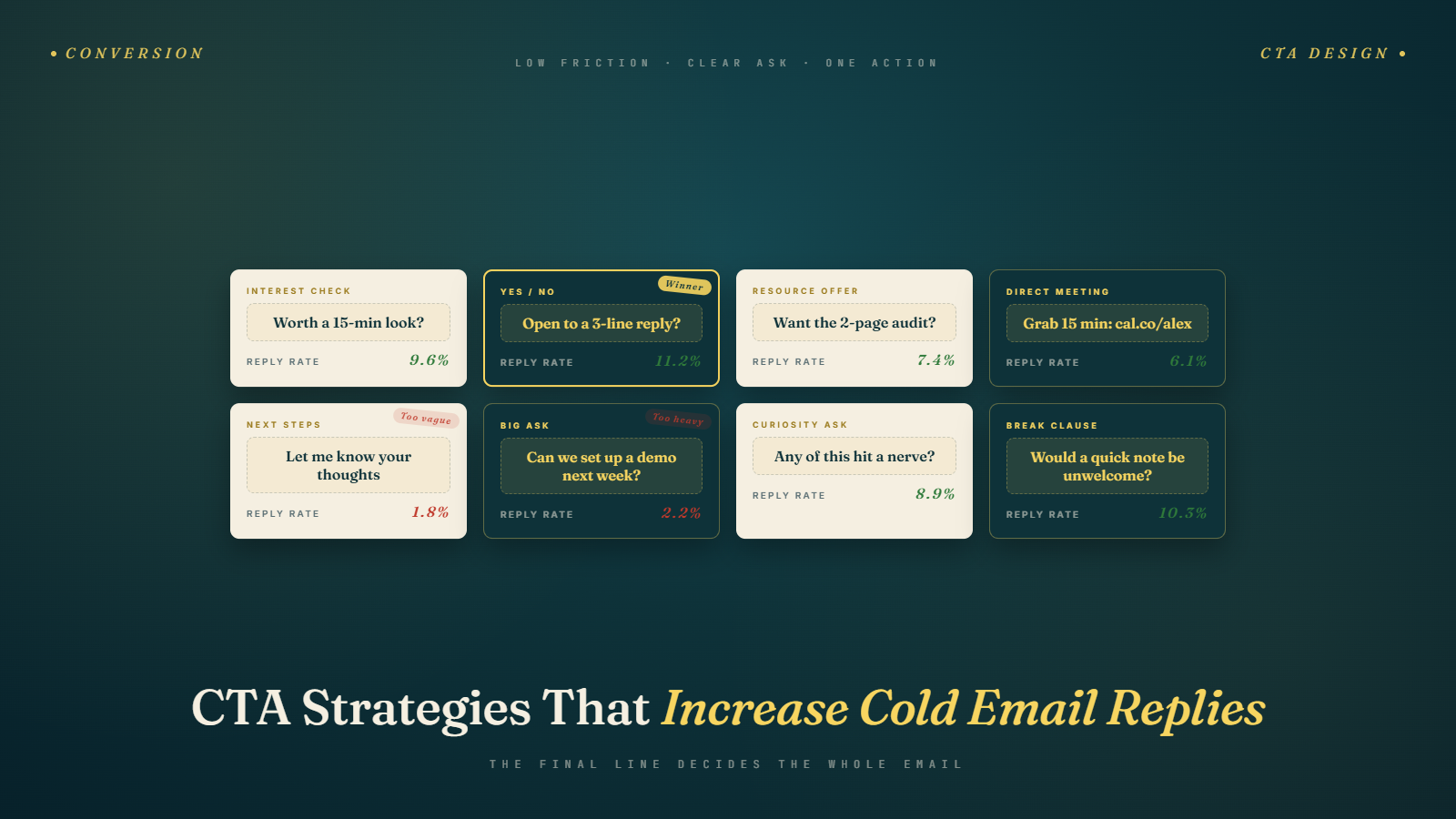
Compare friction levels. Test a yes/no question against a meeting request. Often the yes/no gets a higher raw reply rate, but the meeting request generates more qualified responses (because someone who says yes to a meeting is more committed than someone who says yes to a question). The right answer depends on your pipeline math.
Compare meeting lengths. "15 minutes" often outperforms "30 minutes" significantly — especially in B2B. People are more willing to commit 15 minutes to something uncertain. Once they're on the call and find it valuable, you can run longer.
CTA Mistakes That Kill Reply Rates
Mistake 1: The Calendar Link in Email 1
Dropping a Calendly link in your first cold email before the prospect has expressed any interest feels presumptuous. You haven't earned a meeting yet — you've earned enough attention to make an ask. Ask for the permission, then share the link.
Mistake 2: The Non-Question CTA
"Let me know if you have any questions." This isn't a CTA — it's an open invitation to silence. It gives the prospect no specific action to take and no momentum. Be specific: what are you asking them to do?
Mistake 3: Asking for Too Much Information
"Reply to this email with your current email marketing setup, your monthly send volume, and the names of any vendors you're currently evaluating, and I'll put together a customized proposal." This is a questionnaire, not a CTA. You haven't earned the right to assign homework.
Mistake 4: Using Passive Language
"If you're interested, feel free to reach out at your convenience." This is so low-pressure it has no energy. "Would a 15-minute call be worth it?" is a direct ask. The difference in reply rate is substantial.
Mistake 5: Giving the Meeting Topic as the CTA
"Book time for us to walk through our platform." Your prospect isn't motivated by walking through your platform — that's your agenda. "Book time to see how we addressed the deliverability issues you're likely seeing at your send volume" ties the meeting to their problem, not your feature tour.
Industry-Specific CTA Adjustments
Not every CTA works equally well across all buyer types. The friction level and phrasing that performs best varies by industry and seniority — here's how to calibrate:
SaaS founders and startup operators tend to respond well to direct, efficient CTAs. "Worth a 15-minute call?" works well. They're fast-moving and appreciate concision. Overly formal asks ("I'd like to formally request...") feel out of register.
Enterprise buyers and large-company executives often need a lower-commitment initial ask because their decision processes are more involved. "Happy to send over a short summary first if that's useful before getting on a call" can reduce friction by offering something lightweight before asking for time.
Technical buyers (engineers, data scientists, CTOs) are often skeptical of sales processes and respond better to curiosity-driven CTAs than meeting requests. "Curious — is [specific technical problem] something you've managed to solve, or is it still an open question?" invites a technical conversation rather than a sales call.
Finance and compliance-oriented buyers respond well to risk-reduction framing. Instead of "Would you be open to a quick call?" try "Can I send over a brief overview of how this works for teams with similar compliance requirements?" — it reduces perceived risk by offering information before commitment.
Agency owners and independent consultants are often selective about their time. A CTA that frames the call in terms of value exchange works well: "Happy to share what we've seen working for similar agencies in exchange for 15 minutes of your time to understand your setup."
These are adjustments, not rewrites. The core CTA principles — one ask, low friction, question format — still apply. The language just shifts to match the register.
The CTA in Context
The CTA doesn't exist in isolation — it's the culmination of everything that came before it. The subject line got the open. The opener earned attention. The value proposition built interest. The CTA converts that interest into action.
If your CTA isn't getting replies, the problem might actually be earlier in the email — the value proposition wasn't compelling enough, or the opener wasn't specific enough to make the prospect feel like this conversation would be worth their time. Before you iterate only on the CTA, make sure the rest of the email is earning its keep.
But if everything else is solid and you're still not getting the reply rates you want, the CTA is usually the fastest single change to test.
Low friction. One ask. A question, not a statement. Tied to their problem, not your agenda.
Next up: Short vs. Long Cold Emails: What Works Better? — the debate that never seems to die, settled with real data and clear context for when each approach wins.