
Why Facts Don't Sell But Stories Do
In 1969, a Stanford psychologist named Robert Ornstein conducted a study comparing how people retained information when it was presented as a list of facts versus when it was embedded in a story. The story group consistently retained more.
More recent neuroscience has shown why: when we hear a story, our brains don't just process it in the language centers — they light up in the sensory and emotional centers too. We simulate the experience as if it's happening to us. Facts are processed in one part of the brain. Stories activate the whole thing.
In cold email, this matters enormously. Most cold emails present facts: "We have X feature, Y result, Z customers." The reader's brain processes and files it away — or doesn't. A cold email that tells even a brief story — a recognizable situation, a specific tension, a resolution — creates a different cognitive experience. The reader doesn't just understand what you do. They feel what it's like to need it and to use it.
This doesn't mean your cold email needs to open with "Once upon a time." Story in cold email is compression — distilling a narrative arc into a few sentences that hit all the right beats. Done well, it's one of the highest-converting copywriting techniques available.
Done badly, it makes your email too long, too self-indulgent, and too focused on your journey rather than the reader's. This article is about doing it well.
The Three-Act Structure in Cold Email Form
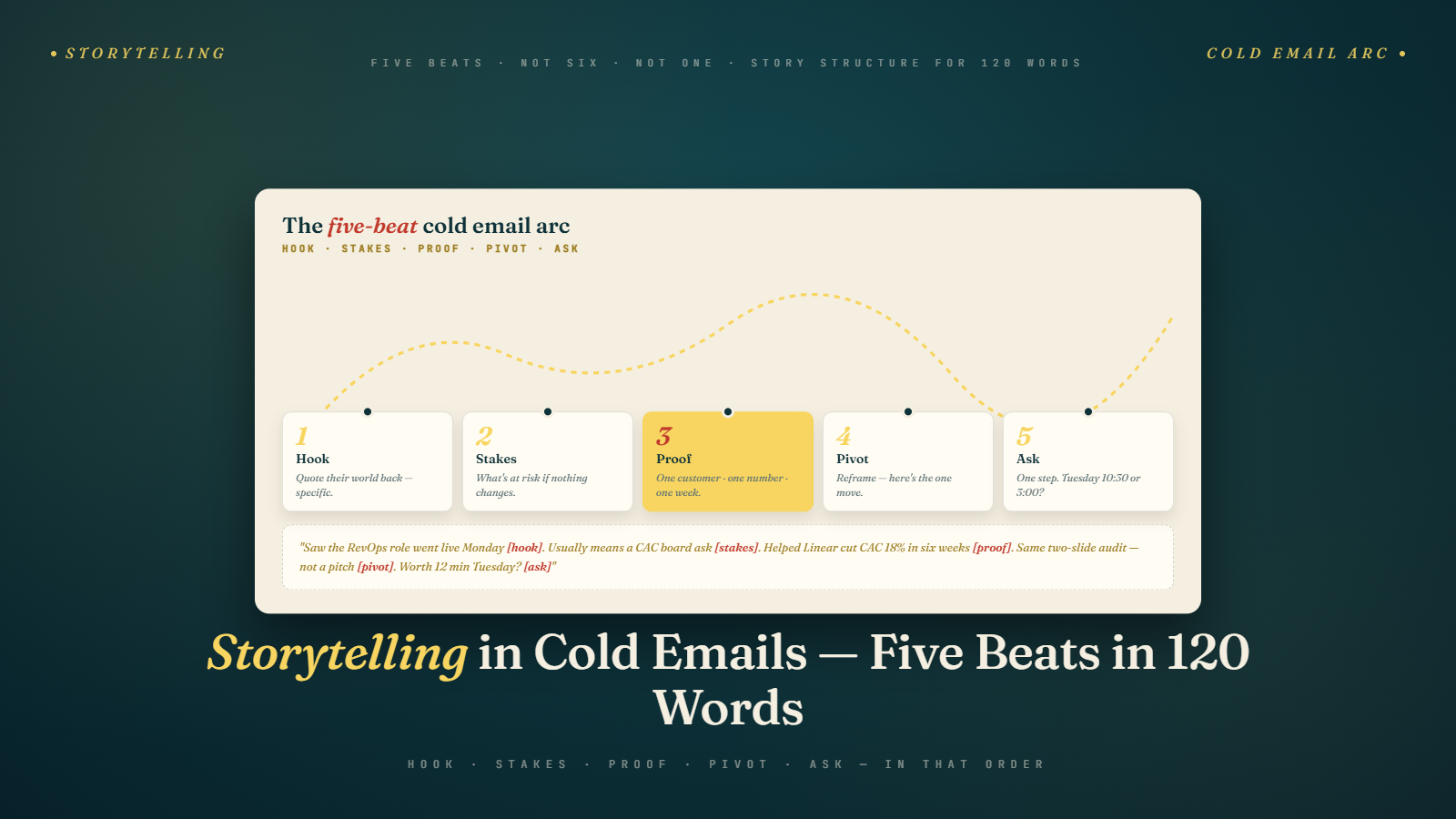
Every story has three acts: setup, conflict, resolution. This is the structure behind every novel, every movie, every piece of compelling narrative. In cold email, the same structure applies — just compressed.
Act 1 — Setup (1 sentence): Establish the situation. Who is the main character (your customer, not you) and what was their world like before?
Act 2 — Conflict (1–2 sentences): What problem did they hit? What was the tension that needed resolving? This should be specific and should resonate with the reader's own experience.
Act 3 — Resolution (1–2 sentences): What happened after they used your solution? What's the outcome? What does their world look like now?
That's a complete story arc in 3–4 sentences. It's not long. But it has all the ingredients of narrative — character, conflict, resolution — that trigger the neurological response we talked about.
Here's an example:
Last year, a 70-person SaaS company came to us after their domain got flagged by Google mid-campaign. Three months of list building, gone — reply rates had dropped to near zero and they couldn't figure out what changed. We rebuilt their verification workflow over four weeks, cleared their domain reputation, and got them back to a 0.8% bounce rate in time for their Q4 push.
That's 62 words. It has a protagonist (a recognizable type of company), a specific conflict (domain flagged, campaign ruined), and a clear resolution (problem fixed, metric improved). The reader who's also running cold email can easily imagine themselves in the same situation — and that recognition is what creates the emotional pull.
The Four Story Formats That Work in Cold Email
Not all stories are equal in cold email. The format you use should match the goal and the context of the email.
Format 1: The Customer Transformation Story (Mini Case Study)
The most widely used and most effective format. You tell a brief story of a customer who had a specific problem, worked with you, and got a specific result.
Structure:
- [Customer type] was dealing with [specific problem]
- They [did/tried X] which led to [result]
Example:
A 50-person fintech company was seeing bounce rates above 5% on their outbound campaigns — high enough that their ESP had started throttling their sends. After running their list through a proper verification workflow, they cut bounce rate to under 1% and opened three new sending domains without issue. Their SDR team went from 30 touchpoints per day to 80 within a month.
What makes it work: Specificity. The company type, the exact problem metric, the exact outcome metric. A reader who's experiencing similar challenges recognizes the situation and wants to know more.
Format 2: The Pattern Recognition Story (We See This Constantly)
Instead of telling one customer's story, you describe a pattern you've seen across many customers — a repeating situation that the prospect will likely recognize as true of their own business.
Structure:
- Most [company type] at [stage/situation] deal with [specific challenge]
- What usually happens is [sequence of events]
- The pattern breaks when [change or insight]
Example:
Most e-commerce brands we work with hit the same wall around month six of scaling their email program: what worked at 50K subscribers starts breaking at 200K. List hygiene degrades, domain reputation wobbles, and the usual fixes (shorter copy, new subject lines) don't move the needle. The problem is almost always upstream — in the quality of the list itself, not the campaigns.
What makes it work: The reader who's in that situation nods along. You're not telling them anything they don't know — you're articulating something they've felt but haven't fully diagnosed. That's a powerful trust signal.
Format 3: The Founder Story (Origin and Stakes)
Your own story — briefly told — of why you built the product or encountered the problem. This works particularly well for founder-led sales and smaller companies where authenticity and the personal touch matter.
Structure:
- [Context that led you to see the problem]
- [What you realized or experienced that others experience too]
- [What you built and why]
Example:
After spending two years managing outbound at a Series B company and watching perfectly good campaigns crater because of list quality issues, I got frustrated enough to build a tool for it. The existing verification services were either too slow, too expensive, or inaccurate in the exact category that mattered most — catch-all addresses. BulkMailVerifier came out of that frustration.
What makes it work: Human authenticity. You're not a faceless company — you're a person who experienced the same problem your prospect is experiencing. That creates credibility and connection that's hard to manufacture any other way.
Format 4: The Industry Moment Story
A brief story about what's changing in the market that makes this particular moment relevant for the prospect. This works when there's a genuine trend, shift, or event that changes the calculus for your buyer.
Structure:
- [Something has changed in the market/industry]
- [The implications for companies like yours are X]
- [This makes [solution] more relevant now than it was before]
Example:
Google's spam rate threshold changes last year changed the math for cold outreach in a way a lot of teams haven't fully processed yet. Domains that used to run at 3% bounce rate without major consequences are now hitting throttling much faster. What was acceptable tolerance is now an active risk to deliverability.
What makes it work: It positions you as someone paying attention to their world — not just pitching a product, but tracking the changes that affect their business. That's a demonstration of expertise that earns more credibility than any feature list.
Where Storytelling Goes Wrong in Cold Email
Wrong 1: The Story Is About You, Not the Customer
"We started in 2019 with a vision to transform how companies think about email deliverability. Our team of 35 engineers and marketers has spent years building the most comprehensive solution on the market..."
No one asked for your company history. The story should make the reader the protagonist, not you. They should see themselves in the situation, not your founding team.
Wrong 2: The Story Is Too Long
Cold email storytelling should be 3–5 sentences, not three paragraphs. The moment your email starts reading like a blog post or a case study PDF, you've lost the format. The point of cold email storytelling is compression — all the emotional payload of a narrative in the smallest possible space.
We covered the length dynamics in detail in Short vs. Long Cold Emails. Storytelling doesn't exempt you from those principles. In fact, it requires even more discipline because narrative has a natural tendency to expand.
Wrong 3: The Story Isn't Specific Enough
"A customer we worked with was having email problems and we helped them solve it and now they're doing much better." This has the bones of a story — setup, problem, resolution — but none of the specificity that makes stories work. "Email problems" is too vague. "Having bounces" is more specific. "4.7% bounce rate causing ESP throttling mid-campaign" is a story that creates vivid recognition.
Wrong 4: The Proof Is Unverifiable or Implausible
Fabricated or inflated results in a story destroy trust the moment a skeptic looks closely. If the numbers feel too good — "went from 0.2% reply rate to 48% in two weeks" — the reader's credibility filter activates. Real results, even if less dramatic, land better than implausible claims.
Wrong 5: The Story Has No Connection to the CTA
You've told a compelling story. Then the CTA has nothing to do with the story. "Would you be available for a product tour?" doesn't connect to the narrative you built. "Would it be worth a 15-minute conversation to see if the same pattern applies at [Company]?" picks up the thread.
Combining Story with Personalization
The most powerful combination in cold email: a personalized opener that connects to a story.
The opener references something specific to the prospect (their situation, their LinkedIn post, their company trigger). The story then shows a recognizable pattern — something that happened to a company very like theirs. The connection between "this is about you specifically" and "here's a story you'll recognize" creates compound relevance.
Example:
Opener: "Saw you just brought on three new AEs — scaling fast."
Story: "When teams at your stage add headcount quickly, the list quality problem usually surfaces about 90 days in. SDRs are working harder, burn through contacts faster, and the bounce rate creeps up without anyone catching it until the domain gets flagged. We've helped six teams in similar positions stabilize that in the middle of a hiring push."
CTA: "Would it be worth a call to see if that's something you want to get ahead of?"
Personalized opener → familiar story → specific CTA that ties the thread together. The whole thing is under 100 words and has a complete narrative arc.
The Emotional Mechanism: Why Stories Work Neurologically
This deserves a bit more depth because understanding why stories work helps you use them more deliberately.
When we hear or read a story, our brains enter a state psychologists call "narrative transportation." We mentally simulate the events of the story as if they're happening to us. The protagonist's problem becomes our problem. The tension they feel, we feel. The resolution they reach, we vicariously experience.
This is distinct from how we process facts and claims. "Our solution reduces bounce rate by 70%" is processed analytically — the reader evaluates whether they believe it, how relevant it is, and whether it warrants further attention. That's a cognitive process with friction.
A story about a company dealing with an email campaign that cratered mid-launch, watching their stats tank in real time, scrambling for answers — that's felt. The reader who's ever been in that situation (or fears being in it) doesn't evaluate it analytically first. They experience it. And then they want to know how it resolved.
The practical implication: a story positions your solution as the resolution to a tension the reader has already emotionally engaged with. By the time you get to the outcome, the reader isn't weighing whether the feature is relevant — they're already invested in the resolution.
This is why even a three-sentence mini case study can be more persuasive than three paragraphs of feature description. The emotional engagement does persuasion work that logic alone can't.
How to Find Your Best Stories
Most people underestimate how many stories they have available. Here's a systematic way to find your best material:
Talk to your best customers. Not in the context of writing a case study — just ask them: "What was happening in your business when you first realized you needed something like this?" Their answer is the setup and conflict arc of your story. Then ask: "What changed after you started using it?" That's your resolution.
Review your sales calls. If you record your discovery calls, go back through them. The best moments — when a prospect suddenly says "yes, that's exactly the problem" — are story gold. Those are the situations that resonate most with your ICP.
Look at your support tickets and onboarding notes. What problems do customers come to you with? What's the state they're usually in when they first engage? That's your story setup.
Mine your own experience. If you built this product because you experienced the problem firsthand, your own story is often the most authentic one. Founders often have the most compelling origin stories and underuse them.
You're not trying to find a perfect story. You're looking for true, specific, recognizable situations that your ICP will immediately relate to. Three to four solid stories — adapted for different verticals or buyer personas — can carry your cold email program for months.
When to Use Storytelling vs. Direct Pitch
Not every cold email needs a story. Storytelling is particularly powerful when:
- Your value proposition requires context to be appreciated
- The problem you solve is one people often don't recognize until they're in it
- You're selling to buyers who've been burned by overhyped tools before and need credibility before they'll engage
- Your strongest competitive advantage is customer results, not features
A direct pitch without story is more appropriate when:
- The category is well-understood and the prospect already recognizes the problem
- You have a strong, obvious differentiator that can be stated plainly
- The buyer type values efficiency and directness over narrative (some technical and finance buyers)
- The email is a follow-up in a sequence where you've already established the context
The anatomy overview for Phase 3 covers how all of these elements fit together. Storytelling is a tool in the kit, not a mandatory ingredient.
The Story Test
Before you finalize any story you're using in a cold email, apply this test:
- Is there a recognizable character? (The protagonist should be your customer type, not your company)
- Is there specific tension? (Not just "they had a problem" — what was the exact problem and why did it matter?)
- Is there a clear resolution? (Specific, ideally with a number attached)
- Is it three to five sentences? (If longer, cut it)
- Does the story connect directly to the CTA? (The story should be the reason the CTA makes sense)
If yes to all five, you have a cold email story worth using.
Next up: Avoiding Spam Trigger Words — because the best email in the world doesn't matter if it never reaches the inbox.