
The Four Seconds That Decide Everything
Your prospect checks their inbox. They see your email. Their eyes flick to the sender name, then the subject line. They make a decision in under four seconds: open or delete.
That decision — made faster than a conscious thought — is almost entirely based on your subject line. Everything you've put into your ICP research, your prospect list building, your personalization, your carefully crafted body copy — none of it matters if the subject line fails.
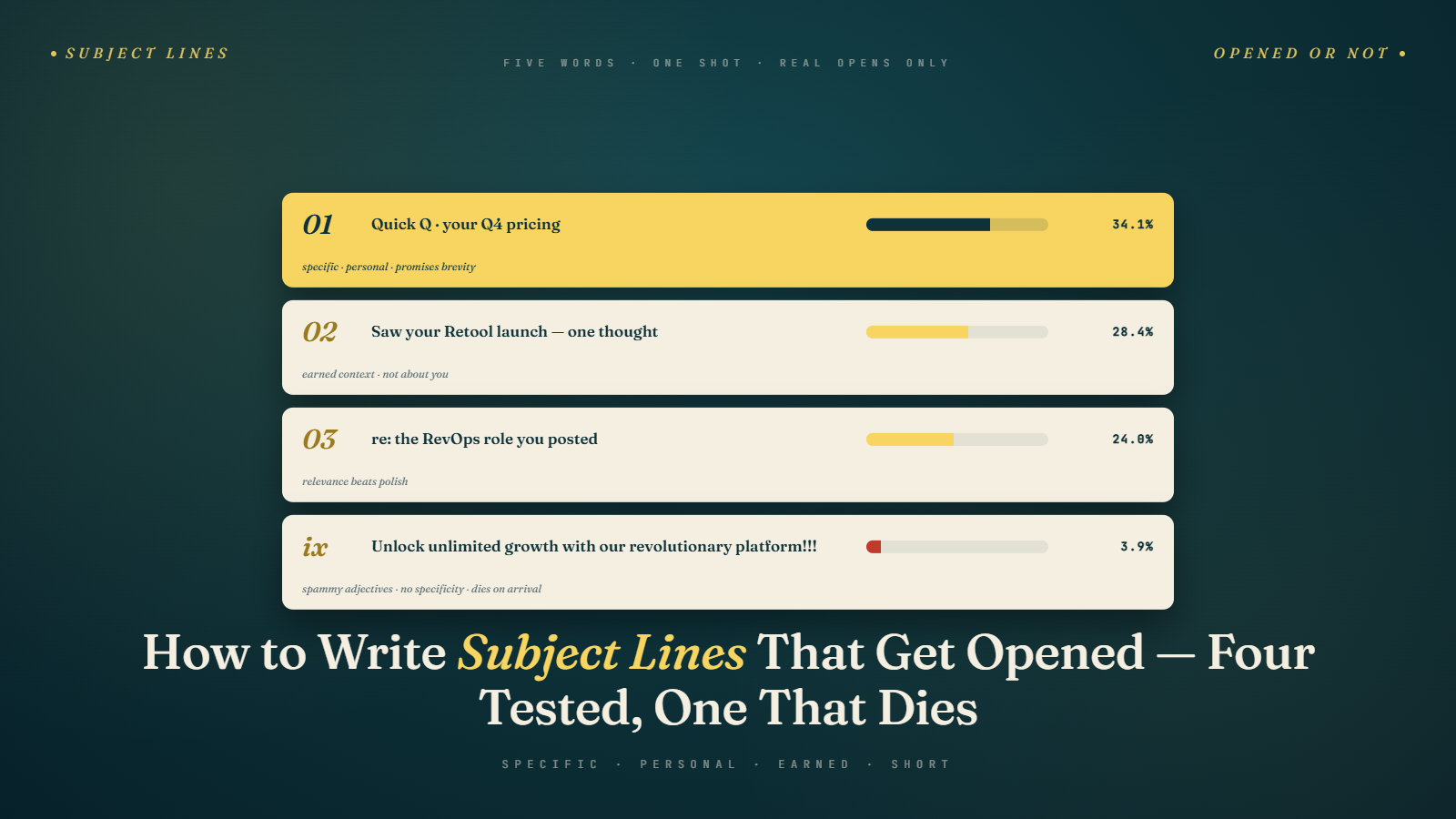
This isn't an exaggeration. Open rates for cold email typically range from 15% to 50% depending on the quality of the list and the strength of the subject line. That gap is almost entirely driven by the subject line itself. Two campaigns sent to identical lists can have wildly different open rates based on nothing but the six words at the top.
This article goes deep on subject lines — the frameworks that work, the psychology behind them, the common mistakes, and how to pair your subject line with preview text for maximum impact. This is part of the Phase 3 anatomy series. If you haven't read the anatomy overview, start there for the full picture.
What a Subject Line Is Actually Competing Against
Before we talk about how to write a good subject line, it's worth understanding what you're competing with.
Your prospect's inbox, on any given morning, looks something like this:
- A thread from a coworker about a deadline
- Three SaaS product update emails
- A LinkedIn notification email
- A newsletter they vaguely remember subscribing to
- Your cold email
- A calendar reminder
- An email from their boss
You're competing for attention among genuinely important things. The bar for "worth opening" is not low — it's actually quite high. Your subject line needs to either feel personal and relevant enough to read now, or create enough curiosity that deferring it would feel like a loss.
Most cold email subject lines fail on both counts. They're vague ("Quick question"), generic ("Partnership opportunity"), or promotional ("Save 20% on your first month"). None of these feel personal. None create real curiosity. None of them win the four-second battle.
The Six Subject Line Frameworks That Work
Framework 1: The Direct Personalized Reference
Format: Something specific to them — their content, their company, their situation
Examples:
- "Your post on SDR ramp time"
- "Re: [Company]'s Series B"
- "Saw you're hiring 5 AEs"
This works because it doesn't look like a template. It can't — it's specific. When someone sees their own company name or a reference to something they actually did in a subject line, the cognitive pattern-match fires: "this person looked at me specifically." Even if they suspect it's cold outreach, that specificity earns a click.
The key: the reference has to be real. Don't fake specificity. "Loved your work at [Company]" is not a specific reference — it's a placeholder dressed up as one. Something like "Your article on buyer intent data" is specific because it's true.
Framework 2: The Curious/Incomplete Statement
Format: A statement that implies something interesting but doesn't complete the thought
Examples:
- "Not sure if this applies to you..."
- "Probably not relevant, but..."
- "Something I noticed about [Company]..."
This triggers the Zeigarnik effect — our brains are wired to notice incomplete things. A statement that implies "there's more" creates a mild itch to close the loop by reading the email. Used sparingly, it's very effective. Overused, it becomes a cliché.
The variation "Probably not relevant, but..." is particularly interesting because it pre-empts the dismissal. You're saying before they think it: "I know this might not apply." That disarming honesty can actually increase opens.
Framework 3: The Peer/Competitor Reference
Format: Mention a company similar to them or a company they'd recognize
Examples:
- "[Competitor] just switched from us to..."
- "How [Similar Company] cut their ramp time"
- "What [Well-Known Company in Their Space] does differently"
This works because of relevance and FOMO. If a company they view as a peer or competitor is doing something, it's automatically interesting. Social proof and competitive intelligence in one subject line.
Be careful not to over-claim here. "How we helped [Company] 10x their revenue" in a subject line feels promotional and unsubstantiated. A more grounded reference — "How [Company] restructured their outbound sequence" — is more credible.
Framework 4: The Direct Question
Format: A short, pointed question about a problem they likely have
Examples:
- "Still using spreadsheets for outbound tracking?"
- "How are you handling deliverability at scale?"
- "Is [specific pain point] on your roadmap for Q3?"
Questions engage differently than statements. They invite the recipient into a dialogue rather than presenting a pitch. The best cold email questions are ones where the honest answer is "yeah, actually, that's a problem" — because if they feel called out, they'll read on to see what you're offering.
Avoid questions that are obviously rhetorical or leading to a sales pitch in an obvious way: "Ready to 10x your pipeline?" This reads as promotional, not curious.
Framework 5: The Two-Way Intro or Name Drop
Format: Reference a mutual connection or context-setter
Examples:
- "Intro via [Mutual Contact]"
- "[Name] suggested I reach out"
- "We met at [Event] — following up"
If you have a genuine mutual connection, this is arguably the most powerful subject line you can use. It's not cold email anymore — it's a warm referral. Response rates jump dramatically.
If you don't have a mutual connection, don't fake one. That's a trust-destroying move the moment they realize it.
Framework 6: The Specific Outcome Promise
Format: A concrete, specific result — not a vague benefit claim
Examples:
- "Cut SDR ramp from 5 months to 6 weeks?"
- "How we found 200 verified leads in one afternoon"
- "11-week ramp at Series B companies"
This works when the outcome is genuinely specific and believable. "Double your revenue" is too vague to be credible. "Reduced onboarding time by 40% for 3 similar teams" is specific enough to be interesting.
The specificity signals that you have real experience with this outcome — not just a hope that it might be useful.
Subject Line Length: The Data vs. The Reality
There's a lot of conflicting advice on subject line length. Some say keep it under 5 words. Others cite data showing longer subject lines can work. Here's the honest answer:
Short subject lines (2–6 words) tend to work better for cold email. Here's why:
- They look less like marketing and more like a personal email
- They don't get cut off on mobile (where most email is now read first)
- Short = confident. You don't need to over-explain in the subject.
"Quick question" is short but terrible because it's also completely meaningless. "Question about your content strategy" is short and specific. Length and specificity are both variables — you want both working in your favor.
Longer subject lines (8–12 words) can work when they're hyper-specific and context-relevant: "Following up on the outbound email challenges you mentioned last week." That's specific enough to justify the length.
The safest default: keep it under 8 words and make every word earn its place.
Subject Lines and Preview Text: The Combination That Doubles Impact
We touched on preview text in the anatomy overview, but it's worth expanding here because it's one of the most consistently under-optimized parts of cold email.
In most email clients (Gmail especially), the recipient sees three things in the inbox row:
- Sender name
- Subject line
- Preview text snippet
The subject line and preview text together form the full "envelope open rate pitch." They should complement each other, not repeat each other.
Bad combination:
- Subject: "Quick question about your team"
- Preview: "Hi {first_name}, I wanted to reach out because..."
Both are vague. The preview wastes its opportunity by starting with a generic greeting.
Good combination:
- Subject: "Your Series B and outbound scale"
- Preview: "Most teams at this stage hit the same bottleneck around month 3."
The subject sparks curiosity. The preview adds a specific hook that pays off the curiosity and creates a reason to open.
How to set preview text deliberately: In most cold email platforms (Lemlist, Instantly, Smartlead, etc.), you can set the preview text explicitly. If you can't, make sure your email's first line is your best opening line — that's what will populate the preview.
The Spam Filter Dimension
Your subject line doesn't just influence human behavior — it also influences spam filter classification. Certain patterns in subject lines trigger spam filters before the email ever reaches a human inbox.
Subject line patterns to avoid:
- All caps or excessive capitalization: "HUGE DISCOUNT FOR YOU TODAY"
- Excessive punctuation: "You won't believe this!!!"
- Classic spam phrases: "Act now," "Limited time offer," "You've been selected," "Make money fast"
- RE: and FWD: prefixes when there's no actual prior thread (this can get your domain flagged)
- Dollar signs and specific monetary claims: "$5,000 bonus inside"
We cover the full landscape of spam triggers — including the technical and content-based signals — in Avoiding Spam Trigger Words. But for subject lines specifically, the rule of thumb is: if it looks like something a scammer would write, a spam filter will treat it like something a scammer wrote.
A/B Testing Your Subject Lines
No amount of theory replaces real data from your actual audience. A/B testing is how you learn what actually resonates with your specific ICP, your specific market, and your specific offer.
How to run a proper subject line A/B test:
Change one variable at a time. If you change both the subject line and the opening line in the same test, you won't know which drove the difference in open rate.
Use a large enough sample. Testing 30 emails per variant won't produce statistically meaningful results. Aim for at least 100 per variant before drawing conclusions.
Let the test run its full duration. Checking after 2 hours and declaring a winner is premature. Let sequences run for at least 3–5 business days.
Test systematically. Keep a log of what you've tested, what the results were, and what you concluded. This becomes institutional knowledge for your outbound motion.
Test one framework type against another. Don't just test two versions of the same approach. Test "personalized reference" against "direct question" to learn which framework resonates with your audience.
Most cold email platforms support A/B testing natively. Use it. Over 3–6 months of systematic testing, you'll develop a real understanding of what works for your specific audience.
Subject Lines by Campaign Type
Different campaign goals can call for different subject line approaches:
Meeting request campaigns: Direct and low-commitment works well — "15 minutes to discuss [specific topic]?" or a simple curiosity trigger that teases the topic.
Content-led campaigns (sharing a resource): "Thought you'd find this useful — [specific topic]" or "Wrote something on [pain point] you might recognize."
Event or trigger-based campaigns: Reference the trigger directly — "Re: [Company]'s recent expansion" or "Following your announcement on [topic]."
Re-engagement campaigns (following up on a previous cold campaign): Straight acknowledgment works — "Tried reaching out a few months ago" or "Circling back — is [topic] still a priority?"
The Emoji and Punctuation Question
Cold email practitioners regularly debate whether emojis in subject lines help or hurt open rates. The answer, predictably, depends on context.
When emojis can work: In consumer-facing or casual B2B contexts where the brand voice is playful, a single well-chosen emoji can make a subject line stand out in an inbox. "Your deliverability 📉" uses an emoji as punctuation that reinforces the message.
When emojis hurt: In formal, enterprise, or compliance-sensitive contexts (legal, finance, healthcare), an emoji in a subject line from an unknown sender looks unprofessional. It undermines the credibility of the email before it's even opened.
The safe default for B2B cold email: Skip the emoji. The potential upside in a few niches doesn't outweigh the downside in most. If you want to test it, do so explicitly — run a version with and without across the same segment and measure the difference.
On punctuation: a question mark is fine and often appropriate. An exclamation point almost always makes a subject line feel more promotional and less personal. Multiple exclamation points or mixed punctuation (!?) are spam filter triggers and should be avoided entirely.
Subject Lines for Re-Engagement Campaigns
If you're running a re-engagement campaign — reaching out to prospects who went through a previous sequence with no response — your subject line strategy should shift.
These prospects have already seen your email at least once. The same subject line approach won't produce different results. What often works for re-engagement:
The direct acknowledgment: "Tried reaching out a few months ago" or "Second attempt — apologies if the timing was off." Honesty about the re-engagement context can actually get more opens because it's different from what they've seen before.
The changed circumstance hook: "Something has changed since my last email" — used only if something actually has changed (you have a new case study, a new product feature, a new relevant piece of context). Don't use this as a fake hook.
The "is this still relevant?" approach: "Still thinking about [topic]?" — a direct question that invites them to self-identify whether the timing is better now.
Re-engagement sequences shouldn't just recycle your original sequence. They should acknowledge the context, add something new, and ask with less pressure.
Common Subject Line Mistakes
Mistake 1: The Faux-Personalization Subject Line
Putting {{first_name}} or {{company_name}} in a subject line isn't personalization — it's a flag that this is templated. "Hi [Name], quick question about [Company]" screams mass email. A truly personalized subject line references something specific, not just a variable.
Mistake 2: Being Clever at the Expense of Clear
Subject lines that are too clever — that rely on a pun or a riddle — often confuse rather than intrigue. Clarity first, cleverness second. Your prospect should be able to tell from the subject line what kind of email this is (even if not exactly what it says).
Mistake 3: Overpromising
Subject lines that set an expectation the email body can't deliver destroy trust the moment the email is opened. If your subject says "The secret to 200% pipeline growth" and your email is a generic SaaS pitch, you've lost them permanently.
Mistake 4: Copying What You See in Your Own Inbox
The subject lines that fill your inbox are often the ones from mass email campaigns — not high-converting cold outreach. Don't use your own inbox as your benchmark. Look at what gets you to open emails from people you don't know, not from brands you've subscribed to.
Mistake 5: Ignoring Mobile Rendering
More than 60% of emails are first opened on mobile. Subject lines longer than about 35 characters will be cut off on most mobile clients. Check your subject line length and make sure the most important part isn't getting truncated.
The Bottom Line on Subject Lines
The subject line isn't the most important thing in your cold email — the opening line and value proposition carry more weight in the overall conversion from open to reply. But nothing else matters if the email isn't opened, which makes the subject line the critical first gate.
Write it last. After you've written your email, you'll know exactly what the message is about and what the most compelling hook is. Then distill that into 6 words.
Test it. Your audience will tell you what works if you listen to the data.
And always pair it with a deliberate preview text. Two opportunities to earn the open — use both of them.
Next up: Personalization at Scale: Best Practices — how to make your cold emails feel individually crafted without spending hours on each one.