
A Debate That's Been Going on for a Decade
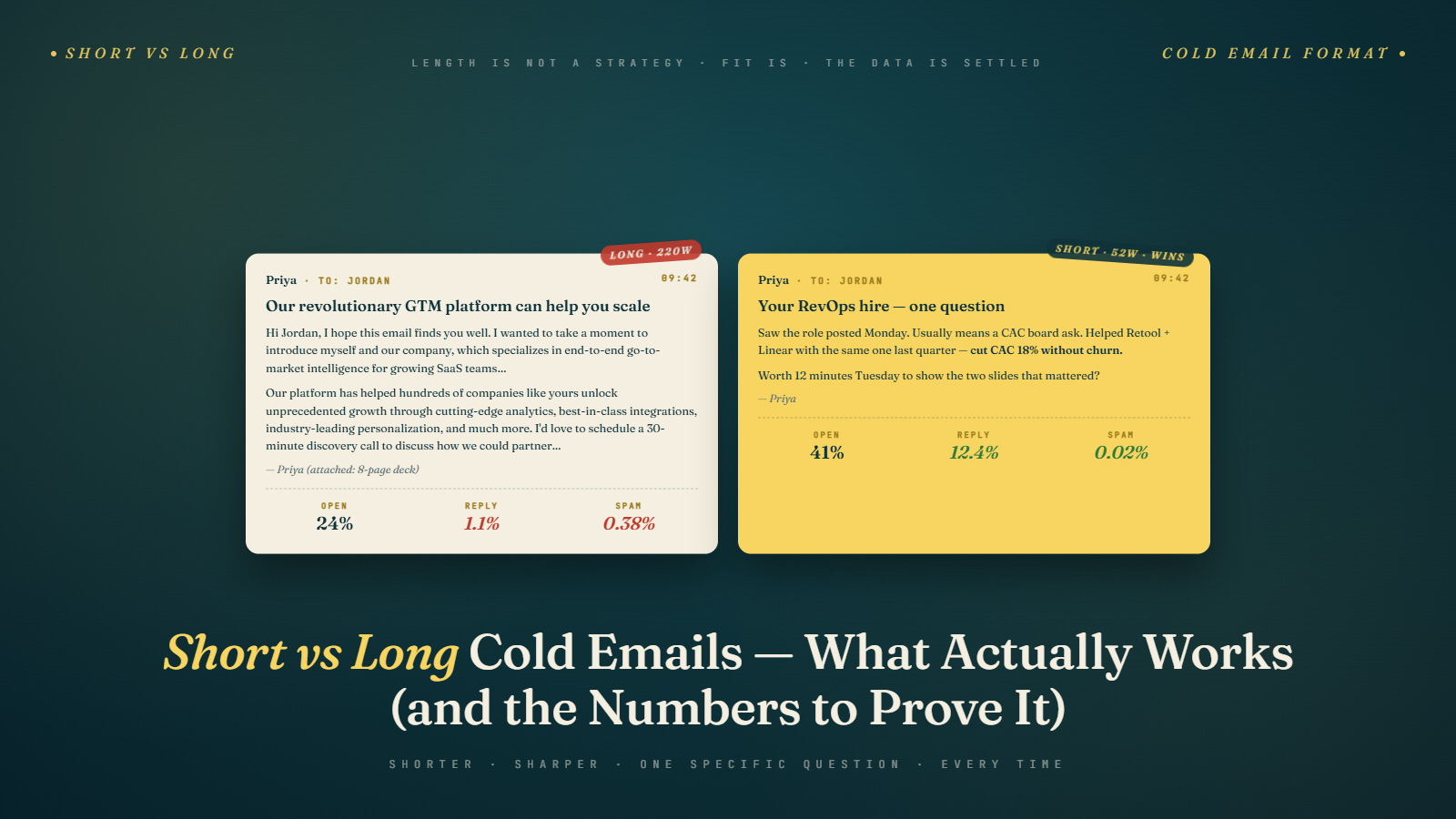
Ask ten experienced cold email practitioners whether short or long emails perform better and you'll get ten different answers. Some will swear by the 3-sentence email. Others have data showing 200-word emails outperform 75-word ones in their campaigns. Both are right — for their specific context.
The problem with the debate is that it's treated as binary. "Short emails work better" becomes the rule, and people write 60-word emails that are too vague to make a compelling case. "Long emails work when you have something to say" becomes the justification for feature-dumping 400-word walls of text.
The real answer is context-dependent, and the factors that determine the right length are knowable. This article breaks them down.
Why Length Is a Symptom, Not the Real Variable
Here's the frame that makes the short vs. long debate more useful: length is not actually the variable that drives cold email performance. Relevance and value density are.
A short email that's vague and underdeveloped will underperform. A long email where every sentence earns its place can outperform the short version. Conversely, a short email that's sharp, specific, and directly relevant will beat a bloated long email almost every time.
The question isn't really "how many words?" It's "does every word in this email add value?"
Long emails underperform not because they're long, but because they're long AND padded. They contain:
- Throat-clearing intros that don't say anything
- Feature lists when outcomes are what matters
- Redundant sentences that repeat points already made
- Caveats and hedges that dilute the core message
- Filler phrases that exist only because the writer felt the email needed more substance
Remove all of that, and often what you're left with is 100–200 words. Not because you aimed for short, but because nothing extra earned its place.
What the Data Generally Shows
Most large-scale studies on cold email length point to a sweet spot in the 75–150 word range for initial cold emails. Emails in this range tend to:
- Respect the reader's time (the signal that you've thought carefully about what to include)
- Feel like a real person wrote them (longer emails feel more like marketing materials)
- Create curiosity rather than answer every question (which gives the prospect a reason to reply)
- Perform well on mobile, where people are more likely to scan than read
But — and this is important — these studies are averages across diverse populations. They don't tell you what works for your specific ICP, your specific offer, and your specific campaign context.
There are well-documented examples of longer cold emails (250–400 words) significantly outperforming short ones when the content was hyper-relevant to the recipient, the problem required more context to make compelling, or the audience was one that responds to thoroughness and depth (certain technical buyers, for example).
So use the 75–150 word guideline as a starting point, not a ceiling.
The Six Factors That Should Determine Your Email Length
1. Deal Size and Complexity
High-ticket, complex products with long sales cycles often benefit from a slightly longer first email — not because more words are better, but because the value proposition is inherently more complex to explain.
If you're selling a $300/month SaaS tool with an obvious value prop, a crisp 80-word email is likely the right call. If you're selling a $50,000 consulting engagement that requires the prospect to understand a nuanced problem before they can appreciate the solution, 150–200 words might be justified.
The calibration: the complexity of your offer and the sophistication required to understand why it's valuable should guide how much space you need to make the case.
2. Buyer Type and Seniority
Senior buyers — C-suite, founders, VPs — are typically time-compressed and have strong filters for anything that looks like a sales pitch. Brevity signals respect. A tight 100-word email from a peer-level sender often performs much better than a comprehensive pitch.
More junior or more technical buyers can be more receptive to detail — they may actually want to understand the mechanics of how your solution works before agreeing to a call. For these buyers, a bit more depth can be justified.
3. How Well-Known Your Category Is
If your prospect already understands the category you're in — email verification, CRM, sales intelligence — you don't need to educate them on the problem. A short email assuming category familiarity and jumping straight to differentiation is appropriate.
If your solution is novel or exists in an emerging category the prospect may not be familiar with, some additional context is needed to make the email land. You can't skip the problem-framing step if they don't yet recognize the problem.
4. The Warmth of the Prospect
A completely cold contact who's never encountered your brand needs a slightly fuller email to establish credibility. Someone who attended your webinar last month, downloaded a piece of content, or was referred by a mutual connection has some pre-existing context — your email can assume that and get to the point faster.
For warm prospects, shorter is almost always better. For fully cold prospects, the calibration is more nuanced.
5. The Specificity of Your Personalization
Counter-intuitively, highly personalized emails can often be shorter because the relevance is immediately obvious. If your opening line perfectly captures a specific situation the prospect is in, you've already established enough context that the rest of the email doesn't need to work as hard.
Generic emails often end up longer because they're trying to establish relevance through volume — mentioning multiple use cases, multiple pain points, multiple proof points, hoping something sticks. Specific emails establish relevance quickly and don't need the extra surface area.
6. Where in the Sequence the Email Falls
Email 1 of your sequence should generally be your most concise. You're making a first impression. Lead with the most compelling hook, make the ask, and stop.
Follow-up emails can be progressively shorter — often much shorter. By email 3 or 4, a single-paragraph follow-up that acknowledges you've tried before and offers a quick out ("no worries if timing isn't right") is more appropriate than another full pitch.
The Anatomy of a Short Email That Actually Works
Short emails fail when they're so compressed that they lose substance. Here's the structure that makes a short email deliver everything it needs to:
[Opening line — personalized, specific, 1–2 sentences]

[Problem + Outcome — their pain, your result, 2–3 sentences]

[Proof — one specific, credible data point, 1 sentence]

[CTA — one low-friction question, 1 sentence]
That structure can be executed in 80–100 words. Here's an example:
Saw your post on SDR ramp challenges — you're describing something we see constantly at Series A/B SaaS companies.
Most teams in your position see ramp time compress from 5–6 months to under 10 weeks after restructuring the onboarding sequence. We've run this with 30+ teams in the last 18 months.
Would it be worth a 15-minute call to see if the approach translates to your setup?
That's 72 words. It has a specific opener, a problem-outcome arc, a proof point, and a low-friction CTA. Nothing wasted.
The Anatomy of a Long Email That Actually Works
If the context calls for more length — complex offering, unfamiliar category, technical buyer — here's how to use the extra space productively:
Additional problem depth: Walk through why the problem is more significant than it appears on the surface. What are the second-order consequences of not solving it? This only works if the extra depth is genuinely revealing and not just repetition.
More thorough proof: A mini case study format — "Company X was dealing with Y, they implemented Z, and saw A result in B timeframe" — gives more credibility than a single metric and works well for longer emails where you have room for it.
Pre-empting an obvious objection: If you know your ICP has a predictable skepticism ("we already tried something like this"), you can briefly address it in the body. "I know there are a lot of tools in this category that overpromise — the difference here is X" is a useful use of extra words.
A secondary hook: A longer email can include a second proof point, a link to a relevant piece of content, or a brief reference to a mutual connection or shared context that didn't fit in the opener.
What a longer email should NOT do: repeat itself, add filler phrases, or add features that aren't directly relevant to the specific reader.
How to Audit Your Own Emails for Length Quality
Here's a practical exercise: take any cold email you've written and go line by line. For each sentence, ask: "If I removed this sentence, would the email be weaker?"
If the answer is no — if removing it doesn't meaningfully hurt the case you're making — cut it.
Most cold emails I review in this exercise can be cut by 20–40% without losing anything. The remaining email is almost always stronger for the compression.
Specific things to cut:
- Opening pleasantries ("I hope you're doing well," "I know you're busy")
- Redundant restatements ("What this means is that..." — just say the thing)
- Category hedges ("While of course every situation is different...")
- Over-qualified claims ("We typically see results, in many cases, with the right setup...")
- Feature-before-outcome descriptions (cut the features, keep the outcomes)
The Role of Formatting in Perceived Length
An email doesn't just feel long because of word count — it feels long because of how it looks on the screen. Two emails with the same word count can create very different impressions based on formatting.
Dense paragraphs feel longer. A 150-word email in one solid block of text feels harder to read than the same 150 words broken into three short paragraphs. Your eye sees a wall of text and anticipates work. Short paragraphs — 2 to 3 sentences maximum — create visual breathing room that makes even a moderately long email feel manageable.
White space is not wasted space. Every blank line in your email is a visual pause. It signals to the reader: "this is a new thought, not an endless continuation of the previous one." Counterintuitively, adding white space can make an email feel more refined, not more padded.
Single-sentence paragraphs. Used sparingly, a one-sentence paragraph creates emphasis and pace. It forces a pause. It isolates the most important thought so it doesn't get buried in surrounding content.
Bullet points almost always expand perceived length. Even though bullets can organize information efficiently, they signal "I have a list of things to tell you" — which makes the email feel more comprehensive and often more salesy. For cold email, prose almost always reads better than bullets unless you genuinely have distinct parallel items that don't work in sentence form.
If you want your email to feel shorter without actually cutting words, look at the formatting first.
Testing Length Empirically
The best approach is not to pick a length based on theory but to test it with your specific audience.
The test: Take the same list segment. Send one group a 75-word version of your email. Send another group a 175-word version. Track reply rates. Which got more replies? What was the quality of the replies?
This tells you what your specific ICP at your specific offer responds to. That's more valuable than any blanket rule.
Run this test across different segments and different parts of your sequence. Length preferences aren't uniform — some audiences genuinely respond to depth and thoroughness, and you'll find that out quickly if you're measuring.
Reading the Room: How to Judge the Right Length in Real Time
Beyond the six factors above, experienced cold emailers develop an intuitive sense for length that comes from reading the contextual signals of each specific campaign.
Signal: How sophisticated is the buyer? A technical founder who's been running cold email for their own outreach will read your email through a different lens than a VP of Operations who gets a few cold emails a week. The technical founder recognizes compressed, efficient copy as a signal of quality. Giving that person more detail than needed actually backfires — it signals you don't know how to communicate efficiently.
Signal: How competitive is the outreach environment? If your prospect is in a high-demand role or industry — a Series B VP of Engineering, a growth-stage CMO — they're likely getting 10–20 cold emails a day. In a crowded inbox, brevity and sharpness are competitive differentiators. If your prospect is in a niche role that doesn't get much cold outreach, you have a bit more room to provide context.
Signal: How novel is your offering? Novel solutions need more setup. If your prospect has never encountered a category like yours, a very short email will leave them confused about what you're even offering. A bit more body copy to establish the problem space is justified. If you're in a well-established category (CRM, email tool, calendar scheduling), everyone already knows the problem — skip the preamble.
Signal: What does your past data say? If you've run cold email before, look at your own reply data by email length. Did shorter emails get more replies? Did longer ones get better quality replies? Did one specific length show up again and again as the winner? Past campaign data is more reliable than any general principle.
Mobile Formatting and Length
One underappreciated dimension of the length debate: mobile rendering. Over 60% of emails are now first opened on a mobile device. On a phone screen, a 200-word email that looks manageable on desktop can look like an essay.
On mobile, your effective "scannable length" is about 3–4 short paragraphs. Beyond that, the reader has to scroll, and each scroll is another opportunity to exit.
This pushes the optimal length even shorter for mobile-first campaigns. If your ICP tends to check email primarily on their phone — many founders and senior executives do — a 75–100 word email with short paragraphs (2–3 sentences each, lots of white space) will perform better than a 200-word block.
Test this by sending to your own phone and assessing the scroll experience. If you have to scroll more than once to read the body of the email, it's probably too long for mobile.
The Working Rule
Here's a practical working rule that covers most B2B cold email situations:
Write long enough to make a compelling case. Cut everything that doesn't contribute to that case.
If you've made your case in 80 words, stop at 80 words. If the case genuinely requires 200 words to land, use them — but earn every word.
Don't write short for the sake of appearing succinct, and don't write long for the sake of appearing thorough. Write until the case is made and the CTA is clear. Then stop.
Next up: Storytelling in Cold Emails — how to use narrative structure to create connection and make your cold email unforgettable without making it long.