
For twenty years the email marketing conversation has orbited one question: did it make it to the inbox. Deliverability consultants built careers on the answer. Tools like GlockApps, Inbox Monster, and Everest exist because getting past spam filters was hard enough to need specialists. I have built programs that obsessed over SPF, DKIM, DMARC alignment. I have spent late nights debugging bounce categorizations. That world still exists. But it is not the main event anymore.
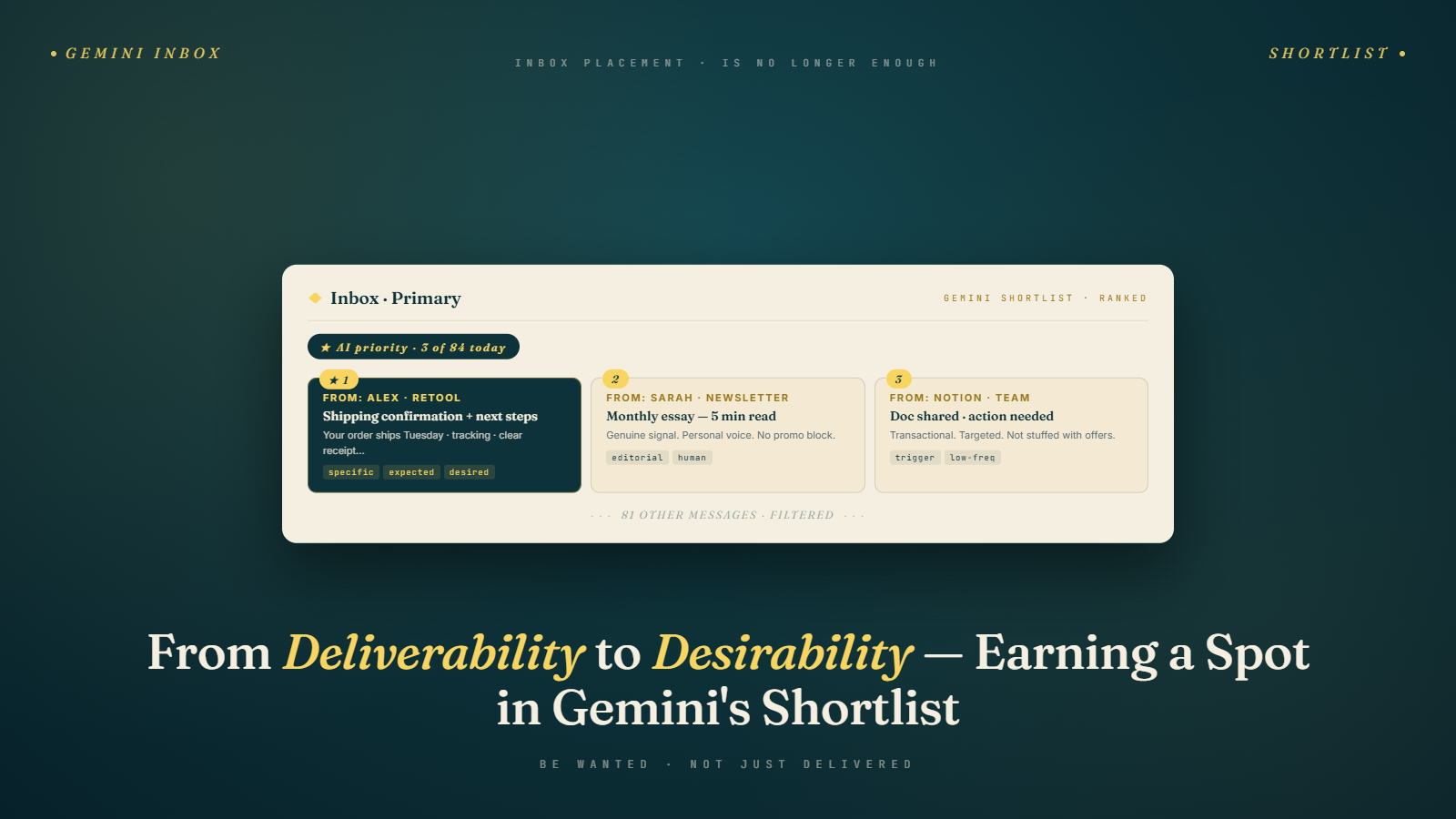
The main event, as of early 2026, is desirability. Gemini now surfaces a shortlist to subscribers, a curated selection of the messages it thinks they actually want to engage with. Delivery to the inbox is table stakes. Making the shortlist is the game. And the marketers who are winning the shortlist war are not doing anything new. They are doing old things correctly.
That is the contrarian take I want to make in this piece. The Gemini era does not require a new playbook. It requires returning to the playbook that good email programs always followed and that bad email programs always pretended to follow while doing something else. The tooling changed. The principles did not.
What The Shortlist Actually Is
When a subscriber opens Gmail on their phone, they see their inbox. But increasingly, they also see Gemini-generated summaries, highlighted messages, and "you might want to read" surfaces. On some accounts there is a literal summary card at the top of the inbox showing three to five emails the AI has decided deserve attention. On others, the surfacing is more subtle, embedded in the tab ordering and the preview emphasis we covered in our AI inbox relevance sorting piece.
The shortlist is personalized per subscriber. Two people on the same list will see different shortlists. Your job is not to be on one shortlist. Your job is to be on as many individual shortlists as you can earn.
The signals that appear to determine shortlist placement are consistent across everything we have observed. High reply rates. Consistent engagement over time. Low complaint rates. Content that matches recipient interest. Frequency that matches recipient tolerance. Sender domain reputation. These are the same signals that made email programs good for the last decade.
The Old Playbook Was Right All Along
Here is what I have been telling clients since 2015. Send relevant mail to people who asked for it, at a frequency they can tolerate, from a well-authenticated domain with a clean reputation, and measure what actually matters. Do not buy lists. Do not re-engage people who never engaged in the first place. Do not blast to the entire database because it feels productive.
The marketers who actually did this have a structural advantage in 2026. Their reply rates are higher because their content is worth replying to. Their complaint rates are lower because their subscribers asked to be there. Their engagement is higher because their segmentation is real. Their domain reputations are High because their fundamentals are clean. Gemini rewards them because the signals are already there.
The marketers who pretended to follow the playbook while actually running mass sends to marginal lists are being exposed. Their engagement signals are weak. Their complaint rates are elevated. Their reply rates are effectively zero because their content is not conversational. Gemini does not hate them. It just has better candidates for the shortlist, and they are losing to better candidates.
Reply Rate As The Clearest Desirability Signal
If I had to pick one metric to predict a sender's 2026 performance, it would be reply rate, by a wide margin. We went deeper in our engagement metrics post, but the short version bears repeating in this context. Replies are the clearest signal that an email was wanted. Gemini weighs them heavily. Marketers who earn replies are on more shortlists.
The marketers who have been ignoring reply rate for years and now want to improve it are not going to catch up in a week. Earning replies requires: a real reply address, a culture of responding within 24 hours, an editorial voice that invites conversation, a content strategy built around questions and curiosity rather than announcements, and a measurement stack that counts replies against campaigns.
Most programs do not have any of these. Building them takes months. The senders who have been doing this for years are running away with the advantage right now because the AI has started weighting what they were already doing.
The Fundamentals That Carry Over
Authentication still matters, maybe more than ever. SPF, DKIM, DMARC at policy enforcement (p=quarantine or p=reject), BIMI where you can justify it. Our Gmail 550 rejection post covered the 2026 enforcement shift. If your authentication is imperfect, you are not in the shortlist conversation. You are in the delivery conversation, which is a lower problem.
List hygiene still matters. A clean list of engaged subscribers beats a dirty list of unengaged ones every single time. Email verification tools remove invalid addresses before you send. Sunset policies remove subscribers who stop engaging. Re-engagement sequences try to recover the ones on the edge. These practices were always right. They are now mandatory because the alternative is placement collapse.
Content relevance still matters. Subscribers who get content aligned with what they signed up for engage more, complain less, reply more, stay longer. This sounds obvious and yet most senders violate it routinely. If someone signs up for shipping notifications, you do not get to also send them promotional blasts without their consent. If someone signs up for your newsletter on productivity, they did not sign up for your company's quarterly earnings announcement.
Segmentation still matters. Bulk sends to full lists were always suboptimal. They are now actively punished because the AI detects the engagement mismatch and suppresses placement. Segmented sends that match content to subscriber interest are not a nice-to-have. They are the work. Our segmentation post covers the mechanics.
Frequency discipline still matters. Manage Subscriptions exposes your cadence to every subscriber. Our post on high-frequency senders goes into the pain. The right frequency is whatever matches subscriber tolerance. Below that is under-utilization. Above it is self-harm.
Unsubscribe friction still matters. The 48-hour compliance rule is now the floor. Compliant unsubscribe flows are not optional. They are a prerequisite for shortlist consideration.
What Actually Changed
A few things did change. I do not want to overstate the continuity.
The margin for error narrowed. In 2018 a complaint rate of 0.2 percent might not have triggered throttling. Today anything above 0.10 percent is a problem. The old tolerances are gone.
The feedback loops got faster. In 2018 a reputation issue took weeks to surface in real data. Today it is days. The AI is recalibrating faster, and your placement reflects the recalibration faster.
The opacity increased. You used to be able to deconstruct why your email landed where it did. Now the AI decides, and the decision is composed of signals you cannot directly see. You have to run experiments and observe the output.
The penalty for mediocrity got steeper. Mid-performing programs used to get mid-tier placement and mid-tier results. Now they get bottom-tier placement because the AI is sorting more aggressively. The gap between the top and the middle widened.
The reward for doing the fundamentals well got bigger. Top-performing programs are seeing lift because the AI's sorting benefits them. If your reply rate is 2 percent and your complaint rate is 0.03 percent, you are in the shortlist more often than ever. The reward got bigger.
Why This Is Actually Good News
For marketers who have been doing this right, the shift is a tailwind. For marketers who have been cutting corners, it is a reckoning. The distribution of outcomes widened. The top is higher. The bottom is lower.
I have a client who has been running a subscriber-first program for eight years. Their email is request-only, opt-in verified, heavily segmented, single-sender voice, response-driven. Their reply rate runs around 2.8 percent on broadcasts. Their complaint rate is under 0.02 percent. Their unsubscribe rate on broadcasts is under 0.1 percent. In the last twelve months, their revenue per email has gone up 41 percent with the same list size. The AI is rewarding them. They did nothing differently except keep doing what they were already doing.
I have another client who ran the opposite playbook for years. Big list, daily sends, minimal segmentation, no reply handling, complaint rate hovering around 0.18 percent. They are in trouble. Deliverability is slipping. Engagement is crashing. Their quarterly revenue is down 22 percent. The fix is not tactical. It is a ground-up rebuild of the program. They do not want to hear it. They are going to have to.
The Contrarian Position
The industry press is full of pieces about AI this and AI that and how email is entering a new era. The framing suggests you need new tools, new tactics, new vendors. I think that framing sells tools, which is why it is popular.
What you actually need is what you always needed: respect for the subscriber's inbox, content worth sending, cadence that fits the relationship, infrastructure that actually works. The new tools help with measurement and automation of the fundamentals. They do not replace the fundamentals.
If you want to be in Gemini's shortlist, you do not need to chase Gemini. You need to chase the subscriber. Gemini is trying to do the same thing. Your interests are aligned. The system rewards alignment.
What A Subscriber-First Program Looks Like In Practice
Acquisition that is honest. The signup form says what subscribers will get, how often, from whom. No lead magnets followed by ambush frequency. No dark patterns.
Onboarding that delivers what was promised, in the format that was promised, at the frequency that was promised, within the first week. Missed expectations set up the first complaint.
Content that is actually worth sending. Written by humans, or at least reviewed by humans, with a point of view, a voice, a reason to exist beyond the send button. Not every email needs to be brilliant, but every email needs to be intended.
Segmentation that matches actual subscriber behavior, not just declared preferences. Behavioral signals beat survey data every time. See our segmentation post for more.
Frequency that the subscriber can tolerate and that you can sustain with quality. If you cannot maintain quality at five sends a week, you are doing three sends a week. Quality compounds. Quantity without quality decays.
Measurement that includes reply rate, complaint rate, unsubscribe cohort analysis, engagement recency, and real conversion lift. Not just opens and clicks. The old scoreboard is broken.
Responsiveness. When subscribers reply, someone replies back. When they complain through support channels, they get heard. When they unsubscribe, the process is instant and easy. The infrastructure around the email is as important as the email itself.
Infrastructure hygiene. Authentication clean. Domain reputation High. Bounces handled. Invalid addresses suppressed, which is where an email verification service fits. The plumbing is not glamorous and it is not optional.
The Short Answer For Snippets
Gemini surfaces a personalized shortlist of emails it thinks each subscriber wants. Shortlist placement is driven by the same signals that always indicated program health: high reply rates, consistent engagement, low complaint rates, content matched to subscriber interest, frequency matched to tolerance, clean domain reputation. The Gemini era does not require new tactics. It requires doing the old tactics correctly. Marketers who have been subscriber-first for years have a structural advantage now that the AI is weighting what they were already doing.
The Structural Advantage
If you started building a subscriber-first program in 2023, you were early. You are now reaping the compounded benefit of three years of disciplined sends. Your reputation is already High. Your engagement is already strong. Your reply rate is already measurable. When Gemini started sorting, you were already optimized for the things it measures.
If you are starting this work in 2026, you are late. Not too late, because email is a long game. But late enough that you will spend the next 12 to 18 months catching up while your better-prepared competitors extend their lead. The patience required is real. The alternative, faking the shortcut, does not work because the AI will detect what is actually happening underneath the marketing.
Our inbox placement post has more on the reputation side of this. The personalization post covers the content side. The fundamentals have been documented for years. They are not hidden knowledge. They are unglamorous knowledge, which is why most programs skip them until they have no choice.
The Failure Mode Nobody Names
Programs that try to fake desirability instead of earning it have a recognizable failure pattern worth naming directly.
They buy or scrape lists and then try to engineer engagement signals through sophisticated tactics: artificially triggering opens, fabricating clicks through link scanners, or running engagement farms. Gemini's models are trained against this behavior specifically because it was a common adversarial pattern before the AI-weighted era. Artificial engagement signals have a different fingerprint than genuine engagement, and the AI reads the fingerprint.
The more subtle failure is running real campaigns to subscribers who never wanted them. The senders who bought a data list in 2024 and have been mailing it with genuine content are often surprised that their reputation keeps sliding despite real content effort. The issue is that the subscribers on the list did not consent to the relationship, their engagement signals are mostly deletions and complaints, and no content quality fixes that. Running your list through verification catches the dead addresses, but it does not create consent where none exists. The only fix for a non-consented list is to rebuild acquisition around consent, which is slow and unglamorous.
What To Do Tomorrow Morning
Pick one fundamental you have been skipping. For most programs it is reply handling. For some it is authentication. For others it is segmentation. Pick the one that, if fixed, would most change the behavior of your program. Put it on the roadmap for the next 60 days. Not a project to study it. A project to ship it. When it ships, pick the next one. Keep going. The compounding starts the moment you stop pretending the fundamentals are already in place, and it does not stop.