
The Quality Cliff
Every cold email operation eventually hits a point where someone looks at the results and says: "We need to send more." More prospects, more volume, more pipeline.
The first response is usually to push the existing system harder: more contacts added to existing sequences, sequences extended to more steps, SDRs asked to cover more ground. And for a while, this works — volume goes up, meetings go up, pipeline goes up.
Then, usually gradually rather than suddenly, quality starts slipping. The personalization hooks get lazier. The ICP filter gets looser because "we need more leads." The follow-ups get more generic. Complaint rates tick up. Deliverability starts degrading. Reply rates start declining even as send volume increases.
This is the quality cliff — the point where scaling harder without scaling smarter produces diminishing and eventually negative returns.
Avoiding the quality cliff isn't about sending less. It's about building systems that make quality sustainable at scale, so that sending more doesn't mean sending worse. This article is about those systems.
Why Personalization Degrades at Scale (And Why It Doesn't Have To)
Personalization typically degrades at scale for one of three reasons:
Time budget: Individual researchers can only do so much per hour. As volume requirements grow, research time per contact shrinks. The result is shallower personalization or template-based shortcuts.
Knowledge gap: Early-stage cold email is often run by the founder or a senior person who deeply understands the ICP, the product, and the market. As the team grows, less-experienced SDRs run the same playbook with less contextual knowledge — and the emails subtly show it.
Template drift: As sequences run longer, templates become "the standard" and stop getting refined. A template that was sharp 6 months ago has often gone stale — its language no longer reflects the current market, its proof points are dated, its framing has been copied by competitors.
None of these are inevitable. They're all preventable with the right architecture.
The Tiered Personalization System at Scale
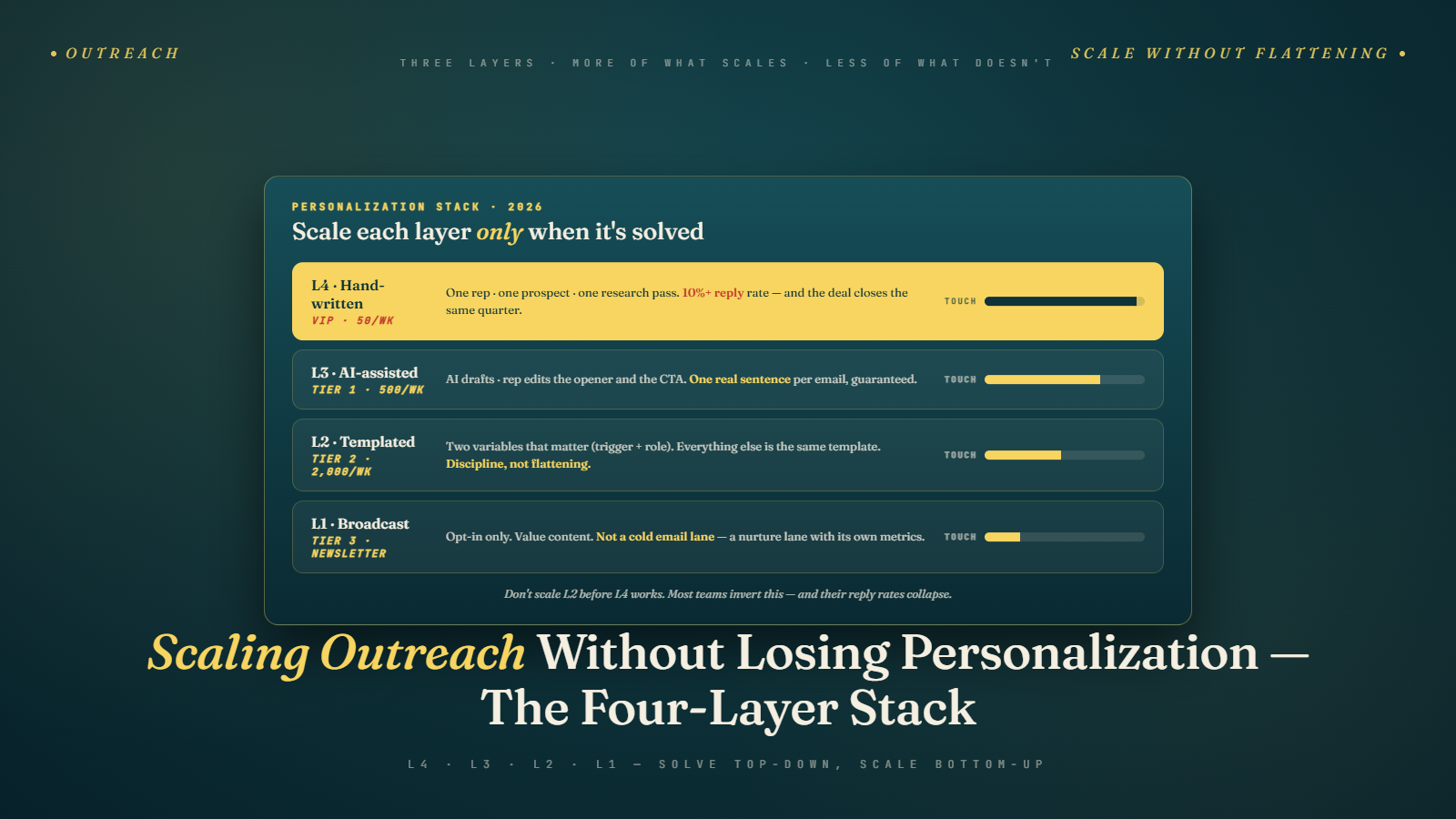
The most durable approach to scaling without quality loss is a formal tiered personalization model — something we introduced in Personalization at Scale in Phase 3, but here we address it from the scaling and operations angle.
The principle: invest personalization effort proportional to deal potential. Not every contact gets the same depth of research; research depth maps to revenue expectation.
Tier 1 — Strategic Accounts (High ACV) Characteristics: Dream clients, enterprise targets, or strategic accounts that would materially change your business.
Research investment: 15–30 minutes per contact. Full manual research. Custom opening lines. Potentially multiple touches over months.
Personalization: Reference multiple specific signals (recent content, company news, career history, mutual connections). Email feels entirely written for this person.
Scaling mechanism: Keep this tier small enough that it stays manageable. 5–10% of your total prospect list. These are the accounts where volume is irrelevant — quality is everything.
Tier 2 — Core ICP (Mid ACV) Characteristics: Strong ICP fit, deal size justifies real research but not the highest-touch approach.
Research investment: 3–7 minutes per contact. Check LinkedIn for recent posts or job change. Check company page for news. One specific personalization hook.
Personalization: One genuine individual signal in the opening line; segment-specific framing for the rest of the email.
Scaling mechanism: Tooling (Clay, LinkedIn Sales Navigator spotlights) surfaces the individual signal efficiently. The human writes the personalization hook; the template carries the rest.
Tier 3 — Broad ICP (Low-Mid ACV) Characteristics: Broadly matching ICP, high volume, deal size makes deep individual research uneconomical.
Research investment: Under 60 seconds. Maybe a quick scan to confirm they're still at the company in the right role.
Personalization: Segment-level only. The email is written to be highly specific to the type of person, not the individual person.
Scaling mechanism: The segment copy does the personalization work. Investment goes into writing better segment-specific templates — more research time per template, less time per contact.
This structure means scaling primarily happens at Tier 3, while Tier 1 stays at consistent quality regardless of volume. You're not trying to do deep research on 1,000 people per month — you're doing deep research on 50 people per month and scaling efficient segment-level outreach for the rest.
Building the Systems That Make Tier 3 Actually Work
Tier 3 personalization only works if the segment-level copy is genuinely specific and resonant. Generic "spray and pray" email with a company name variable is not Tier 3 — it's no tier at all.
The investment for Tier 3 is upfront: writing segment-specific copy that's compelling enough to work without individual hooks.
What makes Tier 3 copy effective:
- The opening line references a situation or pattern specific to this type of company, not just this company: "Most e-commerce brands hitting $5M ARR start seeing the same pattern with their email program..."
- The pain point is stated in the exact language this segment uses internally: not "email performance issues" but "deliverability degrading right as you're scaling your subscriber list"
- The proof references companies of the same type: "We've worked with 12 DTC brands in the $3M–$15M range on this..."
- The CTA is calibrated to this segment's buying behavior: "Is this worth a 15-minute call to compare what you're seeing with what we see at your stage?"
Writing copy at this level takes real investment — customer interview data, win/loss analysis, deep understanding of the segment's language and concerns. But once written, it scales to thousands of contacts without degrading because the quality was baked into the template, not into per-contact research time.
The Template Maintenance System
Templates go stale. Copy that was sharp six months ago may now be using language your competitors have adopted, referencing proof points that are no longer your most compelling, or missing new angles that have emerged from recent customer conversations.
Scale amplifies template decay: the more contacts your template reaches, the more quickly its patterns become familiar to recipients, and the faster your reply rates normalize downward.
Template maintenance cadence:
- Weekly: Review reply rate and open rate data for live templates. Flag any sequences showing declining performance.
- Monthly: Read every active template as if you were the prospect. Does it still sound sharp? Is the language current? Are the proof points still your best?
- Quarterly: Full template refresh for any sequence that's been running more than 3 months. Rewrite from a fresh perspective, incorporating everything learned from campaign data and new customer conversations.
The teams that maintain strong results at scale are not the ones with the best first draft — they're the ones with the best iteration discipline. The template is always improving.
The Research Infrastructure That Enables Scale
Manual research doesn't scale. But not all research needs to be manual. Building a research infrastructure — a set of tools and processes that surface personalization signals automatically — is what enables Tier 2 personalization to scale beyond what a single human could do manually.
LinkedIn Sales Navigator Spotlights: The "changed jobs recently" and "posted on LinkedIn in last 30 days" filters are powerful scale tools. They automatically surface the subset of your ICP who have the most relevant timing signals. If you're working from a filtered list of only people who meet these criteria, you've pre-selected for the contacts most likely to have a natural personalization hook — making research time more efficient.
Clay workflows: Clay can automate multi-source enrichment — pulling LinkedIn data, company news, tech stack information, and other signals into a structured output per contact. With a well-designed workflow, you get a "personalization brief" per contact that a human can review in 60–90 seconds and turn into a first line. This is the closest thing to scalable Tier 2 research that currently exists.
Google Alerts: Setting up Google Alerts for your Tier 1 and top Tier 2 target companies means relevant news surfaces to you automatically, without daily manual checking. A simple alert for "Company X funding" or "Company X CEO" keeps your research current with minimal ongoing effort.
CRM signal tracking: If your CRM captures product engagement data, website visit data, or past interaction history, surfacing that data in your outbound workflow gives you personalization signals that no external research can replicate.
Team Structure and Quality Control at Scale
As the cold email program grows and more people contribute to it, quality control becomes an operational function, not an individual judgment call.
Copy review processes: Any new template or significant copy update should go through at least one review before it enters live campaigns. The reviewer checks: does this sound like a human wrote it? Does it pass the "could I have sent this to anyone" test? Is the personalization real?
Quality benchmarks: Define minimum acceptable performance standards for each segment and sequence type: "We don't continue running a sequence below X% reply rate." Below benchmark, the sequence gets reviewed and refreshed before it continues.
SDR calibration: When multiple SDRs are doing research and writing personalization hooks, regular calibration sessions ensure everyone is working to the same standard. Review actual personalization lines together, identify patterns of what's working and what's not, and update the shared understanding of what "good" looks like.
Random audits: Periodically pull a random sample of emails that actually went out and read them as a recipient would. Does the program still look like what you intended? This catches drift that metrics alone won't catch — subtle shifts in tone, gradually loosening ICP standards, formula language that's become habitual.
Metrics That Reveal Quality Degradation
Scale-related quality problems don't always show up in volume metrics. These are the signals that specifically track whether personalization and targeting quality is holding:
Reply rate per segment (not total): A declining reply rate in a specific segment that can't be explained by list exhaustion suggests copy quality has degraded for that audience.
Positive reply rate (vs. total reply rate): Total reply rate includes "unsubscribe," "not interested," and "stop emailing me" replies. Positive reply rate — replies that indicate genuine interest — is the real quality metric. If positive reply rate falls while total reply rate holds, you're generating more noise and less signal.
Spam complaint rate trends: Rising complaint rates are often an early indicator of targeting drift — your ICP filter has loosened and you're reaching people who find the email irrelevant. This shows up in metrics before it shows up in qualitative review.
Meeting quality scores: Are the meetings your cold email is booking converting at the same rate as before? If meeting-to-opportunity conversion drops, the issue may be that the ICP targeting has loosened — you're booking more meetings with people who were never really going to buy.
The List Verification Layer at Scale
One quality dimension that degrades at scale with particular speed is list hygiene — specifically, email address validity. When you're sending 50 emails a week manually, you notice and handle bounce issues in real time. When you're running automated sequences at 300+ sends per day, bounce accumulation can quietly damage your sender reputation before you catch it.
The solution is treating email verification as an automated, non-negotiable step in your list preparation workflow rather than a manual one-off you remember to do sometimes.
The practical workflow: every batch of contacts — regardless of source — goes through bulk verification with BulkMailVerifier before entering any live sequence. Contacts flagged as invalid or high-risk are removed. Catch-all domains are reviewed separately and triaged based on your acceptable risk threshold. This step, done consistently, keeps your bounce rate where it needs to be (under 3%) even as send volume grows.
The teams that skip verification "because the data came from a reliable source" are the ones who discover mid-campaign that 8% of their Apollo export has gone stale since the database was last refreshed. Contact data decays faster than most people expect — industry estimates put professional email turnover at roughly 20–25% per year. A list that was clean 6 months ago has meaningfully degraded.
At scale, make verification part of your automation stack. Most list-building workflows in tools like Clay can integrate verification as a workflow step. Zapier and Make can trigger batch verification as contacts are added to campaigns. The goal is zero manual effort on verification — it happens automatically, and only verified contacts advance to live sequences.
Maintaining Quality as the Team Grows
Quality degradation at scale often has less to do with the email system and more to do with the human system. As the cold email function grows from one founder-sender to a team of SDRs, the institutional knowledge that lives in one person's head needs to be codified into processes that transfer reliably.
The copy standards document: Every cold email program at scale needs a document that defines what "good" looks like in concrete, reviewable terms. Not "write personalized emails" — that's too abstract. Instead: "The opening line must reference a specific signal from the prospect's LinkedIn, the company's website, or a recent news event. Generic observations like 'I noticed you work in sales' do not qualify as personalization." This level of specificity allows review and calibration.
The ICP definition document: Your ICP should be documented in enough detail that a new SDR can use it as an actual filtering guide — with specific firmographic criteria, disqualification signals, and example companies that do and don't fit. A fuzzy ICP definition gets fuzzier with every person who interprets it.
The onboarding test: Before a new SDR runs live campaigns, have them write personalization hooks for 10 sample contacts using your process. Review those hooks against your quality standard. This is faster than discovering quality problems six weeks into live campaigns.
Regular copy reviews: Monthly or bi-monthly sessions where the team reviews actual emails that went out, reads them as a prospect would, and identifies where copy has drifted from the standard. These sessions reinforce what good looks like and catch drift early.
The underlying principle: the processes that allow one expert to produce quality output need to be made explicit and teachable before they can scale. What lives in your head as intuition needs to become a checkable standard.
Common Scaling Mistakes
Mistake 1: Assuming More Volume Compensates for Lower Quality
The math never actually works out this way. 1,000 emails at 1% reply rate generates 10 replies. 300 emails at 5% reply rate generates 15 replies — from 70% less effort and 70% less deliverability risk. Chasing volume at the expense of quality is a losing trade.
Mistake 2: Delegating Without Teaching
When a new SDR takes over a cold email program, they need to understand why the copy works, not just how to run the sequences. If they don't understand the ICP deeply enough to write a sharp personalization hook, they'll default to the generic. Teach the principles before handing over the playbook.
Mistake 3: Treating Templates as Finished
Templates are working documents, not finished products. The team that treats templates as "done" after the first version almost always sees performance decay over time.
Mistake 4: Scaling the List Faster Than You Scale the Infrastructure
Adding 500 new contacts per week to sequences is meaningless if your sending infrastructure isn't ready for the volume. The list and the infrastructure need to scale in sync — as covered in Sending Limits & Scaling Safely and Managing Multiple Email Accounts.
Next up: A/B Testing Your Cold Emails — the rigorous testing framework that turns your scaling data into compounding improvements.