
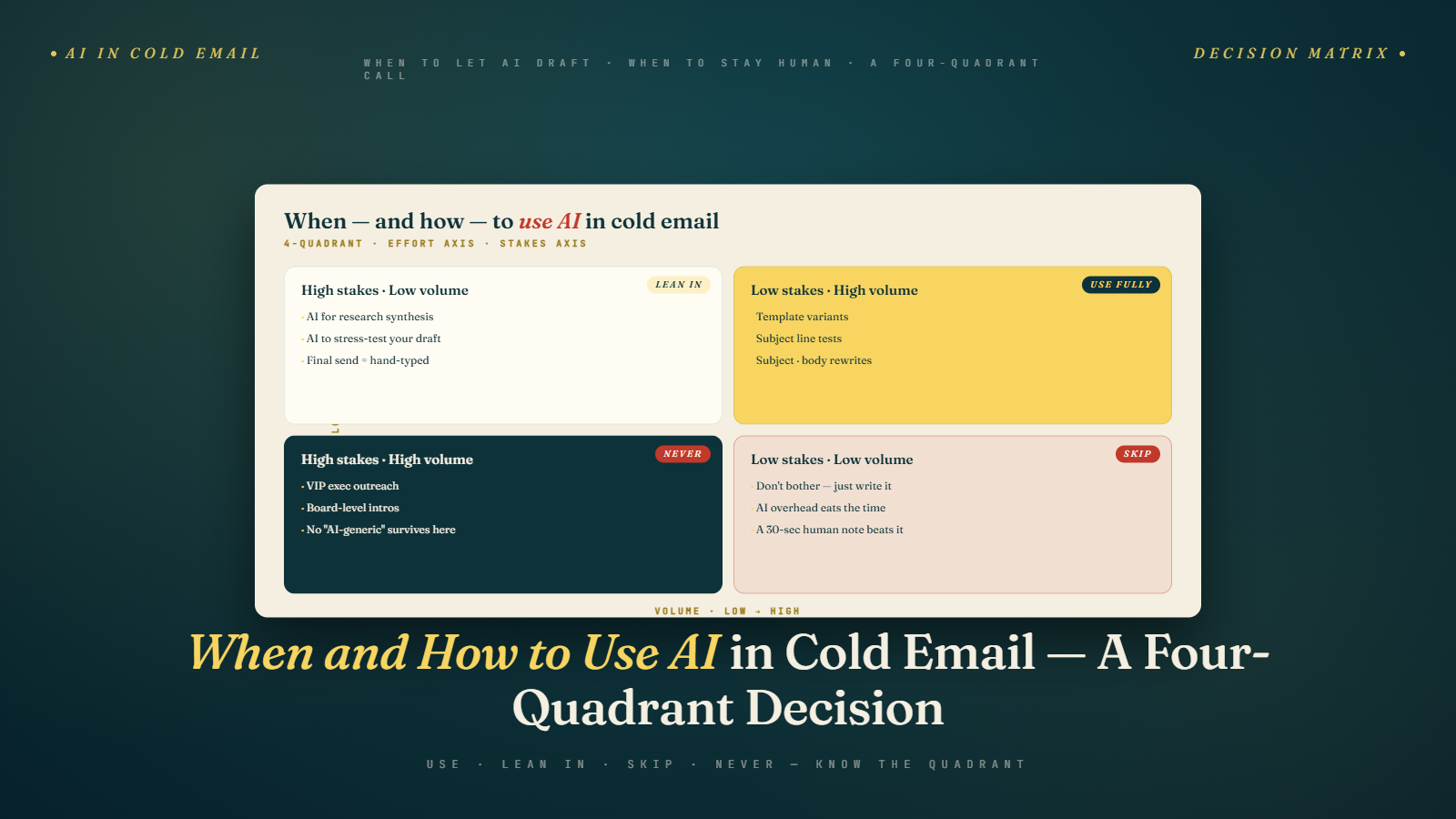
The Hype and the Reality
The moment ChatGPT became mainstream, cold email vendors rushed to announce AI-powered personalization. "Let AI write personalized emails for every prospect at scale." The promise was appealing: the quality of individually researched outreach at the efficiency of automation.
In practice, most people who've actually tested AI-generated cold emails at scale have found the results... underwhelming. Reply rates didn't dramatically improve. Some teams saw them fall. And practitioners with experience reviewing large volumes of cold email started identifying AI-generated messages fairly reliably — not because AI is obviously bad at writing, but because AI-generated cold email has a particular texture: technically competent, logically structured, missing the lived specificity that comes from a human who has genuinely been in the industry.
None of this means AI is useless in cold email. It means the hype vastly overstated what AI could do while missing what it actually does well.
This article gives you the honest picture: specific use cases where AI genuinely accelerates cold email work without degrading quality, specific use cases where it degrades quality without you necessarily noticing, and the workflow architecture that extracts value from AI while keeping human judgment where it matters.
What AI Does Well in Cold Email
Research and Information Gathering
Before writing a personalized email, a human researcher needs to: find recent LinkedIn posts, scan company news, identify relevant triggers, understand the industry context. This research process — not the writing — is where most personalization time is spent.
AI accelerates this meaningfully when used as a research assistant:
- Summarizing LinkedIn profiles: Feed a LinkedIn profile URL (or the text of a profile) to an AI tool and ask it to surface the most relevant personalization hooks for your specific offer. A 5-minute manual review becomes a 30-second AI summary plus a 60-second human judgment call.
- Company news digestion: Ask AI to summarize recent news about a target company and flag anything relevant to your value proposition. Useful for identifying triggers before you write.
- Industry context: "What are the top challenges facing mid-market e-commerce companies scaling past $10M in 2026?" gives you background for more resonant segment-level copy.
In all of these cases, AI is accelerating research, not replacing judgment. The human still decides what's relevant and how to frame it.
First-Draft Generation
AI can generate competent first drafts of cold email copy. These drafts are rarely publication-ready, but they're often a useful starting point — faster to edit than to write from scratch, especially for practitioners who find blank-page writing slow.
The effective workflow:
- Define the ICP, the problem, the outcome, and the proof point you want to use
- Give AI the specific context: "Write a cold email to a VP of Sales at a 100-person SaaS company. The problem is SDR ramp time. Our outcome: average ramp reduced to 10 weeks from 5 months. Proof: worked with 40+ similar teams."
- Review the draft. It will almost certainly need editing — AI tends toward slightly formal, slightly generic language even with good prompts. Edit it to sound like you.
- Use the edited version as your template base.
The value here is speed on the structural/mechanical writing work, not the final judgment on what makes the email compelling.
Sequence Structure Brainstorming
Building a 5-email sequence requires 5 different angles, hooks, and value frames. AI is genuinely useful for brainstorming what those angles might be:
"I'm writing a 5-step cold email sequence for [ICP]. Email 1 covers [angle]. Suggest 4 more distinct angles for subsequent emails, each targeting a different dimension of the problem."
The output is usually 4–6 usable ideas, of which 2–3 will be good and worth developing. It's not replacing the judgment call about which angles are best — it's populating the brainstorming phase faster.
Subject Line Variation
Generating 10–15 subject line variations for A/B testing is exactly the kind of creative volume task that AI handles efficiently. The frameworks are consistent (as covered in How to Write Subject Lines That Get Opened), and AI can apply them to your specific context quickly.
Input: "Generate 15 cold email subject lines for [ICP + specific problem]. Use these approaches: direct question, peer reference, specific outcome, trigger-based..."
Output: A list to evaluate, cut, and test from — much faster than writing 15 variants from scratch.
Sequence Template Scaling
If you've written a strong cold email template for one segment and need to adapt it for three other segments, AI can generate the adapted versions from the original as a base. The structure and logic stay consistent; the segment-specific language and pain point framing get adjusted.
Again: these are starting points for human review, not finished products.
Where AI Degrades Cold Email Quality
Generating "Personalization" Without Real Research
The most oversold AI cold email use case: "AI scans the prospect's profile and generates a personalized first line automatically." In theory, elegant. In practice, the outputs tend to be:
- Generic observations that could apply to many people ("I noticed you have extensive experience in sales leadership...")
- Compliments that sound hollow because they're derived from data patterns rather than genuine observation ("Your company's impressive growth trajectory caught my attention...")
- References to things that are technically true but irrelevant or not worth referencing
Recipients who receive a lot of cold email — and your best prospects usually do — recognize this flavor of AI-generated "personalization" fairly quickly. The uncanny valley of something that looks personalized but feels hollow is often worse than a clean, generic segment-specific email.
The test: if you read the AI-generated personalization line out loud, would you be embarrassed if the prospect knew a machine wrote it? If the answer is yes, it needs human rework.
Writing the Full Email Body
AI-written cold email bodies have a characteristic that experienced cold emailers notice: they're logically sound but emotionally flat. The sentences are grammatically correct and structured correctly. They make the points in the right order. But they lack the specific texture — the industry vernacular, the practitioner's instinct for what actually resonates, the earned authority that comes from genuinely working in this space — that makes cold email feel like it was written by someone who actually knows what they're talking about.
This isn't a criticism of AI capability in general. It's an observation that cold email quality depends on specificity and felt expertise — things that AI in its current state approximates but doesn't replicate.
Use AI to draft, then rewrite enough that it sounds like you. If your editing process amounts to just changing a few words and calling it done, you probably haven't added enough of yourself.
Replacing ICP Research and Targeting Decisions
AI cannot tell you who your best customers actually are. It can describe personas, generate profiles, and synthesize research — but the real ICP comes from customer interviews, win/loss data, and earned market knowledge. AI substitutes for this with plausible-sounding synthesis that may or may not reflect reality for your specific product in your specific market.
The ICP definition process from Phase 2 is irreplaceable by AI. Use AI to process and summarize data about your ICP once you've validated it through real market experience — not to define the ICP in the first place.
Automating Replies
Sending AI-generated responses to cold email replies is a fast way to destroy the rapport that the entire sequence was designed to create. The reply is the moment human interaction begins. Don't automate it.
The AI-Assisted Cold Email Workflow
Here's a practical workflow that extracts AI's genuine value without letting it into the areas where it degrades quality:
Step 1: Prospect Research (AI-assisted)
- Use AI to summarize LinkedIn profiles of high-value targets
- Use AI to scan company news pages for relevant triggers
- Use AI to generate industry context for your segment messaging
Step 2: Personalization Hook Selection (Human)
- Review AI-surfaced information and decide which elements are genuinely worth referencing
- Write the actual personalization hook yourself based on the research
- This is a judgment call that needs to stay human
Step 3: Template Drafting (AI-assisted, human-edited)
- Use AI to generate a first draft of each email in the sequence, given specific inputs
- Edit substantially — cut the generic filler, inject your voice, sharpen the specificity
- If you're not editing more than 30–40% of the AI output, you probably haven't edited enough
Step 4: Subject Line Generation (AI-assisted)
- Use AI to generate 10–15 variants across different frameworks
- Select 2–3 for testing based on human judgment about what resonates for this ICP
Step 5: Quality Review (Human)
- Read the full sequence out loud
- Does it sound like a human wrote it? Does it sound like you?
- Would you be comfortable if the prospect knew you used AI as a drafting tool?
Step 6: Personalization Variable Filling (Mixed)
- For Tier 1 targets: human-written personalization hooks, inserted as custom variables
- For Tier 2 targets: AI-drafted hooks, human-reviewed and edited per contact
- For Tier 3 targets: segment-level templates with minimal individual personalization
This workflow uses AI most heavily in the research and first-draft stages — where its speed advantage is greatest — and most conservatively in the judgment and quality stages — where human review is irreplaceable.
Specific AI Tools Worth Knowing
ChatGPT / Claude / Gemini: The general-purpose LLMs are the Swiss Army knives of the stack. Best for research summarization, first drafts, subject line generation, and brainstorming. Free or low-cost at the individual level.
Clay: Not purely an AI tool, but its AI enrichment features deserve mention here. Clay can use AI to generate personalized first lines at scale by pulling data from LinkedIn and other sources, running it through an LLM, and outputting a custom variable for each contact. When configured carefully with good prompts and human quality-check sampling, this is one of the best implementations of AI in cold email prospecting and personalization at scale.
Lavender: An AI writing assistant built specifically for cold email. Provides real-time feedback on email quality scores, personalization strength, and likely deliverability. More useful as a quality-check layer than as a primary writing tool.
Twain: An AI writing assistant that specializes in cold email and sales copy. Better at the genre conventions of cold email than general-purpose LLMs. Worth testing for teams that want an AI tool trained on cold email specifically.
Instantly / Lemlist AI features: Both platforms now include AI assistance for subject line generation, copy variations, and personalization. Convenient if you're already on these platforms, but generally less capable than dedicated LLMs with well-crafted prompts.
The AI Detection Question
As noted earlier in Avoiding Spam Filters in 2026, spam filters are increasingly integrating signals that identify AI-generated content. This doesn't mean AI-written emails get automatically filtered — but it's a directional risk that adds to the argument for keeping AI as a drafting aid rather than a final author.
Beyond filter detection, human detection matters more. Senior buyers and experienced professionals can often identify AI-written cold email from the texture of the language. When that happens, the credibility of the outreach drops — not because AI assistance is inherently illegitimate, but because unedited AI copy signals "I didn't care enough to actually write to you."
The standard to aim for: an email where you could confidently tell the prospect "I used AI to draft this, then rewrote it to reflect my actual thinking and knowledge." That's transparent, efficient, and honest. An email that you couldn't describe that way — one where AI was the author and you were the spell-checker — isn't meeting the standard.
Prompting AI for Better Cold Email Outputs
Most people who complain that AI-generated cold email is generic are working with generic prompts. The quality of AI output in cold email correlates directly with how much context and constraint you provide upfront. A lazy prompt produces a lazy email; a detailed, specific prompt produces something much closer to usable.
The difference between a weak AI prompt and a strong one for cold email:
Weak prompt: "Write a cold email to a VP of Sales."
Strong prompt: "Write a cold email from a B2B SaaS company that reduces SDR ramp time. The recipient is a VP of Sales at a 150-person SaaS company that recently raised a Series B. They posted on LinkedIn last week about challenges with new hire productivity. The email should be under 120 words, have no marketing language, use a conversational tone, reference the specific problem of SDR ramp time (not generic sales productivity), include one specific proof point (we've helped 40+ teams reduce ramp from 5 months to 10 weeks), and end with a low-friction yes/no question. Do not use the phrases 'I hope this email finds you well,' 'I wanted to reach out,' or 'I'd love to chat.'"
The second prompt produces email that's specific, constrained, and much closer to something you'd actually send. You'll still edit it — but you're editing 20% rather than rewriting from scratch.
A few prompting principles that improve AI cold email output consistently:
- Specify the word count ceiling. AI will write long by default. Force brevity: "Under 100 words, not counting the sign-off."
- List phrases to avoid. AI has learned from millions of sales emails and has absorbed every cliché in the genre. Explicitly exclude the clichés.
- Give the specific proof point. AI will invent plausible-sounding but vague proof points if you don't provide real ones. Provide the actual metric, the actual client type, the actual result.
- Define the tone with examples. "Conversational, like a text from a colleague you respect" gives AI more useful direction than "professional but friendly."
- Tell it what not to do as much as what to do. The prohibition list is often more valuable than the instruction list.
This approach won't make AI output ready to send without editing. But it will make the editing process much shorter — and the gap between the AI draft and the finished email much smaller.
Common AI Mistakes in Cold Email
Mistake 1: Trusting the AI Personalization Without Reviewing It
AI research summaries are starting points, not ground truth. They can contain outdated information, mischaracterize a company's situation, or surface irrelevant details. Always spot-check AI-surfaced personalization before it goes into a live sequence.
Mistake 2: Using AI to Scale Generic Templates Faster
If your underlying template is generic, using AI to fill in personalization variables faster doesn't fix the generic problem — it automates generic outreach at higher speed. The result is more fast-moving noise, not better signal.
Mistake 3: Not Editing the AI Output
"The AI draft was good enough" is almost never true for high-quality cold email. AI drafts are starting points. They need human editing to remove the generic phrases, inject the practitioner knowledge, and bring the specific texture that makes outreach feel like it came from someone who actually works in this space.
Mistake 4: Using AI for Reply Management
If a prospect replies to your cold email and your first response is AI-generated, you've replaced the human moment with an automation. This is where the whole sequence was trying to get to — don't automate the payoff.
Next up: Scaling Outreach Without Losing Personalization — the systems and processes that maintain quality as your cold email volume grows.