
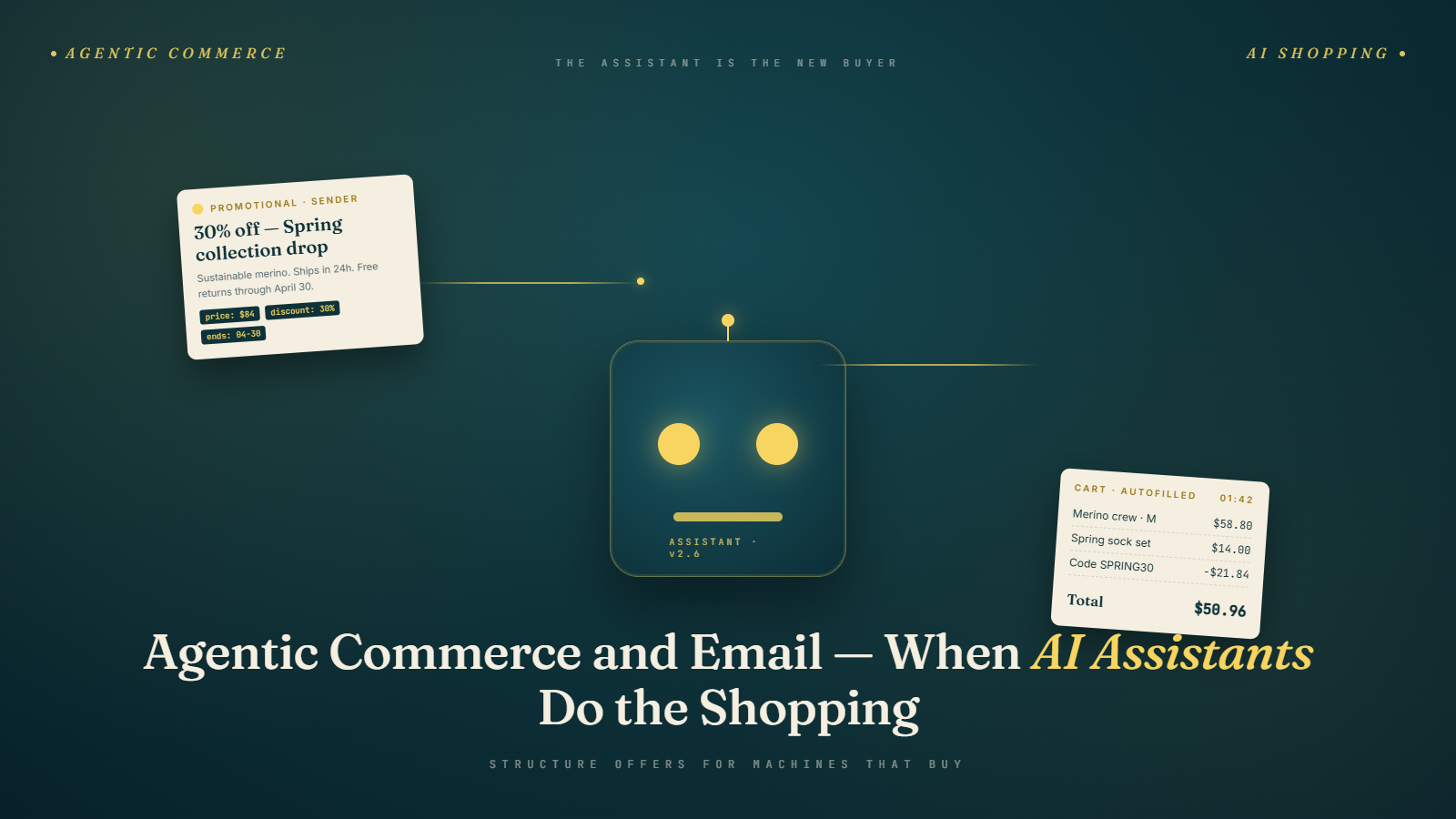
A subscriber gets your 20%-off email on Tuesday morning. They do not open it. Later that day, they ask their AI assistant: "What deals do I have on running shoes right now?" The assistant scans their inbox, reads your email, extracts the offer, and either surfaces the deal as a recommendation or, increasingly, completes the purchase directly.
This is happening now. Not at scale, not everywhere. But enough that the forward-thinking senders I talk to are already adjusting how they write promotional emails.
Agentic commerce is the shift from AI as a search tool to AI as an acting agent. Google's Gemini can read your Gmail, summarize promotions, and surface purchase options inside Search. Perplexity Shopping pulls product data from multiple sources, including emails when given access. ChatGPT's shopping features, combined with memory and browsing, let users delegate buying decisions. The gap between "AI helped me find something" and "AI bought it for me" is closing fast.
What does this mean for promotional email? Mostly it means the emails that were already written clearly will benefit more than vague ones. But there are specific structural choices that matter more now than they did two years ago.
What AI Shopping Agents Actually Need from Your Email
When Gemini reads a promotional email, it is not absorbing tone and brand feeling. It is looking for specific pieces of data: what is the product, what is the price (or discount), when does the offer expire, and how does the buyer act on it. That is essentially the same question a customer would ask, but without any patience for discovery.
I have run tests showing that standard ecommerce promo emails often fail this basic extraction. Typical formats like "Up to 40% off sitewide" give the AI agent very little to work with. Which products? Is this the running shoes or the yoga mats? Does it apply to sale items? When does it end?
The AI cannot infer what you mean by "sitewide" if your site has exclusions. It will either skip the email or produce a vague summary like "possible discount, details unclear."
Compare that to an email that says: "20% off all running shoes through midnight Friday, April 18. Use code RUN20. [Shop Running Shoes]." An AI agent reading that can return a clear answer to the subscriber's question. It can even complete the purchase if configured to do so.
This is not about dumbing down your email copy. It is about front-loading structured facts before the narrative copy that follows.
The Emails That AI Agents Ignore
Some email formats are almost invisible to AI shopping agents. These are worth knowing so you can decide when they matter.
Pure image emails rank first on the ignore list. If your offer text is baked into a JPEG, no AI agent can extract it. The image gets processed as an image (sometimes with alt text), but structured offer data is gone. A subscriber asking "what deals do I have on shoes" will not surface your sale if the discount is in a banner image with no accompanying text.
Vague promotional copy comes second. "Exclusive member pricing" means nothing to an AI trying to match it against "running shoes under $120." You know what the pricing is. Put the number in.
Emails without expiration dates are problematic for a different reason. AI agents, especially those helping with purchase timing, need to know if an offer is still valid. "Limited time offer" is not a date. "Ends April 18" is.
Long emails with the offer buried at the bottom rank similarly low. AI agents do not always process the full email, especially when the inbox is full of competing messages. I have seen Gemini summaries that describe an email based almost entirely on the opening paragraph, even when the actual promotional details were in paragraph four.
These are structural problems. Most of them fix easily once you know they matter.
Which Email Formats Work Well for Agentic Commerce
The formats that perform well share one characteristic: they communicate the core offer in the first 100 to 150 words, with structured text rather than images.
Short-form product-specific emails work best. A dedicated email about one product, one discount, one CTA, with an explicit expiration date, is nearly perfectly structured for AI extraction. The AI can read it in seconds and return a clear summary.
Transactional-style promotional emails also perform well. Think of the format your order confirmation uses: product names, prices, and links clearly labeled. Taking that same structured approach to a promotional email makes it easy for agents to parse.
Newsletter-format promotions can work if the promotional section is clearly marked with a heading or label. Something like "This week's deals" as a section header, followed by specific product names and prices, gives an AI agent a clean extraction target.
Personalized recommendations with explicit product names, prices, and SKUs are ideal. If you are sending "We think you'll like these running shoes based on your last purchase" and you include the actual shoe name, price, and a direct link, an AI agent can act on that directly.
The underlying principle: if a human could extract the key purchase facts in a ten-second skim, an AI agent probably can too.
Structuring Emails for Machine-Readable Offers
Adding machine-readability to your emails does not require a technical overhaul. Most of it is copy structure.
A few specific practices that I recommend to clients now:
Put the offer in the preheader AND the body opening. The preheader is already the first text an AI often reads. Make it specific: "20% off Nike running shoes, ends Friday." Then repeat and expand that in the first paragraph of the email body.
Use product names as text, not just in images. If you are promoting the "Brooks Ghost 16" and that product name appears only in a product image, no AI agent will surface it in response to "deals on Brooks Ghost running shoes." Text it.
State the expiration in a standard format. "Expires April 18, 2026" is clearer than "this weekend only." Date formats that include the year are best for AI parsing. If your promo runs until end of day, say "expires 11:59 PM ET April 18."
Include prices or discount amounts as text. "Was $149, now $119" is infinitely more useful to an AI shopping agent than "great savings inside."
For relevant context on how AI reading your emails has changed deliverability and summary behavior, see Gmail's AI reading and open rate tracking and the broader implications in writing for both humans and AI simultaneously.
How This Intersects with List Quality
There is one angle most discussions of agentic commerce miss entirely: your list quality directly affects whether AI agents act on your emails at all.
An AI shopping assistant that scans someone's inbox and returns a summary of current deals is only working from emails in that inbox. If your deliverability is poor and your emails are hitting spam folders, they are invisible to the AI agent doing the shopping. The agent looks in the inbox, not in spam.
This makes deliverability more valuable, not less, in an agentic commerce environment. If anything, the stakes are higher. A bounce or a spam placement does not just mean one missed open anymore. It means the subscriber's AI agent never has a chance to act on your offer.
Clean lists, verified addresses, and good sender reputation are foundational. Tools like Bulk Mail Verifier help with that first layer: making sure the email reaches the inbox in the first place. After that, structural clarity is what gets the AI agent to surface and act on your offer.
For the deliverability side of this equation, avoiding spam filters in 2026 remains essential reading before any agentic commerce preparation.
When Agentic Commerce Actuality Meets Email Frequency
Here is a counterintuitive implication: agentic commerce may reward lower-frequency senders. If you send five emails a week and all of them follow similar formats, a Gemini summary might consolidate them or show the subscriber a single "you have several offers from [Brand]" message rather than surfacing each deal individually.
A sender who sends one carefully structured promotional email per week, with a specific product, explicit pricing, and a clear deadline, may get more AI-mediated purchases than a high-frequency sender whose offers are vague and repetitive.
This is not an argument to slash your frequency. It is an argument to make each email worth surfacing. Specificity is the differentiator.
High-frequency senders should consider whether some emails can be more specific and time-bound. Instead of "shop our sale," a specific email that says "last 24 hours on the Ghost 16 discount" creates a clearer AI extraction target and a more compelling human read.
What Forward-Thinking Senders Are Testing Now
Some senders are beginning to add machine-readable hints to their email HTML, inspired by schema.org product markup used on web pages. Embedding offer details in structured metadata (offer price, offer expires, product name) does not affect visual display but may help AI agents that process email HTML parse offers more reliably.
This is early and not standardized. But the same logic that drove web publishers to adopt structured data for Google search results will likely apply to email over the next two years. Getting familiar with the concept now is useful even if you are not implementing it yet.
Other senders are experimenting with what I call "AI-first email blocks." This is a dedicated section at the top of a promotional email, formatted very simply, that states: product name, price, discount, expiration, CTA. Almost like a JSON summary for humans. Below it, the usual brand voice email continues for the human reader who wants the story.
The parallel to writing accessible HTML is instructive here. A screen reader needs text labels, alt attributes, and clear semantic structure to convey what a sighted user gets visually. AI agents need text-based offer data to convey what a visually attentive human gets from your whole email. The underlying discipline is the same: communicate your meaning in multiple formats.
A Client Story on Restructuring One Campaign
A mid-size footwear retailer I worked with in February ran two versions of the same Presidents' Day email to a test split of 40,000 subscribers each. Version A was their usual format: a hero image banner with "UP TO 50% OFF" baked into the JPEG, a short line of intro copy, then a grid of product images with prices overlaid on the images themselves. Version B used the same creative direction but moved the offer details into HTML text. The first sentence read "25% off the Brooks Ghost 16 and 30% off the Hoka Clifton 9 through 11:59 PM ET Monday, February 17." Product names, prices, and the discount code appeared as text above each product image.
The human-facing open rate was within a percentage point between versions. But when they later audited Gemini summary behavior on a sample of Google Workspace test accounts, Version B produced complete offer summaries 71% of the time. Version A produced complete summaries 14% of the time. Most Version A summaries came back as "promotional email about footwear sale, details in images."
More concretely, Version B drove 18% higher revenue per recipient over the 72-hour promotional window. The retailer attributed some of that to clearer human reading, but they also had three direct customer support tickets from shoppers who said "my assistant told me about your Ghost 16 deal," which they had never heard before. That is not proof of causation, but it is the kind of signal that shifts internal consensus quickly. This is also why clean delivery matters so much. If the email lands in spam, none of this structural work ever reaches the agent. A list hygiene pass before a major send, guided by email verification best practices, protects the investment you are making in machine-readable copy.
What to Measure as Agentic Commerce Develops
Most email marketing dashboards measure human behavior: opens, clicks, conversions attributed to an email click. None of those metrics directly capture agent-mediated activity, which is one reason this shift feels invisible to teams that do not go looking for it.
A few proxies are worth tracking as you adjust your program. First, watch for conversions that occur within the offer window but without a recorded email click. Historically those would be attributed to organic or direct traffic. As AI assistants begin completing purchases based on email offers, some of that previously unattributable revenue is likely tied to your promotional calendar. Compare your offer-window baseline to non-offer periods and see if the gap is widening.
Second, look at the share of your sends that include structured offer data (product name as text, explicit price, explicit expiration date). Treat this as a program-level metric, not a per-email one. I have seen brands move from 20% structured to 80% structured over a quarter and see meaningful improvements in revenue per email across the whole file, even though no single email changed dramatically.
Third, if you have any visibility into Gmail Postmaster Tools or similar telemetry, watch for changes in how long your messages stay in the inbox before being archived or deleted. Agent-read emails tend to get archived faster because the subscriber never opens them manually. A rising archive-without-open rate is not necessarily bad news. It may mean an agent read and summarized the offer on your subscriber's behalf.
For the sender-reputation side of this measurement work, Yahoo Sender Hub versus Google Postmaster Tools in 2026 covers the platform-specific telemetry gaps that matter when you are building a new measurement model. Separately, keeping promotional sends cleanly distinct from transactional traffic is getting more important as AI inboxes apply different treatment to each, which is covered in AI-era separation of transactional and promotional email.
What to Do This Week
If you run promotional email campaigns, the agentic commerce shift gives you three practical changes to make in your next send.
First, move your offer specifics to the first 100 words. Product, discount, expiration. If the subscriber (or their AI) reads nothing else, they have the essential facts.
Second, remove any images that carry exclusive offer text. If your "20% off" message is only in an image, it is invisible to agents. Put it in text too.
Third, add a date to every promotional email that has a time-limited offer. "Ends April 18" takes three words and removes the ambiguity that causes AI agents to skip or under-represent your deal.
These changes take minutes to implement. They also tend to improve human engagement, because clarity is clarity regardless of who is reading. The subscribers who do open your emails themselves will get a clearer, faster read of what you are offering.
That is the real upside of the agentic commerce shift. The structural improvements that make your email legible to AI agents make it better for everyone reading it.