
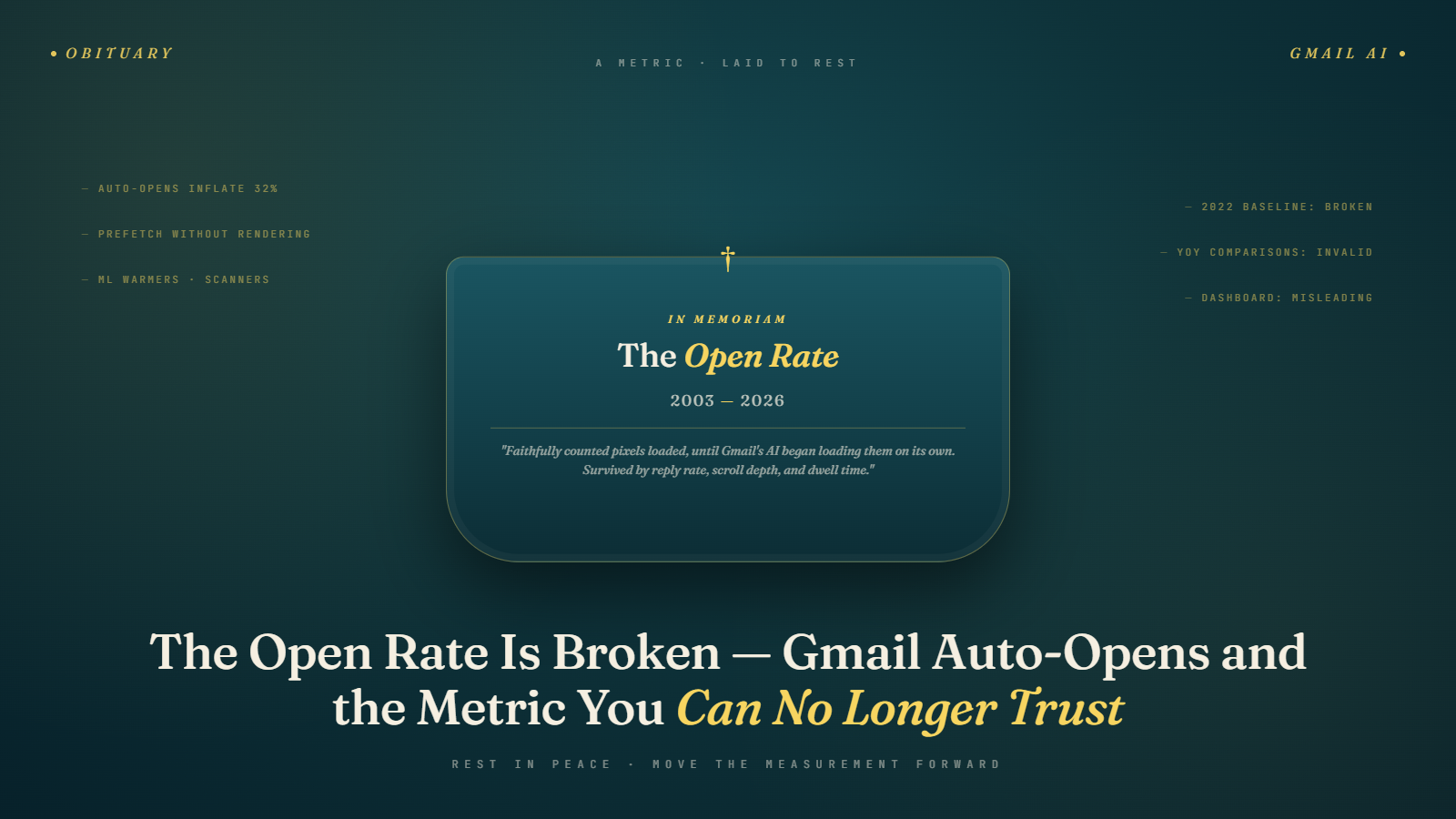
A client called me in January with a familiar kind of excitement. Their open rate had climbed to 34% on a recent send, up from 22% six months earlier. They wanted to know what they were doing right.
The answer was: nothing new. Their audience hadn't grown more engaged. Their subject lines hadn't gotten better. Gmail had quietly started prefetching email content for Gemini's processing pipeline, and that prefetch fires the tracking pixel.
Their 34% open rate contained a substantial portion of machine-generated events that had nothing to do with a human choosing to read the email. When we looked at click rates over the same period, they'd barely moved.
What Actually Happens When Gmail "Opens" Your Email
Open rate has always been a proxy metric. It measures "a 1x1 tracking pixel was loaded," which typically means someone opened the email. The inference was reasonable for years.
Two things have broken that inference. The first was Apple's Mail Privacy Protection (MPP), which launched in 2021 and caused Apple's mail servers to pre-load all pixels in emails delivered to iOS and macOS Mail. That was widely discussed and most email marketers adjusted their benchmarks.
The second is Gmail's Gemini-era prefetching, and it's been less discussed. When Gmail's AI processes an incoming email to generate a summary card or evaluate it for inbox placement, it fetches the full email content. That fetch loads your tracking pixel. Gmail's IP addresses get logged as an open event in your ESP.
The important distinction from MPP: Apple's pre-loading was consistent and affected all Apple Mail users uniformly. Gmail's prefetching is more variable. It appears to trigger based on certain content signals, sender reputation factors, and Gemini processing activity. It's not every email, every time. That inconsistency makes it harder to identify and adjust for.
Why Your 2022 Open Rate and Your 2026 Open Rate Are Different Numbers
If you show me a 25% open rate from a campaign in 2022 and a 25% open rate from a campaign in 2026, they represent fundamentally different things.
In 2022, a 25% open rate meant approximately 25% of delivered emails triggered a pixel load, which meant roughly 25% of recipients (minus a small number of caching edge cases) actually opened the email. The measurement was imperfect but directionally accurate.
In 2026, a 25% open rate for a Gmail-heavy list might mean 15% of recipients actually opened the email, with the remaining 10 percentage points coming from Gmail's prefetching, MPP on Apple devices, and other machine-generated loads. Or it might mean 22% actually opened and only 3% are machines. There's no reliable way to separate the signal from the noise at the aggregate level.
This has direct consequences for anyone who has been tracking open rate trends over time. The apparent improvement in your open rates over the past two years may not reflect improved engagement at all. It may reflect increased machine activity as Gmail's AI infrastructure has scaled up.
I've seen this create real decision errors. Teams that interpreted rising open rates as validation of a new subject line strategy, or a new sending cadence, when the underlying human engagement was flat or even declining. Troubleshooting low open rates in 2026 requires first establishing whether the open rates you're troubleshooting are even real.
The Specific Inflation Numbers I Have Measured
Across roughly twenty client programs I have audited between November 2025 and March 2026, the inflation pattern has been consistent enough to put some approximate numbers around it.
For promotional senders with Gmail concentrations above 50% of their list, reported open rates have typically run 8 to 14 percentage points higher than what click-to-open analysis suggests actual human opens are producing. A client whose ESP shows a 34% open rate is probably seeing around 22% real human opens, with the remaining 12 points split between Gemini prefetching, Apple MPP pre-loads, link scanners, and security gateway activity.
For B2B senders with heavier Outlook and Office 365 exposure, the inflation is usually smaller, around 3 to 6 percentage points. Outlook's security scanning has always inflated opens modestly, but the Gemini-style AI prefetching is less prominent in enterprise Microsoft environments as of early 2026. That may change as Copilot integration expands through the year.
For senders with mixed B2B and consumer audiences, the inflation is unpredictable because it depends heavily on which subset of the list opens a particular campaign. A subject line that resonates with your consumer segment pulls more Gmail opens, which carry more prefetch inflation. A subject line that resonates with your B2B segment pulls more Outlook opens, which carry less. The same content performance varies depending on which segment responds, and the open rate numbers cannot tell you which dynamic is dominating.
The practical implication: your program's inflation level is specific to your list composition. Industry average benchmarks are almost useless for judging whether your open rate is healthy. The only useful comparison is your own program over time, and even that requires adjusting for the known drift caused by increasing prefetch activity.
How Open-Rate-Based Automations Break
The most concrete problem isn't with reporting. It's with automations.
Behavioral email sequences are common: if a subscriber opens an email, they get one follow-up; if they don't open, they get a different re-engagement message. Many ESPs trigger these automations based on open events.
If machine-generated opens are being counted as real opens, a segment of your "opened" group didn't actually open the email. They're receiving a follow-up that assumes they read your message and expressed interest, when they did neither. The automation logic is corrupted at the source.
Re-engagement campaigns are even more affected. Many senders identify "unengaged" subscribers based on no opens in 90 or 180 days. If some of those subscribers are generating machine opens, they'll never qualify as unengaged. They'll stay on your active list indefinitely, damaging deliverability without ever reading anything you send.
Email list segmentation built on open data needs to be rebuilt around more reliable signals. This is not optional maintenance. It's an active liability.
Which Metrics to Use Instead
Clicks are the first replacement metric. A click requires a deliberate human action. Machines that prefetch email content for AI processing don't generally click links. The click-through rate is not a perfect metric either (bots, link scanners, and security tools can fire clicks), but it's substantially more reliable than open rate as a measure of human engagement.
Reply rate is underrated. It's essentially noise-free. No machine sends a reply to a marketing email. If your sequences can generate replies, even short ones, that's cleaner engagement data than any open rate.
Conversion rate (tracked through your website analytics rather than your ESP) is the most reliable metric in the chain. It requires the subscriber to open, click, arrive at your site, and take an action. Each step filters out noise.
For list health purposes, focus on hard bounces, spam complaints, and click activity over rolling 90-day windows rather than open-based engagement scoring. Measuring the true ROI of email campaigns requires this kind of first-principles rethinking of which signals actually matter.
How to Recalibrate Your Benchmarks
If you want to understand what your real human open rate might be, there's an imperfect but useful approach.
Take a recent campaign. Look at your click-to-open rate (CTOR): the percentage of "openers" who also clicked. In 2022, a typical CTOR for a promotional email ran between 12% and 18%. If your current CTOR is significantly lower, say 6-8%, that's evidence that your open count includes a large number of non-clicking machine opens.
You can also look at your opens by email client. Your ESP likely segments opens by client. Machine prefetching from Gmail will register under Gmail's user agent. If Gmail shows dramatically higher open rates than other email clients when your list composition doesn't justify that, you're looking at inflated numbers.
Another useful signal: the timing distribution of opens. Genuine human opens tend to cluster in the hours after sending. Machine-generated opens often occur in the first few minutes at unusual hours. Some ESPs now provide open timing reports granular enough to show this pattern.
None of these methods gives you a clean "real open rate" number. What they give you is a better sense of whether your trend line is trustworthy.
Is Open Rate Useful at All Anymore?
The honest answer is: as a primary KPI, no. As one signal among many, with heavy caveats, it still carries some information.
Open rate is useful for: comparing two subject line variants in an A/B test run simultaneously (the inflation affects both variants roughly equally, so the relative difference is still meaningful); spotting catastrophic deliverability problems (a sudden drop to near-zero opens usually reflects a real deliverability issue, not just AI noise); rough health checks on new list segments.
Open rate is not useful for: year-over-year performance comparisons; setting engagement thresholds for list hygiene; triggering behavioral automations; reporting "success" to clients or stakeholders who will take the number at face value.
I want to be clear about something most email marketing advice glosses over: the people resisting this shift are often in organizations where open rate is a KPI baked into performance reviews or client contracts. Renegotiating those agreements is uncomfortable. But presenting inflated open rates as genuine engagement is misleading, and the downstream consequences (poor list hygiene decisions, broken automations, misattributed wins) compound over time.
What to Tell Your Stakeholders Without Losing Credibility
The hardest part of this shift is often not the technical recalibration but the stakeholder conversation. Marketing directors reporting to CMOs, agencies reporting to clients, and email leads reporting to boards all face the same awkward moment: explaining that the open rate number everyone has been looking at for years is now less reliable than it used to be.
The conversation works best when framed in terms of what has changed in the inbox rather than what is broken in the reporting. Stakeholders accept the idea that the email environment has changed because they have seen it change in their own personal inboxes. They see AI summaries, they see inbox grouping, they see their phones prefetching content. Connecting the reporting conversation to their own observations makes the explanation land as context rather than excuse.
What tends to fail is walking in with "open rate is dead, stop using it." That framing sounds defensive, especially if open rates had been climbing. It invites the question of why the team did not flag this sooner. Better framing: "Open rate is now measuring a blend of human and machine activity, and we are shifting our primary metric to X because X is still a clean human signal." Then show the alternative metric with an equivalent trend line. Give them something to look at, not just a thing to stop looking at.
For agencies and service providers, this conversation goes even better if the alternative metric shows a favorable trend. Click-to-open ratio, reply rate, or conversion rate over the past quarter often tell a story the open rate obscured. If your real engagement was improving while the inflated open rate was also rising, you can show both trends and credit the underlying work rather than the inflated headline.
The worst outcome is continuing to report open rate as a primary KPI while knowing it is unreliable. That approach sets the team up for a future correction that will look much worse than an intentional shift now. Auditors, new hires, or incoming executives eventually notice the disconnect, and the question of why the team kept reporting on a known-flawed metric is harder to answer than the question of why the team proactively moved to better ones.
What Gmail Postmaster Tools Tell You That Open Rates Don't
Gmail Postmaster Tools provides metrics based on Gmail's own processing of your emails. Spam rate, domain reputation, and delivery errors are all tracked there based on actual recipient actions, not pixel loads.
The spam rate in Postmaster Tools reflects how often recipients marked your email as spam, gathered at scale across Gmail users. This is a genuine human signal. Domain reputation reflects Gmail's overall assessment of your sending behavior. These metrics don't get inflated by prefetching.
If your ESP shows strong open rates but your Postmaster Tools domain reputation is declining, you're seeing the disconnect between machine-generated opens and actual human engagement. The real engagement data is in Postmaster Tools. The open rate is flattering noise.
Checking Postmaster Tools weekly takes about five minutes and provides cleaner signal than any open rate report. Sender reputation and inbox placement are ultimately what determine whether your emails reach anyone, and Gmail is measuring reputation based on genuine engagement signals that open rate no longer captures.
The open rate had a good run. For about 15 years it was a reasonable proxy for human attention. Now it's a noisy blend of real opens, Apple prefetches, Gmail AI processing, and various bot activity, all reported as a single number that looks meaningful but increasingly isn't.
The practical response isn't to panic. It's to shift your optimization target. Build your automation triggers on clicks and replies. Build your list hygiene decisions on click activity and conversions. Report to stakeholders on metrics that require a human to act.
Pull your campaign data from the past 90 days and calculate click-to-open rate for each send. Compare it to industry benchmarks for CTOR. If it's low, you have inflated open counts. That's your starting point for recalibrating.
Pair this diagnostic with list hygiene. The subscribers most likely to generate prefetch opens without real engagement are often addresses that have been on your list for years without meaningful activity, and running that segment through email verification catches the dead addresses that are still generating pixel loads without ever being read by a human. Bulk Mail Verifier handles the list hygiene side while the metric recalibration covered here handles the measurement side. Together they give you a program where the engagement signals you are acting on are real, and the metrics you are reporting on are actually measuring what you think they are measuring. The sooner you make the shift, the less painful the eventual reset becomes.