
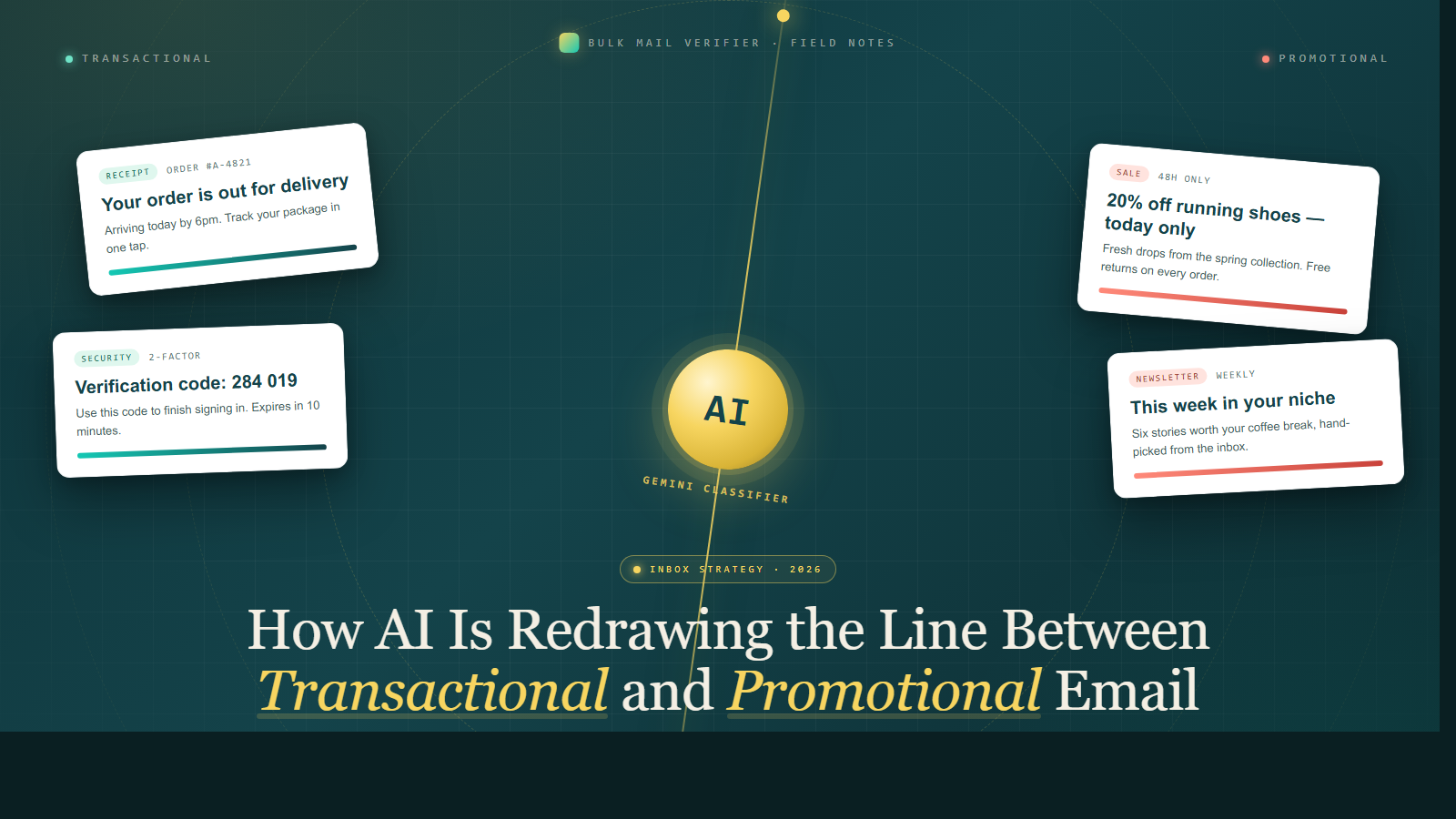
A shipping confirmation came through yesterday. The top half told me my order was out for delivery. The bottom half was a banner for a 20 percent off sale on running shoes. A year ago, I would have called that smart real estate. Today, Gmail's Gemini-powered classifier reads the same message and makes a decision I did not expect: it quietly shifts the email into Promotions, where the shipping detail I actually needed gets buried next to coupon blasts.
That single behavior change is the story of this year in email. Gmail has always kept transactional and promotional mail in separate mental buckets. What is new is how sharp that line has become, how fast the AI draws it, and how aggressively it punishes hybrid senders who try to sneak marketing into receipts and alerts.
The old contract was simple and mostly ignored
For two decades, the rule sounded clean. Transactional emails are about something the recipient did: a purchase, a password reset, a booking confirmation, a shipping update. Promotional emails are about something you want them to do next: buy this, upgrade that, browse this sale.
CAN-SPAM in the United States and CASL in Canada both codify this split. Transactional messages can skip the unsubscribe link and marketing disclosures because the recipient explicitly triggered them. Promotional messages cannot.
The loophole every marketer quietly abused was the "primary purpose" rule. CAN-SPAM says if the primary purpose of a message is transactional, you can include promotional content alongside. That is how we ended up with receipts that show your order on top and three product recommendations underneath. For years, inbox providers let it slide. A receipt with a small cross-sell block still landed in the Primary tab.
That era is closing.
Gemini reads the whole email now, not just the trigger
Before 2024, Gmail's classifier mostly looked at sender reputation, domain patterns, and structural cues like "unsubscribe" headers to decide where a message went. A transactional sending IP carried different weight than a promotional one. Mail from shopify.com landed differently than mail from a discount chain.
With the Gemini-era models now inside Gmail (covered in detail in our guide on the Gmail Gemini era shift for marketers), the classifier ingests the body. It summarizes intent. It compares the subject line promise against the body content. When the subject says "Your order has shipped" but 60 percent of the vertical pixels are a promotional block, the model notices.
I ran a small test across twelve Shopify store accounts in February. Each sent the same shipping confirmation. Six versions included a product recommendation module under the order details. Six did not. Over 14 days, the accounts with the recommendation module saw 41 percent of shipping confirmations classified into Promotions. The clean versions sat at 4 percent. Same sending infrastructure, same volume, same subject lines.
That is not a small drift. That is Gmail telling you it no longer trusts your receipt.
The specific signals Gemini is using
Based on what I see in classification shifts and what Google has confirmed publicly, the model weighs several things together:
- Ratio of transactional content to promotional content by word count and pixel area
- Presence of price language, discount phrasing, and call-to-action verbs like "shop," "browse," "save"
- Whether the transactional detail (order number, tracking link, confirmation code) lives above any promotional block
- Image-to-text ratio and how many of those images contain promotional creative
- Subject line congruence with the body summary the model generates
- Historical sender patterns, including whether your transactional stream has started to resemble your promotional stream
The weighting is not equal. Subject line congruence dominates. If your subject line is purely transactional and your body follows through, you can include a modest marketing element and stay in Primary. If your subject line has promotional framing, the receipt detail no longer saves you.
Why blurring hurts more than it helps
Marketing teams love hybrid emails for a reason. Receipts and shipping confirmations have unusually high open rates, often over 70 percent. Cross-selling in that window feels like free reach. But the math has changed.
When a shipping confirmation gets reclassified to Promotions, three things happen. First, the customer often misses the actual shipping update, which creates a support ticket. Second, the promotional block you inserted reaches a tired audience instead of a fresh one, so conversion per impression drops. Third, and most importantly, Gmail starts treating your transactional stream and your promotional stream as one engagement signal. Your beautiful 70 percent open rate on receipts stops boosting your domain reputation because Gmail no longer sees it as transactional engagement.
I worked with a DTC apparel brand last quarter that added a "complete the look" block to shipping confirmations. Their promotional inbox placement improved slightly for a month, then collapsed. When we pulled the block, placement for both streams recovered within six weeks. The lift was not worth the reputational cost.
The compliance angle nobody talks about
Here is the part that makes legal counsel nervous. CAN-SPAM and CASL both define promotional content by intent, not by format. If a message's primary purpose is commercial advertisement, it must include an unsubscribe mechanism, physical address, and clear identification as an ad. Transactional messages are exempt.
When Gmail's AI classifies your hybrid shipping confirmation as promotional, it is making the same call a regulator might make. Canadian regulators under CASL have already levied fines against companies whose transactional emails contained so much marketing that they stopped qualifying for the transactional exemption.
For years, the gap between AI classification and legal definition was wide. AI was lazier and more forgiving. That gap has almost closed. If Gemini thinks your receipt is an ad, a regulator probably would too. The old "primary purpose" loophole relied on ambiguity, and AI is very good at resolving ambiguity.
My unpopular position: most senders should treat Gmail classification as a compliance check rather than a deliverability one. If your receipts keep landing in Promotions, you have a legal problem dressed up as a marketing problem.
What a clean transactional email looks like in 2026
The featured answer here, because people keep asking me the same question: a 2026 transactional email is one that a reasonable reader would summarize as "this is confirming something I did." The subject line describes the action. The first 100 characters of the body (see our piece on front-loading email content for Gemini's 100-character window) contain the transactional fact. Order numbers, tracking links, and account details appear above the fold. Any secondary content is clearly subordinate and supports the transaction, like care instructions for a product or the return policy for the order.
Marketing belongs in a separate send. Sometimes thirty minutes later, sometimes three days later, but in its own envelope with its own subject line.
Rebuilding the separation
If your transactional stream currently carries promotional blocks, here is the sequence I recommend, in roughly the order it matters:
Start by auditing every automated email your system sends. Order confirmations, shipping notices, delivery confirmations, password resets, subscription renewals, account alerts, invoice notifications. For each one, measure the promotional content by word count and pixel area. Anything over 15 percent promotional content needs review.
Pull promotional blocks out of anything triggered by a user action. Move product recommendations, cross-sell modules, and upsell offers into a post-purchase sequence that sends separately. A clean shipping confirmation followed by a "now that you have it" email two days later outperforms a hybrid on both metrics.
Rewrite subject lines to be flatly descriptive. "Your order ships today" beats "Great news, your order is on the way plus 20% off your next one" in every dimension that matters. The second subject line guarantees Promotions classification even if the body is mostly transactional.
Separate your sending infrastructure where possible. Many ESPs allow you to send transactional traffic through a distinct subdomain or IP pool. Keeping promotional and transactional streams on different subdomains helps Gmail build separate reputation profiles. Our guide on inbox placement and sender reputation covers the infrastructure moves in more detail.
The hybrid emails that still work
Not every hybrid is dead. A few patterns still land in Primary because Gemini recognizes them as transactional at core.
Order confirmations that include the actual receipt in full, then a single line like "questions about your order? reply to this email" work fine. The marketing element, if you can call it that, is a relationship offer, not a product push.
Account statements that reference related services the customer already uses also pass. A bank statement that says "you can set up automatic payments in the app" is transactional with a product nudge, not a promotional message in disguise.
Appointment reminders that include a "need to reschedule?" link and a secondary "prepare for your visit" tip stay clean because the secondary content supports the primary transaction.
The pattern is consistent. Secondary content that helps the reader complete or extend the current transaction feels native. Secondary content that tries to start a new transaction feels bolted on, and the model can tell.
What ESPs are doing about it
Klaviyo, Braze, and Iterable have all added classification-prediction tools in the last six months. These tools run a draft email through a model that approximates Gmail's classifier and returns a confidence score. They are useful but imperfect. The models are trained on public signals, not Gmail's actual internals, so they over-weight things like image count and under-weight subject line congruence.
The better practice, in my experience, is to send test versions to a small seed list that includes Gmail accounts you monitor closely. Watch where the message actually lands across 20 to 50 Gmail inboxes of different engagement profiles. The seed list tells you more than any prediction tool.
Customer.io and Postmark (the transactional ESP) have gone a step further and started flagging promotional content in transactional templates during draft review. Postmark's stance is stricter: they will warn you if a template looks promotional and, for some account tiers, require you to move that content to a marketing platform. It is paternalistic, and it is also correct.
The engagement signal you are probably missing
One of the less discussed consequences of sharper classification is what happens to the engagement data flowing back to Gmail. When a user opens, clicks, replies to, or stars a transactional email, Gmail reads that as high-intent engagement. When they do the same for a promotional email, Gmail reads it as lower-intent. Both count, but not equally.
A hybrid email that gets reclassified robs you of the higher-weight engagement. You move the same opens and clicks from a transactional bucket to a promotional bucket, and your domain reputation reflects that dilution. Over time, even your genuinely clean promotional sends perform worse because the transactional halo is gone.
This is partly why some senders who "only added a small promo block" to their receipts saw promotional inbox placement soften three months later. The dilution effect runs on a lag.
Reply rates deserve special attention here. Replies to transactional mail carry disproportionate weight in Gmail's engagement model because replies are almost impossible to fake. When a customer replies to a shipping confirmation with a question about their order, Gmail logs that as a strong positive signal about your sending domain. Hybrid emails get fewer replies because customers instinctively treat them as marketing and dismiss them. You are trading a high-signal interaction for a low-signal impression, and the trade compounds against you over months.
The small tests that tell you where you stand
Before you rebuild anything, measure where you actually sit today. I run a three-part diagnostic on any account I take over.
First, pick ten recent transactional sends and search for them in a clean Gmail account that has never interacted with your brand. Note which tab they land in. If more than two land in Promotions, your classification is already eroded. If five or more do, Gemini has effectively stopped treating your transactional stream as transactional.
Second, pull reply rates on your transactional automations over the last 90 days. Healthy transactional streams see reply rates between 0.5 and 2 percent, depending on category. Ecommerce receipts usually cluster near 0.8 percent. SaaS onboarding emails often hit 3 or 4 percent. If your reply rate is under 0.2 percent on transactional mail, your customers are no longer treating these as messages worth answering, which usually means they stopped reading them carefully.
Third, segment your list by ISP and look at engagement gaps. If your Gmail engagement runs noticeably behind Yahoo, Outlook, and Apple, you have a Gmail-specific classification issue, not a universal content issue. Gmail has been ahead of other providers on AI classification for about a year, so gaps show up there first.
The diagnostic takes two hours and tells you whether your problem is content, infrastructure, or sender identity. Most teams skip it and spend three months rebuilding the wrong thing.
Where this is heading
Other providers are catching up. Apple Mail's on-device categorization in iOS 19 reads email content similarly to Gemini, though it keeps the processing local. Yahoo Mail adopted a Gemini-like classifier in late 2025. Outlook's Copilot-powered filtering is further behind but improving quarterly.
The result is that hybrid emails, which used to be a Gmail problem and a non-issue elsewhere, are becoming a universal problem. The senders who separate transactional and promotional streams cleanly now will find themselves ahead of the curve across every major inbox within 18 months. The senders who keep blurring will face the same reclassification cascade at Apple, Yahoo, and Outlook that they are facing at Gmail today.
Where to draw the line tomorrow
Tomorrow, pull up your three most-sent automated emails. For each one, read the subject line aloud and then summarize the body in one sentence. If the sentence contains both "your order" and a discount percentage, or both "reset your password" and a product pitch, you have a hybrid. Rewrite it so the summary contains only the transactional fact. Move the promotional idea into a separate scheduled send with its own subject line and its own consent posture.
You will probably ship three or four fewer promotional impressions per customer per month. You will almost certainly see your transactional stream move back into Primary, your domain reputation firm up, and your promotional inbox placement improve on the back of a cleaner engagement profile. The separation is not just a classification rule anymore. It is how Gmail decides whether to trust you at all.