
A friend of mine runs a small home goods brand. Last month she forwarded me a screenshot from her own inbox. Gemini had summarized her latest campaign as: "Email from [brand] about new arrivals. Does not specify what is new or when it becomes available."
She had written a 400-word editorial opening about the inspiration behind the collection. The actual product reveal was in paragraph four. The launch date was in the image. Gemini read what it saw, and what it saw was vibes without facts.
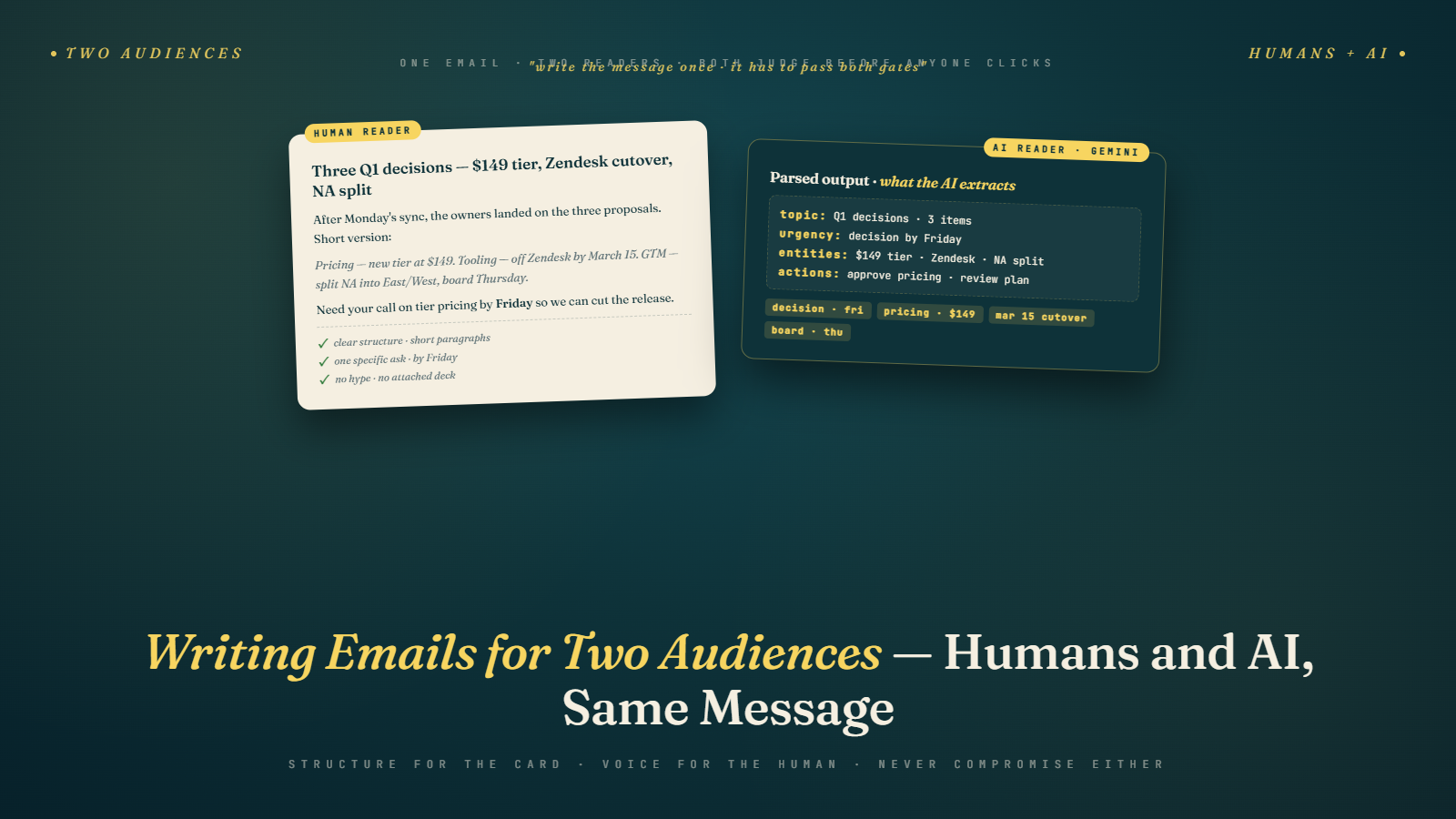
That screenshot convinced her that email copy now has two audiences, not one. The subscriber who opens the email is still there. They still want voice, story, aesthetic. But behind them, quietly reading over their shoulder, is an AI summarizer that needs something different. Specific facts. Clear offers. Product names as text. Action verbs.
The good news, and this is the part most copywriters are slow to accept, is that writing well for the AI makes the email better for the human too. The friction is mostly in our heads.
The two readers have different priorities
Your subscriber is a person with emotion, history with your brand, and a limited window of attention. When they open your email, they are looking for a reason to care. Voice, narrative, images, design, all of it serves the emotional pull that gets them from "skim" to "read" to "click."
The AI reading your email is literal. It wants entities (products, dates, prices, codes), relationships between those entities (this discount applies to this category until this date), and a clear statement of the action the email is asking the reader to take. It does not care about your founder's childhood dream or the sunlight through the warehouse window at 6am. It cares about whether "free shipping on orders over 50 dollars through April 20" is stated in extractable text.
The mistake most brands make is treating these as competing priorities. They assume that adding more facts kills the voice, or that clear structure makes the email feel transactional. That is almost never true when done well.
The accessibility parallel is exactly right
I have started telling clients that writing for AI is like writing for screen readers. Fifteen years ago, writing for screen readers felt like a constraint. You had to add alt text. You had to avoid relying on color alone. You had to structure content with real headings. Many writers treated this as a chore that hurt creativity.
Then everyone noticed that the sites that did accessibility well were also easier to skim, easier to quote, easier to translate, and easier to rank in search. The constraint forced better writing.
The same thing is happening with AI summarization. The emails that summarize cleanly are almost always the emails that read well for humans too. They make their point quickly. They do not bury the CTA. They do not rely on a hero image to carry the message.
If your team resists the idea of "writing for AI," reframe it. You are writing for accessibility. The AI is one accessibility layer. The screen reader user is another. The subscriber on a tiny Apple Watch notification preview is a third. They all benefit from the same habits.
A before and after from a real ecommerce promo
Here is a redacted version of an email I rewrote for a DTC client last quarter. The original had been sending for two years with the same structure. Conversion was steady but the inbox-summary quality was bad enough that organic replies often asked basic questions the email technically answered.
The original opened with 90 words of brand narrative about spring and renewal, moved into a lifestyle image with text baked in, and closed with a shop button. The offer (20 percent off dresses and tops through April 15) appeared only in the image and in the small preheader text.
The rewrite kept the narrative opening but trimmed it to 40 words. Right after it, I added a four-line plain-text offer block: category, discount, code, end date. Then the lifestyle image. Then the shop button with an explicit label ("Shop spring dresses") rather than a generic "Shop now."
Conversion went up 7 percent in the next campaign. More importantly, when I pasted both versions into three different AI assistants and asked them to summarize, the rewrite produced clean, accurate summaries every time. The original produced summaries that missed either the discount amount, the product category, or the end date in five of six tries.
The human reader got a better email. The AI reader got the facts right. Nobody lost.
What human writing still does that AI cannot replace
There is a version of this conversation that ends with "so just write structured data and skip the prose." That would be a mistake, and it misreads where we are.
Subscribers still read email. They still convert based on the emotional pull of a well-written opening, a clever turn of phrase, or a story they recognize themselves in. The best-performing emails I saw in 2025 were the ones where the brand voice was sharp enough that readers felt something in the first ten seconds. AI summaries are useful, but they are the preview. The email itself still has to earn the open when the subscriber taps through.
Where human writing stops being negotiable: the hook, the rhythm of the opening, the voice that distinguishes your brand from the four other newsletters your subscriber gets in the same category. You do not let the AI-optimization tail wag the copywriting dog. You write a great email, and then you audit it for machine legibility.
This is also the right sequence for new writers on your team. Train them to write voice first. Then teach them the five or six structural habits that keep their work AI-legible. Reversing the order produces bloodless emails that summarize beautifully and convert poorly.
The structural habits that do most of the work
A short list of the habits that have the biggest impact, based on the rewrites I have run for about forty campaigns in the last six months:
- Put the offer summary (category, discount, code, deadline) in explicit text within the first 150 words of the email body.
- Give every image with meaningful text a parallel text block directly beneath it that repeats the same information as prose.
- Use verb-first CTA copy ("Shop spring dresses," "Reserve your seat," "Download the guide") rather than "Click here" or "Learn more."
- Add H2 headings to anything over 300 words. Use them to name what the section is about, not as clever teasers.
- Write subject lines that contain the specific thing being offered, not the emotional wrapper around it.
- Use full entity names on first mention. "Our spring 2026 loungewear" rather than "the new drop."
None of those habits kill your voice. Several of them improve it by forcing you to be specific. Voice without specificity is just tone, and tone alone does not move product.
When the AI gets it wrong, you usually wrote it wrong
I have stopped blaming the AI when summaries come out bad. Nine times out of ten, pasting the email into a model and reading the summary tells me exactly where my writing was ambiguous. The model is not being lazy. It is extracting what is actually there. If the summary is vague, the email was vague. If the summary invents a detail, the email implied one.
This has become my favorite QA step. Before a campaign goes out, I paste the final copy into Gemini or Claude and ask two questions: "What is this email offering?" and "What does it want me to do?" If the answers are specific and correct, the email is ready. If the answers are vague, I know exactly where to tighten.
This is a five-minute check that has saved several of my clients from launching campaigns with broken summary behavior. Try it on your next send and see what it surfaces.
Brand voice survives this transition if you want it to
I know writers who are genuinely worried that AEO and AI-legibility will flatten brand voice across the industry. That every email will end up looking like a product spec sheet with a logo on top. I do not think that will happen, and the reason is simple: the brands that have strong voice will keep their voice, because that is what differentiates them in a crowded inbox.
The brands that had weak voice to begin with will look more homogenized, but that was always going to happen. They were never competing on voice.
The writers who keep strong, specific voices while building the structural habits described here are the ones whose work will still feel distinctive in two years. That is a solved problem if you care to solve it. We covered a related angle in our post on front-loading email content for Gemini, and the voice-plus-structure combination there holds up.
The quiet advantage of writing for two audiences
One unintentional benefit of writing with both readers in mind: your copy gets easier to QA across teams. The brand person reviewing for tone and the ops person reviewing for accuracy end up looking at the same clean draft. There is no separate "designer version" with the facts hidden in image copy and "data version" with a stripped-down summary.
This also helps your compliance and legal reviewers. Offers that are explicit in text are easier to disclose correctly. The fine print lives where it can actually be read. Promotional language that crosses a line is easier to spot when it is in prose rather than layered over a photo.
A former client in financial services told me their switch to text-forward promotional emails cut their legal review cycle in half. The reviewer could see the offer terms without squinting at a Photoshop file. Humans and AI both benefit from copy that stands on its own.
The personalization tension
One place where writing for AI and writing for humans creates genuine friction: hyper-personalization. Many brands still use merge tags to stitch first names, browsing history, and purchase data into copy, hoping the personalization improves conversion. For humans, there is a diminishing-return curve. Past a point, it reads as creepy rather than helpful.
For AI summaries, personalization is mostly irrelevant because most summary systems do not expose it. The summary reader sees the generic template output. So all the effort you are putting into dynamic copy never reaches the summarizer, and some of it hurts the human reader.
My recommendation for clients now: personalize the parts that genuinely help the subscriber (product recommendations based on recent browsing, location-specific shipping info) and stop personalizing the parts that add friction (using first names in subject lines when you have low confidence in the name quality, stitching purchase history into opening paragraphs in a tone that feels surveilled). The best personalization practices we covered in our personalization at scale guide still hold, but the AI-summary era adds a fresh reason to stop over-personalizing just to seem sophisticated.
This is also where verified, accurate data matters. First-name personalization that pulls "there" or "null" because your list has messy data hurts you twice: once with the human reader, once in any system trying to parse your email. Keeping your list clean with a service like ours at Bulk Mail Verifier solves part of that problem. The other part is just discipline about when personalization actually helps.
Tone without losing clarity
A question I get all the time: can you maintain a playful, irreverent brand voice and still be AI-legible?
Yes. The trick is separating the voice layer from the facts layer. Your voice lives in your opening, your CTAs, your taglines, your asides. Your facts live in a designated block that reads cleanly regardless of voice. Brands like Chubbies, Liquid Death, and Who Gives A Crap do this well. The playful voice is on every line. The offer details are explicit text that a model can parse without needing to get the joke.
Compare that to brands whose voice is so arch that every fact feels ironic. Those brands summarize poorly, and their summaries make them sound incoherent to readers who are meeting them through an AI preview for the first time. If your voice prevents you from stating a price or a deadline plainly, the voice is doing too much work.
The writers I admire right now are the ones who can be weird, specific, and funny in the voice sections and then pivot to clean, explicit text for the offer. That is a two-gear transmission. Humans appreciate the downshift. AI needs it.
What to do with your next email
Open the draft of whatever you are sending next. Read the first 200 words and ask yourself: if a stranger read only this, would they know what the offer is, who it is for, and when it ends? If the answer is yes, you are already writing for both audiences. If the answer is no, you are leaning too hard on voice and images to do work that explicit text should do.
One rewrite pass per campaign for the next month will shift your whole program. You will notice that your summaries in Gmail get sharper, your open-to-click ratios improve modestly, and the replies you get from subscribers stop asking questions you thought you had answered. You will also notice, the first time you paste one of your own emails into an AI assistant for QA, that the exercise is humbling in exactly the right way.
This is the same shift your best SEO writers made a decade ago, covered in pieces like our guide on how to write subject lines that get opened. The writers who adapted kept their jobs and got better. The ones who refused got left behind. The difference between those two groups was not talent. It was willingness to treat machine readers as part of the audience. Start tomorrow.