
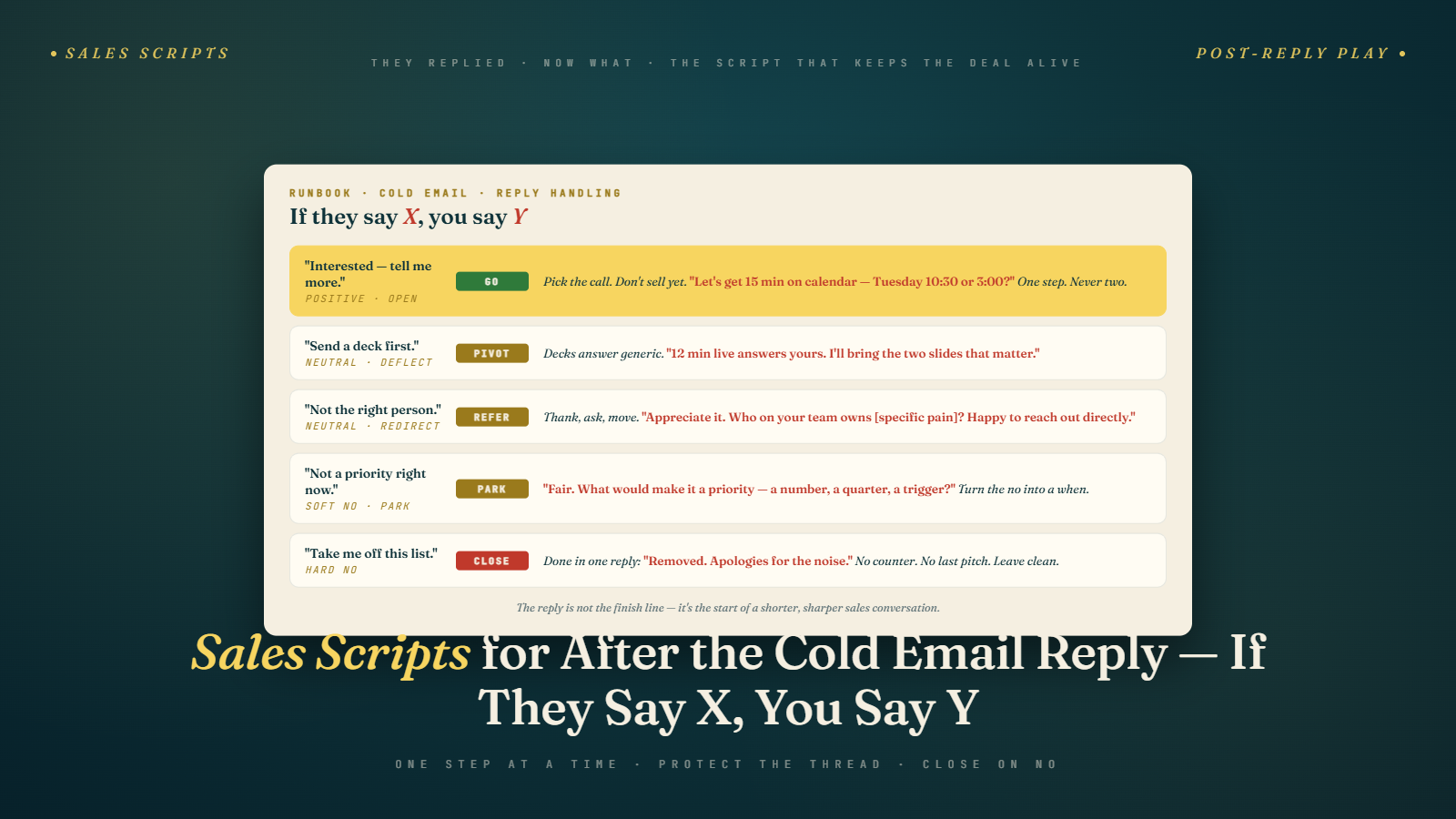
Why "Script" Is the Wrong Word
Before we get into the actual frameworks, let's clear something up: the most effective salespeople don't use scripts. They use structures.
The difference is significant. A script is a predetermined sequence of words to be delivered in a fixed order regardless of what the other person says. A structure is a flexible framework — a set of questions to ask, topics to cover, and transitions to make — that adapts to what actually comes up in the conversation.
Scripts fail in sales calls because they create a peculiar kind of conversational deafness. The person running the script isn't actually listening to the prospect's answers — they're mentally queuing up the next line. Prospects feel this. When someone asks "how are you doing?" and doesn't actually hear your answer before launching into the pitch, you know you're being sold to, not talked to. That feeling kills rapport instantly.
What you actually need is a clear structure: how to open, what to find out, how to transition, what to demonstrate, how to close toward a next step. The words within that structure should be natural and responsive — shaped by what the specific prospect in front of you is actually saying.
This article gives you that structure, calibrated specifically for the first call that comes from a cold email reply — which has its own distinct context and dynamics.
This is part of Phase 6 of the cold email series. The foundation for this call was laid in Turning Replies into Conversations and Booking Meetings from Cold Emails. For measuring whether these calls are moving the needle overall, see Measuring ROI of Cold Email Campaigns.
The Unique Context of a Post-Cold Email Call
The first call from a cold email reply is different from an inbound discovery call in several meaningful ways, and failing to account for those differences is a common source of call failure.
The prospect knows you came to them. This isn't someone who searched for your solution and is already half-sold. They were cold, they read your email, something resonated, and they said yes. They have likely told themselves "I'll see what this person has to say" — not "I'm going to buy this." The baseline level of intent is lower.
Your cold email copy set expectations. Whatever you said in the sequence — the problem you claimed to solve, the outcomes you referenced, the proof points you mentioned — is the frame they agreed to hear more about. If you said "15-minute call to compare notes on SDR ramp time" and you show up with a 60-minute product demo, you've broken the implicit agreement.
You know things about them they may not realize you know. You researched them, found a trigger, personalized the email. The first call is a natural place to reference that research — but only if it comes across as thoughtful rather than surveillance-y. "I saw your post about SDR productivity challenges" is thoughtful. "I've been following your LinkedIn for three months" is unsettling.
Trust has to be built quickly. With an inbound lead, some trust is already extended by virtue of them coming to you. With a cold outreach lead, you need to earn it within the first few minutes of the call. How you open — whether you come across as a human professional with genuine interest, or a quota-driven rep running a script — determines whether the trust builds or doesn't.
The Opening: The First Three Minutes Matter Most
The opening of the post-cold email call sets the tone for everything that follows. Done well, it establishes you as a credible, curious professional who respects the prospect's time. Done poorly, it signals "I am a salesperson, now brace for the pitch."
A strong opening structure:
- Brief acknowledgment of the call context (without being awkward about it)
- Restate what you're hoping to accomplish together
- Give them permission to tell you if it's not a fit
- Flip the conversation to them immediately
Example opening:
"Thanks for making time — I appreciate it. When I reached out, the reason I thought this was worth a conversation was [specific original relevance: the hiring signal, the pain point, the trigger]. I want to make sure this is actually useful for you, so my goal for today is to understand more about where you are with [problem category] and see if what we do is genuinely a match. If it's not, I'll say so — no pressure. But first, [discovery question]."
A few things to notice about this structure:
- It connects back to the original email (continuity)
- It articulates a shared goal for the call (not "let me show you our product")
- It explicitly reduces pressure ("I'll say so if it's not a match") — this is counterintuitively effective at building trust
- It ends with a question, not a pitch
The last point is critical: the opening of the discovery call should end with you asking a question, not talking. The faster you get the prospect talking, the better. You learn more, they feel heard, and the call becomes a conversation rather than a presentation.
The Discovery Phase: What You're Trying to Find Out
Discovery is the heart of the first call, and most salespeople rush through it to get to the demo or pitch. This is usually a mistake. A thorough discovery that surfaces the prospect's real situation, real priorities, and real decision-making process makes everything else in the sales cycle easier and faster.
What you're specifically trying to learn:
The actual problem. Not the generic pain point your cold email pointed at — the specific version of that problem as it exists in their world. "We're struggling with SDR ramp time" is the start of an answer. "We've got four new SDRs who've been in seat for three months and two of them are behind on quota and one just gave notice" is the real problem.
The context and history. Have they tried to address this before? What happened? Why is it still a problem? Understanding the history shapes how you position your solution. If they tried a competitor and it didn't work, you need to understand why — and you need to either differentiate credibly or recognize that this is a genuinely difficult fit.
The success criteria. What does "this worked" look like for them? This question does two things: it surfaces what they actually care about, and it gives you a benchmark to position your solution against. "What would have to be true six months from now for you to consider this a success?" is one of the most useful questions in B2B sales.
The decision-making process. Who else is involved? Who has to sign off? Is there a budget process? Is there an existing evaluation underway? You don't want to get to the end of a great conversation only to discover that there are four other stakeholders, a 12-month procurement cycle, and a competitive RFP in progress.
The timing. Not as a pressure technique, but as genuine information. Is there a reason to act now, or is this more exploratory? Understanding timing lets you calibrate your close appropriately.
Discovery Questions That Actually Work
The quality of your discovery depends heavily on the quality of your questions. A few principles:
Open-ended over closed-ended. "Tell me more about how your current process works" extracts more useful information than "Are you happy with your current process?" Yes/no questions give you binary data points; open questions give you context.
Specific over general. "What does your current SDR ramp process look like?" is better than "Are you having any challenges?" The more specific the question, the more specific the answer.
Future-oriented questions that surface real stakes. "What happens if this problem doesn't get solved in the next 12 months?" is more revealing than "Is this a priority?" One is a thought experiment that reveals real consequences; the other is a question most people answer with "yes" to avoid seeming uncommitted.
Follow-up questions. The best discovery happens in layers. A prospect says "we've been struggling with time-to-revenue on new hires." A good follow-up: "When you say struggling — what's the number you're seeing versus what you'd want to see?" Another follow-up: "How long has that gap been showing up?" You're building a picture, not collecting data points.
The Pivot to Your Solution: Timing and Frame
Moving from discovery to positioning your solution is where the call most often breaks down. The mistake is transitioning too early — before you've actually understood the situation well enough to make the positioning relevant.
The signal that it's time to pivot: you've confirmed that the problem you solve is real and material for this prospect, you understand the specific version of it they're experiencing, and you have enough context to connect your solution directly to their situation.
The transition: "Based on what you've described — especially the [specific element they mentioned] — I think this is actually a pretty direct match for what we do. Can I show you specifically how we'd approach [their stated problem]?"
This transition is more effective than "Let me show you a quick demo of our product." It's framed around their problem, not your features. And it creates a natural connection between the discovery (what you just learned about them) and the demonstration (what you're about to show them).
Keep the pitch focused. Don't show everything. After discovery, you know which 2–3 capabilities are most relevant to their specific situation — focus on those. Prospects don't need to see a full feature list; they need to see convincing evidence that you can solve the problem they just described to you.
Handling "I Need to Think About It" and Other Soft Closes
The end of a successful first call should result in a clear, agreed-upon next step — not a vague "let's stay in touch."
When the call has gone well and there's genuine interest, propose a specific next step before hanging up: "Based on our conversation, it sounds like the next useful step would be [specific thing — a second call with your team, a pilot proposal, a technical evaluation]. Does that make sense, and if so, when would be a good time to move that forward?"
When you get "I need to think about it" or "I'll need to talk to my team," don't accept the vague close. Clarify: "Completely understood — what specifically do you need to think through? Is it more about the fit, the timing, or how to get others on your team involved?" This question separates genuine deliberation from a polite brush-off and helps you understand what actually needs to happen next.
If they need to involve other stakeholders: offer to help. "Would it be useful if I put together a brief summary of what we discussed — something you could share with [the decision-maker] without having to recap the whole call?" This keeps you in the process and makes the prospect's internal advocacy easier.
The Follow-Up Email After the Call
Every first call should be followed by a brief, human summary email within 24 hours — ideally within 2–3 hours while everything is fresh.
What the follow-up email should contain:
- A one-paragraph summary of what you heard (the problem, the context, the stakes)
- A clear statement of how your solution addresses specifically that situation
- A recap of the agreed next step with a specific time or deadline
- An open door to ask questions or add anything you missed
What it should not contain:
- A company brochure
- A full feature list
- An ask they didn't agree to on the call
- More selling than listening
The follow-up email reinforces that you heard what they said (not just ran your pitch). It gives them a natural re-engagement point if they need to share what was discussed with colleagues. And it creates a written record of the next step, which makes it harder for either party to let the conversation quietly die.
When the First Call Doesn't Convert
Not every well-run discovery call converts to a next step, and it's worth normalizing that. Sometimes the timing genuinely isn't right. Sometimes the problem you solve isn't their most pressing priority. Sometimes the budget situation is more constrained than the initial reply suggested.
If a call ends without a clear next step, don't just disappear. Send the follow-up email anyway — summarize what you heard, note that the timing seems off, and make it easy to re-engage: "Based on our conversation, it sounds like the timing isn't quite right with [constraint]. Happy to reconnect when that changes — I'll check in [in three months / when the budget cycle opens / when the project wraps]. Let me know if I get the timeline wrong."
A graceful, specific follow-up after a non-converting call keeps you in the prospect's awareness without being pushy. Cold-to-warm leads that come back around months later are some of the most efficient pipeline — and they almost exclusively come from programs that handle the non-conversion gracefully.
Common First-Call Mistakes
Mistake 1: Pitching Before Listening
The most common call mistake: spending the first 10 minutes presenting your product before asking a single discovery question. The prospect hears a pitch for something they may not need in the form they're being presented. Discovery first, always.
Mistake 2: Not Acknowledging the Cold Email Context
Pretending the call is a warm inbound conversation when the prospect knows it started cold feels slightly dishonest. A brief, natural reference to how the call came about ("When I reached out about [topic]...") establishes authentic continuity.
Mistake 3: Talking More Than Listening
A first discovery call should have the prospect talking at least 60% of the time. If you're talking more than that, you're pitching, not discovering.
Mistake 4: Letting the Call End Without a Next Step
"Let's stay in touch" is not a next step. Every call should end with either a specific agreed next step or an honest conversation about why there isn't one.
Mistake 5: The Multi-Product Demo
Showing 12 features when 3 are relevant is a common way to obscure your value rather than demonstrate it. Know what matters for this specific prospect and show that — nothing else.
Next up: Measuring ROI of Cold Email Campaigns — the metrics that tell you whether the entire cold email system is generating real business value.