
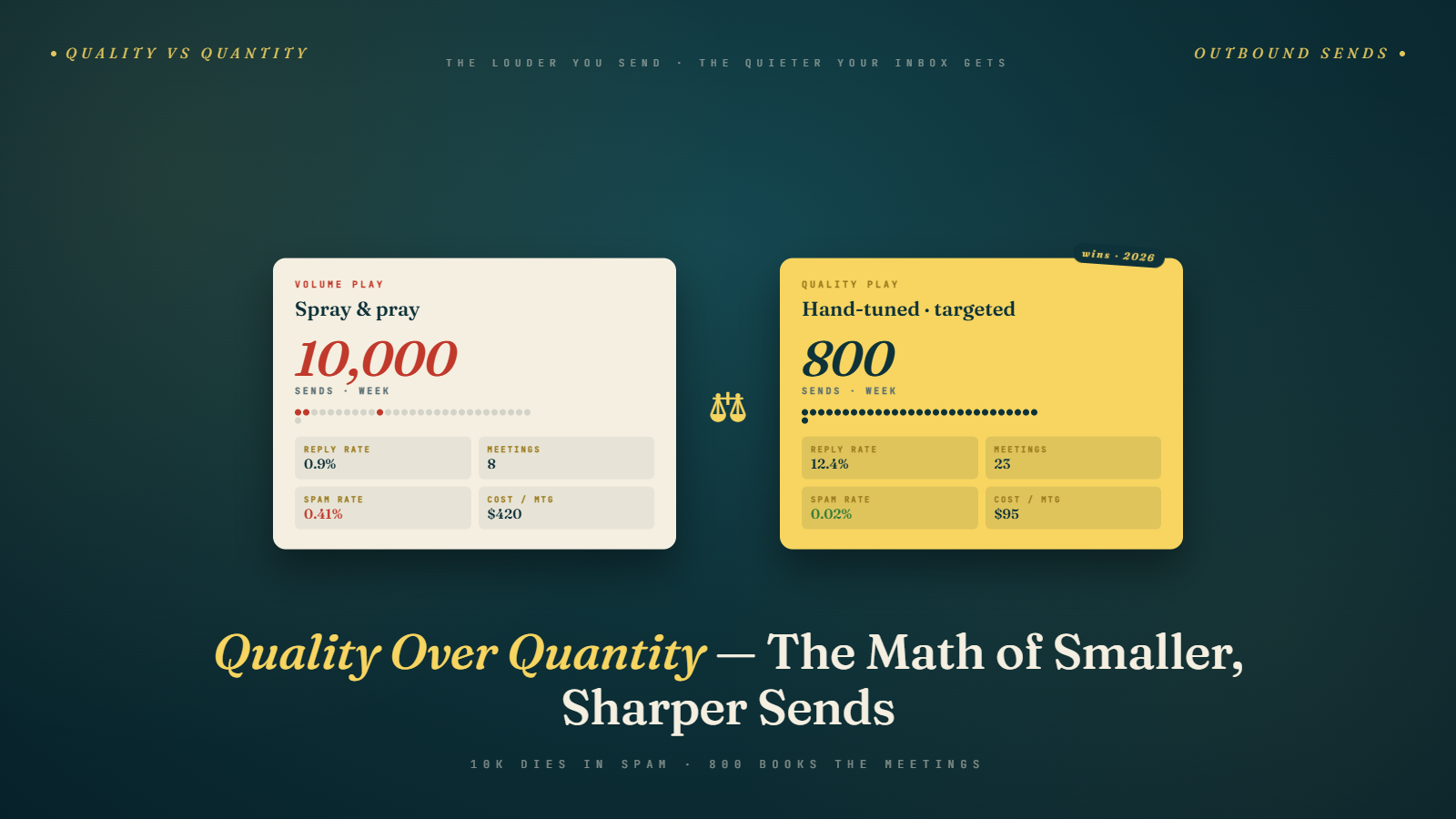
A DTC brand we advised cut their email sending cadence from five broadcasts a week to two in Q3 of 2025. They were panicking in month one. Revenue from email was down about eleven percent. By month three, revenue had recovered. By month six, email revenue was up twenty-two percent over their old peak, and they were sending fifty-eight percent fewer emails to get there.
This is not a rare story anymore. Across programs we have worked with in the last eighteen months, the pattern keeps repeating: cut volume, raise the bar, watch revenue per recipient rise enough to more than cover the volume loss. The advice the industry gave for a decade ("more sends, test into higher frequency, let the unsubscribes sort themselves out") is no longer producing the results it used to.
I want to take a clear position: for most programs in 2026, the next ten percent of revenue growth comes from sending less, not more. Not because less is virtuous. Because the environment has changed underneath the old playbook, and the old playbook is quietly costing you money.
What changed between 2022 and 2026
Three things happened, and they compound.
The Gmail AI inbox, which moved from beta to default for the majority of consumer accounts through 2025, does not tolerate marginal sends the way the old filter did. The old filter used spam signatures, engagement over time, and authentication to decide where to place mail. The new filter does that plus an active judgment about whether this specific message to this specific recipient is worth their attention right now. Messages that pass authentication and are not spam, but are clearly low relevance, get quietly shuffled into Promotions subtabs, collapsed digest summaries, or simply deprioritized. We covered this shift in depth in the Gmail Gemini era for marketers.
Complaint rates accumulate faster. Gmail's February 2024 sender requirements (0.3 percent complaint cap, 0.1 percent as a practical ceiling) are now enforced more strictly, and complaints from Gmail's AI-driven "this email feels like spam" prompt count against you the same as manual complaints do. A single bad broadcast to a tired list can take your rolling complaint rate over the line and trigger soft failures that last weeks. We walked through the math on the 0.1 percent complaint rate ceiling.
Subscriber fatigue shortened. People are on more lists than ever, and their patience for one more promotional email from a brand they have not bought from in six months is close to zero. The unsubscribe rate on broadcasts to lapsed subscribers in 2026 is about double what it was in 2022 for the same offers. Filter placement and user behavior are both working against low-relevance volume.
What "quality" actually means
"Quality over quantity" is the kind of phrase that sounds obvious and tells you nothing. If I ask you to judge whether a planned send is quality, you and your colleague will disagree, and both of you will think you are right. So I want to define it in a way that can be measured before the send.
A quality send has three things: an engaged segment, a relevant offer, and the right timing. If any one of the three is missing, the send is a quantity send in disguise, regardless of how nice the creative is.
Engaged segment means the recipients have shown behavior in a window that predicts receptiveness. For a weekly ecommerce brand, that window is usually the last sixty to ninety days. For a quarterly B2B program, it is much longer. The recipients do not all have to be VIPs, but they have to be alive. Sending to a segment where more than thirty percent of addresses have not engaged in ninety days is not a quality send. You are buying a few incremental conversions at the cost of deliverability for the next send.
Relevant offer means the content addresses a specific need, interest, or trigger for the recipients. "New arrivals" is not an offer. "New arrivals in the category you bought from last month, in your size" is an offer. Most broadcasts fail this test. They are a promotion someone on the team wanted to run, sent to everyone, with a vague hope of relevance.
Right timing means you are sending when the recipient is receptive, not when your calendar says it is Tuesday. Receptiveness can be behavioral (browsed yesterday, purchased this category last quarter, opened an email earlier today) or contextual (the product is seasonal and now is the season). Sending because it is Tuesday at 10 AM is a scheduling decision. It is not timing.
Calculating whether a planned send is worth it
Here is the framework I use with teams, and it has killed more planned sends than any other single intervention.
Before the send, estimate four numbers.
Number one, expected revenue. Take your last three similar sends (same audience size and offer type), average their revenue per recipient, and multiply by this send's audience size. Be honest.
Number two, expected complaint rate. Look at the complaint rate from the last three similar sends. If it is near or above 0.08 percent, this send is adding risk even if it produces revenue.
Number three, expected unsubscribe rate. Take the unsubscribe rate from the last three similar sends as a percentage. Multiply by list size. That is the absolute number of subscribers you are spending to run this.
Number four, the cost of the subscribers you will lose. Use your rough subscriber lifetime value (total email-attributed revenue over the last year divided by average active subscribers during that year). Multiply by the number from step three.
Now subtract number four from number one. If the remainder is positive, send. If it is negative, cancel.
Most teams never do this calculation. When they do, they discover that their weekly "we have to send something" broadcast to the full list is a net loser. The couple thousand dollars of attributed revenue is genuinely smaller than the lifetime value of the subscribers the send is quietly killing. The send looks like it made money because the unsubscribes do not appear on the same report as the conversions.
The featured snippet version
Why are fewer email sends outperforming high-volume programs in 2026? Three factors have flipped the math: Gmail's AI inbox deprioritizes low relevance mail even when it passes spam filters, a 0.1 percent complaint rate ceiling makes a single poor broadcast costly for weeks, and subscriber fatigue has shortened so that low-relevance sends drive higher unsubscribe rates than they did in 2022. Programs that cut volume by thirty to fifty percent while improving targeting and content are seeing higher revenue per email, better deliverability, and lower opt outs. The old "send more, test more, let it shake out" playbook now costs money.
A real example, with numbers
Consider the brand I opened with. Before the change, their send schedule was a weekly newsletter, two promotional campaigns, and one "clearance" send per week, total five. List size was 340,000 subscribers, of which about 190,000 were active in the last ninety days. Revenue per email send was averaging $0.11 across all sends. Complaint rate was hovering at 0.09 percent. Unsubscribes per send averaged 0.32 percent, which on a 340,000 list is about 1,088 people leaving the list every single send, or about 5,440 subscribers per week.
After the cut, the schedule was two sends per week: a Tuesday promotional with a sharpened offer, and a Thursday content send tied to category interest. The Friday clearance got absorbed into the Tuesday promo when relevant. The general newsletter got killed entirely. Revenue per email climbed to $0.31, roughly tripling. Unsubscribes per send dropped to 0.17 percent. Complaint rate fell to 0.04 percent, giving them headroom for the rest of the year.
The total weekly revenue math: before, 5 sends per week at 340,000 recipients, about $187,000 in attributed email revenue. After, 2 sends per week at an average of about 220,000 recipients (because the bottom of the engagement curve got excluded from most sends), about $136,000 in attributed email revenue. That looks like a loss of $51,000 per week.
Except: the subscriber retention improvement was worth about $90,000 per month in protected lifetime value based on their own LTV model, and the deliverability improvement lifted their triggered flow revenue (which sends to much smaller, higher-intent audiences) by about eighteen percent, adding roughly $62,000 per month. Net, the program was ahead. And the team had more time to spend on the sends that were left, which is how quality starts to compound.
The objections
Whenever I make the case for less volume, I get the same three pushbacks.
"But our revenue is tied to send volume." This was true in 2018. It is still true if your program has no behavioral flows, no segmentation, and no welcome series. In that case, every broadcast is pulling forward demand. But if you have a functioning lifecycle program (welcome, cart abandonment, post purchase, browse, winback), most of your email revenue is already coming from triggered sends, not broadcasts. You can usually cut broadcast frequency by a third without moving revenue by more than a percentage point, and the complaint and deliverability picture improves immediately.
"Our CEO wants us to send more." This is a political problem, not a marketing problem. Bring the CEO the four-number calculation for the last ten sends. Show which ones were net positive and which ones were net negative. Most CEOs who understand unit economics will back off when they see lifetime value subtracted from attributed revenue. The ones who do not are not going to be persuaded by you either way.
"Our competitors are sending more." Your competitors are probably over sending. Their deliverability numbers, which you cannot see, are almost certainly worse than yours. Volume parity is not a strategy. You can read about what volume parity does to B2B programs in cold email metrics to track and how scaling safely requires deliberate restraint in sending limits and scaling safely.
How to actually cut volume without losing revenue
If you have decided to shift, here is the order of operations that works.
First, audit which sends are pulling their weight. Export the last ninety days of broadcasts. For each one, calculate revenue per recipient, complaint rate, and unsubscribe rate. Rank them. The bottom third is almost certainly the cut list.
Second, keep the top third untouched. Whatever you are doing on those sends, it is working. Do not mess with them yet.
Third, replace the bottom third with nothing. Not a better send, just no send. Watch revenue and engagement for two to four weeks. You will almost certainly see engagement metrics rise on the remaining sends because you stopped burning attention.
Fourth, rebuild the middle third. These are sends that half work. The audience is probably too broad or the offer is too vague. Cut the audience by half (to the more engaged portion) and sharpen the offer. Do not try to make the content more clever. Make it more specific.
Fifth, and only after the first four steps stabilize, start testing whether you can add sends back at the higher quality bar you have now set. The answer is often that you can add one or two targeted sends per month, not a return to the old cadence.
One list is useful here, kept short on purpose. The failure modes of "quality over quantity" programs I have watched happen:
- Cutting volume but not cutting sends to disengaged segments. The bad audience is still getting the same mail, just less often. Complaint rates barely move.
- Cutting sends but keeping the same vague content. Fewer bad sends is still bad sends.
- Cutting broadcasts but letting triggered flows overlap into the same complaint exposure. Flow volume has to be counted in the total.
- Measuring only short-term revenue and concluding the shift failed in week three. You have to give it eight to twelve weeks for list health to catch up.
For the content side of this, see how to increase email click-through rate, which covers what actually moves engagement once your volume is sane. For the list quality side, a quarterly email verification pass paired with lower volume will accelerate the complaint rate improvements.
What to measure after the cut
You need to watch the right numbers, and most teams watch the wrong ones during a transition. Revenue per send will jump almost immediately because you stopped including the weakest recipients. That is not the proof. Total weekly email revenue is the number that matters, and it will often dip in the first four to six weeks before recovering.
Four metrics to track weekly during a volume reduction. Total email-attributed revenue (not per send, total). Active subscriber count (how many subscribers opened or clicked at least once in the last sixty days). Complaint rate thirty-day rolling. Unsubscribe count per week across all sends.
If active subscriber count starts rising two to four weeks in, the reduction is working. Active subscribers grow because people who would have unsubscribed from the fifth marginal send each week now do not leave at all. That is the compounding effect. A subscriber who stays six extra months because your program got easier to tolerate is worth far more than the attributed revenue from the sends you cut.
If complaint rate drops below 0.05 percent for a full rolling thirty days, you now have reputational headroom to be more aggressive on high-conversion sends (product launches, flash sales) without risking deliverability. That headroom is an asset you can spend deliberately. Most high-volume programs never build it because they burn it continuously.
The contrarian position, stated clearly
The industry spent fifteen years teaching that email is the channel where more is better, because the marginal cost is so low. That was true when inbox placement was based mostly on technical signals and recipients had more patience. It is no longer true. The marginal cost of a bad email in 2026 is not the delivery fee, it is the placement degradation and complaint exposure that bad send creates for the next twenty sends.
Programs that internalize this become leaner and more profitable. Programs that do not spend the next two years watching revenue per email slide while total volume grows, blaming "declining open rates" or "inbox consolidation," and missing that the cause is on their own servers.
Tomorrow, pull the last ninety days of broadcasts, rank them by revenue per recipient minus unsubscribe cost, and identify the bottom third. Do not send them again next month. That single cut, without any new tools or rebuild, will move your program more than the next campaign will.