
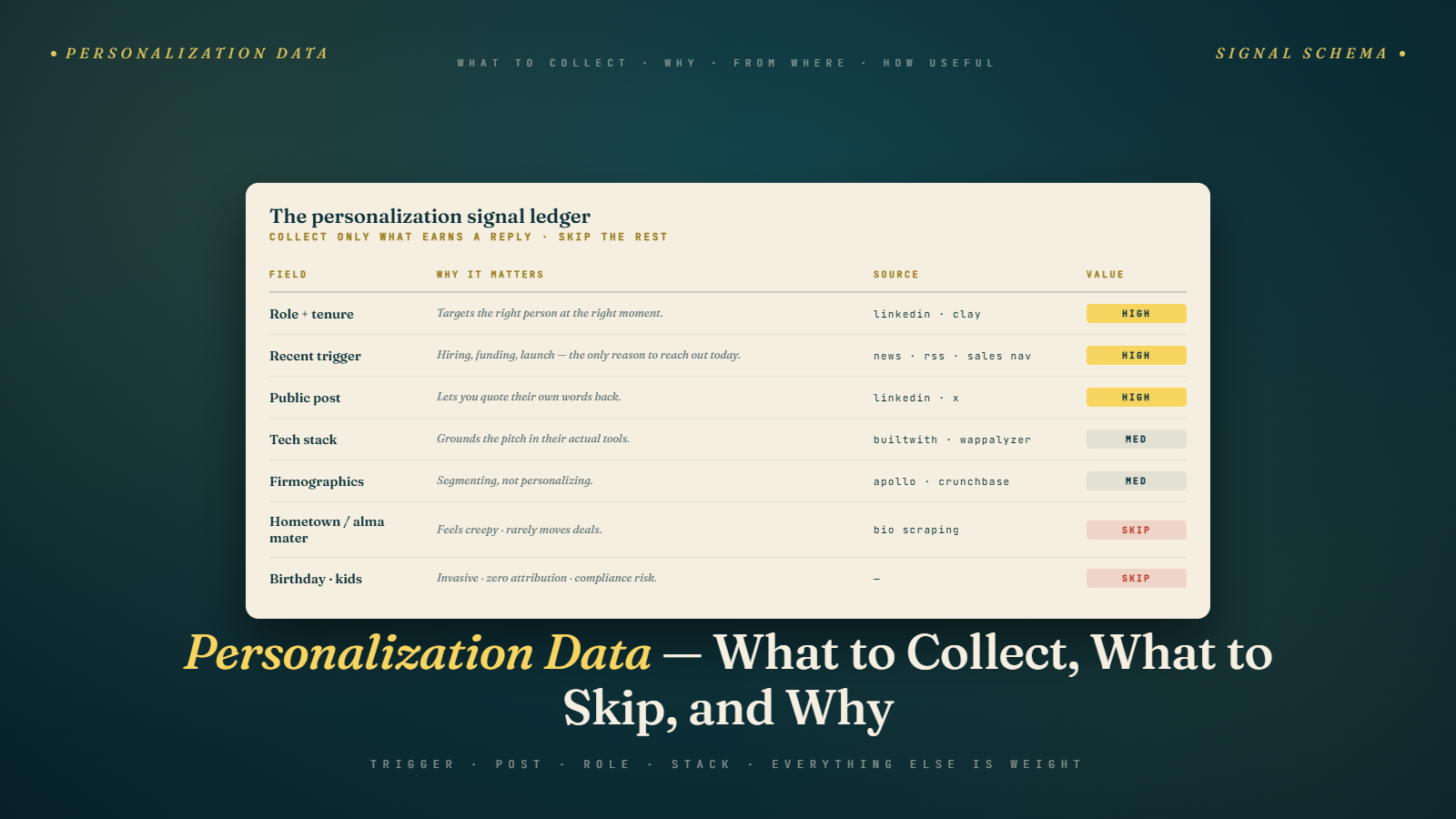
The Difference Between Fake Personalization and Real Personalization
There's a version of "personalization" that almost everyone in cold email does. It looks like this:
"Hi {{first_name}}, I noticed that {{company_name}} is in the {{industry}} space and I thought you might be interested in..."
That's not personalization. That's mail merge. It uses the same tokens for everyone, pulled from a spreadsheet, filling in a template that was clearly written for thousands of people. Recipients can see through it instantly — and many of them find it more off-putting than a generic email would be, because it's trying to look personal while clearly not being personal.
Real personalization is specific. It references something that could only apply to this person, at this company, right now. It shows you did some actual research. It creates a moment of recognition — "this person clearly looked at my stuff" — that immediately raises the email above the noise.
The difference in outcomes is significant. Generic templated emails might get a 1–3% reply rate. Well-personalized emails from a tightly targeted list regularly hit 8–15%, sometimes higher.
This is the final piece of the Phase 2 puzzle. You've defined your ICP, built a targeted prospect list, sourced data from the right places, done your LinkedIn research, verified your email addresses, and segmented your list. Now we're going to talk about the specific data points you need to collect to actually personalize your outreach — and how to use them.
Two Levels of Personalization
Before we get into the specific data types, it's useful to think about personalization at two levels: segment-level and individual-level.
Segment-level personalization is what we covered in segmenting your email list — crafting messaging that resonates with a specific type of company or buyer (e.g., "e-commerce brands scaling their email channel" or "Series B SaaS companies hiring their first sales team"). This is powerful and scalable.
Individual-level personalization is research you do on a specific person or company that goes beyond segment characteristics. It's the LinkedIn post they wrote, the company news they announced, the podcast they appeared on, the product they recently launched.
You need both. Segment-level personalization makes your messaging relevant to the right group. Individual-level personalization makes the email feel like it was written for this specific person, not their segment.
The ratio of how much time you invest in each depends on deal size. For a $500/month SaaS tool targeting SMBs, you can't spend 30 minutes per prospect. For a $50,000+ enterprise deal, that time is completely justified.
Category 1: Firmographic Personalization Data
This is the foundational layer — data about the company that your prospect works at. Most of it should already be in your prospect list if you did the data sourcing work properly.
Industry and Vertical
The industry your prospect is in shapes everything about what they care about and how they talk about it. Two VPs of Marketing — one at a SaaS company, one at a manufacturing firm — have completely different metrics, channels, and concerns.
How to use it: Reference their industry in your email when it helps establish relevance. "Working with a lot of teams in B2B SaaS, we see X pattern constantly..." signals you understand their world specifically.
Company Size and Stage
Headcount and revenue stage signal where the company is in its growth journey and what problems they're likely dealing with.
A 25-person company is probably dealing with doing-everything-yourself problems. A 250-person company is probably dealing with process and scale problems. A 2,500-person company is dealing with efficiency and governance problems.
How to use it: Frame your value proposition around the stage-appropriate problem. "At your stage of growth, most teams find that X becomes a real bottleneck..." is more resonant than a generic pitch.
Recent Funding
A company that just raised a Series A or B is in a very specific moment: they have fresh budget, they're under pressure to scale quickly, and they're likely evaluating tools and vendors. This is one of the best timing signals in B2B outreach.
How to use it: Open by acknowledging the milestone. "Congrats on the Series B — impressive round. At that stage, teams usually start hitting X challenge..." connects the trigger to the problem you solve.
Where to find it: Crunchbase, Dealroom, LinkedIn announcements, TechCrunch/the company's own press releases.
Recent Hiring Activity
The roles a company is hiring for tells you a lot about where they're investing. Actively hiring SDRs? Sales outreach tools become relevant. Hiring a Head of Data? Data infrastructure tools become relevant. Hiring a Customer Success Manager for the first time? They're scaling their customer base and may need tools to manage that.
How to use it: "I noticed you're actively building out your sales team — specifically looking for SDRs..." immediately signals you know something specific about their situation.
Where to find it: LinkedIn job postings, the company's careers page.
Category 2: Technographic Personalization Data
Knowing what tools a company already uses is enormously powerful for personalization — especially if your product integrates with or replaces those tools.
Current Tech Stack
If you know a prospect is running Salesforce, you can reference Salesforce in your email. If they're on HubSpot and you integrate with HubSpot, that's a specific, relevant hook. If they're on a legacy CRM and you've seen companies make the switch to something more modern, you can reference that transition.
How to use it: "Since you're already using Salesforce, the integration is native — no additional setup..." or "I see you're on Klaviyo — we've worked with a bunch of Klaviyo users who found that X was a gap..."
Where to find it: BuiltWith, Wappalyzer, Apollo technographic data (covered in Best Data Sources for Cold Email Outreach).
Competitor Tools
If a prospect is using a competitor product, that's also valuable personalization data. You're not going to say "I see you're using our competitor and they're terrible" — but you can reference the category in a way that signals you understand their current solution landscape.
How to use it: Oblique references work better than direct competitive knocks. "We work with a lot of teams that have outgrown [category] and are looking for [next thing]..." lets the prospect connect the dots if they're in that situation.
Category 3: Trigger-Based Personalization Data
Triggers are events or signals that indicate a specific moment of relevance — a time when the prospect is more likely to be open to your message because of something that just happened.
Job Change
A decision-maker who just started a new role in the last 3–6 months is in a high-receptivity window. They're evaluating existing tools and processes. They want to make an early impact. They're often more willing to try new approaches than someone who's been in the same role for 5 years.
How to use it: "Congrats on joining [company] as [title] — curious what you're thinking about in terms of [relevant problem] as you get settled in..."
Where to find it: LinkedIn's "Open to Work" updates, job change notifications in Sales Navigator, or tools that track job movements like Apollo or Cognism.
LinkedIn Activity
If a prospect recently posted on LinkedIn — especially about a topic adjacent to your offering — that's an excellent personalization hook. It shows you were paying attention, and it gives you a genuine, specific opening that's impossible to fake.
How to use it: "I came across your post on [topic] — interesting take on [specific point]. It made me think of [connection to your offering]..." This approach works best when the connection is genuine, not forced.
Where to find it: Simply look at their LinkedIn profile before writing the email. Sales Navigator's "Posted on LinkedIn in last 30 days" filter helps you find active posters in your prospect list.
Company News and Product Launches
Did the company recently launch a new product, enter a new market, win an award, publish a major piece of research, or make a significant announcement? These are all personalization hooks.
How to use it: "Saw the announcement about [product launch] — makes sense that you're scaling [related function] at this stage. That's actually the context a lot of our customers come from..."
Where to find it: Company LinkedIn page, their blog, their press releases, Google news alerts set up for the company name.
Podcast Appearances and Conference Talks
If a prospect has spoken at a conference or appeared on a podcast, they've publicly shared their views on something. That's a gift for personalization — you have something specific and genuine to reference.
How to use it: "Caught your talk at [conference] on [topic] — the point you made about [specific insight] really stood out. That's actually the exact problem we help teams like yours solve..."
Where to find it: Google the person's name + "podcast" or "keynote" or "speaker." Conference websites. LinkedIn posts where they share their appearances.
Category 4: Individual-Level Research
Beyond company and trigger data, there's research you do on the specific person — their background, their career trajectory, their stated views and priorities.
Career History
Someone who spent 5 years at a larger company before joining a startup may have specific sensitivities and preferences shaped by that experience. A former founder who's now a VP at a bigger company thinks differently than someone who's been enterprise their whole career.
How to use it: This usually influences your tone and frame more than it shows up explicitly in the email. Knowing a VP was formerly a founder helps you write in a way that respects their operational experience.
Mutual Connections
A shared connection between you and the prospect creates a small but real familiarity bridge. Even without getting a formal introduction, referencing a mutual connection can warm up a cold email.
How to use it: "I noticed we're both connected to [Name] at [Company] — small world. Anyway, reaching out because..." Keep it brief and natural, not forced.
Where to find it: LinkedIn "Mutual connections" section on any profile.
Public Writing and Thought Leadership
Articles they've written, blog posts, LinkedIn newsletters, Twitter/X threads — all of this reflects what they think about and care about professionally.
How to use it: Reference a specific piece of their content and connect it to your outreach. This works especially well for thought leaders who are proud of their intellectual contributions.
How Much Research Per Prospect?
Here's a practical framework:
High-value enterprise targets ($25K+ ACV): 15–30 minutes of individual research. Pull all four categories. Write a highly customized opening. Use multiple personalization hooks across a multi-touch sequence.
Mid-market targets ($5K–$25K ACV): 5–10 minutes per prospect. Check LinkedIn for recent activity and job changes. Look at the company for recent funding or hiring signals. Write a semi-custom opening.
SMB targets ($500–$5K ACV): Segment-level personalization is the priority. Use 1–2 data points for individual personalization (usually something you can check in under 2 minutes — did they post recently? Any notable company news?). Rely more heavily on segment-specific messaging for the rest.
High-volume SDR outreach (under $500 ACV): Mostly segment-level personalization. Individual-level research isn't cost-effective at this deal size and volume. Focus on writing highly relevant segment-specific messaging and build that well.
Building a Personalization Research Workflow
If you're doing prospecting at any scale, doing research ad hoc for each prospect is inefficient. Build a systematic process:
- Add a "personalization notes" column to your prospect list where you record 1–3 specific hooks per contact as you do your research
- Batch your research — do all the LinkedIn checks for a batch of 20 prospects at once rather than context-switching between researching and writing
- Use your sending tool's custom variable features — most modern cold email platforms let you add custom fields (beyond just first name and company name) so you can insert your personalization hooks as variables
- Templatize where you can — the structure of how you use a trigger can be templated even if the specific detail changes. "Congrats on [funding milestone] — at that stage, teams usually start feeling [pain point]..." is a template that gets custom-filled per prospect
The Opening Line Is Everything
All of this personalization research is in service of one primary goal: writing an opening line that stops the prospect from deleting the email.
Your opening line is not "My name is [X] and I work at [Y]." It's not "I hope this email finds you well." It's not a long preamble about your company.
Your opening line is a signal to the prospect that this email was written for them specifically. It can be:
- A reference to something they did or said recently
- An acknowledgment of a specific company trigger
- A shared industry observation that shows you understand their world
- A direct, specific question about a challenge they're likely facing
The best opening lines I've seen follow this formula: [specific observation about them or their company] → [why that's relevant to what you're about to say]
Example: "Saw you just announced your Series B — congrats. A lot of teams at your stage start running into the same problem with inbound pipeline quality right around this point..."
That's not a pitch. It's the start of a conversation grounded in something specific and relevant. From there, the email earns the right to make the ask.
Common Personalization Mistakes
Mistake 1: Confusing Variables with Personalization
{{first_name}}, {{company_name}}, {{industry}} are not personalization. They're template tokens. Use them, but don't mistake them for the real thing.
Mistake 2: Fake Specificity
"I was impressed by your company's recent growth" — when you have no idea if they've grown or not — is not personalization. It's a guess that sounds like research. Experienced buyers can tell the difference.
Mistake 3: Overdoing the Flattery
"I've been following your work for years and you're really one of the leading thinkers in this space" sounds desperate and hollow. Genuine acknowledgment is good; sycophantic flattery is off-putting.
Mistake 4: Making the Personalization About You
"I really resonated with your post about X..." is about you, not them. Make the personalization about them: "Your point about X in that post is exactly the kind of insight we see from teams who end up getting the most out of [solution]."
Mistake 5: Spending Equal Time on All Prospects
Not every contact on your list deserves the same level of research. Prioritize your research time based on deal potential.
Putting Phase 2 Together
You now have the complete framework for Phase 2 of this cold email series:
- Define your ICP — know exactly who you're targeting and why
- Build a targeted prospect list — quality over volume, company layer first
- Source data from the right places — layer multiple sources for coverage and accuracy
- Use LinkedIn systematically — the most current B2B database in existence
- Find and verify email addresses — never send without verification
- Segment your list — different messaging for different meaningful groups
- Collect and use personalization data — make every email feel like it was written for the specific person reading it
This is the infrastructure. Everything else in cold email — the subject lines, the sequence structure, the follow-up cadence, the A/B testing — performs dramatically better when it's built on top of this foundation.
The prospect research work is done. The list is clean, segmented, and personalized. Now it's time to write.
Phase 2 complete. In the next phase, we move into cold email copywriting — subject lines, opening lines, body copy, CTAs, and how to structure a full multi-touch sequence that actually converts.