
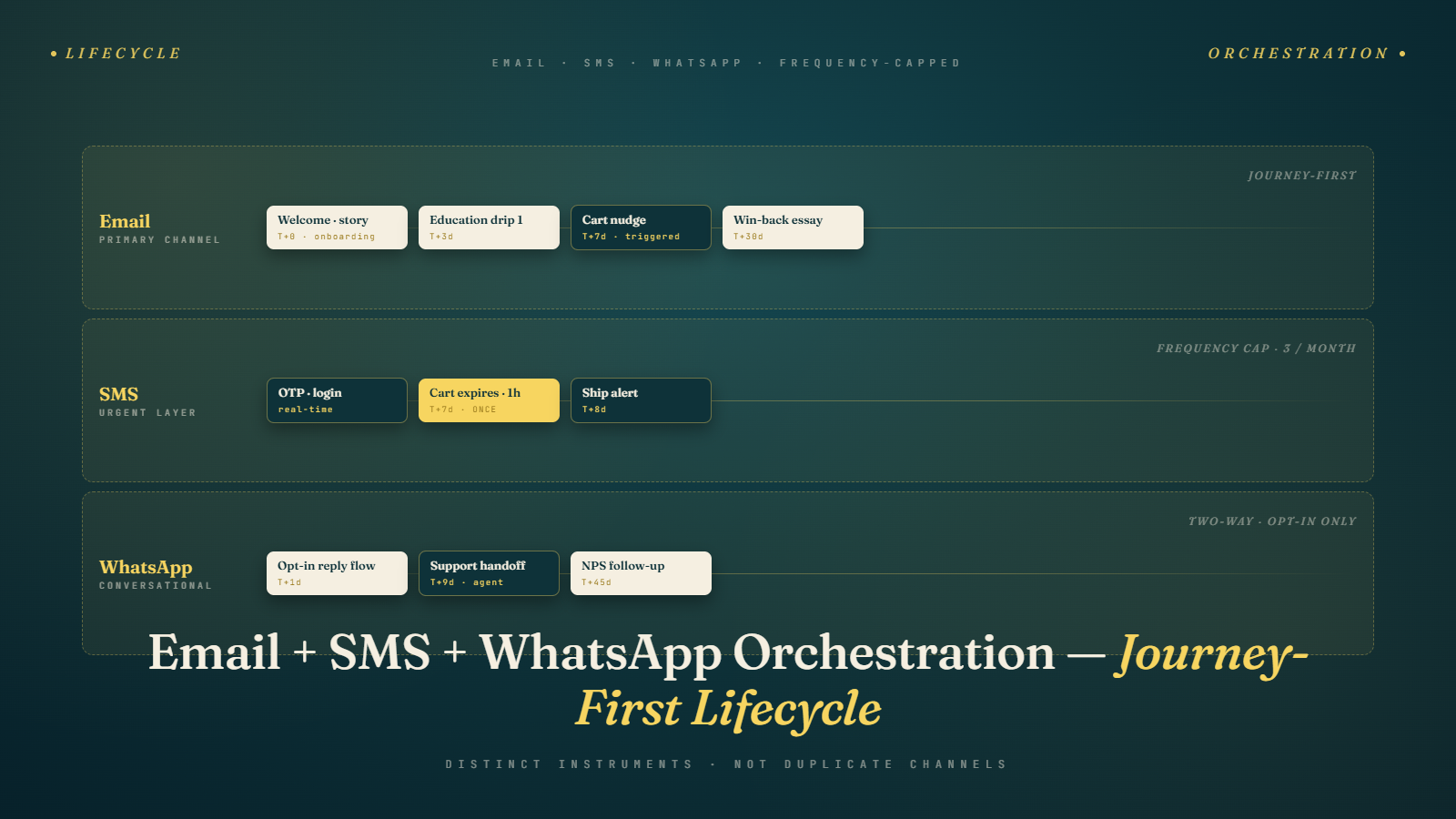
A retailer I worked with last fall had what looked like a healthy lifecycle program on paper. Every abandoned cart triggered an email at one hour, an SMS at three hours, and a WhatsApp message at twenty-four. The three messages said almost the same thing, with the same discount, written by the same copywriter who rotated between channels on a spreadsheet. Conversion on the flow was 2.1 percent. Unsubscribes from SMS were climbing by about eight percent month over month. The team thought adding a fourth channel would fix it.
We cut the flow to one email and one SMS, rebuilt around the behavior instead of the schedule, and conversions moved to 4.8 percent in six weeks. Nothing about the offer changed. Only the thinking did.
Multi-channel orchestration is now within reach of mid-size senders. Klaviyo, Brevo, Iterable, and Attentive all ship native SMS and WhatsApp alongside email, and the pricing finally makes sense for a brand doing a few million in revenue. What has not caught up is the design discipline. Most teams bolt new channels onto their existing email calendar and then wonder why the numbers get worse.
Stop thinking channel first
The default approach looks like this: you map out your email flows, then ask where SMS could "add touchpoints," then layer WhatsApp on top for markets where it has traction. This is backwards. You end up with three overlapping calendars, none of which respects the subscriber's actual state or preference.
Journey-first design starts somewhere else. You name the behavior you care about (cart abandoned, product viewed, first purchase completed, subscription paused) and the outcome you want (recover, nurture, upsell, reactivate). Only then do you decide, message by message, which channel fits the content.
Email is for detail. It carries images, comparisons, longer copy, and structured information like shipping dates or warranty terms. If the recipient needs to read, scan, or reference, email is the right container.
SMS is for urgency and brevity. It interrupts. The best SMS messages are short, have one verb, and respect the fact that the recipient's phone is buzzing in their pocket. If you cannot defend why this message deserves to interrupt, it belongs in email or nowhere.
WhatsApp sits differently. It feels conversational, it supports two-way replies naturally, and it allows rich media without the one-way broadcast feel of email. WhatsApp belongs where you want a dialogue, a quick photo of a product in context, or a message that can be answered with a thumb. It does not belong where you would normally write a newsletter.
The mistake everyone makes is treating all three as interchangeable delivery pipes for the same content. A subscriber who gets "Your cart is waiting, here is ten percent off" three times in one evening through three channels is not being orchestrated. They are being harassed with a cadence.
The consent reality most teams ignore
Email consent, at least in practical terms, is forgiving. A double opt in is nice but not legally required in many markets, and the bar for a valid subscriber is low enough that list growth tactics have decades of wiggle room. SMS and WhatsApp do not work this way, and teams coming from email keep getting this wrong.
In the US, the TCPA and its 2025 amendments treat every promotional SMS as something the recipient must have agreed to with a clear, channel specific opt in. Bundling SMS consent into a generic "I agree to receive marketing" checkbox has been the basis for class actions that ended in six and seven figure settlements. Your email signup form cannot quietly harvest phone numbers into your SMS list. The consent language needs to name SMS explicitly, say what kind of messages to expect, and disclose frequency.
WhatsApp is even tighter. Meta's Business Platform rules require opt in to happen through a channel the user recognizes as them agreeing to WhatsApp messaging, and the template messages that can be sent outside an active conversation window are limited to categories Meta approves. Send a promotional WhatsApp template to someone who did not explicitly opt in to WhatsApp, and you can have your business account suspended. Not rate limited, suspended.
The practical implication: your three lists are not the same list. A subscriber can be opted in to email and SMS but not WhatsApp, or email only, or all three. Your orchestration has to respect each subscriber's exact consent state per channel and per message type, which rules out the spreadsheet approach most brands still use.
Frequency caps across, not within, channels
Here is the most common gap I find in audits. A brand has a reasonable email cap (say, three per week), a reasonable SMS cap (say, two per week), and a reasonable WhatsApp cap (one per week). On paper, totally sensible. In practice, a single subscriber on all three channels is getting six commercial messages from the same brand in a week, before transactional or flow-triggered sends. That is not a cap, that is a ceiling stacked on top of another ceiling.
Real orchestration needs a cross-channel frequency budget. A weekly total, not a per-channel total. For most ecommerce brands, four to five commercial messages per week across all channels combined is the upper limit before fatigue starts showing up in complaint rates and unsubscribes. For B2B or considered purchases, two or three.
Platforms handle this unevenly. Klaviyo has cross-channel frequency logic in its newer journey builder but does not apply it to legacy flows by default. Iterable exposes it through channel weights but requires some engineering. Brevo treats the three channels as mostly independent unless you build throttle logic into each flow. If you are running orchestration in 2026 without a cross-channel cap you have enforced yourself, you are almost certainly oversending.
When you do enforce it, you run into priority questions. If the subscriber is near their cap and the cart abandonment flow wants to fire, does it beat the weekly newsletter? Which one gets dropped? My rule: behavior-triggered beats scheduled, high-intent beats low-intent, and a channel the subscriber has engaged with recently beats one they have ignored. You will not get this right from the start. Build the cap, then watch which messages get suppressed and adjust.
How to pick a channel for each message
Think of it as three questions, in order.
First, what does the message need to do? If it delivers a receipt, shipping notice, or anything the recipient may reference later, email. If it is a reminder the recipient needs now but not later, SMS. If it is a conversational prompt where a reply is expected, WhatsApp.
Second, what is the subscriber's current engagement state on each channel? A subscriber who has not opened email in sixty days but tapped two SMS in the last week is telling you where they live. Send the next message there, not in the channel you wish they used.
Third, what is the cost? SMS in the US runs about three cents per message, WhatsApp template messages run from a cent to nine cents depending on category and country, email is a fraction of a cent. If you are sending a message that would produce the same outcome regardless of channel, you are burning money running it through SMS or WhatsApp.
A working rule for most lifecycle programs: sixty to seventy percent of total messages stay on email, twenty to twenty-five percent go to SMS, the rest (only for brands with meaningful WhatsApp consent) sit on WhatsApp. That ratio shifts by market. In parts of Latin America and Southeast Asia, WhatsApp should be fifty percent or more. In Germany, SMS barely exists. Do not apply a US playbook globally.
A cart abandonment flow that actually uses all three
Here is the flow we rebuilt for the retailer I mentioned at the start. It assumes the subscriber has email, SMS, and WhatsApp consent and has abandoned a cart worth over eighty dollars.
At forty-five minutes, email one. Subject line names the product, body reproduces the cart with images, includes a clear link back. No discount. If the subscriber clicks and does not buy, branch to path A. If they do not open or click, branch to path B.
Path A, at four hours, SMS. Short. "Still thinking about [product name]? Free shipping if you check out today." Uses the attention they already showed on email. No attachment, no image, one link.
Path A, at twenty-four hours, WhatsApp. Conversational template: "Hi [name], noticed you were looking at [product]. Any questions about sizing or fit? Reply here and our team can help." A human actually replies. This is the only step that requires staffing, and it is where WhatsApp earns its keep, because the conversion rate on recovered carts that go through a WhatsApp reply runs about three times higher than an automated touch.
Path B, at twenty-four hours, a second email. This one has social proof (reviews for the abandoned item) and a ten percent code. No SMS, no WhatsApp. A subscriber who did not engage with the first email is not a candidate for channel escalation; they are a candidate for a second, different email angle or eventual removal from the flow.
Path B, at seventy-two hours, one SMS with the same code and a deadline. If this does not work, the flow ends.
That is five touches maximum, across three channels, respecting which signals the subscriber sent. Compared to the original nine-touch same-message blast, it converts more and burns the subscriber less. You can see the same journey-first thinking applied to top of funnel work in our piece on segmenting your email list for better results.
The featured snippet version
What is email, SMS, and WhatsApp orchestration in lifecycle marketing? It is designing a single behavioral journey, like a cart abandonment or post purchase flow, and assigning each message to the channel that fits its purpose: email for detail and reference, SMS for urgent brevity, WhatsApp for conversational exchanges. Orchestration requires separate consent per channel, a cross-channel weekly frequency cap rather than per-channel caps, and suppression logic so the same message does not repeat across pipes. Done right, it reduces total message volume and lifts conversions on the journey.
Where teams get in their own way
A few patterns come up every time I audit an orchestration program that is underperforming.
Same copy across channels. If you are writing an email and then "adapting" it for SMS by cutting it down, you are doing it wrong. SMS copy is a different craft. It should be written from scratch by someone who understands the channel, or at least rewritten, not trimmed.
Simultaneous cross-channel sends. Firing an email and an SMS within ten minutes of each other is not coverage, it is a double tap. Space them by hours at minimum, and only if the second channel is genuinely adding information or urgency.
No suppression of triggered sends during broadcast sends. If a subscriber got this morning's newsletter, they should not also get an email at 2 PM from a browse abandonment flow that happens to fire. Global suppression windows around broadcast sends are basic hygiene.
Ignoring engagement decay per channel. Subscribers age out of channels at different rates. Someone who stopped opening email six months ago may still be active on SMS. Your flow logic needs to check channel-specific recency, not just overall list membership.
Running WhatsApp as a broadcast channel. WhatsApp punishes broadcast behavior by shadow limiting your templates. Use it where two-way interaction is plausible. Where it is not, stick to email and SMS.
You can also read about specific engagement signals that should drive channel selection in new email engagement metrics in the AI inbox and how send frequency interacts with deliverability in quality over quantity.
What to build this quarter
If you are starting from a standard email-only program, the order matters. First, make your email program genuinely good, because SMS and WhatsApp will amplify whatever quality level you are at. If your email content is mediocre, adding channels will just distribute the mediocrity faster.
Second, add SMS with a real consent flow and one or two high-intent trigger points: cart abandonment, back in stock, shipping updates. Do not start with a weekly promotional SMS. Let the channel prove its value on behavioral moments first.
Third, and only if you have a meaningful consent base, layer in WhatsApp for conversational touchpoints where a human or a well-designed bot can actually respond. If you cannot staff replies, WhatsApp is not ready for you yet.
Fourth, implement the cross-channel frequency cap before you expand the program further. Every brand I have seen grow orchestration without this step has had to unwind it later, often after a deliverability crisis.
Measuring orchestration, not channels
Channel-level reporting will mislead you. If your SMS click rate is twenty percent and your email click rate is three percent, it is tempting to shift more volume to SMS. But SMS only gets sent to subscribers who have already shown high intent, so the comparison is rigged. You are measuring the audience, not the channel.
The honest metric is journey level. For a given behavioral trigger (cart abandoned, product viewed, trial started), what percentage of subscribers complete the desired action within the journey window? Did changing the channel mix move that number? Did it move revenue per recipient entering the journey? Did it move complaint rate and unsubscribe rate across all three channels combined?
I like tracking four numbers per lifecycle journey: conversion rate end to end, revenue per entrant, total messages delivered per entrant (a load number), and opt out rate across all channels. If the first two go up and the second two stay flat or drop, the orchestration is working. If the first two go up but message load doubles, you borrowed the gain from somewhere and it will show up as fatigue later. The framework holds up whether you are running a four-step welcome or a multi-month post purchase series, and it pairs naturally with the revenue-first view laid out in measuring ROI of cold email campaigns.
One more discipline worth naming: clean data before you orchestrate. Dead email addresses, wrong numbers, and unverified mobile digits will break your journey logic and burn through your SMS budget on undeliverable sends. A monthly email and phone verification pass before high-volume orchestrated flows pays for itself in the first send.
Tomorrow, open your lifecycle program and pick one flow (start with cart abandonment or post purchase, they are the highest volume). Map each message to a channel based on purpose, not schedule. Count the total messages a single subscriber could receive if they hit every branch. If that number is above five, cut it. That single exercise, done honestly, will do more for your orchestration than any new platform feature this year.