
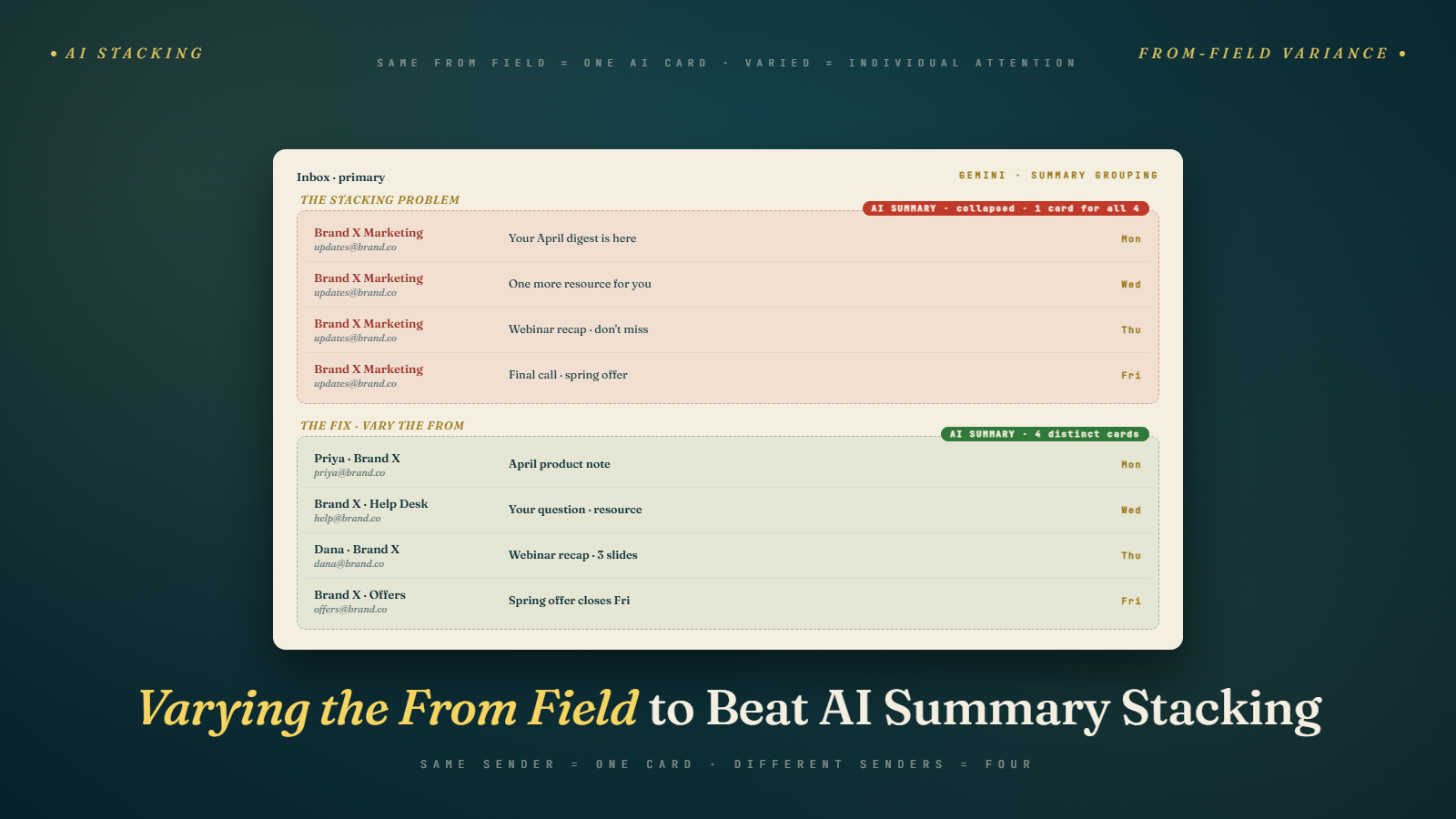
A beauty brand I consult for noticed in February 2026 that Gmail was grouping their weekly promotional email, their tutorial newsletter, and their loyalty program update into a single AI summary block. Three different emails sent across the same week, written by three different teams, serving three different subscriber intents, were showing up in the inbox as one compressed preview with a "from BrandName" header and a combined summary that read as a mess. Engagement on all three dropped at the same time.
The cause was not content quality. It was that all three emails shipped from the same From name: "BrandName". Gemini's summary engine treated them as a series and stacked them. The fix turned out to be almost embarrassingly simple, but it cuts against a decade of "use one consistent sender name" guidance that most email programs still follow.
What AI Summary Stacking Is
Gemini groups emails in the inbox using signals that include sender identity, category, send cadence, and content similarity. When multiple emails from the same From name arrive in a short window, the grouping logic tends to collapse them into a single summary card. That card gives the subscriber one condensed preview of the batch rather than separate previews of each message.
This is usually helpful. If a brand sends a shipping confirmation, a delivery update, and a delivery completion notice across four days, grouping them into a single summary card makes the inbox cleaner. The subscriber sees the current state of their order without three separate notification entries.
The problem appears when the grouped emails serve different intents. A promotional email and an educational newsletter and a loyalty update are not variations on the same message. They are distinct communications to different aspects of the subscriber relationship. When Gemini groups them, subscribers lose the ability to triage each one on its merits. The promotional offer disappears under the summary. The educational content gets skimmed because it is bundled with promotional material. The loyalty update feels like part of a sales push.
Stacking compresses your brand's multi-faceted relationship with a subscriber into a single generic preview. That is the symptom you are trying to prevent.
The 45-Second Version
If you send multiple email types to the same subscriber in a week, use different From names for each type. Promotional from "BrandName Deals", educational from "BrandName Team", loyalty from "BrandName Rewards", transactional from "BrandName Orders". Gemini treats each From identity as a distinct sender for grouping purposes, so your summaries stay separate and each email gets its own preview card. The cost is minor authentication work. The benefit is that subscribers actually see each message instead of a compressed blend.
That is 70 words and it covers the mechanism. The detail worth understanding is when to use this tactic, when it hurts rather than helps, and what authentication changes it requires.
Why This Works Against the Grain of Old Best Practices
For fifteen years the received wisdom on From fields was consistency. Pick one sender name. Use it across every email. Build brand recognition through repetition. That advice was correct for an era where the From field was primarily a trust signal. Subscribers recognized the sender by name and decided whether to open based on that recognition. Variation muddied the signal.
The Gemini era changes the calculus. The From field still matters for recognition, but it now also functions as a grouping key for AI summary generation. A single consistent From name tells Gemini "these are all the same stream" and invites stacking. Multiple distinct From names tell Gemini "these are separate streams" and keep them separate in the summary layer.
The contrarian point here is that a little From variation actually reinforces brand recognition rather than weakening it. A subscriber who sees "BrandName Deals" in their promotional inbox and "BrandName Team" on educational content experiences a coherent brand architecture, not a confused sender identity. The common brand name anchors recognition. The suffix differentiates the context. Subscribers parse this instantly, because they already recognize this pattern from companies like Amazon, Airbnb, and most major retailers who run distinct sender identities for transactional, marketing, and account communications.
The programs still following the "one From name" rule rigidly are often the ones getting hurt most by summary stacking. Their brand consistency at the From field level produces brand dilution at the inbox summary level.
When This Tactic Backfires
This is not free. Using multiple From names carries costs, and there are programs where it causes more problems than it solves.
Authentication complexity increases. Each From name needs to align with your DMARC policy. That means SPF, DKIM, and DMARC records configured correctly for each sending identity. If your program uses a single ESP and one sending domain, this is usually straightforward: different From names sharing the same From address domain with proper auth is fine. If you are sending from multiple subdomains or across multiple platforms, the authentication work gets non-trivial. Subdomain DMARC configuration becomes a prerequisite, not an option.
Sender reputation fragments across names. If you send a low volume from each of four From names rather than a high volume from one, you may not build enough reputation signal on each to land well at restrictive receivers. This is a real consideration for small programs. Below roughly 50,000 Gmail subscribers or 200,000 monthly sends, the benefit of fragmenting identities is often smaller than the cost of diluting reputation.
Subscribers can get confused by proliferation. Two or three distinct From names is coherent. Six or seven is chaos. "BrandName Deals", "BrandName News", "BrandName Alerts", "BrandName Community", "BrandName VIP", "BrandName Updates", and "BrandName Partners" is not a brand architecture, it is a filing problem. Subscribers start treating all of them as noise.
The tactic works when the From names map to clearly distinct subscriber intents and stay limited in number. It breaks when used as a workaround for underlying segmentation or frequency problems.
A Working From-Field Architecture for 2026
The structure that has tested well across client programs has three or four distinct From identities, aligned to clear subscriber-facing purposes.
A transactional identity, used for order confirmations, shipping updates, password resets, and anything where the subscriber is actively waiting for a specific message. "BrandName Orders" or "BrandName Support" reads as unambiguously service-related. Subscribers open these at extremely high rates because they are expecting them.
A primary marketing identity, used for the bulk of promotional content, broadcasts, and campaign sends. Often just "BrandName" or "BrandName Deals" depending on the brand's tone. This carries most of your sending volume and most of your reputation development work.
A content or community identity, used for newsletters, educational content, founder notes, or community updates. "BrandName Team" or a person's name at the company like "Sarah from BrandName". This identity benefits from feeling more personal, because the content it carries is usually less commercial.
A loyalty or account identity, used for rewards updates, tier notifications, and subscriber-specific account communications. "BrandName Rewards" or similar. Most programs under a certain size can skip this fourth identity and fold its content into the transactional or primary marketing identity.
That structure keeps summary stacking from collapsing three different conversations into one, while keeping the From identity count low enough that subscribers can parse it.
What to Set Up Before You Make the Change
A numbered checklist because this is one of the few places where the order matters.
- Audit your current sending domains. Every From name needs to resolve to a From address on a domain you control and have authenticated. "BrandName Team (team@yourbrand.com)" is fine if team@yourbrand.com is a real authenticated address.
- Verify SPF, DKIM, and DMARC alignment for each From identity you plan to use. If any of them fail alignment, Gmail's reputation scoring treats them as lower-quality sources and your stacking problem is replaced by a deliverability problem. See SPF and DKIM dual alignment under DMARC for the specifics of what needs to match.
- Update your ESP configuration to route different campaign types through the correct From identity. Most ESPs let you set the From name at the campaign level, but automation sequences often have a default that overrides campaign-level settings. Check the automation defaults.
- Configure your reply-to addresses. A From name of "BrandName Team" with a reply-to address of marketing-noreply@yourbrand.com produces cognitive dissonance. If you send from a personal-feeling identity, accept actual replies at that address, or route them through a monitored inbox. Subscribers treating replies as broken is a trust signal you do not want.
- Launch one new From identity at a time and monitor the deliverability for at least two weeks before adding the next one. A staged rollout lets you catch authentication or reputation issues on one identity before the problem multiplies across four.
The Stacking Test Before You Even Start
Before making any From field changes, run a diagnostic to confirm summary stacking is actually happening to your program. Not every program has this problem. Programs that send once a week, or that send multiple types of content but spread them across different weeks, may not experience stacking at all.
Send yourself (using a personal Gmail address that is subscribed to your program) two or three different email types within the same week. Promotional on Monday, newsletter on Wednesday, loyalty update on Friday, or whatever your actual cadence looks like. Then open Gmail in the web or mobile client and look at how the messages appear in the inbox.
If each email shows up as a distinct entry with its own summary card, you do not have a stacking problem, and the From field change may not be worth the authentication work. If the emails are grouped into a single summary entry with a combined preview, you do have a stacking problem, and the From field tactic will likely help.
Do this test on both mobile and web, because the grouping behavior differs slightly across clients. Gmail's mobile app tends to be more aggressive about grouping than the web interface.
What Changes in Your Metrics When This Works
The metric pattern that indicates the From field change is working shows up in a few places.
Open rates on secondary email types (newsletters, loyalty updates, educational content) typically rise because the emails are no longer being absorbed into the summary card of your promotional sends. This is often the most visible and immediate change. An educational newsletter that was running 18% opens climbs to 25% when it gets its own summary card rather than being stacked under a deals summary.
Click-through rates on the primary marketing identity often hold steady or improve slightly because subscribers who open promotional emails are now more specifically intent-matched. The general-interest readers who were opening promotional emails out of summary confusion filter themselves out into the secondary identities where their interest actually lives.
Unsubscribe rate on the primary marketing identity sometimes rises. This is not usually a bad sign. Subscribers who unsubscribe from your promotional identity while staying subscribed to your newsletter identity are telling you they want the relationship minus the sales pressure. The composite subscriber health improves even though the promotional-list unsubscribe number ticks up. How the new AI-era engagement metrics shift the picture covers this reframe in more detail.
Reply rates on community or founder-style identities often spike. Subscribers treat personally-named From identities more conversationally. They reply more. Given that replies are increasingly weighted as a positive engagement signal in Gemini's relevance scoring, this compounds over time into better placement for all your sends.
The Contrarian Take on Why This Is Controversial
The "one consistent From name" advice has enough inertia that recommending variation still draws pushback from some email practitioners. The argument against variation usually boils down to brand consistency and the risk of subscriber confusion.
Both concerns are real, and both are addressable without abandoning the tactic. Brand consistency lives in the From name shared prefix (BrandName), not in the uniform identity. Subscriber confusion is a function of how many identities you use, not whether you use more than one. Three distinct identities with a common anchor prefix are not confusing. Eight are.
The deeper argument against variation is that it treats an AI summary layer as a permanent feature of the inbox that should shape sender strategy. That is a reasonable skepticism. If Gemini's summary behavior changes in a year, the From field architecture you built around it may become less useful.
My read: the summary layer is not going away. If anything, it is going to become more aggressive. Apple's Mail equivalent is already rolling out similar features. Outlook's Copilot integrations are moving the same direction. Building a sender architecture that respects AI summary behavior is not a one-off tactical response to Gemini. It is adapting to how the inbox works for the foreseeable future.
Pair this tactic with the rest of your Gemini-era adjustments: front-loaded email content, structured content for AI parsing, and list hygiene through email verification to keep your sender reputation healthy. The From field change is one lever among several. It happens to be a cheap lever with a clear mechanism, which is why it is worth running before the more involved content rewrites.
Send yourself your last three campaigns from a personal Gmail address and check the inbox. If they are stacking, your next From field identity split is worth testing on your next send. If they are not stacking, keep this tactic in your back pocket for when your send volume or variety grows.
The long-term view on this tactic is that From field strategy is going to become a standard part of email program design over the next few years rather than a niche optimization. As AI summary and grouping behaviors spread to Apple Mail and Outlook alongside Gmail, the senders who already built multi-identity sender architectures will have a structural advantage over the senders who are still running everything under one From name. The authentication work you do now to support three or four From identities pays off across multiple inbox environments, not just Gmail. Pair this architecture work with list hygiene through email verification and the combination produces an email program that reads as intentional and well-maintained to both AI systems and human subscribers, which is the posture that wins durably in the 2026 inbox.