
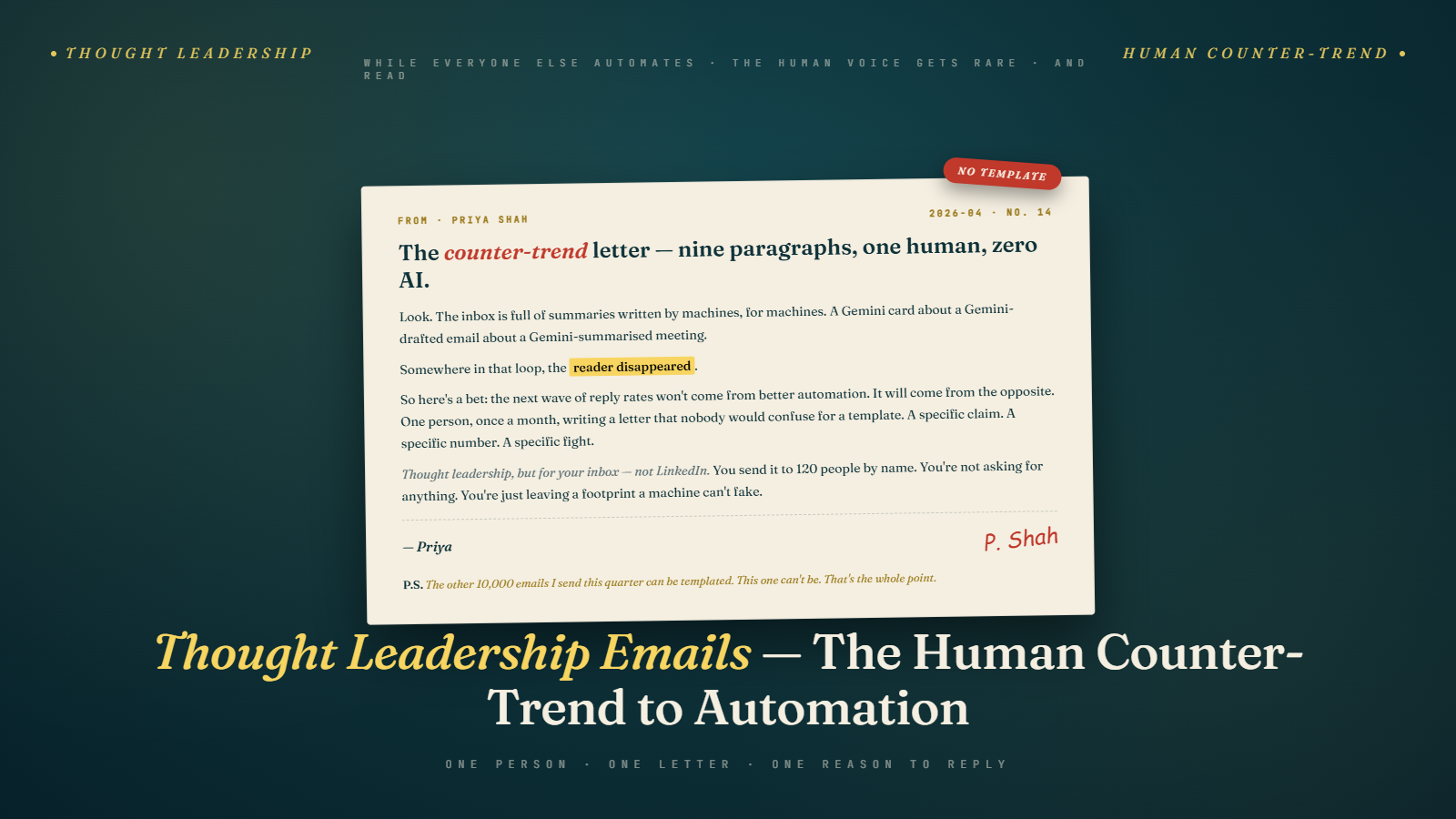
A software founder I know sends a Tuesday morning email from his personal address to his company's list of 48,000 subscribers. The email is usually 600 to 900 words. No graphics except occasionally a screenshot. No product promotion beyond a single soft reference at the bottom. Just his thinking about what he has been working on, what the team is seeing in the market, and what he would tell his former self a year ago. Open rate: consistently above 40%. Reply rate: around 2%. Revenue attribution from this email alone, measured through to deal closure: the largest single source of new pipeline in his company's marketing mix.
That email is almost everything conventional email marketing advice would tell you not to do. It is long. It is text-heavy. It uses a personal From address instead of a brand identity. It does not sell. It goes out weekly without fail even when there is no campaign theme to attach it to. And it is outperforming every other email the company sends by a wide enough margin that they have started structuring their whole marketing strategy around it.
This is the counter-trend I keep seeing in the programs doing best through the AI inbox transition. As most brands move toward more automated, more AI-generated, more heavily designed email, a small number are moving the other direction toward plainer, longer, more personally voiced thought leadership. The results are consistently better than the polished brand emails those same companies also send.
Why Plain Human-Voiced Email Is Working Now
Three things happened simultaneously that created the opening for thought leadership emails to outperform traditional promotional formats.
Inboxes filled with AI-generated content. Subscribers increasingly see email that reads like it was written by a model or produced by a template. A handwritten-feeling email stands out through contrast alone. Not because it is better writing, but because it feels different from what surrounds it.
Gmail's Gemini summaries changed the information economics of opening an email. If a promotional email can be summarized in a card, subscribers often skip the open. A thought leadership email with nuanced argument, specific anecdote, and personal voice cannot be cleanly summarized without losing the point. Subscribers who are interested open it because the summary is inadequate. See the broader Gemini-era dynamics for marketers for the full mechanism.
Trust has become a more valuable currency than attention. Brands competing for the same attention across a dozen channels are finding that genuine trust, built through consistent useful content from a specific human, compounds in ways that raw reach does not. A subscriber who reads your founder's thoughts weekly for six months develops a relationship with your brand that no promotional sequence produces.
The intersection of these three factors is why thought leadership email is working now in ways it was not five years ago. The inbox environment has changed, and the format has become more valuable as a result.
The 45-Second Version
Thought leadership emails work when they are from a specific person, written with personal voice, contain actual insight the subscriber could not get elsewhere, and run on a predictable cadence. They fail when they are ghostwritten generic content attributed to an executive, when they are promotional in disguise, when they publish irregularly, or when they feel like content marketing rather than someone actually thinking out loud. The ROI is slower than promotional email but compounds over quarters. Most brands that start these programs abandon them at month three, which is exactly when they would have started working.
That is 92 words and captures the critical success factors. The rest of this post covers the specific execution patterns that make these emails perform and the common ways brands undermine their own thought leadership efforts.
What Subscribers Are Actually Reading
When thought leadership emails perform well, subscribers are usually reading them for one of three reasons.
To learn something specific to their work. A B2B founder writing about building a sales team has something to offer a reader who is also building a sales team. The content is useful in a direct operational sense. The subscriber reads because they expect to come away with one concrete idea they can act on.
To hear how a specific person thinks. Subscribers who have been on the list for months or years often read because they have developed a para-social interest in how the writer approaches problems. The content might not be immediately actionable. It is valuable because it shapes how the subscriber thinks about their own adjacent problems.
To feel connected to a community or movement. Some thought leadership emails function more like newsletters that create a sense of shared identity: these are my people, this is what we are paying attention to. The content serves as the social fabric for a loose community of readers.
Any of these three can support a successful thought leadership email program. The programs that fail usually fail because they try to do none of them. They produce content that is not useful, not distinctively voiced, and not community-building. It is generic thought leadership that sounds like everyone else's generic thought leadership. Subscribers disengage because there is nothing specific to engage with.
Why Ghostwriting Usually Fails
The ghostwriting question is where most executive-attributed thought leadership goes wrong. A CEO is busy. The marketing team offers to draft emails in the CEO's voice for them to review. The CEO barely reviews. The draft goes out under the CEO's name with the CEO's face in the signature. This has been the dominant model for executive thought leadership for a decade, and it is now actively counterproductive.
Subscribers can tell. Not always consciously, but the signals are all there. The writing has a generic corporate voice. The specifics that would come from actually doing the work described are absent. The tone is carefully safe in a way that real human thinking rarely is. Experienced readers develop a sense for ghostwritten content and discount it accordingly.
The ghostwriting failure is compounded by the AI era. Subscribers already suspect a share of email is AI-generated. When the email is ghostwritten by marketing, even if no AI was involved, it lands with the same "nobody really wrote this" sensation that AI-generated content produces. The voice flattens into corporate blandness that the subscriber has seen a thousand times.
The teams that make thought leadership work with executives have solved this differently. Either the executive actually writes the emails, sometimes with light editorial help, or the marketing team does substantial interviews with the executive, transcribes the discussion, and shapes it into email form with direct quotes and actual phrasing preserved. The latter is not ghostwriting. It is closer to journalism. The executive's voice comes through because it actually came from them.
If the executive will not invest the time for either approach, a different author than the executive is a better choice. A marketing lead writing under their own name, with their actual perspective, will outperform a CEO-attributed email that reads like marketing.
The Cadence That Actually Works
Thought leadership email is a cadence-dependent format in a way that promotional email is not. Promotional emails can run on varying schedules tied to campaign windows. Thought leadership emails need a predictable rhythm because subscribers develop a habit around them.
The cadences I see working consistently: weekly on a specific day, every other week on a specific day, or monthly on a specific date. The common thread is predictability. Subscribers who know the Tuesday email is coming look for it. Subscribers for whom the email shows up randomly do not develop the same anticipation.
Weekly is ambitious and requires real commitment, usually from someone whose job is this. Every other week is more sustainable for programs where the author has other primary responsibilities. Monthly is the floor; less than monthly and the relationship atrophies between sends.
The specific day and time matter less than the consistency. Tuesday morning works because many subscribers batch their weekly reading then. Sunday evening works for audiences that plan their week over the weekend. The key is picking one and holding it for at least a quarter before evaluating performance.
Missing sends is the single most damaging thing you can do to a thought leadership program. A subscriber who expects Tuesday and gets nothing on Tuesday registers that as the relationship slipping. A few missed sends and the subscriber stops looking, which means the next send has to recapture attention from scratch rather than slotting into an established habit. The founder I mentioned at the start has missed two weekly sends in three years. Not one missed week because he was busy, not one missed week because he could not think of a topic. Two, and both were weeks he was on extended travel with unreliable connectivity. That commitment is rare and it is also the minimum standard for the format to work.
Production Reality
A 700-word thoughtful email takes about three to four hours to produce well, including the thinking that happens before writing. Multiplied by weekly cadence, that is roughly 150 hours per year. For a founder or executive whose time is the most expensive in the company, that is a non-trivial cost. For a team weighing whether to start a thought leadership program, that production reality matters more than most starting-this-quarter advice acknowledges.
The cost has to be weighed against the value. A thought leadership email program that reaches 50,000 subscribers weekly and drives, say, 30 pipeline meetings per quarter (a realistic mid-point for a well-executed B2B program) is delivering meaningful revenue for the time investment. A program that reaches 2,000 disengaged subscribers and drives two meetings per quarter is not. The math on starting depends on the audience size, audience quality, and the author's ability to produce content that actually warrants reading.
Programs that try to run thought leadership with a stretched team usually collapse around month three. The author misses a week, misses another, starts producing lower-quality pieces to keep the cadence, and the program drifts into mediocrity that does not justify the time cost. Better to do no thought leadership than to do it inconsistently.
What Separates Winning Emails from Generic Ones
A few patterns that show up in the thought leadership emails that perform well and are absent from the ones that do not.
Concrete specificity. The good emails reference specific situations, specific numbers, specific people (with permission), specific tools, specific decisions. The weaker emails deal in abstractions and general principles. "We learned that our cold outreach response rate was 3.2% before we changed our sequence, 8.7% after" lands differently from "we learned a lot about outreach sequences."
First-person voice that admits uncertainty. The best thought leadership emails are comfortable saying "I thought X and turned out to be wrong about Y" or "I do not know if this will work but here is what we are trying." The weaker ones deliver received wisdom from a position of implied authority. Subscribers respond to the humility because it signals real thinking rather than performance of expertise.
A clear point. Not a takeaway in the marketing sense, but an argument the writer is actually making. The email stakes out a position. Good thought leadership emails often disagree with received industry wisdom in specific, defensible ways. The subscriber finishes with a clearer sense of what the writer thinks about something. Weak thought leadership emails finish without the subscriber being able to articulate what the writer was saying.
Appropriate length. Long enough to develop an idea fully, short enough not to pad. Most good thought leadership emails land between 500 and 1,000 words. Shorter than that often does not have room to develop a real idea. Longer than that requires genuinely exceptional content to hold attention.
Light on calls to action. A thought leadership email with a big promotional push at the bottom feels like the whole email was a setup for the sale. Subscribers recognize this pattern and discount future emails. The better pattern is no CTA or a soft contextual reference at the bottom. The email is the thing, not a wrapper for the conversion.
The Metrics That Actually Matter
The engagement metrics for thought leadership email work differently than for promotional email, and programs that evaluate them on promotional-email metrics often miss what is happening.
Open rate matters, but the floor is higher. A thought leadership email running a 25% open rate is signaling that subscribers are mildly interested. Running 40% or higher signals a genuine habit. Below 20% and the program is probably not connecting with the audience.
Reply rate is the strongest signal. Subscribers replying to a thought leadership email is a much higher-intent action than clicking on a promotional email, and it compounds in the Gemini era where reply rate is weighted more heavily as an engagement signal. A reply rate above 1% for thought leadership email is excellent. Above 2% is exceptional.
Click-through rate matters less. Thought leadership emails often have no primary click target, and that is fine. Subscribers reading to the end and replying is more valuable than subscribers clicking through to the blog.
Unsubscribe rate should run lower on thought leadership emails than on promotional emails. Subscribers who unsubscribe from your thought leadership are the clearest signal you can get that the content is not for them, and losing them is usually a good outcome. But the absolute unsubscribe rate on a well-run thought leadership program is typically 20-40% lower than on promotional content because the value proposition is clearer.
Attribution to pipeline or revenue. This is the hard one. Thought leadership email rarely drives direct conversions. It builds the relationship that leads to conversion later through other channels. Attribution requires patience and looking at the full customer journey rather than last-touch attribution. The programs doing this well use UTM tagging consistently and look at revenue from contacts who engaged with thought leadership content over the preceding 90 days, regardless of which channel the conversion closed on.
The Counter-Trend Is Not Universal
Thought leadership email is not the right strategy for every brand. A DTC fashion retailer with a 2-million-subscriber list and a 4-person marketing team is not going to run a successful founder newsletter. The economics do not work, the audience probably does not want the format, and the production cost is too high for the expected return.
The brands where thought leadership email works have one or more of these characteristics. Considered purchase categories where subscribers research extensively before buying: B2B software, professional services, high-end consumer goods, financial services. Founder-led or expert-led brands where the authority of a specific person is part of the value proposition. Audiences who are themselves practitioners in the category and genuinely interested in the thinking behind the products. Brands where trust is a significant conversion barrier that content can help address.
For those brands, thought leadership email is one of the highest-ROI channels available. For brands outside that profile, it is probably not worth the effort, and traditional promotional email with better targeting is a more productive investment. Pair the decision about format with the right-sizing analysis on segmentation: a broadly-targeted well-voiced thought leadership email can outperform hyper-segmented promotional content for the right audience.
What to Actually Start This Quarter
If you have concluded that thought leadership email fits your brand, three specific first steps.
Identify the author. This is the most important decision and the one most programs delay. It has to be a specific named person whose time will actually go into this. Start with whoever is genuinely interested in writing and has enough domain credibility for subscribers to value their perspective. Do not commit the CEO unless the CEO has said they will actually do the writing.
Commit to a cadence and the first ten emails. Do not start with "let's see how the first one goes." Write a rough outline for the first ten. That outline is what separates a program that lasts from one that dies at week four when the author runs out of topics.
Set up a separate From identity for these sends if they are going to the same list that receives promotional content. Varying From fields to prevent AI summary stacking covers the authentication setup. A thought leadership email sent from the same From identity as promotional content often gets bundled into a summary card with the promotional content, which defeats the purpose.
Pair the thought leadership program with email verification for list hygiene so your well-written content lands in inboxes that will actually read it. Bulk Mail Verifier handles the list side. The content work is necessary but not sufficient without the deliverability foundation underneath.
Write the first email this week. Not next month, not when the plan is perfect. This week. The first ten will be rougher than the next ten, and the next ten will be rougher than the ten after that. The only way to get to the program that compounds is to start producing and keep producing. Schedule a recurring hour on the author's calendar and treat it with the same seriousness as any other strategic commitment. The programs that work are the ones where that hour is non-negotiable for a year before anyone evaluates whether the program is working.