
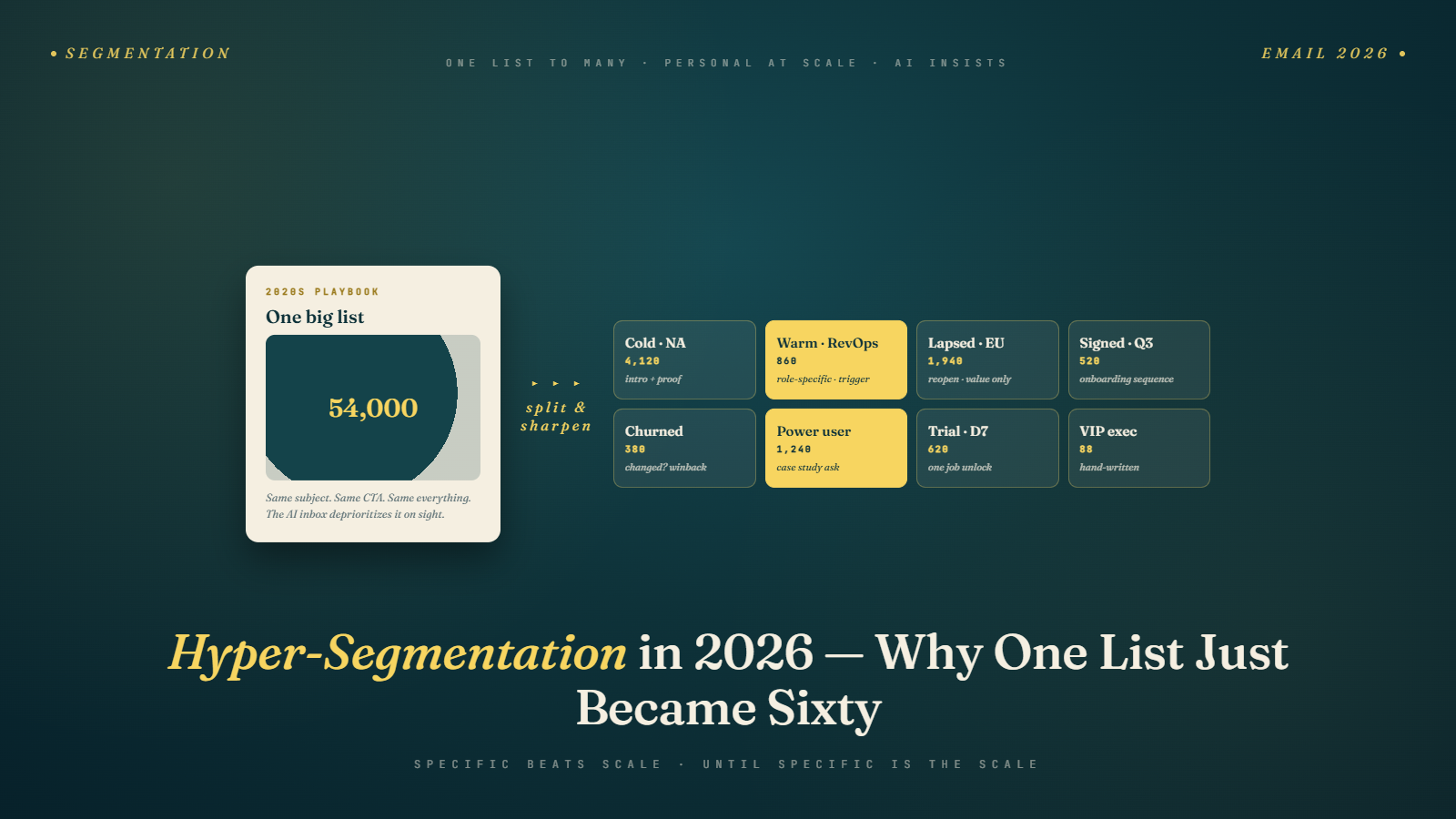
A mid-market apparel brand came to me in late 2025 with a segmentation strategy they were proud of. Forty-seven distinct customer segments, each with its own email cadence and content track. They had built it over two years. They were also seeing a 23% year-over-year decline in email revenue per subscriber and could not figure out why. My first recommendation was to collapse forty-seven segments into seven. They thought I was joking. They were up 14% in revenue per subscriber four months later.
That experience is not unique. Most email programs I audit in 2026 are over-segmented relative to what their content operations can actually serve well. The industry conversation about segmentation has pushed toward more and finer, with the implicit assumption that more segments always means better performance. The data does not support that assumption, and the 2026 production realities make it less defensible than ever.
What Hyper-Segmentation Usually Produces
When a program scales segment count beyond what the content team can produce meaningfully differentiated content for, each segment receives content that is only slightly different from what other segments receive. The subscriber experiences not a personalized message but a template with minor variable swaps. The personalization is nominally there. The felt personalization is not.
The underlying issue is production capacity. A team that can produce genuinely differentiated content for four or five distinct audience segments cannot produce genuinely differentiated content for thirty. The additional segments get filled in with minor variations on a base message, because no team has bandwidth to write thirty substantively different emails per week.
The result is a program that looks sophisticated in the ESP dashboard and performs mediocrely in the inbox. Subscribers get emails that are marginally tailored to their segment but fundamentally similar to what they would have received in a broader segmentation. The operational complexity produces little lift over a simpler, better-executed approach.
The apparel brand I mentioned was a textbook case. Their forty-seven segments were real in the data sense but fake in the content sense. Their weekly promotional email had forty-seven variants that differed by product selection and by two lines of copy. The core message, the offer, the visual design, and the call to action were identical across all of them.
The 50-Second Argument
Hyper-segmentation fails when segment count exceeds the content team's capacity to produce distinct, high-quality content per segment. Four to seven well-executed segments typically outperform twenty poorly-executed segments. The correct segmentation count for a program is determined by how many distinct content streams the team can actually write well, not by how many behavioral dimensions the data allows. Most programs should collapse segments rather than proliferate them. The signal that segmentation is working is content that feels materially different per segment, not data complexity.
That is 84 words and captures the core argument. The rest of this post covers where segmentation actually pays off, where it degrades performance, and how to right-size your segmentation for 2026 realities.
Why Segment Count Has Been Creeping Up
The industry has drifted toward hyper-segmentation for understandable reasons. ESP platforms have made segment creation nearly frictionless: drag-and-drop builders, behavioral triggers, and integration with CDPs mean that creating a new segment takes minutes. The marginal cost of adding a segment is near zero, so programs keep adding them.
Segmentation also looks impressive in marketing team reviews. A program with forty segments appears more sophisticated than one with six. Executives reviewing marketing performance see segment count as a proxy for thoughtfulness about the audience. Nobody wants to be the team using just five segments when the competitor is using thirty.
Behavioral data availability has exploded. Every click, purchase, page view, and email open generates a potential segmentation dimension. The temptation to slice the audience along all of those dimensions simultaneously is strong, and most ESPs make it possible.
The problem is that segment creation is easy while segment servicing is hard. A segment that exists in the database but receives the same content as four other segments is not a real segment. It is a line item in a dashboard.
The Capacity Ceiling Nobody Measures
Here is the uncomfortable question to ask your content team: how many genuinely different emails can you produce per week? Not variants of the same email, but emails with distinct messaging, distinct offers, distinct tone, distinct creative. For most in-house teams, that number is surprisingly small.
A two-person email marketing team operating on a standard weekly cadence might be able to produce three or four distinct high-quality emails per week. Each distinct email represents one supportable segment. A program with thirty segments being served by this team is, by definition, serving most of those segments with near-duplicate content.
The teams I see doing segmentation well are honest about this capacity constraint. They identify the four or five segments where content differentiation meaningfully moves the needle, invest in genuinely distinct content for those segments, and accept that the remaining subscribers receive broader content rather than artificially narrow content.
The teams doing it poorly treat segmentation as a data exercise separate from content production. They build segments first, then scramble to produce content that vaguely fits, and end up with each segment receiving content that is 85% the same as what every other segment receives. Subscribers do not perceive this as personalization. They perceive it as noise.
What Segments Actually Move Revenue
Across the client programs where I have run segmentation tests, a small number of segmentation dimensions consistently outperform the rest. The pattern repeats often enough that I think of these as the default segments worth building, with everything else subject to proof.
Purchase recency and behavior. The difference between a customer who bought last week, a customer who bought six months ago, and a customer who has never bought is so large that any program should segment on it. Content for recent buyers focuses on complementary products and experience-building. Content for dormant buyers focuses on re-engagement and selective promotions. Content for prospects focuses on brand introduction and entry products.
Stated interest (zero-party data). Subscribers who have told you what they care about are a segment that performs dramatically better when you actually honor their stated preferences. The zero-party data playbook covers this in depth. The short version: subscribers who said they want women's activewear and receive women's activewear convert better than subscribers who said they want women's activewear and receive everything.
Engagement recency. Subscribers who opened or clicked in the past 30 days are a different audience than subscribers who have not engaged in a year. Their content should differ. The engaged segment gets your highest-energy, highest-volume content. The unengaged segment gets a much more restrained re-engagement track or gets sunset entirely.
Account stage or subscription status. New subscribers need welcome content. Active subscribers need core promotional and engagement content. Lapsing subscribers need retention-focused content. Churned subscribers need re-engagement or removal. These four buckets are usually enough for stage-based segmentation; finer divisions often produce marginal content differentiation.
Sometimes, geography or channel context. A subscriber in New York who opens on mobile has different needs than a subscriber in rural Wyoming who opens on desktop. This segmentation is worth building when content or offers meaningfully differ by geography. It is not worth building when the only difference is which shipping region the discount mentions.
That list covers most of the meaningful segmentation for consumer email programs. Four or five dimensions, each producing distinct content worth writing. Everything beyond this needs to earn its place by demonstrating revenue lift in testing.
Where Hyper-Segmentation Actually Works
The contrarian qualifier: hyper-segmentation is not always wrong. There are program types where it genuinely pays off.
High-value B2B programs with small, high-stakes audiences. A B2B software company selling six-figure annual contracts to 2,000 target accounts can reasonably run fifty segments, because each account relationship is valuable enough to justify custom content work. The economics support the production cost in a way that consumer programs rarely match.
Large-scale consumer programs with sophisticated content operations. A retailer with a 15-million-subscriber list and a dedicated editorial team of 20 can produce genuinely differentiated content for many segments. The capacity-ceiling argument does not bind the same way when the content team is large enough to serve many streams well.
Programs with highly variant product catalogs. A marketplace selling everything from kitchenware to power tools to beauty products has subscribers with genuinely distinct interest areas, and serving them with broad content produces worse results than serving them with category-aligned content. Segmentation here is responding to real product variety, not imposed complexity.
Loyalty or rewards programs with tiered structures. Different tier levels often genuinely warrant different content, different offers, and different communication cadences. The tier structure itself is the segmentation, and honoring it meaningfully improves the subscriber experience.
The test for whether hyper-segmentation makes sense for a specific program is whether the content each segment receives would be noticeably worse if collapsed into a broader segment. If yes, the segmentation is earning its complexity. If no, you are producing operational overhead for little subscriber benefit.
How to Audit Your Current Segmentation
A pragmatic audit that takes about four hours for most programs.
Pull your active segments from your ESP and list them. Count them. If you cannot describe in one sentence what content differentiates each segment from every adjacent segment, you have your first diagnostic.
For each segment, look at the last three sends that segment received. If you put those sends side by side with the sends the most similar other segment received, are they meaningfully different? Different offers, different copy, different creative? Or are they templates with small variable swaps? Segments failing this test are candidates for collapse.
Check your performance data by segment. If two segments have similar conversion rates, similar revenue per subscriber, and similar engagement, you are probably looking at a segmentation boundary that is not producing differential performance. Collapse them and test whether the combined segment performs worse on a standalone basis.
Identify the segments carrying the most revenue. Often 80% of revenue comes from 20% of segments. Those high-value segments warrant continued investment. The long tail of low-revenue segments often needs to be rethought or combined.
The output of this audit is typically a reduced segment count and a clearer content plan. The programs that do this audit honestly usually end with fewer segments, more distinct content per segment, and better overall performance.
What to Do With the Data You Are Not Segmenting On
One concern that comes up when I recommend collapsing segments: what happens to all the behavioral data that the program was slicing into segments? Does it go unused?
No. The data still informs personalization within a segment, just not through creating new segments. A subscriber in the "engaged promotional audience" segment can still receive product recommendations based on their browsing history, discount codes calibrated to their purchase pattern, and send-time optimization based on their open history. The personalization happens within the email, not through fragmenting the segment they belong to.
This is an important distinction. Segmentation is about which content stream a subscriber belongs to. Personalization is about how the content within that stream is tailored. Many programs conflate these and try to do both through segmentation, which is the root of the over-segmentation problem. The healthier pattern is a small number of segments (each with a distinct content stream) combined with rich in-email personalization within each segment.
The AI tools that have matured through 2025 and 2026 are good at the in-email personalization layer. Product recommendation engines, send-time optimizers, dynamic content blocks, and offer-matching algorithms do this work at scale. They do not require you to pre-segment the audience to make them work. In many cases, they work better against broader segments because they have more data to train on.
The Connection to Deliverability
Over-segmentation creates a deliverability problem that most practitioners do not recognize. When you split your sending volume across many segments, each segment has less volume, less frequency, and less consistent engagement pattern. ESPs and inbox providers use sending consistency as a reputation signal. A sender that sends 200,000 emails per week in three big streams looks different from a sender that sends the same 200,000 emails across forty small streams.
The big-streams sender builds stable reputation per stream. The fragmented sender is essentially running many small sender identities, each with less data for the receiver to score against. This is subtle and rarely the dominant factor in deliverability, but it contributes to why over-segmented programs sometimes show deliverability degradation without obvious cause. Pair this with the Gmail 550 enforcement shift and the consolidation pressure gets clearer: fewer, healthier streams beat many fragmented ones.
Practical Right-Sizing
Three changes to make this quarter that collectively right-size most programs.
Identify your top four to seven segments by revenue contribution and invest in making them substantively distinct. Different content, different offers, different creative, different voice if appropriate. These are the segments that deserve real content production effort.
Collapse the long tail of small segments into one or two broader segments. The subscribers who were in "women aged 25-34 who bought in the past 90 days and have opened a fashion email in the past 30 days" can be in "recent engaged female subscribers" without a meaningful drop in experience quality, because the personalization happens within the email anyway.
Audit the content each surviving segment is actually receiving. If the content across segments looks more similar than the segment definitions would imply, invest in making the content genuinely different. That is where the revenue lift lives.
Pair segmentation work with list hygiene, because a segment full of stale addresses is not improved by making it more precisely targeted. Run your lists through email verification so you are segmenting subscribers who will actually deliver. Combined with the zero-party data collection covered in the data playbook, this produces a clean, well-targeted program without the complexity overhead of hyper-segmentation.
The contrarian summary: fewer segments, better content per segment, richer personalization within each segment. That combination outperforms hyper-segmentation in almost every program I have audited. The sophistication is in the content, not in the segmentation complexity. Start by counting your segments, and be honest about how many of them are producing content that genuinely differs from the neighbors.