
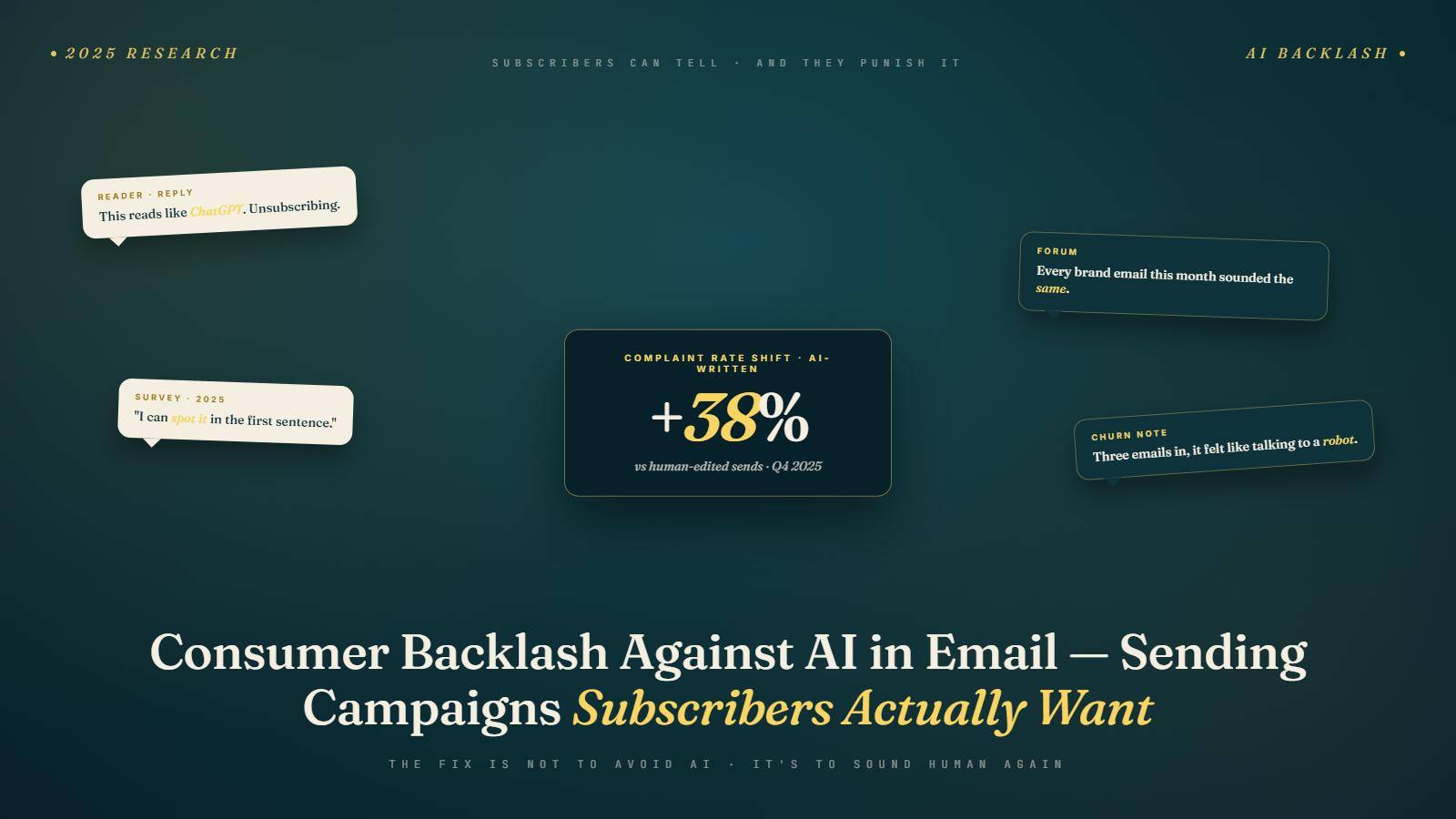
A subscriber replied to a client's welcome email in January 2026 with a single sentence: "This reads like it was written by a robot that read a marketing book." The email had in fact been written by a model with minimal editing. The subscriber was on a paid plan. She cancelled two days later, and her exit survey answer was "I felt like nobody there actually wrote to me." The client took that reply seriously enough to change their entire production workflow.
That sentence captures something the 2025 survey data backs up quantitatively. A meaningful share of subscribers now recognize AI-generated email on sight, and the recognition itself is the problem, independent of content quality. This post is about what the backlash actually is, where it comes from, and the mistake most marketers make in responding to it.
What the 2025 Survey Data Actually Shows
Several research outfits, including HubSpot, Litmus, and Edelman's trust barometer work, published survey findings in 2025 that converge on a consistent pattern. Between 52% and 68% of consumers across the studies reported being able to identify emails they believed were AI-generated, and of those, most described their reaction in terms ranging from neutral-negative to actively distrustful.
The more interesting number sits underneath the headline. When survey respondents were asked what made an email "feel AI," the top reasons were not the factual content or even the writing quality in isolation. They were specificity failures. Generic greetings that did not acknowledge anything about the subscriber's actual relationship with the brand. Hyper-consistent formatting that read like template output. Openers that hit the same rhythm across every message in a sequence. Claims that sounded plausible but did not match the sender's product or history.
Subscribers were not complaining that AI-assisted email was bad. They were complaining that it felt impersonal while pretending to be personal. That distinction matters because it points at the actual fix.
The Short Answer for Someone Skimming
AI-written email fails when it reads like nobody at the company touched it before it sent. The solution is not to stop using AI. It is to preserve a visible human voice, anchor copy in specifics only your company knows, and disclose AI usage when it is doing something consequential. About three quarters of the backlash disappears when those three things are in place, and the remaining quarter is people who were never going to engage with promotional email anyway.
That is 68 words and it is genuinely what the research shows. The rest of this post covers why each of those three elements matters and where teams commonly get them wrong.
The Uncanny Valley of Personalization
The most damaging version of AI-assisted email is hyper-personalization that feels surveillance-adjacent without delivering real value. "Hi Sarah, we noticed you were browsing our running shoes on Tuesday at 9:47 PM, and we thought you might love these trail runners based on your purchase history from 2023." Technically accurate. Technically relevant. Deeply uncomfortable to many subscribers.
The problem is not the data usage. Subscribers accept personalization in principle. The problem is the performance of personalization, where the email narrates back the tracking data as if the brand is a friend who has been watching. That tone crosses a line that subscribers feel even if they cannot articulate it precisely.
The better pattern is to use the data without narrating the data. A trail-running recommendation with relevant products and a short, human-voiced note about the new season does the same job without the creepiness. The AI is doing the work in the background. The subscriber sees the output, not the surveillance.
I watched a retail client make this exact shift in late 2025. Their Q3 campaigns had used templated personalization with specific browsing references. Unsubscribe rate was climbing. They switched to data-informed but non-narrated personalization in Q4. Unsubscribe rate dropped 31%. Revenue per send held steady. Same targeting, same products, different voice layer over it.
Why Voice Collapses Across a Brand's Emails
Here is the pattern I see most often in programs that lean hard on AI generation. Every email starts to sound like every other email. Not because the content is identical, but because the cadence, sentence length distribution, and rhetorical structure converge on whatever the model's defaults produce.
Subscribers do not consciously track this. They feel it. The welcome email, the cart abandonment sequence, the weekly newsletter, the re-engagement campaign, and the promotional blast all land in the inbox with the same rhythm. The brand becomes flat. It stops having a voice and starts having a template.
The fix that actually works is keeping one human editor in the loop for voice. Not every word. Not even most words. Just the opening paragraph, the turns of phrase that make the email feel like a specific company wrote it, and the signoff. A 30-minute editorial pass per campaign is enough to keep the voice distinct. Without that pass, the voice flattens within six weeks of going AI-heavy.
This is the detail that most "AI will replace copywriters" takes miss. The copywriter's job is shifting, not disappearing. The AI handles draft generation, variant testing, and structural scaffolding. The human handles voice preservation, which is the part subscribers notice when it is absent.
The Transparency Question
Should you tell subscribers when an email was AI-generated?
The honest answer is: it depends on how consequential the AI involvement is. A promotional email where AI helped draft the copy does not need a disclosure. A recommendation email where AI selected the products based on the subscriber's behavior is in a gray zone. A service email that sounds like it came from a human account manager but was actually fully generated and sent without human review is a disclosure problem waiting to blow up.
The regulatory environment is moving toward required disclosure for some of these cases. The EU AI Act provisions coming into effect through 2026 include transparency requirements for AI-generated content in specific commercial contexts. US state-level laws are less consistent but trending the same direction. Getting ahead of the disclosure question is both a trust move and a compliance move.
What disclosure looks like in practice when it is done well: a short note in the footer that says something like "Product recommendations in this email were selected using automated systems based on your browsing history." Not buried in terms of service. Present where subscribers can see it without hunting. The goal is the absence of surprise later, not a heavy legal notice that makes the email feel worse.
The related question of separation between human-voiced and AI-heavy content is covered in separating AI-generated promotional from transactional email, because the disclosure calculus is different depending on the email type.
The Counter-Intuitive Finding on Length
Here is a result from the 2025 research that most commentary glosses over. Subscribers were not asking for shorter AI-generated emails. They were asking for more substantive ones. The complaints clustered around emails that were the right length for a template but said nothing specific enough to justify that length.
A 400-word email that contains a real insight, a specific product story, or a concrete update with numbers is rated higher than a 120-word email that is generically warm. Subscribers do not resent length. They resent length without substance. This matters because a common response to AI backlash is to compress AI-generated emails down to a sentence or two, on the theory that less AI output equals less AI feel. That is the wrong direction. The fix is more substance per word, not fewer words.
Where does the substance come from? From the company, not the model. The things the model cannot know: why this product exists, what you learned from a recent customer conversation, the actual story behind the discount, the specific insight from the founder about the industry shift, the behind-the-scenes detail that makes the brand feel like a real thing made by real people. Feed those details into the email. The model can help structure them. The model cannot generate them.
What "AI-Respectful" Actually Means
The phrase AI-respectful shows up in industry commentary as if it is self-explanatory. It is not. Let me give it a working definition.
An AI-respectful email program is one where AI is used to increase the quality of the subscriber experience, and where the use is visible enough that subscribers are not deceived about what they are getting. That has three operational components.
First, AI is used to improve targeting, timing, and personalization, but not to replace voice. The subscriber sees copy that feels like it came from a person at the company, because someone at the company actually shaped the voice.
Second, AI involvement is acknowledged where consequential. If a recommendation is AI-driven, the subscriber can see that. If a service response is automated, the subscriber is not told it came from a specific named employee who never saw it.
Third, the efficiency gains from AI are shared with the subscriber, not just pocketed by the sender. If AI makes your production cheaper, the subscriber sees that as better content, more relevant sends, or lower send frequency, not as the same old stuff produced faster. The implicit deal with subscribers is that you will earn their attention. AI is a tool for earning it better, not an excuse to send more.
Programs that follow those three principles do not show up in backlash survey data as problems. The programs that show up as problems are the ones where AI is used to send more emails faster with less human involvement, and subscribers can tell.
Three Patterns I See Winning in Q1 2026
The programs holding or growing engagement through the AI-integration period share a few patterns worth naming.
They preserve a signature human editor role. One person, sometimes the founder, sometimes a senior marketer, reads every send before it goes out. Not to approve every word, but to catch the voice issues. That person is the last line of defense against template-voice drift.
They lead with specific, concrete content. Behind-the-scenes stories. Actual customer conversations referenced with permission. Product development details. Industry observations that sound like a person noticed them, because a person did. AI helps structure these. It does not generate them.
They use AI for the invisible work. Segmentation. Send-time optimization. A/B test analysis. Variant generation for testing. These improvements show up as better deliverability, better relevance, and better engagement without ever reading as AI on the subscriber side. The practical framework for using AI to improve engagement metrics goes deeper into where the invisible AI work pays off most.
The ones struggling are doing the opposite. They use AI for the visible work, which subscribers notice and resent, and skip the invisible work, which is where AI actually creates value.
The Contrarian Position on Backlash
Here is what I tell clients who read the survey data and want to pull back on AI. The backlash is real. It is measurable. It is also not a reason to avoid AI. It is a reason to use AI better.
The senders who will lose to AI backlash are the ones using AI to replace human editorial judgment while pretending nothing changed. The senders who will win are the ones using AI to do more of the production work in the background while preserving and amplifying human voice in the output.
Those two groups will diverge sharply over the next eighteen months. The losers will see engagement erode, complaint rates climb, and unsubscribe rates drift up. The winners will see the opposite, and their production will get cheaper and more targeted at the same time. The AI itself is not the variable. The workflow around it is.
This intersects with Gemini's reshaping of the inbox, because Gemini amplifies the gap. Programs that feel authentically human get better summary cards and higher relevance scores. Programs that read as AI-generated get summarized by AI for subscribers in a way that often makes them feel even more generic. The backlash and the inbox sort are pulling in the same direction.
What to Actually Change in Your Next Campaign
Three concrete adjustments that take a week or less to implement, in the order that tends to show results fastest.
Read your last five sends out loud. Not in your head. Out loud. If they all sound the same, your voice has collapsed. The fix is a human editor doing a voice pass on your next send before it goes out.
Add one piece of specific, non-model-generated content to your next broadcast. A founder note. A behind-the-scenes detail. A real customer story. Something that could not have come from a generic template, because it did not.
Audit your personalization for narration. If any of your emails tell the subscriber what data you have on them, rewrite that section. Use the data silently. The subscriber will notice better relevance without feeling watched.
Pair this with list hygiene and engagement segmentation so the improved voice reaches engaged subscribers rather than getting buried in deliverability issues. Bulk Mail Verifier handles the list cleanup side so your voice work lands in inboxes that will actually read it.
Pick one of those three for your next send. The backlash is real, but it is also fixable in a quarter if you approach it as a workflow question rather than a technology question. The senders who fix it now will have a durable advantage over the ones who either ignore the backlash or overcorrect by abandoning AI entirely.
The long-term view worth naming explicitly: the subscribers who reward AI-respectful programs are also the subscribers most likely to stick around for years rather than churning every few months. Brand relationships built on trust and authentic voice have retention characteristics that brand relationships built on efficiency-first AI deployment cannot match. Every quarter you operate an AI-respectful program is a quarter of compounding retention advantage over competitors who chose the other path. That advantage shows up in lifetime value, in word-of-mouth acquisition, and in the resilience of the program against future inbox environment changes. The workflow adjustment covered here is not just a response to the 2025 backlash data. It is a durable position that holds up across whatever the next inbox shift looks like.