
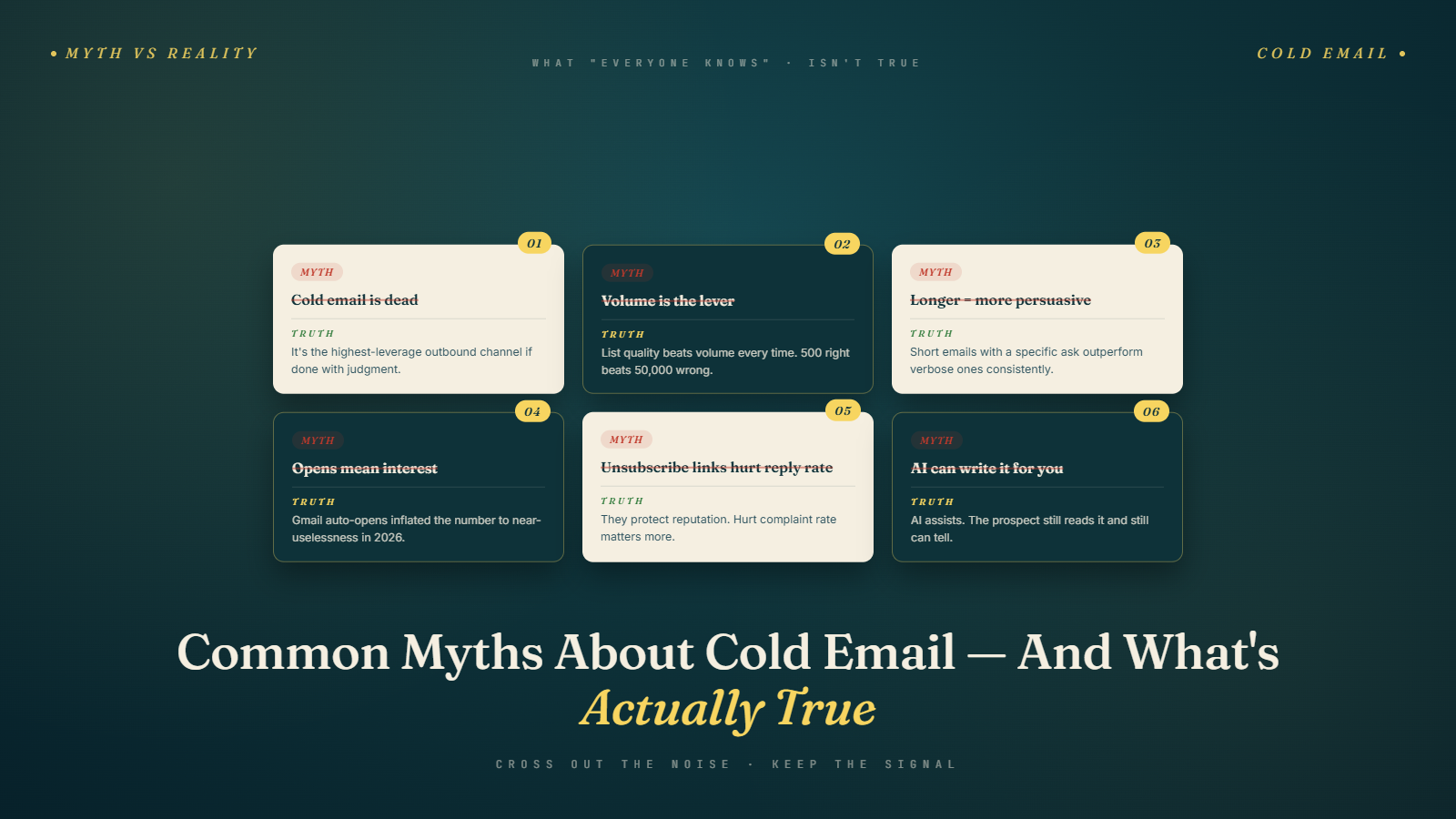
Marcus ran a one-person web design agency. He'd been grinding referrals and LinkedIn DMs for two years, barely keeping his pipeline alive. A friend told him to try cold email. His reaction? "That's just spam. Nobody reads that stuff anymore. I'd be wasting my time and probably get blacklisted."
He put it off for six months.
Then, in a slow January with two projects wrapping up and nothing new on the horizon, he finally tried it. He built a list of 150 e-commerce brands that had recently launched on Shopify. He wrote a short, specific email about a common homepage problem he kept seeing in that niche. He sent it from a warmed-up domain with a clean list.
Eleven replies in four days. Three discovery calls. Two projects closed — worth $14,000 combined.
He didn't discover some secret tactic. He just stopped believing the myths.
Cold email has more misconceptions stacked around it than almost any other marketing channel. Some myths come from people who've never tried it seriously. Others come from people who tried it badly and drew the wrong conclusions. Either way, these myths are costing real businesses real money.
Let's go through them one by one and set the record straight.
Myth #1: Cold Email Is Just Spam
This one has done more damage than any other. It's the reason Marcus waited six months. It's the reason thousands of founders and freelancers dismiss the channel entirely.
Here's the distinction that matters: spam is unsolicited, irrelevant email sent at scale with zero targeting. Cold email is a deliberate, researched, one-to-one message sent to someone who fits a specific profile and could genuinely benefit from what you're offering.
The U.S. CAN-SPAM Act doesn't prohibit cold email. Neither does GDPR when you have a legitimate business interest and handle data responsibly. The laws target deceptive, bulk commercial email — not a personalized outreach from a business to a relevant prospect.
Here's the practical version: if you're emailing a VP of Engineering at a Series B SaaS company because you help engineering teams reduce deployment times, and your email references something specific about their stack or their recent growth — that's not spam. That's sales. People confuse the two because they've received so many terrible cold emails that blanket the definition.
The real test isn't whether the recipient asked for it. It's whether it's relevant, honest, and targeted. Spam is bulk and indiscriminate. Cold email, done right, is the opposite.
Spam is what happens when you scrape 50,000 emails and blast a generic pitch. Cold email is what happens when you do the work.
Myth #2: Nobody Replies to Cold Emails Anymore
This myth usually comes from one of two places: someone who sent a bad campaign and got zero replies, or someone quoting industry averages without context.
Yes, average reply rates across all cold email campaigns are low — somewhere in the 1—5% range when you pool everything together. But that average includes every terrible campaign sent by someone who bought a list off the internet, used a generic template, and didn't verify a single email address. It includes campaigns with 40% bounce rates. It includes pitches so obviously copy-pasted that the recipient's name was in the wrong font.
Well-run campaigns tell a very different story. Agencies and founders who do this properly — targeted list, verified emails, personalized first lines, specific value prop, clean sending infrastructure — routinely see 8—15% reply rates. Some niche campaigns hit 20%+. Those aren't unicorns. That's what happens when you respect the craft.
The distinction between campaigns that get replies and campaigns that don't isn't really about the channel being dead. It's about:
List quality: Are you emailing real people at real companies who actually match your ICP?
Relevance: Does the email speak to something specific about their situation?
Deliverability: Is the email landing in the inbox at all?
The message itself: Is it about them, or about you?
Cold email didn't stop working. Bad cold email always was bad. The bar has just risen because inboxes are noisier — which means the people doing it well stand out more, not less.
Myth #3: You Need a Huge List to Get Results
This myth is particularly dangerous because it pushes people toward behavior that actively destroys their campaigns. The logic seems intuitive: more emails = more replies. It doesn't work that way.
A targeted list of 200 people who perfectly match your ideal customer profile will outperform a generic list of 20,000 people who kind of fit a broad category. Every time.
Here's why. When you're emailing a small, tightly defined list, you can:
Write first lines that reference something real about each person's company
Research their specific situation or pain point
Use language that matches how that specific type of person talks
Send from a domain with clean history and high deliverability
When you're blasting 20,000 people, none of that is possible. You're writing to the average of everyone on the list, which means you're writing to nobody in particular. Your open rate drops. Your reply rate tanks. Your spam complaints go up. Your deliverability degrades. It becomes a self-defeating spiral.
The math also works in favor of small, targeted lists. If you send 200 highly targeted emails and get a 10% reply rate, that's 20 replies. If you send 20,000 generic emails and get a 0.3% reply rate, that's 60 replies — but you've burned your domain reputation, likely damaged your sender score, and alienated thousands of people who now associate your brand with spam.
Start small. Start targeted. Build from there.
Myth #4: Cold Email Only Works for Big Companies or Experienced Sales Teams
This one is just flat-out wrong, and I've seen it disproven more times than I can count.
Some of the best cold email results I've seen came from:
A solo freelance copywriter who landed a $36,000/year retainer client on her first real campaign
A two-person SaaS startup that booked 40 demos in 60 days before they had a marketing budget
A consultant who left corporate, sent 80 targeted emails to mid-market companies in his niche, and had a full pipeline within three weeks
Cold email doesn't require a sales team. It doesn't require a CRM with a six-figure license fee. It doesn't require brand recognition or a warm network. In fact, being a smaller operator is sometimes an advantage — your emails come from a real person, not a corporate address associated with bulk outreach. Recipients are more likely to engage with a human they haven't heard of than with a brand trying to push them into a funnel.
The tools required to do this properly are accessible to anyone: an email account, a list-building tool, an email verification service, and a sending tool. You can get started for under $100/month. The skill barrier is real — you do need to learn how to write good cold email — but it's learnable by anyone willing to put in the time.
The playing field here is genuinely level in a way that most marketing channels aren't. You don't need a budget to compete. You need judgment.
Myth #5: You Need to Follow Up Aggressively (10+ Times)
Somewhere along the way, a subset of the cold email world convinced itself that persistence equals results. The logic: if someone doesn't reply, they haven't said no. So keep going. Eight follow-ups. Ten follow-ups. Some people advocate for twelve.
This is both empirically wrong and just bad behavior.
The data on follow-ups consistently shows that the vast majority of replies come from the initial email and the first one or two follow-ups. A typical breakdown for a well-run sequence looks like this:
Email 1: ~40—50% of total replies
Follow-up 1 (3—5 days later): ~25—30% of total replies
Follow-up 2 (5—7 days later): ~15—20% of total replies
Follow-up 3+: Diminishing returns fast
After three or four touchpoints with no reply, you're not being persistent. You're being annoying. And more importantly, you're burning a prospect who might have been receptive six months from now if you'd left them with a neutral impression.
The sweet spot for most campaigns is three to four emails total: an initial email, two follow-ups spaced several days apart, and optionally a brief "closing the loop" email that gives them a graceful exit. That last one often gets replies precisely because it takes the pressure off.
More volume doesn't unlock more replies. Better emails and better timing do.
Myth #6: If It Worked Before, the Same Template Will Keep Working
Template fatigue is real, and it's one of the quietest killers of cold email performance.
Here's what happens: someone builds a great campaign, gets strong results, and keeps using the same template. For a while, it works. Then it starts to slip. Reply rates drop. They assume it's a seasonal thing. They keep going. Performance keeps declining. Eventually, that same template that once pulled 12% reply rates is sitting at 2%.
Part of this is overexposure. If you've been running the same template for 18 months, the chances that a significant portion of your audience has already seen it — or seen something nearly identical from another sender — are high. Cold email templates spread. What's unique today is a shared template in three months.
Part of this is market sophistication. Recipients get better at pattern-matching cold emails over time. An opener that felt fresh in 2023 reads as formulaic now.
The solution isn't to throw out what works — it's to test constantly and never let any single template run indefinitely without challenge. Run A/B tests on subject lines. Rotate openers. Try entirely different angles on the same core offer. Treat your copy as a living system that needs regular updates, not a solved problem.
What worked before tells you something useful about your audience. It doesn't give you a permanent license to stop iterating.
Myth #7: High Open Rates Mean Your Campaign Is Working
Open rates have always been an imperfect metric. Since Apple's Mail Privacy Protection (MPP) launched in 2021, they've become close to meaningless for a large chunk of your audience.
MPP pre-loads email content — including tracking pixels — when an email is delivered, regardless of whether the recipient actually opened it. Depending on your audience mix, this can inflate your open rate by 20—40 percentage points. Campaigns that show 60% open rates might have a real open rate of 25—30%. You simply can't tell from the numbers alone.
This matters because people optimize for the metrics they track. If you're chasing open rates, you'll write subject lines optimized for curiosity and clicks — but curiosity-driven subject lines don't always lead to engaged readers. Someone who opens an email because the subject line tricked them into it is not a warm prospect. They're annoyed.
The metric that actually tells you whether your campaign is working is reply rate. Replies indicate that a real human read your message, processed it, and decided it was worth their time to respond. That's the signal you want. Secondary metrics worth tracking include positive reply rate (replies that aren't "unsubscribe me" or "wrong person"), meeting booked rate, and ultimately, pipeline generated.
Open rates are useful for diagnosing deliverability issues and very rough subject line testing. They should not be the headline metric for your campaign. We'll dig into the full metrics picture in our upcoming post on cold email metrics to track.
Myth #8: Cold Email Is Only for B2B
The B2B association is understandable — cold email has historically been most commonly discussed in a B2B sales context. But the channel itself isn't inherently B2B-only.
Consider some contexts where cold email works in B2C or mixed models:
High-ticket consumer services: Financial advisors, real estate professionals, and luxury service providers all use targeted outreach to find clients. These are technically consumer relationships but operate more like B2B in terms of deal size and relationship dynamics.
Recruitment: Recruiting is effectively B2C outreach at scale — reaching individuals to interest them in opportunities. Cold email is a core tool.
Journalists and PR: Pitching journalists is cold email. It's targeted, personalized outreach to someone who hasn't asked for it. Done well, it works.
Creator partnerships and sponsorships: Brands reaching out to creators, podcasters, and newsletter writers are running cold email campaigns to individuals, not companies.
The principles are the same regardless of context: be relevant, be specific, make the ask proportional to the relationship. The differences are mostly in list-building approach and the nature of the value proposition. For a deep look at how the strategies diverge, see our breakdown of B2B vs B2C cold email.
Don't rule out the channel just because you're not selling SaaS to enterprise procurement teams.
Myth #9: The Perfect Subject Line Is What Makes Cold Email Work
Subject line optimization is a legitimate discipline. But the obsession with subject lines in cold email circles has created a distorted view of what actually moves the needle.
Here's the reality: your subject line gets your email opened. That's it. Everything else — whether they reply, whether they book a call, whether they become a customer — depends on what's inside.
Think of it proportionally. In a well-executed cold email campaign, subject line quality might account for 10—15% of your overall results. That's meaningful, but it's not the whole game. The other 85—90% comes from:
List quality: Are these the right people? Are the email addresses valid? (Email verification isn't optional — bounces kill your sender reputation.)
Deliverability: Is the email reaching the inbox at all, or going straight to spam?
The opening line: The first sentence is what converts curiosity from the subject line into actual reading.
The body: Does it speak to a real problem? Is it about them or about you?
The CTA: Is the ask clear, specific, and low-friction?
Chasing the perfect subject line while ignoring list hygiene, deliverability, and message quality is like optimizing your storefront sign while the inside of your shop is a disaster. The sign gets people to look. The experience inside determines whether they stay.
Subject lines matter. They're just not the whole story — not even close.
Myth #10: Cold Email Doesn't Work If You Don't Have a Big Brand
The assumption here is that recipients trust recognizable brands more, so unknown senders get ignored. There's something to this, but it's also one of the most self-defeating beliefs a small operator can carry.
Being unknown is not the liability it seems. Here's why.
Big brand cold email often comes from a generic company address — sales@bigcorp.com — associated with a CRM sequence that has been sent to thousands of people. Recipients have learned to treat these emails with skepticism. They know it's automated. They know the "personalization" is a mail merge field.
An email from a real person at a company they've never heard of carries a different set of assumptions. It might actually be a human. It might be relevant to something specific. It might be worth reading.
The blank-slate advantage is real: you don't have the baggage of a brand people have dismissed before. You get to make a first impression without competing against every previous experience someone had with your company. You're not fighting preconceptions.
What makes unknown senders work is specificity and relevance. A cold email that demonstrates genuine knowledge of the recipient's business or industry earns trust on its own merits — independent of brand recognition. That's a level playing field anyone can compete on.
Practical Takeaways
You've just cleared out ten pieces of mental baggage. Here's what to do with the clear space:
Prioritize list quality over list size. Two hundred well-researched contacts will consistently outperform twenty thousand scraped emails. Verify every address before sending — bounces destroy deliverability, and deliverability is the foundation everything else sits on.
Write to one specific person. Not to a demographic. Not to a job title. To a person at a company with a specific problem you can actually help with. Every word in your email should feel like it could only have been written for them.
Keep your sequences short and your follow-ups respectful. Three or four touchpoints is enough. If someone hasn't responded after four well-spaced emails, move on. Leave them with a neutral impression, not a negative one.
Measure reply rate, not open rate. Open rates are broken. Reply rates tell you whether real humans are engaging with your message. That's the metric that connects to pipeline.
Keep testing. No template lasts forever. Rotate your copy, test your openers, challenge your best-performing sequences every 60—90 days. The channel rewards people who treat it as a continuous practice, not a solved problem.
Start before you feel ready. The biggest cost of these myths is paralysis. Marcus waited six months. Most of the objections he had turned out to be false. The same is probably true for you.
Cold email isn't magic, and it's not dead. It's a skill that rewards clarity, specificity, and consistency. Every myth on this list has one thing in common: it gives you a reason not to try. Now you don't have those reasons anymore.
For more on why the channel remains one of the highest-ROI outbound strategies available, read why cold email still works in 2026. And if you want to understand what makes recipients actually respond — the psychology underneath the tactics — that's exactly what we cover in The Psychology Behind Cold Emails That Get Replies.