
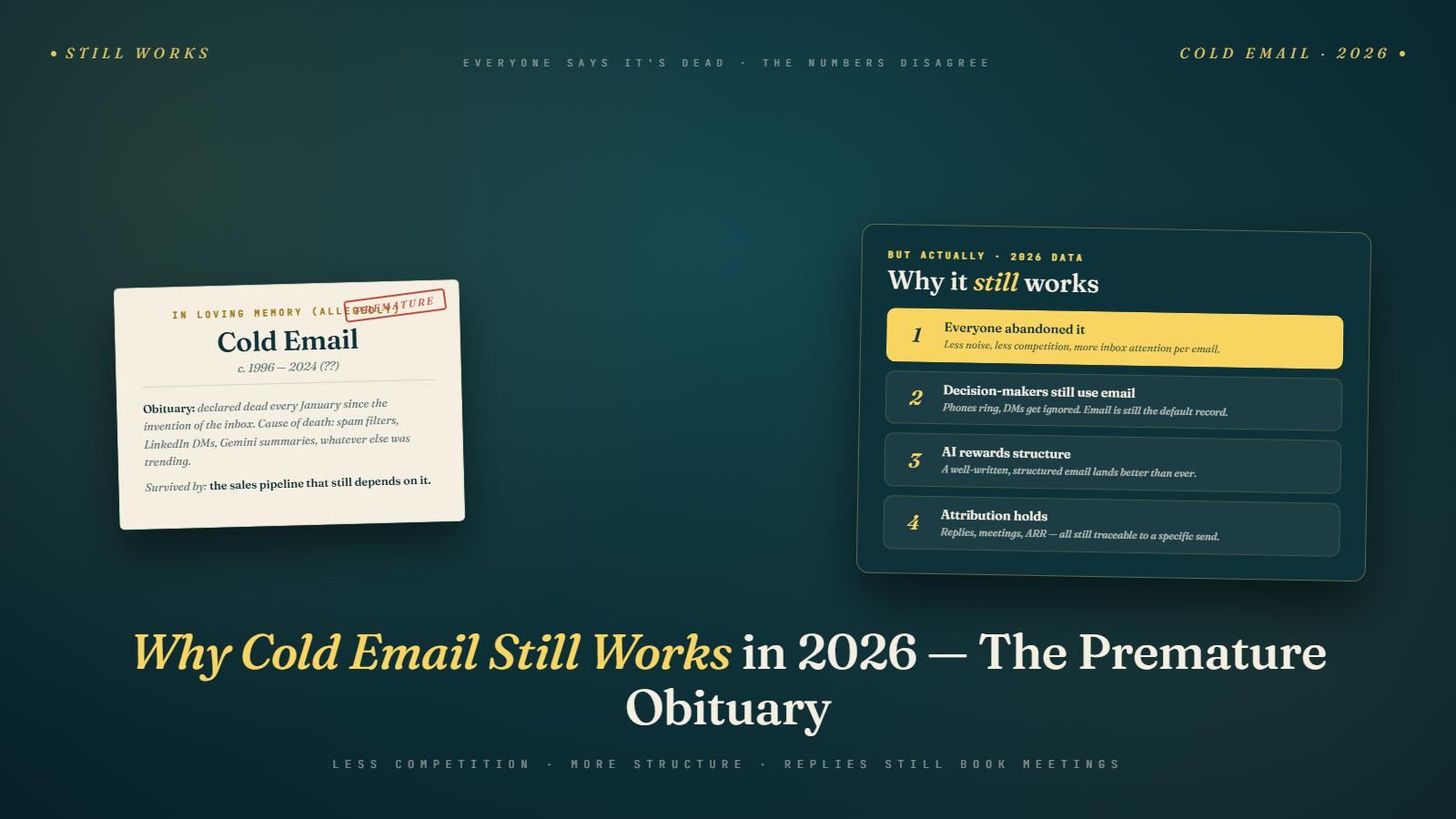
"Cold email is dead."
I've been hearing this since approximately 2015. Every year, someone publishes an article, a LinkedIn post, or a podcast episode declaring that cold email has finally, definitively, breathed its last breath. Every year, the sales teams and founders who actually use cold email — who use it seriously, technically, and with real targeting — keep booking meetings and closing deals.
Here's my honest take after running cold email campaigns at scale for years: cold email isn't dead. Bad cold email is dying. And the people loudly declaring the channel dead are almost always the ones who were sending bad cold email.
This post is for the people who want to understand what's actually going on — what's changed, what hasn't, and why the businesses winning with cold email in 2026 are doing things differently than the ones failing with it.
The "Cold Email Is Dead" Myth — Where It Comes From
The narrative has never been entirely baseless. There are real trends driving it.
AI-generated spam has flooded inboxes. Since GPT-3 made it trivially easy to generate semi-coherent text at scale, the volume of AI-written cold email has exploded. A lot of it is terrible — generic, obviously templated, lacking any real signal that the sender did five minutes of research. This has made prospects more skeptical and more trigger-happy with the spam button.
Overused templates have trained people to recognize cold email on sight. "I came across your LinkedIn profile and was impressed by..." "I noticed you recently [event]..." "Just bumping this to the top of your inbox..." These openers are so common they've become noise. Prospects have pattern-matched on them. The moment they see those first few words, they're already hitting delete.
Open rate data has become unreliable. Apple's Mail Privacy Protection, rolled out starting in 2021, has made open rates nearly meaningless as a performance metric for a large portion of recipients. If you were using opens as your primary signal of campaign effectiveness, the data started lying to you. Teams that didn't adapt concluded cold email wasn't working when actually their measurement was broken.
But here's the critical distinction that gets lost in all of this: "cold email done badly is dying" is not the same thing as "cold email itself is dying."
Channels don't die because bad practitioners use them badly. TV advertising didn't die because most TV ads are forgettable. Direct mail didn't die because most direct mail goes in the recycling. Cold email is a channel. The channel is fine. The practice of sending lazy, untargeted, AI-generated blasts to purchased lists — that practice is getting appropriately punished.
The people declaring cold email dead are almost always describing their own failure, or observing someone else's failure, and generalizing from it. What they're actually observing is that the bar for quality has gone up. That's a very different thing.
Why Cold Email Still Works — The Structural Reasons
Before we get into what's changed, let's be clear about why cold email works in the first place — because these fundamentals haven't changed at all.
Email is still the primary professional communication channel. Not Slack. Not Teams. Not LinkedIn DMs. When a decision-maker needs to communicate with someone outside their organization, they use email. When deals close, contracts are exchanged by email. When a vendor relationship starts, it usually starts with email. The inbox is where professional decisions happen.
Decision-makers check their email. A VP of Engineering might not accept a LinkedIn connection request from someone they don't know. They might never see your Twitter/X message. But they open their email every morning. It's where their work lives. That inbox-level access is something no other channel can quite replicate.
Direct, one-to-one access with no algorithmic gatekeeper. You send an email, it arrives in someone's inbox. There's no algorithm deciding whether your message gets shown to them. There's no paid placement auction you have to win. You don't need followers or a platform or a network. You just need a relevant message and a valid email address.
Good cold email stands out precisely because most cold email is bad. This is the contrarian insight that the "cold email is dead" crowd consistently misses. If 95% of the cold email hitting a prospect's inbox is generic AI slop, then the 5% that's actually researched, personalized, and relevant absolutely stands out. The noise makes the signal more valuable. A genuinely relevant cold email in 2026 is arguably more likely to get a positive response than it was in 2015, because everything around it is so much worse.
What's Actually Changed (And What Hasn't)
What's Changed
AI-generated spam has increased inbox noise dramatically. The barrier to sending large volumes of cold email has dropped to near zero. Anyone with a ChatGPT account and a list can generate thousands of "personalized" emails in an afternoon. The result is that inboxes are noisier and prospects are more skeptical. This is real.
Google and Yahoo's 2024 sender requirements raised the technical bar. Starting in February 2024, both Google and Yahoo implemented stricter requirements for bulk email senders: mandatory email authentication (SPF, DKIM, DMARC), one-click unsubscribe, and spam rate thresholds that will get your sending domain penalized if you exceed them. This killed a lot of lazy operators who weren't handling the technical side of cold email properly.
Prospects are more skeptical of generic pitches. The combination of more AI-generated email and years of templated cold email has made buyers less charitable about outreach they can't quickly identify as relevant. The tolerance for anything that feels like a blast has dropped.
Open rate data is broken for a significant portion of your list. Apple MPP pre-fetches email content, triggering open pixels even when the recipient never actually opened the email. Depending on your list composition, this can make 30–60% of your "opens" false positives. If you're still measuring campaign success primarily by open rates, you're navigating with a broken compass.
What Hasn't Changed
People still buy from people. B2B sales, at every level of deal size, is fundamentally about human relationships. The businesses that use cold email well aren't using it to replace human connection — they're using it to initiate it. A cold email that leads to a call leads to a relationship leads to a deal. That sequence still works because humans still run companies.
A relevant, well-timed email still gets a reply. If you send someone an email that addresses a problem they're actively experiencing, at a moment when they're thinking about that problem, from someone who clearly understands their situation — they reply. This has been true for twenty years and it's still true today. Relevance and timing are evergreen.
The ROI of cold email versus alternatives. Go spend $50,000 on a conference sponsorship. Go put $10,000/month into LinkedIn ads. Go hire an SDR at $80,000/year and have them spend six months trying to get inbound leads. Then compare all of that to a properly run cold email campaign targeting the same audience. Cold email consistently delivers more pipeline per dollar than almost any other outbound channel.
The inbox is still the most personal digital channel. Social media is public. Ads are broadcast. Cold email lands in a private, personal space that the recipient considers their own. That's why email marketing outperforms every other digital channel for conversion — and it's why cold email, done well, can cut through noise that other channels can't.
The Real Numbers — What Cold Email Produces in 2026
Let's get specific, because vague claims about cold email "working" don't help anyone calibrate expectations.
Reply rates for well-run campaigns typically land in the 5–15% range. Poorly run campaigns see 0.5–2%. The difference is almost entirely targeting precision and message quality — not some mysterious change in the channel itself.
Meeting booking rates from replies are typically 20–40% of positive replies. So if you're running a campaign that produces a 10% reply rate and 30% of those are positive, you're booking meetings from 3% of your sends. At 500 contacts, that's 15 meetings.
Cost per lead on a well-run cold email program is often $30–150 per meeting booked, depending on the quality of your list, the complexity of your targeting, and your tool costs. Compared to paid search ($200–500+ per lead in competitive B2B categories) or LinkedIn ads ($100–300+), that's remarkably efficient.
A concrete example: A SaaS company selling HR software ran a cold email campaign targeting HR Directors at companies with 200–1,000 employees. Over six weeks, they contacted 1,200 qualified prospects, achieved an 8.5% reply rate, and booked 34 discovery calls. Of those, 9 turned into pipeline opportunities. Total cost including tooling and one SDR's time: roughly $4,200. Pipeline generated: approximately $180,000. That's not an anomaly — that's what a competent cold email program produces when the targeting is right and the messages are actually good.
The math works. It keeps working. That's why the companies doing it well keep doing it.
The AI Question — How AI Is Changing Cold Email
This is worth addressing directly, because "AI is killing cold email" and "AI is supercharging cold email" are both things you'll hear, and they're both partially right.
AI is making bad cold email worse. The ability to generate high volumes of mediocre, vaguely personalized emails has dramatically increased the supply of bad cold email in the world. Most of what gets produced with "AI personalization" tools is thin, formulaic, and immediately recognizable as automated. This is raising the noise floor and making prospects more defensive.
But AI is making good cold email better. Used properly, AI can help with company research at scale, identifying relevant trigger events, suggesting personalization angles based on what you know about a prospect, and drafting initial frameworks that a human then rewrites. The key word is "draft." AI for research and structure; human judgment for the actual writing.
The bar for quality has risen — and that's good news for senders who clear it. When the average quality of cold email drops, the relative impact of a high-quality email increases. If you're sending something that's clearly been researched, written with care, and actually relevant to the recipient's situation, you're operating in blue water right now. Most of your competition is drowning in AI-generated sameness.
Human-feeling emails still win. Not "fake" human emails — actual human thinking expressed clearly. Prospects have developed sophisticated pattern recognition for AI-written content, and they don't like it. The irony is that in the age of AI, writing that feels genuinely human is more valuable than ever.
Cold Email in 2026 vs 2020 — What You Need That You Didn't Before
The mechanics of cold email haven't changed. The requirements for success have gotten stricter. Here's what you need in 2026 that you could arguably have gotten away without in 2020:
Proper technical setup. SPF, DKIM, and DMARC authentication are now required by major inbox providers for bulk senders. This isn't optional. If you're sending without proper authentication, you're not getting delivered.
Higher personalization depth. "Hey {first_name}, I noticed you work at {company}" doesn't count as personalization anymore. Prospects have seen that template a thousand times. Real personalization means demonstrating that you actually know something about their business, their role, or their current situation. One strong, specific detail is worth more than ten generic merge tags.
Cleaner lists. The 2024 sender requirements mean that high bounce rates and spam complaint rates will get your domain flagged or blacklisted. You cannot afford to send to dirty lists anymore. Verifying your email list before every campaign isn't optional — it's table stakes. Learn more about unlimited email verification and bulk email verification services to understand your options.
Proper domain warm-up. Cold emailing from a fresh domain without warming it up is a good way to get that domain burned immediately. Modern inbox providers are sophisticated about detecting new senders who suddenly start sending hundreds of emails. Warm your sending domain properly before scaling. Here's how to warm up an email domain the right way.
More sophisticated follow-up sequencing. The first email rarely closes. A strategic follow-up sequence — typically 3–5 touchpoints over 2–3 weeks — is where most replies and meetings actually come from. These sequences need to add value at each step rather than just bumping the thread.
Common Mistakes That Make Cold Email Feel "Dead"
Sending to lists they haven't verified. A 20% bounce rate is a domain-killing event. Verify before you send.
Using subject lines that scream "cold email." "Quick question," "Following up," "Just checking in" — prospects have learned to ignore these. Write a subject line that's specific to the person or their company. It takes more work. It's worth it.
Pitching in the first email. The first cold email is not a pitch. It's an introduction with a relevant hook and a low-friction ask. If your first email is "here's what we do, want to see a demo?" you've misunderstood cold email fundamentally.
No genuine research. If you can't point to one specific, true, relevant thing about this person's business in your email — something you actually looked up — you shouldn't be sending the email yet.
Sending from their primary domain. If your cold email campaign goes wrong and your domain gets blacklisted, you don't want that to be your company's main domain. Use dedicated sending domains.
Giving up after one touch. Most replies in a well-run cold email sequence come in follow-up emails 2–4, not in the initial send. If you're giving up after one email and concluding cold email doesn't work, you're drawing the wrong conclusion from incomplete data.
Practical Takeaways
Cold email works when it's relevant, targeted, and technically sound. It fails when it's generic, untargeted, and technically broken.
The rise of AI-generated spam is an opportunity for senders who invest in quality. Be the signal in the noise.
Fix your technical foundation first — authentication, deliverability, clean lists — before worrying about copy optimization.
Measure what matters: replies, meetings booked, pipeline generated. Open rates are noise.
Personalization at scale is possible, but it requires actual research, not just merge tags.
One well-crafted email to 100 precisely targeted prospects will out-perform one generic blast to 10,000 purchased contacts. Every time.
Cold email is not dead. The people saying it's dead are either doing it wrong, measuring it wrong, or have a vested interest in selling you an alternative channel. The companies actually running it well — with clean lists, proper technical setup, genuine personalization, and strategic follow-up — are generating consistent, cost-effective pipeline that other channels can't match.
The bar for quality has risen. That's fine. Rise with it.
For the full picture on how to run a cold email program that converts, see our cold email mastery guide — it covers the end-to-end process in detail.
Up next in the series: B2B vs B2C cold email — because the strategies that work for business prospects are very different from the ones that work for consumer audiences.
And if you're just getting oriented on the channel, start at the beginning: what cold email outreach actually is, and make sure you understand how cold email is legally compliant before you scale your program.