
Picture this: a VP of Marketing at a mid-size SaaS company receives two cold emails on the same Tuesday morning. Both are from the same sender, promoting the same service, sent within twenty minutes of each other to two different email addresses she checks. Same company. Same offer.
One she replies to within two hours. One she deletes without finishing the first sentence.
What's different? It's not the domain. It's not the sending time. It's not even really the quality of the writing in the technical sense — both emails are grammatically clean. The difference is something more fundamental. One email landed in the part of her brain that processes relevance and responds with attention. The other landed in the part that processes intrusion and responds with deletion.
That difference is psychology. Not luck, not timing, not the secret subject line formula from a Twitter thread. The emails that get replies don't just happen to be good — they're constructed around how human beings actually process unsolicited messages and decide whether to engage.
This post is about that construction. Not Cialdini summarized, not a list of tips — but a real look at what's happening in your prospect's head when your email arrives, and how to write with that in mind.
What's Actually Happening in Your Prospect's Brain
Before you can write an email that works, you need to understand the environment it lands in.
Your prospect is not sitting at their desk waiting for your email. They're context-switching between twelve things. They check their inbox for the same reason most people do: to clear it, to find what they're looking for, and to deal with what can't be ignored. Everything else gets processed in under three seconds and eliminated.
Those three seconds follow a specific pattern. First: the sender name. Is this someone I know, or someone at a company I recognize? Second: the subject line. Does this seem relevant to me right now? Third — if the first two pass — the first visible line of the email body in the preview pane. Does this confirm or destroy the relevance signal from the subject?
That's the entire window. Three checkpoints, all cleared in the time it takes to scroll past your email in a list of forty others.
What makes this harder is that most business people — especially in decision-making roles — have developed what I'd call a cold email filter. It's not a spam filter in the technical sense. It's a pattern-recognition reflex. They've read enough cold emails to recognize the structure from the opening sentence: "I noticed you recently..." or "I came across your company and..." or "I help companies like yours..." The moment they detect the pattern, the filter activates and engagement drops to near zero — even if the underlying offer is relevant and valuable.
The gatekeeper question running in the background of all of this is simple but ruthless: Is this actually for me? Not "is this well-written" or "is this a good company" — just, does this person demonstrably understand who I am and why they're reaching out to me specifically? If the answer isn't immediately apparent, the email loses.
Everything that follows in this post is about answering that gatekeeper question in the affirmative — quickly, credibly, and without feeling like you're trying to.
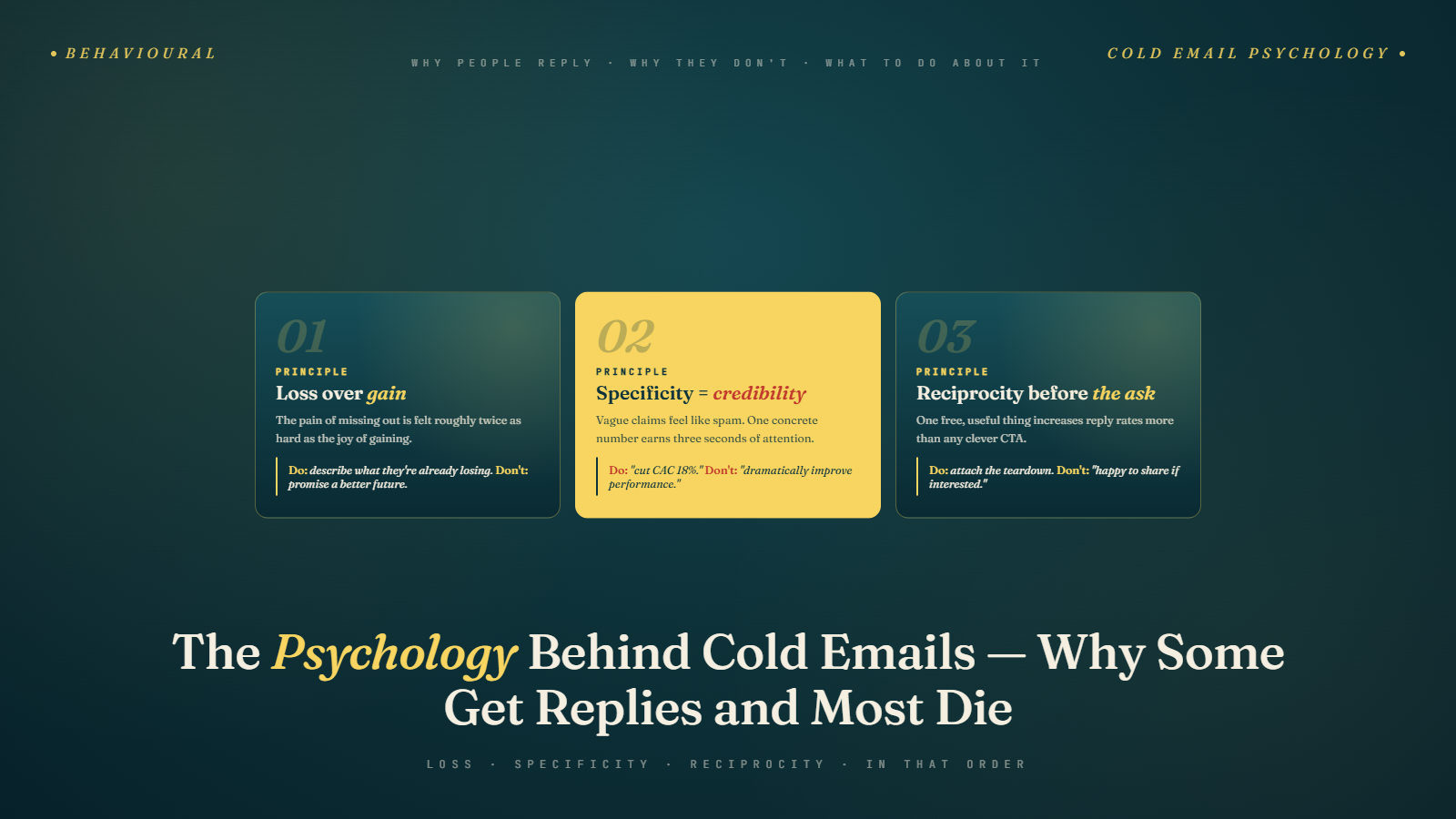
The Principle of Reciprocity — Give Before You Ask
Robert Cialdini's work on influence isn't new, but most cold email writers apply it incorrectly. They treat reciprocity as a transaction: give a compliment, then ask for something. That's not how it works psychologically, and recipients can smell the manipulation from the subject line.
Real reciprocity in cold email means leading with something genuinely useful — an insight, an observation, a piece of analysis — that the recipient didn't have before reading your email. Something that benefits them regardless of whether they ever reply to you.
This is harder than it sounds, which is exactly why it works so well when done properly. Most senders aren't willing to do the research required to offer something genuinely useful. When you do, it signals investment, competence, and relevance all at once.
Here's what this looks like in practice.
Transactional version (fails):
Hi Sarah, I really admire what you've built at Acme. I work with SaaS companies to improve their email deliverability. Would you be open to a quick call this week?
This isn't reciprocity. The "admire" comment is a thin attempt at flattery that anyone can see through. The ask comes immediately after. There's nothing in this email that Sarah didn't already know or that benefits her in any way.
Reciprocity version (works):
Hi Sarah — I was looking at Acme's email footer links and noticed your unsubscribe flow redirects through a third-party URL that's currently on the Spamhaus DBL. That won't affect deliverability on its own, but if you're sending transactional sequences, it could be contributing to inbox placement issues at Gmail. Happy to send over a quick audit if useful.
Sarah didn't know that. It's specific to her situation. It's actionable right now. And it signals that the sender knows what they're talking about. The ask at the end is almost incidental — because the value has already been delivered, the psychological impulse to respond is already activated.
The give doesn't need to be this technical. It can be a relevant data point, a useful reframe on a challenge they're facing, or a specific observation about their market. It just has to be real.
Curiosity Gaps — The Science of the Irresistible Subject Line
A curiosity gap is the psychological discomfort created when you have partial information but not complete information. Your brain treats it as an open loop, and open loops want to be closed. The subject line's job is to open a loop that the recipient can only close by reading the email.
The critical distinction is between a genuine curiosity gap and clickbait. Clickbait creates a loop that can't be legitimately closed by the content — the promise of the subject line doesn't match what's inside. This works once, generates resentment, and trains recipients to distrust your future subject lines.
A genuine curiosity gap creates a loop that the email body closes with something actually worth reading. The subject signals partial information; the email delivers the rest.
Subject lines that work and why:
"Your competitor Hubex just did something interesting" — Specific company reference, teases information they don't have, mildly threatening (competitor activity always gets attention). The loop: what did they do?
"Quick question about your onboarding flow" — Specific enough to feel personal, low commitment phrasing, implies the sender has looked at their product. The loop: what's the question?
"Found something on your site you might want to know about" — Slightly alarming (could be a problem), very specific to them, low-pressure framing. The loop: what did you find?
Subject lines that don't work and why:
"Increasing revenue for SaaS companies" — No loop opened. No curiosity created. Generic to the point of being invisible.
"Following up" — This is a loop closer, not a loop opener. And it's the most identifiable cold email subject line in existence.
"Quick question" alone, without any specificity — Overused to the point of becoming invisible. Used to work. Doesn't anymore.
"RE: Our last conversation" — Creates a loop but dishonestly. When recipients realize there was no last conversation, the trust is gone before they've read a word.
The best subject lines feel personal without being obviously personalized. They reference something real, open something unresolved, and don't try too hard.
Pattern Interrupts — How to Stand Out in a Cluttered Inbox
Most cold emails look the same. The structure is identical: flattery opener, company intro, value proposition, social proof, CTA. Recipients have read this email so many times that they can predict the fifth sentence from the first two words.
A pattern interrupt is anything that breaks that structure in a way that forces reengagement. It's not about being weird or gimmicky. It's about disrupting the prediction long enough for the reader to actually process your message rather than pattern-matching it into the bin.
The most effective pattern interrupts in cold email tend to fall into a few categories:
The abrupt opener. Starting with a statement that doesn't read like a cold email at all. "Your pricing page has a conversion problem" reads like feedback, not a pitch. It creates enough cognitive dissonance to make someone continue reading to understand the context.
The counterintuitive observation. "I actually think you shouldn't hire a content agency right now" sent by a content agency is jarring. It breaks the self-interest assumption. The reader continues because they want to understand why the sender is arguing against their own pitch.
The specific reference. Mentioning something so specific to the recipient — a recent LinkedIn post they wrote, a particular feature of their product, a talk they gave — that it couldn't possibly be automated. This breaks the "this is a sequence" assumption and activates the human response instead.
The unusually short email. When most cold emails are 200—300 words of careful pitch-building, a 60-word email with a single specific question stands out purely by contrast. The pattern is broken by the absence of pattern.
None of these are tricks. They're just departures from what recipients have learned to filter out. The bar is low because most senders are operating from the same playbook.
Social Proof and the Herd Effect
Social proof works in cold email for the same reason it works everywhere else: humans use other people's behavior as a shortcut for evaluating decisions in conditions of uncertainty. When you're an unknown sender asking for an unknown prospect's time, uncertainty is the default state. Social proof is how you reduce it.
The key word is relevant social proof. Name-dropping a Fortune 500 company as a client works if your prospect is a Fortune 500 buyer. It actively hurts you if your prospect is a startup founder who immediately wonders whether you'll price them out of the conversation or understand their constraints. Match the proof to the prospect.
Weak social proof in cold email:
"We work with companies like Google, Amazon, and Microsoft."
This tells the reader nothing meaningful. It's also the kind of claim that's so frequently fake or stretched that it no longer generates credibility. Every software vendor in existence claims to work with Google.
Strong social proof in cold email:
"We helped three Series A SaaS companies — including one in your exact vertical — cut their onboarding drop-off rate by 34% in 60 days."
This is specific, quantified, relevant, and time-bounded. It tells a story in one sentence. The "in your exact vertical" does significant psychological work: it signals that this isn't a generic claim, and that the sender has considered whether this is actually applicable to the recipient.
The other thing to know about social proof in cold email is that you don't need much of it. One specific, credible claim outperforms a laundry list of logos. Less is more — a single well-chosen proof point signals confidence. A long roster of names signals insecurity.
Specificity as Trust Signal
This is one of the most underappreciated psychological mechanisms in cold email, and it might be the most actionable one.
Vague claims feel like lies. Specific claims feel like truth. This isn't a rational response — it's automatic. When you read "we significantly improved our client's results," your brain flags it as a claim without evidence. When you read "we reduced their cost per acquisition from $312 to $187 in 45 days," your brain processes it as a fact, even though you have no way to verify it.
Specificity creates credibility not because specific numbers are harder to fake (they're not) but because the level of detail signals that someone actually did the work. Vague claims can be generated by anyone. Specific claims require knowledge of an actual situation.
This applies everywhere in your email:
Instead of "we help companies grow faster," try "we help B2B SaaS companies reduce their trial-to-paid conversion time by compressing the onboarding sequence."
Instead of "I noticed you're hiring," try "I saw you posted two SDR roles on LinkedIn last week."
Instead of "our clients see great results," try "our last four clients in the HR tech space averaged 22% reply rates on their first campaign."
Every place you find yourself writing a vague qualifier — "significant," "better," "faster," "companies like yours" — ask whether you can replace it with a specific. Most of the time, you can. And every time you do, the email becomes more credible without becoming longer.
The Low-Friction Ask — Why a Smaller CTA Gets More Replies
This is Cialdini's commitment and consistency principle applied to cold email, and it's one of the most direct levers you have on reply rate.
The principle is simple: people are more likely to say yes to a small request than a large one, and once they've said yes to something small, they're psychologically primed to say yes to the next step. The mistake most cold email senders make is asking for too much too soon.
Think about the ask spectrum:
High friction: "Can we schedule a 45-minute discovery call next week so I can walk you through the full platform?"
This is asking a stranger to commit 45 minutes, plus the mental overhead of a scheduled call, based on a 200-word email they just read for the first time. The psychological cost is enormous relative to the established trust.
Medium friction: "Would you be open to a quick 15-minute call this week?"
Better. Shorter time commitment, softer framing. Still requires scheduling effort and calendar access.
Low friction: "Does this sound like it could be relevant to what you're working on right now?"
This asks for nothing more than a yes or no. It invites a reply without requiring any commitment. And here's what happens when someone replies "yes, actually" — they've now made a micro-commitment. Responding to the next email, where you suggest a call, feels natural. They've already indicated interest. Consistency with their own stated position makes the next step easy.
Very low friction: "Would it be useful if I sent over the specific audit?"
This asks for permission to give something. The only cost to the prospect is typing "sure." The reply opens the door, delivers value, and creates the context for a natural follow-on.
The lower your initial ask, the more replies you'll get. More replies means more conversations. More conversations means more pipeline. Stop asking for the whole relationship in the first email.
Timing and Relevance — The Most Underrated Psychological Factor
Here's the thing nobody talks about enough: the best-written cold email in the world will fail if it arrives at the wrong moment in your prospect's situation. And a mediocre email can punch far above its weight if it arrives when the recipient is actively experiencing the pain it addresses.
This is the concept of trigger events — identifiable moments in a prospect's professional life that signal they're in a state of heightened receptivity to a specific type of offer.
Examples of strong trigger events:
New funding announcement: A company that just raised a Series A is suddenly in buying mode. They're hiring, building, spending. Your outreach hits at the moment they have budget and a mandate to move fast.
New hire in a relevant role: If a company just hired a VP of Sales, that person is actively evaluating tools for their stack. They're receptive to sales technology, CRM solutions, training services — anything that helps them succeed in their new role.
Product launch or major feature release: Companies that just launched something new are thinking about go-to-market, distribution, and feedback loops. Relevant offers in those areas land differently than they would two months earlier or later.
Job change: Someone who just moved from one company to another is often actively rebuilding their vendor relationships at their new employer. They're receptive to outreach that acknowledges the transition.
Industry event: The week after a major conference in their industry, people are processing new information, evaluating new ideas, and taking more meetings than usual. The window is short but real.
Using trigger events in your outreach means your email says "I'm reaching out because of something that just happened" instead of "I'm reaching out because I'm reaching out." That shift from random timing to contextual timing changes the psychological framing entirely. You're not interrupting — you're responding to a signal.
The practical work of finding trigger events involves monitoring LinkedIn for job changes and announcements, setting up Google Alerts for funding news and product launches, and using tools that track hiring signals. It takes more effort than blasting a static list. It produces dramatically better results.
What Bad Psychology Looks Like — Common Mistakes
Understanding good psychology is easier when you can see what bad psychology looks like in action. These are the patterns that appear in cold emails every day and reliably destroy replies.
Starting with "I." The single most common mistake in cold email. "I'm reaching out because..." "I came across your company..." "I help businesses like yours..." Every sentence that starts with "I" is a sentence about the sender. Cold email that works is about the recipient. Flip the orientation and watch your reply rate change.
Generic flattery. "I love what you're doing at [Company]" is the cold email equivalent of a canned handshake. It conveys nothing. It costs nothing to write. And recipients know it. If you're going to say something positive about a prospect's company, make it specific and earned: reference a specific blog post, a specific product decision, a specific result they've publicized. Anything that couldn't have been written about a thousand other companies.
Fake urgency. "I only have two spots left this month" or "This offer expires Friday" in a cold email to someone who doesn't know you and hasn't asked for anything. Scarcity and urgency are legitimate psychological principles. Applied dishonestly to a first-touch cold email, they read as manipulation — because they are. Recipients aren't stupid. They know you have more than two spots. The effect is the opposite of the intention: it signals that you're willing to be dishonest to get a reply.
Too many asks. "Would you be interested in a call? Or if not, could you connect me with the right person? And if that doesn't work, would you mind checking out our case study?" Every additional ask reduces the probability of any ask being answered. Pick one. Make it easy. Stop there.
Burying the relevance. Opening with two paragraphs about your company before getting to why any of this matters to the recipient. By the time you explain the relevance, they've already left. Relevance has to be in the first two sentences — ideally the first one.
Bad psychology isn't just ineffective. It's expensive. Every poorly constructed email burns a prospect who might have been receptive with a better approach. These aren't small mistakes — they're the difference between a campaign that generates pipeline and one that generates nothing.
Practical Takeaways — Apply the Psychology Now
None of this is theoretical. Here's how to implement it in your next campaign.
Run the first-line test. Take your current email template. Delete the subject line. Read only the first sentence. Ask: does this sentence immediately make the recipient feel like this email is specifically for them? If the answer is anything other than a confident yes, rewrite it.
Add one piece of genuine reciprocity. Find something useful, specific, and relevant to say to your recipient that has nothing to do with your pitch. Research their site, their recent announcements, their industry context. Lead with that. The pitch can come second.
Match your social proof to your prospect. Don't just copy your best case study into every email. Pick the proof point that is most analogous to the recipient's situation. If you don't have a directly relevant case study, be honest about it and be specific about what you've done that's close.
Lower your CTA by one level. Whatever you're currently asking for — cut the commitment in half. If you're asking for a 30-minute call, ask a yes/no question instead. If you're asking for a yes/no reply, ask if you can send something useful. Smaller first asks create more conversations.
Identify trigger events before you build your list. Don't start with a list of companies. Start with a list of events — funding rounds, hires, launches, changes — and build your list from the companies and people experiencing those events right now. Your timing will be better than almost everyone you're competing with.
Reread your email and replace every "I" in the first three sentences. This one edit will improve almost every cold email immediately.
The difference between cold email as a frustrating chore and cold email as a reliable pipeline channel comes down to whether you're writing for yourself or writing for your prospect. Everything in this post is a facet of that same shift — from sender-centric to recipient-centric, from feature-pushing to genuine relevance, from asking to giving.
The senders who understand this aren't just writing better emails. They're operating with a fundamentally different mental model of what cold email is: not an interruption asking for something, but a relevant message arriving at the right time for the right person with something worth reading.
That's the psychology. Now go apply it.
If you're still clearing out misconceptions about the channel, start with Common Myths About Cold Email Outreach. For a deeper look at the full cold email framework — from first send to closed deal — we'll be covering the complete funnel breakdown in the next post in this series: Cold Email Funnel Explained.
For implementation-level guidance, the Cold Email Mastery high-converting guide covers the tactical side in depth. And before you send anything, make sure your list is clean — every spam trigger, every invalid address, every deliverability hazard degrades the psychological work you've done in writing a great email. Start with the words and phrases that tank deliverability so your message actually arrives.