
Picture this: Marcus runs a small SaaS company selling project management software. He's been doing B2B cold email for two years — decent reply rates, a solid pipeline, the whole thing. He decides to branch out and offer a personal productivity app directly to consumers. Same skill set, he figures. How different could it be?
So he fires off a campaign to a list of Gmail addresses he scraped from a productivity forum. The email opens like this:
"Hi [First Name], I wanted to reach out because I noticed you're part of the ProductivityHackers community. Our tool reduces task-switching overhead by 34% and integrates natively with Slack, Notion, and Google Workspace. Would you be open to a 15-minute discovery call this week?"
Crickets. Worse than crickets — spam complaints. Three people actually responded to say "please remove me from your list."
Marcus had done everything right for B2B. Wrong audience. Wrong mindset. Wrong world entirely.
That's the thing about B2B vs B2C cold email. On the surface they look the same: you write an email, you send it to someone who doesn't know you, you hope they respond. But the mechanics underneath — the psychology, the legal landscape, the tone, the follow-up logic — are completely different. Use the wrong playbook and you don't just underperform. You actively damage your brand and potentially break the law.
Let's break it all down.
The Core Difference — Who You're Talking To
This sounds obvious but people get it wrong constantly.
In B2B cold email, you're reaching a professional at their work address, during work hours, about a problem that affects their company. Their decision to respond — or not — is a business decision. They're thinking about budget cycles, their team's workflow, their boss's priorities, and their own career risk. Even if they personally like your product, they can't just say yes. There are processes, approvals, and colleagues involved.
In B2C cold email, you're reaching an individual at their personal email address. They're going to read your message on their phone at 9pm while watching TV. Their decision is entirely personal. It's about them — their desires, their fears, their wallet, and how your offer makes them feel. There's no committee. There's no approval chain. It's just a person deciding whether you're worth their attention in the next 8 seconds.
That distinction — professional business decision vs. personal emotional decision — changes everything downstream. The tone, the length, the call to action, the follow-up cadence, the legal obligations. All of it flows from this one core difference.
B2B Cold Email — The Full Picture
The B2B Buyer Mindset
B2B buyers don't buy on impulse. Even if they love your pitch, they're unlikely to pull the trigger alone. They're thinking about ROI — will this save us money, make us money, or save us time that translates to money? They're thinking about risk — if this vendor flakes, what happens to my project? What do I tell my VP? They want peer validation — have companies like ours used this? They often need to build internal consensus before anything moves forward.
This means your cold email isn't trying to close a deal. It's trying to open a conversation. The goal is a reply, not a purchase.
Who You're Actually Targeting
One of the biggest mistakes in B2B outreach is targeting the wrong person. There are three roles in most B2B deals:
- The decision-maker: has budget authority, gives final approval, but is often hard to reach
- The champion: the internal person who'll advocate for your solution, usually an end-user or manager
- The influencer: shapes opinions but doesn't have final say — IT, legal, procurement
Your cold email strategy should reflect this. Reaching a VP of Sales directly is high-leverage but competitive. Reaching the Sales Ops Manager who'll become your internal champion is often more effective. They'll pull the VP in when the time is right.
Know who you're emailing and what their stake in the outcome is.
The B2B Sales Cycle and Follow-Up Cadence
B2B deals take time. Weeks at minimum, months typically, quarters for enterprise. This means a single cold email almost never works. You need a sequence — and that sequence needs to be spaced out in a way that feels persistent but not desperate.
A reasonable B2B cadence: Day 1 (initial email), Day 3 (short follow-up referencing the first), Day 7 (different angle or value add), Day 14 (final "breakup" email). Four touches over two weeks is standard. More than that and you're annoying. Less than that and you're leaving replies on the table — most responses in B2B come on the second or third follow-up.
Tone and Messaging for B2B
Be concise. Be specific. Be outcome-focused.
B2B buyers are busy. They scan emails, not read them. Your subject line needs to be clear and relevant, not clever. Your opener should be specific to them or their company — not generic flattery. Your value proposition needs to be expressed in terms of outcomes they care about (revenue, efficiency, risk reduction). Your call to action should be low-friction — a question, not "book a 45-minute demo."
Avoid superlatives. "Best-in-class," "industry-leading," "world-class" — these phrases signal that you have nothing specific to say. Replace them with numbers and specifics whenever you can.
B2B Email Structure Walkthrough
Here's what a solid B2B cold email looks like in practice:
Subject: Quick question about [Company]'s sales cycle
Body:
Hi Sarah,
I noticed [Company] recently expanded into the mid-market segment — congrats on the Series B.
I work with revenue teams at similar-stage SaaS companies to cut their average sales cycle from 45 days to under 30 without adding headcount. [Client Name] went from $800K to $1.2M ARR in one quarter after implementing this.
Would it make sense to have a 15-minute call to see if there's a fit? Happy to work around your schedule.
— James
That's it. Under 100 words. Specific trigger (Series B). Specific outcome (cycle reduction). Social proof. Low-friction ask. No fluff.
B2C Cold Email — The Full Picture
The B2C Buyer Mindset
Consumers buy on feeling. That's not an insult — it's just how human psychology works. They're motivated by aspiration ("I want to feel like that"), fear of missing out, social proof ("people like me love this"), convenience, and price. Logic comes second, if at all.
When you cold email a consumer, you're interrupting their personal life. You haven't earned their attention. You need to earn it fast — and the way you do that is by speaking directly to something they already want or already feel. Not by listing features. Not by citing statistics. By connecting to an emotion.
Why Cold Email to Consumers Is Legally Harder
Let's be direct about this: true cold email to consumers — people who have never heard of you, haven't opted in, and aren't in any commercial relationship with you — is restricted in most countries. GDPR in Europe, CASL in Canada, and various state laws in the US make this territory legally complex. If you haven't read our post on whether cold email is legal, do that first before sending anything to consumer email addresses.
The short version: B2B cold email is generally permitted under legitimate interest provisions, provided it's relevant to the recipient's professional role. B2C cold email requires much more careful legal footing — typically explicit consent, or operating in jurisdictions where CAN-SPAM compliance is sufficient.
This doesn't mean B2C cold email is impossible. It means you need to know the rules before you start.
When B2C Cold Email Actually Makes Sense
There are scenarios where reaching individual consumers by cold email is not only legal but highly effective:
- High-ticket services: A financial advisor reaching out to high-net-worth individuals, a luxury travel agent contacting frequent flyers, a real estate agent emailing homeowners in a specific neighborhood
- Niche, interest-based communities: If you can get a list of people who've publicly expressed interest in something specific (attended an event, joined a forum, downloaded a guide), they're warm enough to contact with the right message
- Event-driven outreach: Someone just sold a business, just got promoted, just moved to a new city — life events create buying intent, and timely outreach can land well
The common thread: there's a specific reason you're reaching this person at this moment. Spray-and-pray doesn't work in B2C cold email. Specificity does.
Tone and Messaging for B2C
Warmer. More conversational. Story-driven. Start with the person, not your product.
Where a B2B email leads with a business outcome, a B2C email often leads with a relatable situation or a vision of what life could look like. It's less "here's our ROI" and more "here's what I've seen people in your situation achieve."
Keep it short, but not terse. Formal language is a red flag for consumers — it signals a corporation, not a person. Write like a human being who has something genuinely useful to offer.
B2C Cold Email Example
Here's how a career coach might cold email a professional who recently announced a job change on LinkedIn:
Subject: Saw your update — thought of something
Body:
Hi Priya,
Saw you just made the jump from corporate to consulting — that's a big move, and honestly, it's one I see a lot of professionals considering these days.
I'm a career coach who works specifically with people navigating that first year of going independent. The transition is exciting, but the first 90 days can be rough — especially around pricing yourself and finding your first anchor clients.
If you ever want to talk through what's working (and what to avoid), I'm happy to jump on a quick call. No pitch, just a conversation.
— Dana
Notice: it's personal, it references a specific trigger event, it names a specific pain point, and the CTA has zero pressure. That's how you do B2C cold email when you do it right.
Side-by-Side Comparison
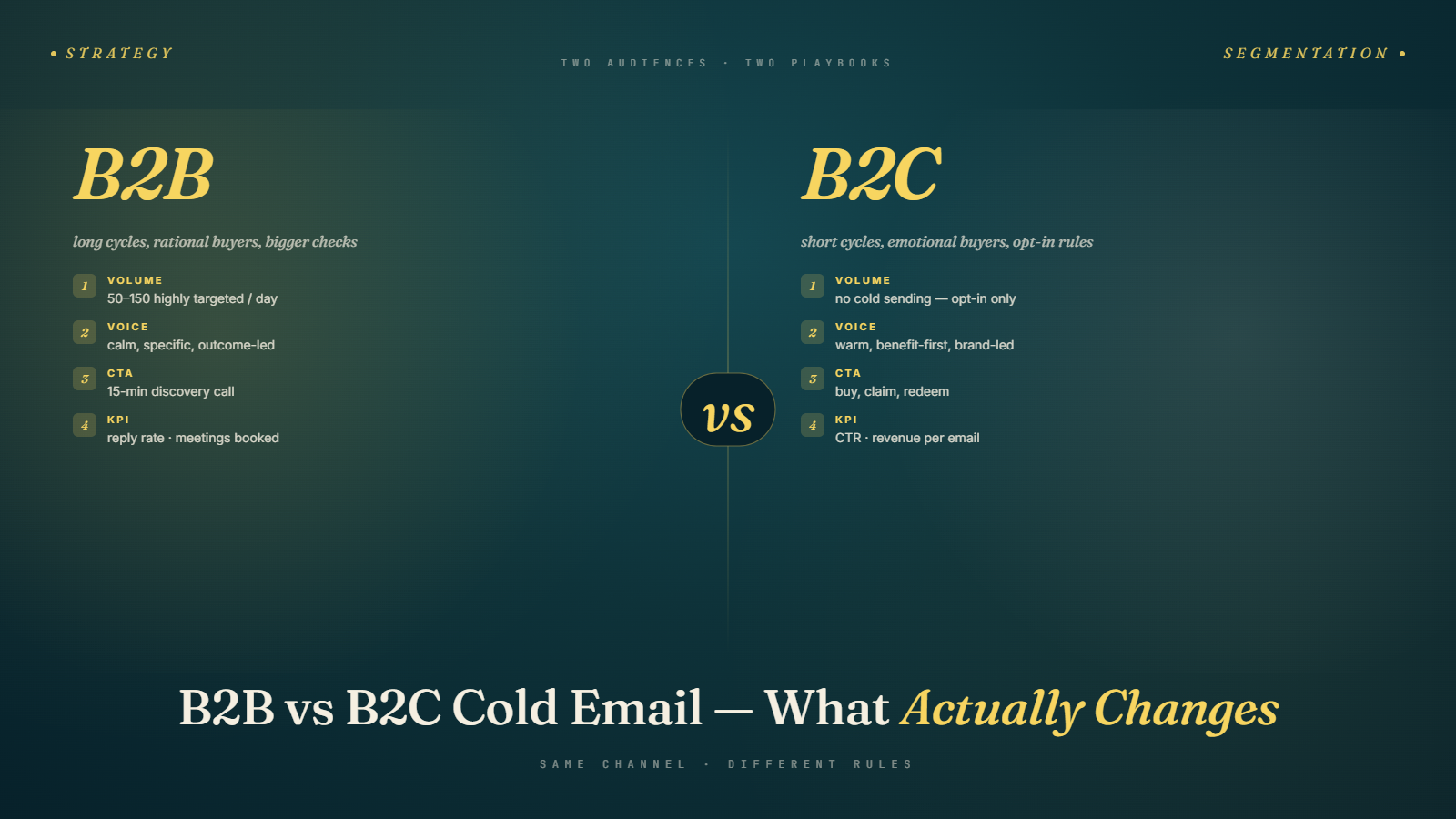
| Factor | B2B | B2C |
|---|---|---|
| Decision-maker | Often multiple stakeholders | Single individual |
| Sales cycle | Weeks to months | Days to weeks (or immediate) |
| Email tone | Professional, concise, outcome-focused | Warm, conversational, benefit-forward |
| Ideal email length | 75–150 words | 100–200 words |
| CTA style | Low-friction: ask a question or suggest a short call | Ultra-low-friction: "reply and let me know" |
| Follow-up frequency | 3–5 touches over 2–3 weeks | 2–3 touches max |
| Legal complexity | Lower (legitimate interest provisions apply) | Higher (consent requirements, GDPR, CASL) |
| Personalization type | Company-level trigger + role-specific pain point | Individual trigger + personal aspiration/pain |
| Primary metric | Reply rate, meetings booked | Reply rate, conversion to call or purchase |
| Primary objection | "We're not in the budget cycle right now" | "I don't know you / don't trust you yet" |
The Gray Zone — When B2B and B2C Overlap
Not every prospect fits neatly into one bucket. Here's where it gets interesting.
Solopreneurs and freelancers: Are they B2B or B2C? Technically they're a business, but they make purchasing decisions like a consumer — personally, quickly, emotionally. They don't have procurement teams or approval chains. They feel the impact of every dollar they spend directly in their personal bank account. Use a hybrid approach: business-relevant outcomes, but warmer and more conversational than you'd be with a corporate contact.
Small business owners: A restaurant owner, a dentist, a local contractor — these people buy for their business but think like consumers. The emotional stakes are high (this is their livelihood), the risk tolerance is low, and they're skeptical of anything that sounds like a corporate sales pitch. Meet them where they are: speak to their specific business situation but with the warmth and directness of a personal email.
High-ticket B2C: Luxury real estate, executive coaching, private wealth management — these deals have long sales cycles, require significant trust-building, and involve more rational evaluation than typical B2C. In these cases, borrow from the B2B playbook: clear value proposition, social proof, low-pressure CTA. But keep the emotional resonance that consumer-facing communication requires.
How to decide which playbook applies: Ask yourself two questions. First, is this person making this decision on behalf of an organization, or for themselves personally? Second, will they need anyone else's approval before saying yes? If it's personal and solo, lean B2C. If it's organizational or involves others, lean B2B.
Practical Takeaways for B2B Cold Emailers
- Lead with specificity. Generic openers kill B2B emails. Reference something real about their company, their role, or a recent trigger event. Doing this alone will improve your reply rates more than any other change.
- Think in sequences, not single sends. One email is almost never enough. Build a 3–5 touch sequence with different angles — a case study in touch 2, a content piece in touch 3, a "worth pursuing?" close in touch 4.
- Respect the buying process. Don't ask for more than a conversation. Your job in cold outreach is to get the first meeting, not close the deal.
- Verify your email list. Sending to bad addresses destroys your sender reputation fast. Use a tool like Bulk Mail Verifier before every campaign to clean your list.
- Measure reply rate, not open rate. Opens are a vanity metric. Replies tell you whether your message is actually resonating.
Practical Takeaways for B2C Cold Emailers
- Know your legal ground first. Seriously, before you send a single consumer email, understand the regulations in your jurisdiction and your recipients'. Our guide on cold email legality is a good starting point.
- Earn trust before you pitch. Consumers don't know you. Your first email should feel like an introduction, not a sale. Give before you ask.
- Trigger-based outreach outperforms list blasts. Find the life events or behavioral signals that indicate someone might need what you offer, and reach out in response to those signals. Relevance is your credibility.
- Keep follow-ups gentle. Two or three touches is usually the ceiling before you start generating negative sentiment. B2C buyers have a lower tolerance for persistence than B2B buyers.
- Make it easy to say no. Paradoxically, giving people an easy out increases response rates. "If this isn't relevant, just let me know and I won't follow up" is a sentence that actually works.
Common Mistakes
Common B2B Cold Email Mistakes
Sending a wall of text. A 400-word cold email to a VP of Sales is going straight to trash. Cut it in half. Then cut it in half again.
Asking for too much too soon. "Can we schedule a 45-minute product walkthrough?" is not a reasonable first ask from a stranger. Ask for a 15-minute call. Or just ask a question that requires a one-line reply.
Generic personalization. "I saw you're in the SaaS industry" is not personalization. That describes 200,000 people. Reference something specific — a funding announcement, a job posting, a LinkedIn article they wrote.
Pitching to the wrong person. Sending a technical product to the CMO when it's really an IT decision is a waste of time for everyone. Do your research on who actually owns the problem you're solving.
No follow-up sequence. If you're only sending one email and calling it a campaign, you're leaving the majority of your potential replies on the table.
Common B2C Cold Email Mistakes
Using B2B language with consumers. "Streamline your workflow," "leverage synergies," "drive ROI" — this language sounds robotic and corporate to a consumer. It signals that you don't really know them.
Emailing cold consumer lists without consent. Buying a consumer email list and blasting it is not a cold email strategy. It's a spam campaign. It's also potentially illegal depending on where your recipients live.
Treating every consumer the same. A 28-year-old first-time homebuyer and a 55-year-old investor are both "real estate prospects" but they need completely different messages. Segment ruthlessly.
Being too salesy too early. Consumers smell a pitch coming from a mile away. If your first sentence is about your product, you've already lost most of them.
Ignoring deliverability. Consumer email providers — Gmail, Outlook, Yahoo — have aggressive spam filters. If your sending domain isn't properly warmed up, if you're hitting invalid addresses, or if your open rates are low, you'll end up in spam before your campaign gets any traction. Make sure you're on top of your deliverability fundamentals.
The fundamental insight here is simple: these are two different games. In B2B, you're helping a professional solve a business problem, and they'll engage with you if you speak their language clearly and specifically. In B2C, you're speaking to a person's life, desires, and identity — and they'll engage if you make them feel understood.
Get that distinction wrong and no amount of A/B testing your subject lines is going to save you.
If you're just getting started with cold email and want the full context, go back to what cold email actually is and why it still works in 2026. If you've been at it a while and keep running into objections, our next post tackles the biggest myths about cold email — including several that are actively hurting people's results.
And whatever context you're emailing in, keep your list clean. Bad addresses are the silent killer of cold email campaigns. Verify before you send.