
Picture this: you've spent an hour crafting an email to someone you've never spoken to. A VP of Sales at a mid-sized SaaS company. You found their name on LinkedIn, dug into what their company actually does, wrote something specific to them, hit send, and then mostly forgot about it.
Three days later, a reply drops into your inbox: "Hey — interesting timing, we were just talking about this. Can you hop on a call Thursday?"
That moment — the unexpected reply from a stranger who turns into a real business conversation — is what cold email outreach is all about. And if you're new to it, it probably feels equal parts exciting and mysterious. How did that work? Can you repeat it? Can you scale it?
Yes, yes, and yes. But you need to understand what you're actually doing first.
This guide covers the fundamentals. What cold email outreach is, how it works mechanically and psychologically, who uses it and why, and what you need to get right before you send a single message. No fluff, no hype — just what you actually need to know.
What Exactly Is Cold Email Outreach?
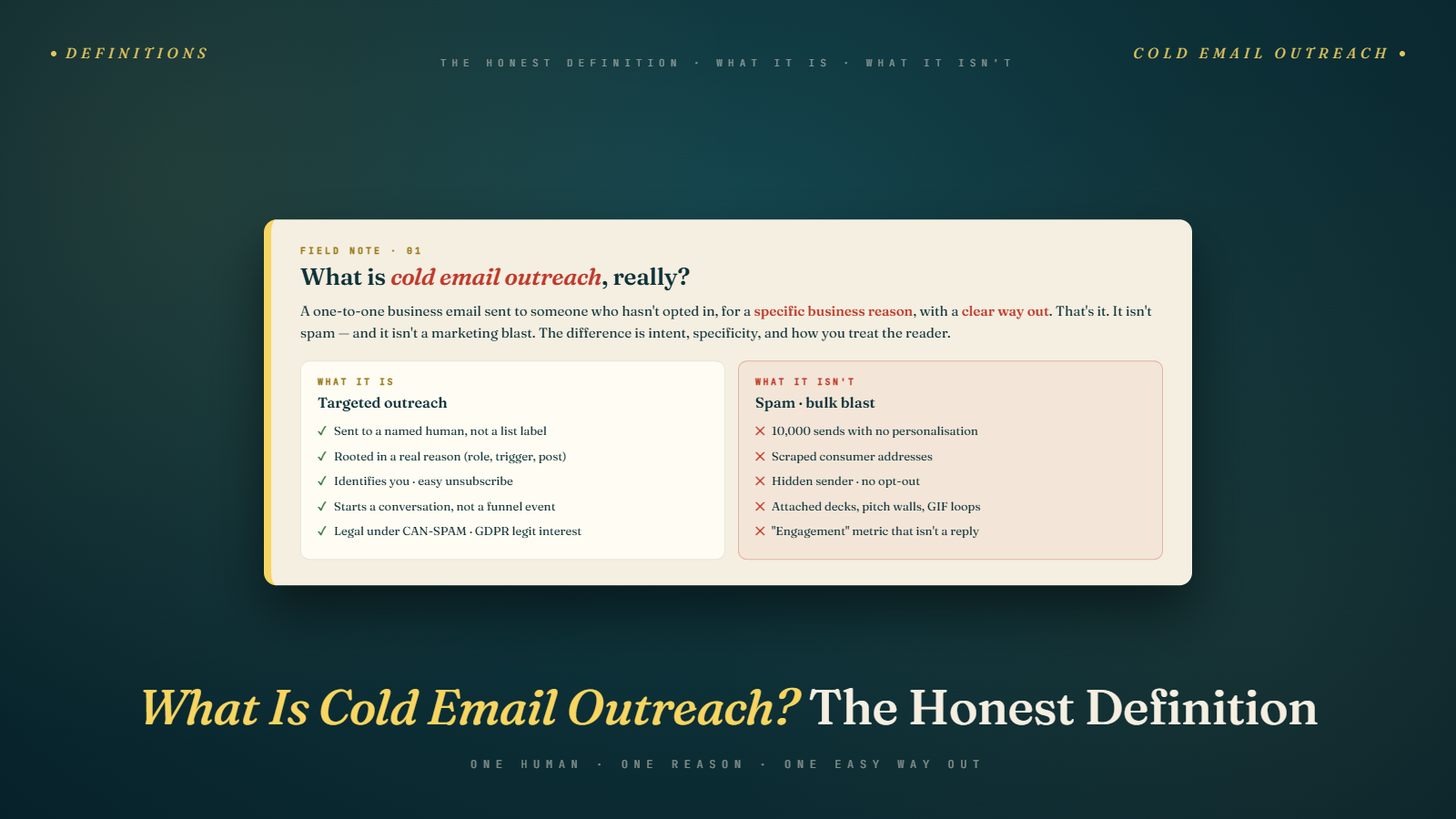
Cold email outreach is the practice of sending personalized, targeted emails to people who haven't previously interacted with you or your business, with the goal of starting a business conversation.
That's the clean definition. Let's pull it apart.
"People who haven't previously interacted with you" — that's the "cold" part. You're not emailing existing customers, people who signed up for your newsletter, or warm leads who downloaded something from your site. You're reaching out to strangers. The relationship is zero.
"Personalized, targeted" — this is what separates cold email from spam. We'll get into this distinction in a moment, but the key word is targeted. You've identified a specific person, at a specific company, for a specific reason. You're not blasting the same message to 50,000 people.
"Starting a business conversation" — note that this is not "making a sale." The goal of most cold emails isn't to close a deal in that first message. It's to create an opening. A reply, a meeting, an introduction. The sale, if it happens, comes later.
The "cold" metaphor makes intuitive sense when you think about it. You know the feeling of a cold call — you pick up the phone and it's someone you've never spoken to. Cold email is that same dynamic, just in your inbox instead of your ear. The recipient has no context for who you are. You're starting from zero trust, zero familiarity.
Cold Email vs Spam — The Crucial Difference
This is the most important distinction to understand before you send anything.
Spam is untargeted, bulk, usually deceptive email sent to people who never asked for it. It's the "Congratulations, you've won!" messages. The pharmaceutical offers. The phishing attempts. Spam doesn't care who you are — it just needs someone to click.
Cold email, done properly, is none of those things.
Here's the difference in practice: if you're emailing a Head of Marketing at a 50-person B2B software company because you have a tool that specifically helps companies at that stage run better LinkedIn campaigns, and your email references their actual company and their actual situation — that's not spam. That's outreach. There's a real reason you're reaching out to that specific person.
The line between cold email and spam comes down to three things:
- Relevance — Is there a genuine, specific reason why this person could benefit from what you're offering?
- Personalization — Does the message reflect that you actually know something about the recipient?
- Intent — Are you trying to start a legitimate business conversation, or just blast a pitch at anyone with an email address?
Spam fails all three. Good cold email passes all three. This matters not just ethically but practically — relevant, personalized emails get replied to. Generic blasts get deleted and reported.
How Cold Email Actually Works
Let's get into the mechanics.
Step 1: Finding Prospects
Before you write a single word, you need a list of the right people to email. This is called prospecting, and it's where most beginners underinvest.
Prospecting means identifying people who fit your ideal customer profile (ICP). That might mean filtering by job title, company size, industry, geography, technology stack, funding stage, or a dozen other criteria depending on what you're selling.
Common sources for prospect data: LinkedIn (manually or via tools like Sales Navigator), Apollo.io, Hunter.io, company websites, job boards, industry directories. You're looking for verified, accurate contact information — specifically business email addresses.
Step 2: Crafting the Message
This is where the work lives. A cold email that gets replies isn't magic — it follows a reliable structure, which we'll cover below. The short version: short, specific, relevant, easy to respond to.
Step 3: Sending
Most people starting out use their regular Gmail or Outlook account for initial tests. That's fine at very low volume. As you scale, you'll want dedicated sending infrastructure — separate domains, proper authentication (SPF, DKIM, DMARC), and volume management. We'll touch on deliverability more in a later section.
Step 4: Following Up
This is the part new senders consistently get wrong by either skipping it entirely or overdoing it. The reality: most positive replies come from follow-ups. Not because people ignored your first email, but because inboxes are noisy and timing matters. A thoughtful follow-up sequence — usually 2–4 messages spread over 1–3 weeks — is standard practice.
The Psychology of the Inbox
Here's something worth internalizing: your prospect's inbox is a warzone. Decision-makers at growing companies might receive hundreds of emails a day. They've developed aggressive filtering habits — mentally and technically.
When they scan your email, the first question is subconscious: Is this relevant to me right now? If the answer isn't immediately obvious, it's gone. That's not personal. That's just how people process information overload.
What this means for you: you have about three seconds and about 20–30 words — the subject line and the first line of the email body — to signal that this message is worth a few more seconds of their time. You're not trying to sell in those first words. You're just trying to earn the next few seconds.
The Anatomy of a Cold Email
A well-constructed cold email has five parts:
1. Subject line Your only job here is to get the email opened. Not to be clever, not to be salesy. The best cold email subject lines are often lowercase, short (4–7 words), and conversational. Think: "quick question about [Company]" or "your onboarding flow" or just "intro."
2. Opener The first sentence needs to be about them, not you. Reference something specific — a recent hire, a product launch, something they wrote, a challenge specific to their industry. This is the signal that you actually did your homework.
3. Value proposition One or two sentences. What do you do, for who, and what's the outcome? This should be specific. "We help B2B SaaS companies reduce churn by improving trial-to-paid conversion" is infinitely better than "we offer innovative software solutions."
4. Call to action (CTA) Make it easy to say yes. Don't ask for a 45-minute demo call as your first ask. Ask a simple question, or offer one specific, low-commitment next step. "Would it make sense to connect for 15 minutes?" or "Worth a quick chat?" work far better than "Please book a discovery call with my team."
5. Signature Your name, title, company, phone number if relevant. Keep it clean. No inspirational quotes. No images in signatures for cold outreach — they mess with deliverability.
Who Uses Cold Email and Why It Works
The range of people running cold email campaigns is wider than most people realize.
SaaS companies use it to fill their sales pipelines with qualified demos. A 5-person SaaS startup cold emailing 500 ideal prospects a week is a completely normal growth strategy.
Agencies — marketing, design, dev, SEO, PR — use cold email as their primary new business channel. It's cheap, direct, and when done well, produces more consistent results than waiting for referrals.
B2B sales teams at larger companies use it as part of multi-channel outbound strategies alongside LinkedIn outreach, calls, and paid ads.
Freelancers use it to land clients directly, bypassing marketplaces and the race to the bottom on price.
Recruiters use it (ethically) to reach passive candidates for senior roles.
Investors and advisors use it to reach founders, partners, or subject matter experts.
The reason cold email works comes down to one thing: it's the most direct channel that doesn't require the other person to already know you exist. Unlike content marketing (they have to find you) or paid ads (they have to click) or referrals (someone has to make an introduction), cold email puts your message directly in front of a specific person who fits your criteria.
A quick scenario: A freelance UX designer wants to work with fintech startups. She builds a list of 200 Series A fintech companies that have recently posted product manager job listings — a signal that they're growing their product team and likely feeling design pressure. She sends a 4-line email referencing one specific design problem she noticed on their product. She follows up once. Over 6 weeks, she books 11 conversations and lands 2 new retainer clients. No ads, no portfolio site traffic required.
That's cold email working as intended.
When Does Cold Email Make Sense (And When It Doesn't)?
Best Use Cases
Cold email tends to work well when:
- You're selling a B2B product or service with a clear, identifiable buyer
- The average deal value justifies the time investment in personalization
- You can clearly articulate who your ideal customer is and why they'd care
- You're targeting a niche where you can get genuinely relevant
- You have something specific and valuable to offer — not just "a call to learn more"
When NOT to Use Cold Email
Cold email is the wrong tool when:
- You're selling directly to consumers (B2C). Mass cold outreach to personal email addresses is both legally problematic and practically ineffective.
- Your offer is extremely low-ticket or transactional. If your product costs $10/month, the ROI math on manual cold outreach doesn't work unless you can automate it extremely well at scale.
- You can't articulate who specifically benefits from what you offer. "Everyone could use this" means cold email is going to be expensive and ineffective.
- You're in an industry where unsolicited outreach is particularly sensitive — healthcare, legal, financial services — without careful attention to compliance.
- You don't have the patience for a 2–8 week sales cycle. Cold email starts conversations; it rarely closes deals overnight.
Getting the Basics Right Before You Send a Single Email
This section is the one most beginners skip. Don't.
List Quality Is Everything
The quality of your prospect list is the single biggest factor in whether your cold email campaign works. A perfectly written email sent to the wrong people, or to bad email addresses, does nothing.
Bad data means bounced emails, which damages your sending reputation. It means messages landing in spam. It means wasted effort pitching people who could never buy from you.
Before you import any list into your sending tool, run it through email verification. Specifically, you want to remove invalid addresses, catch-all domains, and role-based accounts (like info@ or support@) that rarely convert. A good verification pass typically removes 10–20% of raw prospect lists — all email addresses that would have caused problems.
For bulk verification of large prospect lists, check out our guides on unlimited email verification and the best bulk email verification services — both will help you build a clean foundation before you start sending.
Domain Warm-Up
If you're using a new sending domain (which you should be — never use your primary business domain for cold outreach), you can't just start blasting 500 emails a day from day one. Email providers will flag that as suspicious behavior and route your mail straight to spam.
Domain warm-up is the process of gradually increasing your sending volume over 4–6 weeks to establish your domain as a legitimate sender. You start with 10–20 emails a day, increase slowly, and ideally use a warm-up tool that auto-generates positive engagement signals in parallel.
We've covered this in detail in our guide on how to warm up an email domain.
Deliverability Basics
Even with a clean list and a warmed domain, there are deliverability factors you need to get right: SPF, DKIM, and DMARC records properly configured on your sending domain, plain-text or minimal HTML emails (heavy HTML triggers spam filters), and avoiding specific word patterns that flag spam algorithms.
For a full breakdown of how to maximize your chances of landing in the inbox, read our guide on how to boost cold email deliverability.
Practical Takeaways for Absolute Beginners
If you're just getting started, here's what to focus on first:
Start small and manual. Send 20–30 highly personalized emails before you automate anything. This forces you to learn what resonates without burning your domain reputation on a bad first campaign.
Nail your ICP before you write a single email. Who exactly are you reaching out to? Job title, company size, industry, what problem they have, what they'd need to be true for them to say yes to you. The narrower and more specific, the better your results.
Write like a human. Read your email out loud. If it sounds like marketing copy, rewrite it. Cold email works when it feels like a real person reaching out to another real person, not a broadcast from a company.
One ask per email. A single, clear, low-commitment call to action. Not three options. Not a form to fill out. One thing.
Track reply rates, not open rates. Open rates are increasingly unreliable (Apple Mail Privacy Protection inflates them). Replies are what matter. If you're getting below 3–5% reply rates, your targeting or your message needs work.
Verify before you send. Always.
Common Mistakes New Cold Emailers Make
Opening with "My name is [X] and I work at [Y]." Nobody cares yet. Lead with them, not with you.
Making the email too long. If your first cold email is more than 150 words, it's probably too long. Respect their time.
One-size-fits-all personalization. Swapping in the company name with a merge tag is not personalization. "I noticed [Company] recently raised a Series B" followed by a generic pitch is lazy. Real personalization means referencing something specific and relevant.
Giving up after one email. Most replies — somewhere around 60–70% of positive responses — come from follow-up emails. A single send is leaving a lot on the table.
Using their primary company domain for outreach. If your sending domain gets flagged or blacklisted, you want it to be a burner domain, not the one that hosts your main website and corporate email.
Skipping list verification. Bounce rates above 5% will damage your sending reputation fast. Don't skip this step.
Pitching too early. If your first email is essentially a sales brochure, you're going to get ignored. The goal is a reply, not a purchase.
The mechanics of cold email are learnable. The psychology is learnable. What separates people who get results from people who give up after one failed campaign is usually not talent — it's understanding what the fundamentals actually are and doing them consistently.
You now have a solid foundation. The next step is understanding how cold email fits into a broader email strategy — specifically, how it differs from traditional email marketing, which operates under completely different rules with different tools, different goals, and different metrics.
We cover that in detail in Blog 2: Cold Email vs Email Marketing: Key Differences Explained.
And if you're wondering about the legal side of cold email — whether it's actually legal and what rules apply — that's Blog 3: Is Cold Email Legal?. Worth reading before you scale anything.