
Here's a scenario that plays out constantly. A founder of a small B2B software company decides to "do email." They sign up for Mailchimp, upload a list of 3,000 email addresses they scraped from a trade show database and a few LinkedIn exports, write a promotional newsletter about their product, and hit send.
Within 48 hours, their Mailchimp account is suspended. Their domain starts getting flagged by spam filters. Their reply rates are zero. And they're genuinely confused — "I thought this was how email marketing worked."
What they actually tried to do was cold email outreach. They just used the completely wrong tool, the wrong list, and the wrong mental model. The result was predictable.
The confusion between cold email and email marketing is one of the most common mistakes in B2B growth, and it costs people real money and real sender reputation. These are not the same discipline. They operate under different rules, use different tools, measure different things, and serve completely different purposes.
Let's break it down.
They're Not the Same Game
The simplest way to frame this: email marketing is about working a relationship that already exists. Cold email is about starting a new one.
Email marketing assumes consent. Someone gave you their email address because they wanted to hear from you — they subscribed to your newsletter, downloaded your template, became a customer. The relationship is established. You're maintaining and deepening it.
Cold email assumes no existing relationship. You're reaching out to someone who doesn't know you exist. The relationship is zero. You're trying to create a first impression and earn a reply from a stranger.
These two dynamics require completely different approaches, completely different tools, and completely different success metrics. Using email marketing logic to run cold outreach — or vice versa — is like trying to play chess with checkers rules. The pieces are the same shape but the game doesn't work.
What Email Marketing Actually Is
Email marketing is permission-based communication to people who have explicitly or implicitly opted in to receive emails from you.
The canonical use cases: newsletters sent to subscribers, onboarding drip sequences for new users, promotional campaigns to your customer base, re-engagement campaigns for people who've gone quiet, product update announcements, post-purchase follow-up sequences.
The key characteristic across all of these: the recipient agreed, in some form, to receive emails from you. They subscribed. They bought something. They ticked a box. That consent is foundational.
The goals of email marketing are fundamentally about relationship management:
- Retention — keeping existing customers engaged and reducing churn
- Upsell and cross-sell — deepening the relationship with people who already trust you
- Nurture — moving prospects who showed interest toward a buying decision over time
- Engagement — building affinity, brand awareness, community
Notice what's not on that list: meeting strangers, finding new leads, cold prospecting. Email marketing is a retention and nurture tool, not a prospecting tool.
The Tools Email Marketing Uses
Email marketing is the domain of Email Service Providers (ESPs). Mailchimp, Klaviyo, ConvertKit, ActiveCampaign, HubSpot, Constant Contact — these are ESP platforms.
ESPs are designed for:
- Managing large, permission-based lists
- Compliance with unsubscribe requests (legally required)
- HTML-rich templates with branded design
- Automated drip sequences triggered by behavior
- Segmentation and tagging based on subscriber data
- Broadcast sends to thousands or tens of thousands of people at once
What ESPs are explicitly not designed for: sending to people who haven't opted in. Their terms of service prohibit it. Their spam compliance systems will flag it. And if you try to use an ESP for cold outreach and your bounce rates spike or recipients hit "spam," your account gets terminated — sometimes permanently.
This is exactly what happened to the founder in the intro scenario.
Metrics That Matter in Email Marketing
- Open rate — what percentage of subscribers opened the email
- Click-through rate (CTR) — what percentage clicked a link
- Unsubscribe rate — how many people opted out
- List growth rate — how fast your subscriber base is growing
- Revenue per email — for e-commerce and transactional email
- Churn and retention impact — harder to measure directly, but the underlying reason you're doing this
Good open rates for email marketing vary by industry, but 20–35% is typically healthy for a well-managed list. CTRs of 2–5% are considered solid.
What Cold Email Actually Is (Revisited in Context)
Cold email is 1:1 personalized outreach to people who don't know you yet, for the purpose of starting a specific business conversation.
Where email marketing is 1:many broadcasting, cold email is 1:1 precision targeting. Where email marketing maintains existing relationships, cold email initiates new ones. Where email marketing talks to people who asked to hear from you, cold email reaches out to people who fit your ideal customer profile whether or not they've heard of you.
The goals are entirely different:
- Start a conversation — get a reply from a relevant prospect
- Book a meeting — move toward a sales conversation
- Generate a qualified lead — create a new business opportunity that didn't exist before
Cold email is an outbound sales tool. It's prospecting. It's new business development. It has nothing to do with newsletters, broadcasts, or mass communication.
The Tools Cold Email Uses
Cold email has its own dedicated software stack — completely separate from ESP platforms. The major players: Instantly, Lemlist, Apollo.io, Smartlead, Salesloft, Outreach.io, Woodpecker, Reply.io.
These tools are designed for:
- Managing multiple sending domains and inboxes (for volume and deliverability)
- Automated follow-up sequences with personalization variables
- A/B testing subject lines and message variations
- Sending plain-text emails that look like they came directly from a person
- Managing reply detection and pausing sequences when someone responds
- Inbox rotation to distribute volume across multiple email accounts
- Warm-up functionality to build sender reputation on new domains
Notice what cold email tools prioritize that ESPs don't: deliverability at the individual inbox level, plain-text formatting, domain health management, and the ability to send to people who haven't opted in to anything.
You should never use Mailchimp to run cold email campaigns. And you shouldn't use Instantly to run your customer newsletter. These tools are built for fundamentally different jobs.
Metrics That Matter in Cold Email
This is one of the most important differences in practice, because the benchmarks are completely different.
- Reply rate — the primary metric. What percentage of people you emailed actually replied? Anything above 5% is decent; above 10% is strong; above 20% means you've found something that really resonates.
- Positive reply rate — how many of those replies were interested, not just "remove me from your list"
- Meeting booked rate — how many sequences resulted in a call or demo
- Bounce rate — critical to watch. Above 5% indicates list quality problems and will damage your domain.
- Open rate — less useful than it sounds, because Apple Mail Privacy Protection inflates open data significantly. Use it directionally, not as a primary signal.
What cold email does not care about: unsubscribe rates, template click-through rates, or list growth metrics. These are simply not relevant to the job being done.
Side-by-Side Comparison
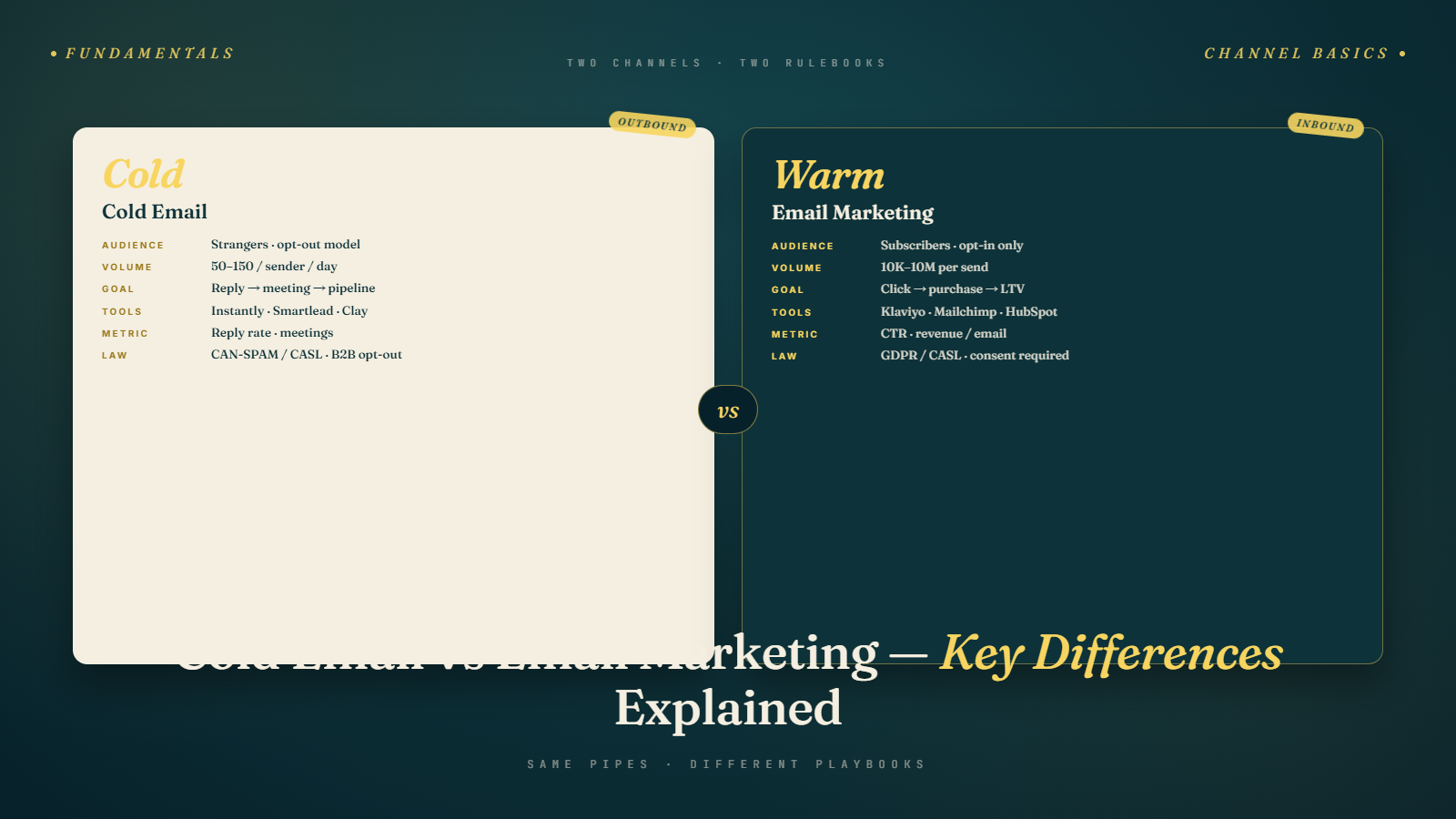
| Factor | Cold Email | Email Marketing |
|---|---|---|
| Audience | Strangers who match your ICP | Existing subscribers / customers |
| Consent | No prior consent (permission-based on legitimate interest) | Explicit or implicit opt-in required |
| Primary goal | Start a conversation, book a meeting | Nurture, retain, upsell |
| Tone | Conversational, personal, 1:1 | Can be branded, designed, broadcast |
| Format | Plain text, short, no images | HTML templates, longer, branded |
| Tools | Instantly, Lemlist, Apollo, Smartlead | Mailchimp, Klaviyo, ConvertKit, ActiveCampaign |
| Primary metric | Reply rate | Open rate, CTR, conversion |
| Volume | Hundreds to low thousands per week | Thousands to millions per send |
| Legal framework | CAN-SPAM, GDPR (legitimate interest), CASL | CAN-SPAM, GDPR (consent-based) |
| Personalization | High — specific to each recipient | Segmentation-based, not 1:1 |
| List source | Prospecting tools, LinkedIn, data providers | Organic sign-ups, lead magnets, purchases |
| Deliverability strategy | Domain warm-up, inbox rotation, plain text | List hygiene, engagement metrics, unsubscribe management |
Can You Run Both at the Same Time?
Absolutely. In fact, for most B2B companies, the answer is: you should.
They serve different phases of the customer lifecycle and they don't compete with each other. Here's how they complement each other in practice:
Cold email fills the top of your funnel. It brings in net new people who've never heard of you. When cold outreach works, you're adding fresh prospects to your pipeline constantly.
Email marketing handles everything after someone enters your world. Once a cold prospect replies, books a call, or signs up for a trial — they've moved from "stranger" to "lead" or "user." That's when your email marketing sequences take over: onboarding drip campaigns, product education emails, upsell sequences, newsletters that reinforce your brand value.
The handoff moment is critical. When a cold prospect converts — they reply positively, they book a call, they start a trial — they stop being a cold email target and start being an email marketing audience member. You add them to the appropriate list in your ESP, and your nurture sequences begin.
Companies that do this well have both engines running in parallel: cold outreach constantly generating new leads, email marketing converting and retaining them. Neither system is trying to do the other's job.
A practical example: a SaaS company might run cold email campaigns targeting growth-stage startups to book product demos. Once someone demos and starts a trial, they enter an onboarding email sequence in ActiveCampaign. After they convert to paid, they join the customer newsletter list in the same ESP. Three different email contexts — one outbound tool, one ESP, all coordinated.
Common Mistakes (And Why They Happen)
Using an ESP for cold email. We've covered this, but it bears repeating because it's the single most common mistake. Mailchimp's terms of service explicitly prohibit sending to purchased or scraped lists. If you try it, your account gets suspended and your domain gets flagged. Use cold email tools for cold email.
Applying email marketing benchmarks to cold email campaigns. If you're benchmarking your cold outreach open rates against "industry average" email marketing open rates of 25–30%, you're measuring the wrong thing entirely. Cold email reply rates are what matter. A 40% open rate with 0% replies means your subject lines are decent but your message is missing.
Treating cold email like a newsletter. Long, designed, image-heavy emails are appropriate for subscribers who signed up for your brand content. They are completely wrong for cold outreach to strangers. A cold email that looks like a marketing email will be filtered, ignored, or reported. Plain text, short, personal.
Not cleaning your cold email list. Email marketing platforms have list hygiene built in because they track engagement over time. Cold email tools don't have this by default — you need to run your prospect lists through verification before sending. High bounce rates will tank your domain reputation faster than almost anything else. Before any campaign, verify your list. Our guide on unlimited email verification walks through how to do this efficiently at scale.
Skipping warm-up on cold email domains. Email marketing with a domain you've been using for years doesn't need this. Cold email on a new domain absolutely does. Skipping warm-up and sending volume immediately will land you in spam. See our post on avoiding spam-triggering words for additional deliverability guidance that applies specifically to cold outreach.
Conflating consent. Someone signing up for your newsletter is not giving you permission to cold pitch them from a different product line or a different company you run. Consent in email is specific. Don't assume that opting in to one thing means they've opted in to everything.
Practical Takeaways
If you're just starting out with outbound sales: Cold email is your tool. You need cold email infrastructure — a separate sending domain, a cold email platform like Instantly or Lemlist, verified prospect lists, and a focused follow-up sequence. Don't touch Mailchimp for this.
If you want to build a long-term email marketing program: You need an ESP, a strategy for growing an opted-in subscriber list, and content worth sending. Think about what your customers or potential customers would actually want to read, and build from there.
If you have an existing business: You almost certainly need both. Your ESP handles your customers and warm leads. Your cold email stack handles net new prospecting. Define the handoff point clearly and make sure contacts don't fall through the gap between the two systems.
On tools: Match the tool to the use case. Cold email tools (Instantly, Lemlist, Apollo, Smartlead) are not ESPs. ESPs (Mailchimp, Klaviyo, ConvertKit) are not cold email tools. There's no overlap that makes sense.
On list hygiene for cold email specifically: Clean your list before every campaign. Remove invalid addresses, catch-alls, and role-based emails. Bounce rates above 3–5% will compromise your domain health quickly. This is non-negotiable if you want campaigns that actually reach the inbox.
On measuring what matters: Reply rate for cold email. Open and click rate for email marketing. Don't mix up your benchmarks — you'll make bad decisions based on the wrong signals.
These two strategies work best when you understand what each one is actually for. Cold email gets people into your world. Email marketing keeps them there and deepens the relationship. They're complementary, not competing — but only when you run them correctly.
If you're new to cold email and want to start from the fundamentals, Blog 1 in this series — What is Cold Email Outreach? A Complete Beginner's Guide — covers everything from the basic definition through the anatomy of a cold email and how to set up your foundation correctly.
The natural next question after understanding the mechanics is the legal one: is cold email actually legal? What rules apply, what can get you in trouble, and how do you stay compliant while still running effective campaigns? That's covered in Blog 3: Is Cold Email Legal?. Worth reading before you scale anything.