
Three weeks into the broad Gemini rollout, a client forwarded me a dashboard screenshot. Same list. Same cadence. Same creative template they had used for eleven months. Click-through rate had dropped from 4.7 percent to 4.1 percent across their last six sends. Nothing else had changed on their end.
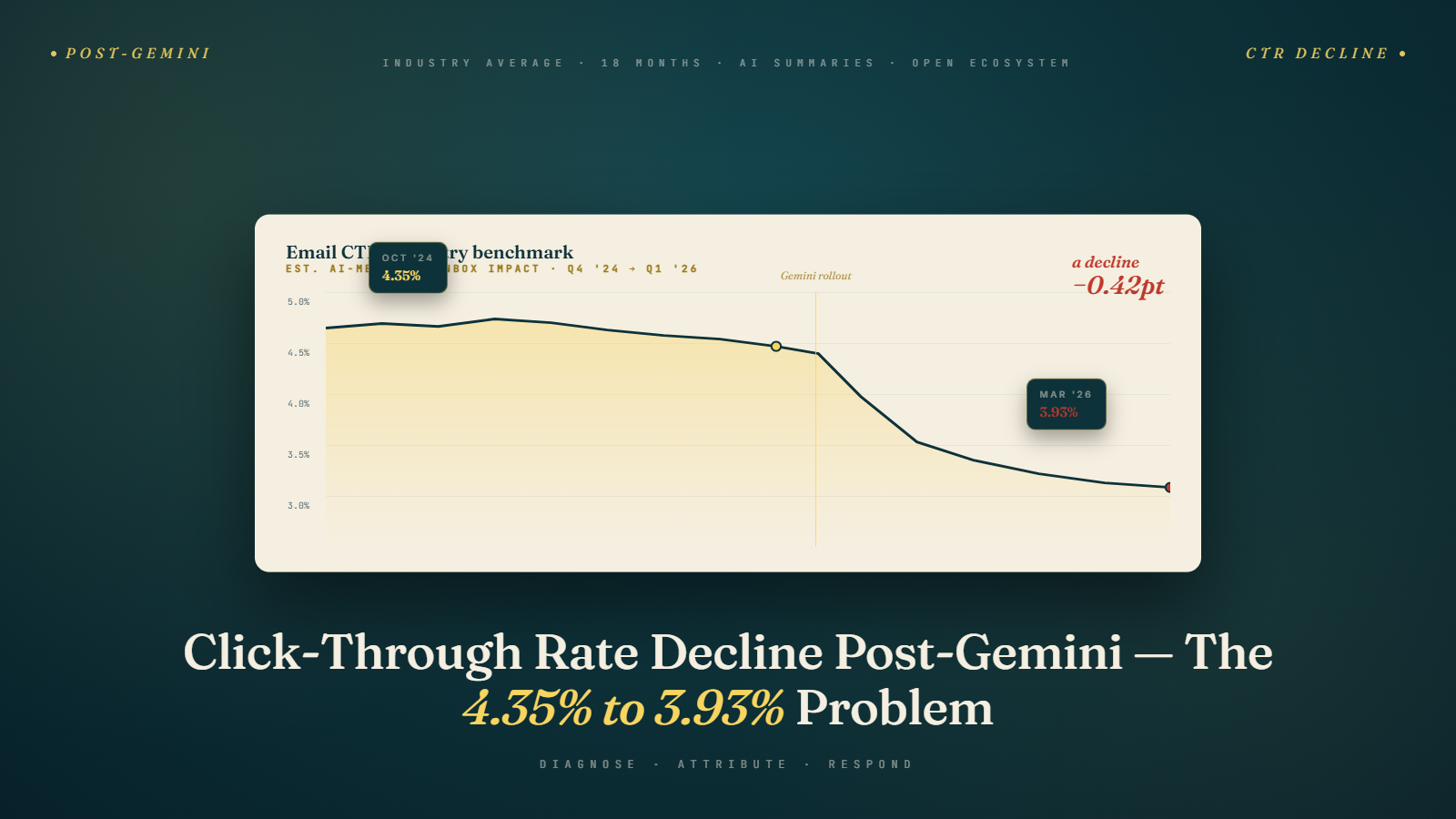
That client was not alone. Industry averages across the major ESPs settled around 3.93 percent in February and March 2026, down from roughly 4.35 percent the previous year. The drop is small in absolute terms and enormous in what it signals. A 9.6 percent relative decline in clicks, during a period when list hygiene practices improved and sender authentication got stricter, means something upstream of the inbox is eating clicks before they happen.
That something is the summary card. And if you have not yet separated Gemini-driven CTR loss from list-driven CTR loss, you are about to spend a quarter optimizing the wrong thing.
Why Summary Cards Erode Clicks
Gemini summaries give subscribers the gist of an email without opening it, and sometimes without the summary even pulling them into the full message. If the key information, the discount code, the shipping update, the event time, is visible in the summary card, the click becomes optional. For a marketer, that is a structural change, not a tactical one.
I have seen this clearest in promotional emails. A client running a weekly sale had trained subscribers to open, scan the offer, click through. Gemini now surfaces "Take 20% off all outerwear through Sunday with code OUTER20" directly in the preview. Subscriber has the code. Subscriber can go to the site via search or bookmark. No click on the email needed. The conversion still happens. The click does not.
The important distinction is that sessions and revenue often did not fall as sharply as clicks did for this client. Direct traffic to their site rose during the same window. Branded search traffic rose. The purchase happened, the attribution moved. If you are reading CTR as a pure demand signal, you will misread the market. If you are reading it as an engagement signal, you will still be correct, but the meaning has shifted.
How To Tell If Your Drop Is Gemini Or Something Else
The honest answer is that you diagnose this the way you diagnose any anomaly: by isolating variables. Here is how I walk through it with clients.
First, segment the drop by email type. Promotional and newsletter sends should show the sharpest CTR decline because they summarize well. Transactional messages, order confirmations, password resets, shipping updates, should be roughly flat or even slightly higher because users still need the underlying links. If your CTR fell evenly across all types, the cause is probably not Gemini. It is more likely deliverability or list quality.
Second, look at click-to-open ratios, not just raw CTR. If open rates held steady (setting aside the Apple MPP mess we already wrote about in our death of open rate post) and CTR fell, the drop is behavioral. Subscribers opened, looked, decided against clicking. If opens fell first and clicks followed, the problem is probably upstream: spam placement, list fatigue, subject lines failing.
Third, compare Gmail-specific CTR to Outlook, Yahoo, Apple Mail CTR. Gemini summaries affect Gmail users disproportionately right now. If your Gmail CTR dropped 12 percent and your Outlook CTR held steady, you have your answer. Most ESPs let you segment opens and clicks by mailbox provider. Use it. If yours does not, manually UTM your sends and segment in analytics.
Fourth, look at time-of-click distribution. Gemini-aware subscribers tend to skim summaries in their morning inbox scan, then act later in the day through search or direct visit. Clicks that do happen tend to happen faster and from the summary card itself. If your click timing got more compressed and earlier, that is a Gemini signature.
Which Email Types Are Most Affected
Promotional broadcasts took the hardest hit. A 14 to 18 percent relative CTR decline is typical among the senders I have audited. These emails are built for summarization. A hero, a headline, an offer, a button. Gemini can compress that into two sentences and still preserve the full offer. The click becomes a courtesy, not a requirement.
Newsletter sends sit in the middle. Curated link roundups, industry updates, digest formats lose somewhere around 8 to 12 percent in CTR, but the pattern is interesting. The top link in a newsletter still gets most of its clicks because Gemini often names the lead story. The middle and lower items get cannibalized harder because users assume they have the headline and can search if they care.
Transactional and behavioral triggers were barely touched. Order confirmations, delivery notifications, password resets, account alerts either held or gained a point or two. These emails are not summarization targets. They are utility. The click is the point.
Lifecycle emails, welcome series, onboarding, re-engagement, held up better than promotional broadcasts because they tend to ask for an action that cannot be summarized, like completing a profile, downloading an app, connecting an account. The summary says "Finish setting up your account" and the subscriber still has to click to do it.
One type that surprised me: content promotion emails linking to long-form articles fell more than I expected. Roughly 11 percent. Gemini often summarizes the article itself, not just the email, and a good summary of a 2,000 word post makes the click feel redundant for a casual reader.
Clicks When Subscribers Already Know The Contents
This is where I want to push back on the reflex response I see from agencies, which is to make emails more opaque so they do not summarize well. That is a short-term trick that damages the user experience and does not survive contact with Gemini's next update. The better path is to give people reasons to click that cannot be captured in a summary.
Exclusive content works. If the email promises a behind-the-scenes video, a subscriber-only early access window, a discount code that only works from the email link, a downloadable guide, the click has intrinsic value. Gemini can say "Subscribers get early access to the spring collection, link inside." The subscriber still has to click.
Personalization that the AI cannot know or summarize is underrated. I ran a campaign for an ecommerce brand where the email included the customer's actual purchase anniversary date, their first product, and a personalized bundle recommendation calculated from their last twelve orders. Gemini summarized it as "A personalized anniversary offer based on your purchase history." Every customer who cared about the details still had to click to see them. CTR on that segment was 6.8 percent, against a baseline of 3.2 percent for their generic sends.
Curiosity gaps that the email does not resolve on its own still pull clicks. This is the oldest trick in the book, and it is aging gracefully. Headline-level tease, subject line question, body that hints but does not answer, link to the payoff. The key is the payoff has to be worth it. Subscribers who click once on a tease and find filler will train Gemini to deprioritize you. Make the click earn its reward.
Interactive content that requires the click is the cleanest defense. Quizzes, calculators, polls, surveys, AMP-powered dynamic content where it works. The email is a door. The experience lives behind it. Summarization does not threaten the click because the content is not the email.
The Tactics I Have Stopped Recommending
I used to recommend aggressive preview text optimization as a CTR lift lever. It still matters for open rates among non-Gemini users, but its influence on clicks has weakened. The summary supersedes the preview text.
I used to recommend "benefit-heavy" subject lines that loaded the value into the headline. Those now train Gemini to write summaries that carry the full value, suppressing the click. A better pattern is subject lines that pose a question, set up a contrast, or imply exclusivity. We went deeper on this in our subject line strategy for 2026 post.
I used to recommend long, content-rich emails that communicated the full pitch. Those summarize too well. Front-loaded short emails that create curiosity, then deliver the full payload on the landing page, hold up better. See our piece on front-loading email content for Gemini's 100 character preview window for the mechanics.
The Short Answer For Snippets
If your email click-through rate has dropped between 8 and 15 percent since early 2026, Gemini summary cards are the most likely cause. The fix is not opacity. The fix is designing emails where the click has a reward the AI cannot replicate: exclusive content, deep personalization, interactive experiences, or curiosity gaps resolved only by clicking. Transactional emails are unaffected. Promotional and newsletter sends are most exposed.
What To Measure Instead
A single-metric view of email is already broken, and CTR is the next casualty. My working dashboard for clients now includes the following signals, roughly weighted.
Click-through-to-conversion ratio. If clicks fall but conversions hold, your real demand is intact. The click is a proxy that is weakening. The conversion is not.
Direct and branded search lift correlated with send times. If Gemini is giving subscribers the gist, and they are acting on it through search or direct visits, you will see a bump in these channels within three to six hours of a send. Most marketers never look for this. The pattern is real and it is measurable.
Reply rate. I have been beating this drum for months, and our piece on new engagement metrics goes deeper, but reply rate is the single most underrated signal right now. Gemini treats replies as a strong positive engagement marker. Campaigns that earn even a fraction of a percent in replies perform better on downstream sends.
Unsubscribe rate, complaint rate, list growth, and the old deliverability fundamentals. These did not get less important. They got more important, because subscriber patience for frequency abuse is lower now that Gmail Manage Subscriptions makes bulk unsub a two-tap operation.
Segment-level CTR rather than list-level CTR. Engaged segments still click at healthy rates. Mass broadcasts to full lists dilute the signal. If your CTR on your top 20 percent most engaged subscribers is above 8 percent, you are fine. If your CTR on that segment dropped 20 percent year over year, you have a real problem that Gemini did not cause.
The Stakeholder Conversation About CTR Decline
This is the part most articles on CTR decline skip. Telling a CMO or a client that CTR is down because of a platform change is a conversation that goes poorly unless you arrive with the supporting data.
The data that makes the conversation go well has a specific shape. Start with a provider-specific breakdown: Gmail CTR over the past six months alongside Outlook and Apple CTR over the same period. If Gmail is the outlier, the diagnosis points to Gemini, which stakeholders have seen and used in their own inbox and will recognize as a real change. If all providers show declines, the story is different and harder to blame on platform shifts.
Pair the CTR chart with a conversion or revenue chart over the same window. If revenue or conversion rate held steady while CTR fell, you have a clean story about attribution shifting rather than demand disappearing. If both fell, the summary card is not the only issue and the team needs to look at other levers.
Then show the reply rate and direct-traffic-from-email-send-windows data. Both of these are harder to capture but they back up the claim that subscribers are still engaging, just through different channels. A reply rate up 0.3 points year over year with CTR down 10 percent tells a story about subscribers shifting engagement mode rather than dropping out.
The framing that lands with executives: "The headline metric declined because the inbox environment changed. Here is what actually matters to the business, and here is what it did during the same period." That framing moves the conversation from "the marketing team is underperforming" to "the measurement framework needs to update." Both are true, but the second framing is actionable and the first one is demoralizing. Programs that get this conversation right keep their budgets. Programs that just report the CTR number and apologize often do not. For more on how to report engagement in the new environment, the post on new email engagement metrics for the AI inbox covers the dashboard structure I recommend.
A Note On Industry Benchmarks
Benchmarks are a trap when the baseline is shifting under everyone. The 3.93 percent figure I quoted is weighted across ESPs and industries. B2B CTR benchmarks sit higher, around 2.9 percent in industries with heavy professional content, lower in consumer goods. Ecommerce promotional CTR dropped hardest. Financial services and utilities held best because their emails summarize poorly and the click is functional.
What I tell clients: stop comparing yourself to last year's benchmark. Start comparing your February 2026 to your October 2025. Look at the curve. If you are flat or up, you are winning. If you are down 6 to 10 percent, you are average for the shift. If you are down more than 15 percent, something else is going on and you need to diagnose.
One ecommerce client of mine runs a weekly subscriber-only drop with a code that only works from the email link. Their CTR held at 5.1 percent through the Gemini rollout. The click has a reward AI cannot replicate. That template works.
Another client runs what they call a "market digest" for their B2B audience. It got hit. Down from 3.4 percent to 2.7 percent, roughly 20 percent decline. The issue: the digest summarizes well because they wrote it to summarize well. Clear headers, bullet points, TL;DR at top. The TL;DR became the summary card. The click stopped being necessary.
What To Do Tomorrow Morning
Pull your last six months of Gmail CTR segmented by email type. Compare promotional to transactional. Compare Gmail to non-Gmail. Look at your click-to-conversion ratio over the same window. If promotional Gmail CTR fell and conversions held, you are in the summary card zone and you need to rebuild the click reward, not the click bait. Start with your next promotional send: make the payoff live behind the click, not in the email. Measure what happens. Then do it again.