
An agency owner I know pasted one of her client emails into an AI inbox assistant last month and asked it to extract the promo details. The assistant came back with a confident summary that was completely wrong. The sale dates were off by a week. The discount percentage was missing. The product name was mangled into something that did not exist in the catalog.
The email rendered fine in Gmail. It looked gorgeous. The copy was sharp. But to the AI, it was noise.
That is the core problem Agentic Engine Optimization (AEO) solves for email. Your subscribers increasingly read your messages through a filter: Gemini summaries in Gmail, Apple Intelligence digests, third-party inbox assistants, and custom agents people are building with ChatGPT and Claude. If those systems cannot parse your email accurately, you lose twice. First, the summary misrepresents your offer. Second, the subscriber acts on the wrong information or skips the message entirely.
AEO borrows its vocabulary from SEO for a reason. In the mid-2000s, writers had to learn that their words would be read by Google before they reached humans. We all adjusted. We wrote for readers while adding machine-readable signals: title tags, schema markup, clean headings. The same adjustment is coming to email, just faster.
What AEO actually means in an email context
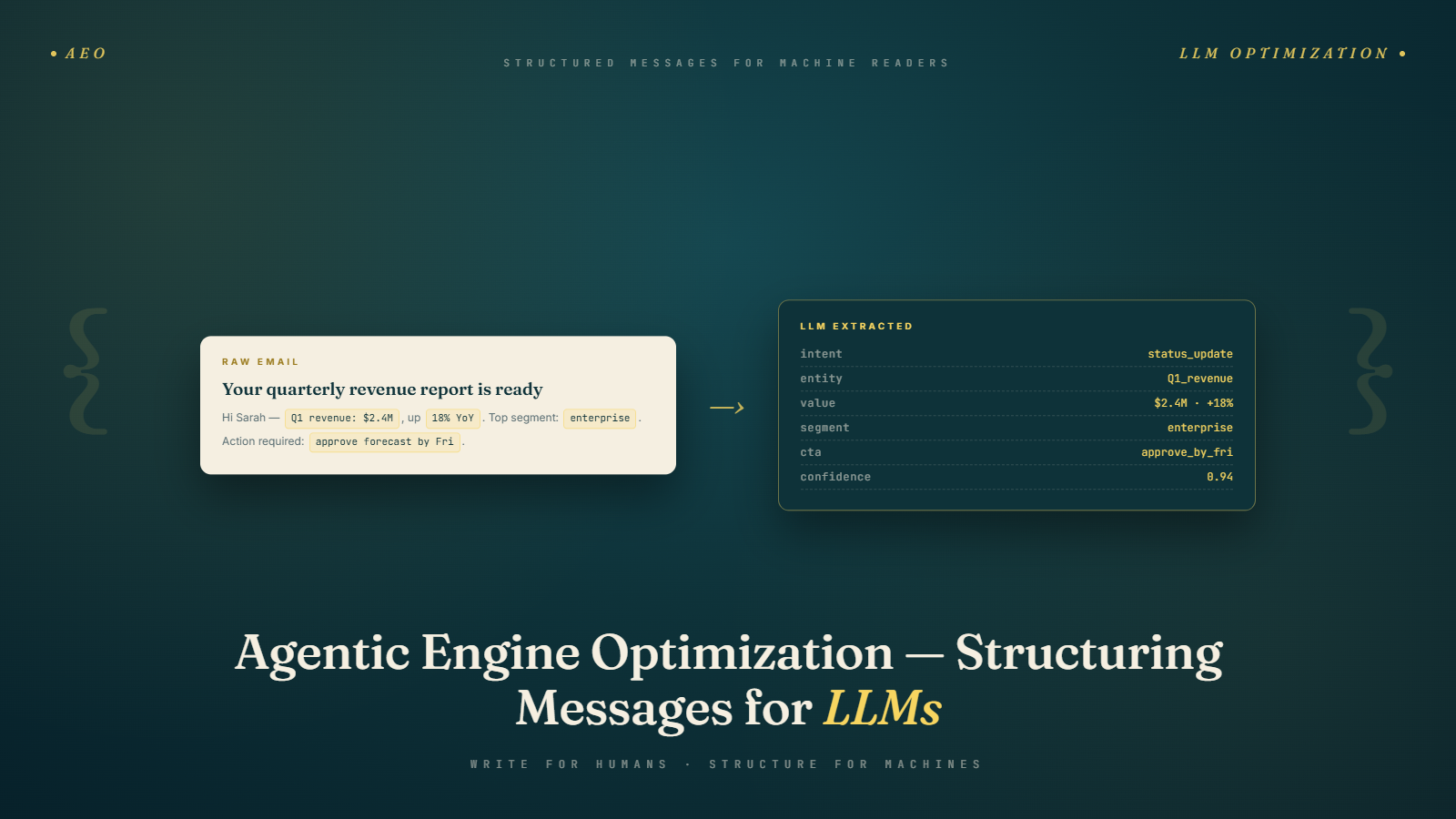
AEO is the practice of structuring your email content so that large language models and AI agents can extract the essential facts (dates, prices, product names, calls to action) without hallucination or ambiguity. The goal is not to write for robots. The goal is to write for humans in a way that also lets robots do their job correctly.
A helpful frame: picture every email being read twice. Once by your subscriber in whatever reading environment they choose, and once by a model summarizing, filing, or acting on it. If the model gets the facts wrong, the subscriber gets a bad experience regardless of how well you wrote the copy.
There are three specific places where AEO diverges from traditional email best practices, and they matter most.
Put the facts in text, not in images
For fifteen years, designers baked offer details into hero images. The 40 percent off banner, the end-of-sale date, the featured product name, all rendered as pixels. Humans processed this fine. Alt text was an afterthought if it existed at all.
This no longer works. Gemini and most inbox AIs do not OCR your hero image. They read the HTML and plain-text version. If the sale dates live only in the image, the summary will either skip them or, worse, invent plausible-sounding but wrong ones. I have seen summaries say things like "limited time offer" when the actual email says the sale ends Friday at midnight. That hurts conversion.
The fix is simple and unglamorous. Every material fact should appear in text in the email body. That includes the discount amount, the sale end date with year, the specific product or category, the shipping cutoff, and the coupon code. If you have a hero image with "40% off spring collection through April 22," mirror that information in a text block directly beneath it, written as a complete sentence a model can parse: "Our spring collection is 40 percent off through April 22, 2026."
This also helps your deliverability because image-heavy emails with little text remain a spam-filter red flag. We covered that in detail in our post on avoiding spam filters in 2026, and AEO makes the same principle more urgent.
Subject and preheader as an action pair
One shift I have made in my own campaigns, and started recommending to clients, is writing subject lines and preheaders as an action pair rather than two independent hooks. The subject states what the email is. The preheader states what the reader does with it.
Before AEO thinking: Subject "Our biggest sale of spring is here" with preheader "You will not want to miss this."
After AEO thinking: Subject "Spring sale: 30 percent off all dresses" with preheader "Use code SPRING30 at checkout, ends April 22."
The second version works better for humans because it respects their time. It works better for AI because every important entity is explicit: offer type, percentage, product category, code, deadline. A summary card in Gemini can pull that almost verbatim and represent your message accurately. We wrote more about the mechanics of this in our piece on subject line strategy for 2026.
The objection I hear is that this kills mystery and hurts curiosity-driven open rates. Two responses. First, curiosity gaps worked better when open rate was a reliable metric and we knew humans were seeing subjects in full. Neither condition holds anymore, as we explained in the death of open rate. Second, the subscribers who open curiosity emails and find thin content learn, and they unsubscribe faster. Specificity compounds trust.
Structured sections beat wall-of-text storytelling
I am not anti-story. A good brand narrative in email still moves product. But the structural container around that narrative should be legible to a model scanning for facts.
That means short sections with H2 or H3 headings that name what the section contains. "What is on sale," "How the promo code works," "Shipping cutoffs by region." It means putting the offer summary in its own block near the top, even if the story lives below. It means making your CTA a distinct line of text that starts with a verb, not a phrase buried inside a narrative paragraph.
A useful question when editing: if someone extracted only the headings and the first sentence under each heading, would they understand the offer? If yes, your structure is AEO-compliant. If they would be confused, tighten it.
This is not a template. Plenty of great emails break these rules and do fine. But if you send high-volume campaigns and care about how they surface in summaries, structure beats clever.
The machine-readable offer block
One tactic I have been testing with ecommerce clients: a small, visually subtle offer summary block near the top of the email, formatted like a mini-specifications list. Something like:
Sale: 30 percent off all dresses Code: SPRING30 Ends: April 22, 2026 at 11:59 PM Pacific Shipping cutoff: April 20 for standard
Rendered in a light background color with a bit of padding, it looks like a benefits bar and reads cleanly for a human skimmer. For a model extracting facts, it is ideal. Every entity is labeled, every value is unambiguous, nothing is hidden in image copy.
The first time I suggested this to a client, she pushed back. She thought it looked too utilitarian, too much like a shipping confirmation. We tested it against her usual editorial header. The AEO version kept overall conversion identical and improved accuracy of AI inbox summaries in spot checks. That is the trade I will take every time.
Structured data and JSON-LD for email
Gmail has supported schema.org markup in email for years, most visibly for things like flight confirmations, event invites, and order receipts. What has changed is that LLMs now treat this markup as a high-signal extraction source. If your transactional and promotional emails include JSON-LD for offers, events, or products, the AI reading them has a clean, unambiguous feed of your content.
Most ESPs support adding schema markup in the raw HTML or through templating. If you run a store on Shopify or a similar platform, your transactional emails likely already include some. Extending it to promotional sends is the next step. An Offer schema with validFrom, validThrough, price, and productName does more for summary accuracy than any other single change I have seen.
This will not be worth doing for every email you send. It is absolutely worth doing for your tentpole campaigns and any send where the offer details matter for the subscriber acting correctly.
AEO does not replace good writing
Here is where I part company with some of the loudest voices on this topic. I have read takes that essentially argue email copy should become pure structured data, because humans are a minority audience now and the models are the new gatekeepers. That is wrong, and it ignores how email actually works.
Subscribers still open the email. They still read at least the top of the message. Brand voice, narrative, and aesthetic still drive the emotional side of the conversion. If you strip all of that out chasing perfect AI parsing, you will beat the models and lose the humans.
The right approach is layered. Write great copy. Then audit it with one question: would an LLM extract the key facts correctly from this? If yes, ship it. If no, add structured elements (a facts block, explicit text for image content, clearer headings) without gutting the voice.
This is the same move good SEO writers made a decade ago. They kept writing for humans but layered in the signals Google needed. AEO is that same layering, for a different set of machines, with stakes that will grow quickly.
Naming entities the way a model expects
One small AEO habit that pays off: refer to products, events, and categories by their full, consistent name the first time they appear in the email, even if it sounds slightly awkward to a human reader.
If your subject line says "New drop," your body should still say "Our new spring 2026 loungewear collection" at least once before getting casual with shorthand. If you are promoting an event, write the full event name, date with year, and city or venue near the top. Models rely on these complete entity mentions to disambiguate.
I worked with a SaaS client who was running a webinar called "Office Hours." Their emails referenced it as Office Hours throughout, assuming subscribers knew what it meant. When I pasted their invite into three different AI assistants, two of them told me the email was about customer support hours at a store. The brand context was invisible. Adding "Our monthly product Q and A webinar, Office Hours" in the first paragraph solved it. Registration improved modestly. Summary accuracy improved a lot.
Consistency matters across the send, too. If you call it "the sale" in paragraph two and "our spring event" in paragraph four, a model may not connect the two. Pick one canonical name and stick with it. Human readers will not notice. AI readers will not get confused.
Plain-text parity deserves a revival
The plain-text alternative in multipart emails has been an afterthought at most ESPs for a decade. Many senders ship plain-text versions that are auto-generated from the HTML and effectively unreadable. A few skip it entirely.
Bring the plain-text version back into your workflow. Several AI inbox assistants, especially ones designed to summarize on mobile or low-bandwidth devices, prefer the plain-text part when it exists and when it parses cleanly. If your plain text is a mess of stripped tags and broken link text, the assistant either falls back to HTML parsing (usually fine) or produces a garbled summary.
A clean plain-text version is not hard to produce. Keep your offer block, your headings rendered as simple capitalized lines, your CTAs as explicit action phrases with the URL next to them. For a typical promotional email, the plain-text version should be 150 to 400 words. It does not need to match the HTML exactly. It needs to convey the same facts.
I treat plain-text parity as a marker of list hygiene, alongside verifying addresses with something like our guide on reducing bounce rate and keeping complaint rates under the threshold we wrote about in our post on the 0.10 percent spam complaint ceiling. It signals care. Models and humans both benefit.
The external agent problem no one is talking about
Most AEO conversation right now centers on Gemini and Apple Intelligence because those are the AI layers baked into major inbox clients. The bigger shift, the one most senders are not ready for, is the rise of external AI assistants that read mail on behalf of users.
I have three clients whose employees now use custom GPTs or Claude projects that pull in recent emails through IMAP or the Gmail API to triage, summarize, and draft replies. These agents are not made by Google or Apple. They are built by individuals or small teams, they vary wildly in quality, and they apply their own reading logic.
Two weeks ago I watched a founder ask her custom assistant to find all the B2B newsletters from the last month that mentioned pricing changes. The assistant returned a list. Half of it was wrong. One of the false positives was a newsletter whose author I know. His email mentioned a case study where a customer mentioned pricing. The agent flagged it as a pricing announcement and summarized it that way. The subscriber got a wrong signal about a vendor she was considering.
You cannot control every agent reading your email. You can write emails that are hard to misread. That is the AEO case in a nutshell. The senders who make their offers unambiguous, their entities explicit, and their structure clean will win the agent-read era. The senders who rely on context, tone, and image-based branding will keep getting misrepresented in ways they never see.
What this looks like on Monday
If you send weekly or more, pick your next campaign and do one pass with AEO in mind. Ask: does my subject plus preheader explicitly state what the email is and what the reader should do? Are my material facts (dates, prices, codes) in text, not just in images? Does my offer have a summary block near the top that a model could parse cleanly? Do my headings name what is in each section?
Do not try to fix every email at once. Pick the sends that matter most, the ones where a misunderstood summary costs you real revenue. Your promotional tentpoles, your product launches, your time-sensitive flash sales. That is where the gap between AI-legible and AI-confusing is most expensive.
The writers and marketers who will still be relevant three years from now are the ones who treat AI readers as a new accessibility layer rather than a threat. Better structure, clearer writing, more explicit facts. The subscribers who read your email directly will appreciate it. The ones reading it through a summary card will finally see your offer correctly. And the list you send it to, assuming you verified it first with a tool like Bulk Mail Verifier, will actually receive the message you meant to send.
Start with one campaign this week. Measure your own eyes on the AI summaries Gmail generates for your sends. If they match what you intended, you are already ahead of most of the market.