
A home goods retailer I worked with in late 2025 had a subscriber list of 340,000 people and a preference center that collected three things: first name, birthday, and product category interest. The product category interest field had not been updated by more than 2% of the list in the previous three years. The retailer assumed they had no zero-party data to work with. What they actually had was a preference center that nobody found a reason to use.
Six months later, after we rebuilt the preference collection flow, 38% of their active list had completed at least three preference signals, and their promotional email revenue per subscriber was up 23%. The list did not change. The collection approach did. That is the gap that most email programs are leaving on the table in the zero-party data conversation.
What Zero-Party Data Actually Is (And What It Is Not)
Zero-party data is information that subscribers consciously and intentionally give you. Preferences they set. Answers to questions you asked. Content selections they made. It is distinct from first-party data (behavioral data you observe on your own properties) and from third-party data (data purchased from external providers).
The distinction matters because the three categories have different decay rates, different accuracy profiles, and different regulatory exposures. Third-party data is dying, both because of cookie deprecation and because the regulatory environment has made it increasingly risky. First-party data is durable but noisy: a subscriber who clicked on a running shoe product once may or may not be a runner. Zero-party data is durable and precise, because the subscriber told you directly.
The trade-off is that zero-party data requires subscribers to do something. They have to fill in a form, answer a question, update a preference, or make a selection. That is the obstacle that most programs never solve, because they treat zero-party data collection as a one-time preference center setup rather than as a continuous subscriber conversation.
The 60-Second Framework
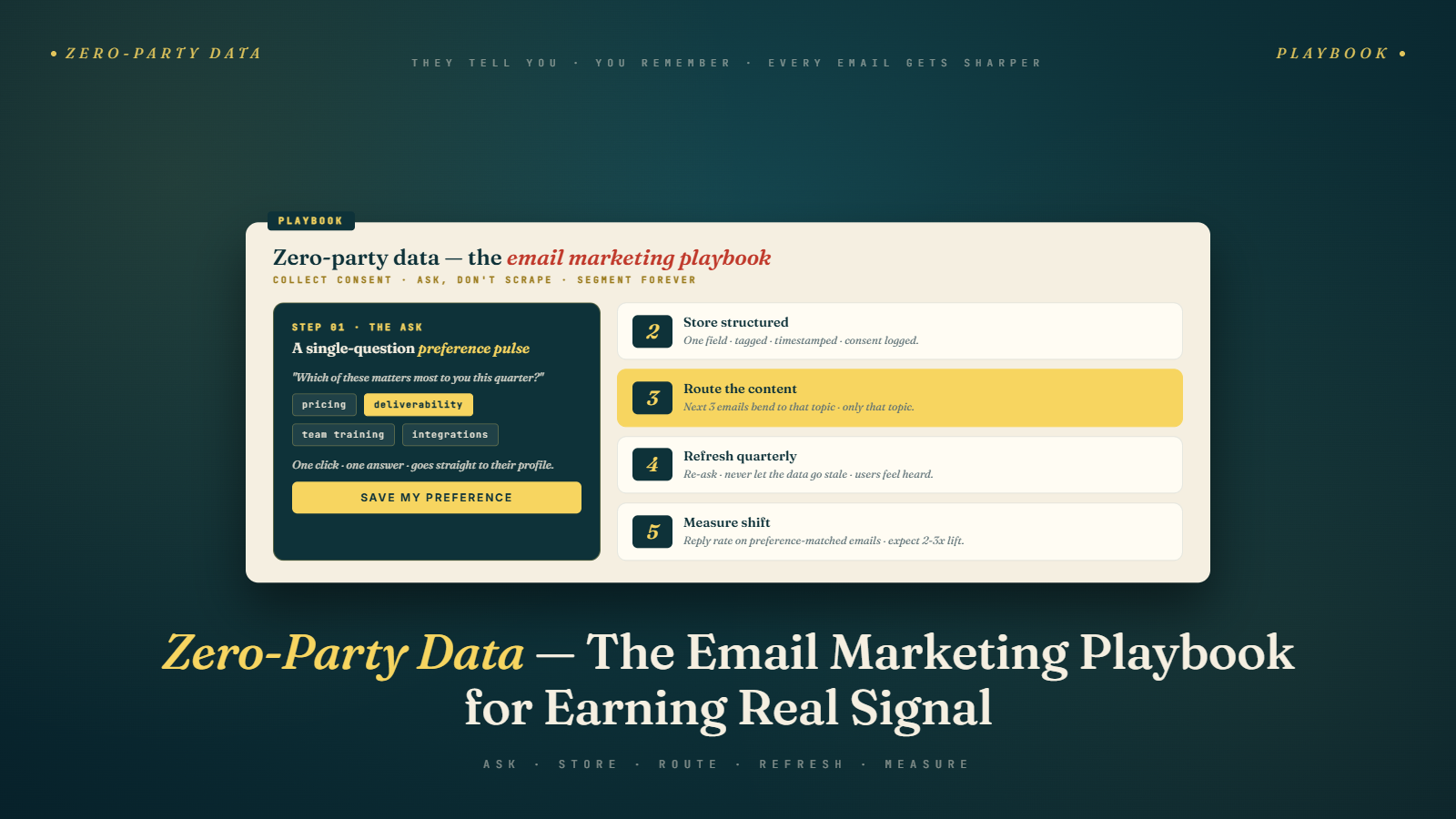
Collect zero-party data through small, frequent asks tied to specific value exchanges, not through comprehensive preference centers that sit unused. Ask one question per email or landing page. Use the answer immediately to personalize the next interaction, so subscribers see their input reflected. Store the data in a format your ESP can actually use for segmentation. Update it regularly by re-asking, because preferences change and the data decays faster than you think. A program that does this well replaces inferred personalization with stated preferences within six months.
That is 87 words and it is the operating framework. The rest of this post gets into where each piece goes wrong and how to build collection that subscribers will actually complete.
Why the Classic Preference Center Fails
The default preference center design, which I still see in 2026, looks like this: a subscriber clicks a link in an email footer, lands on a page with 15 to 30 checkboxes and dropdowns, and is asked to configure their email frequency, content topics, product categories, format preferences, and sometimes more. The page is comprehensive, well-designed, and ignored.
The reason it fails is not design quality. It is cognitive load. A subscriber clicks the preference center link because they have a specific intent: "I want less email" or "I want to change my category." When they land on a page with 20 other decisions to make, they either bail entirely or complete only the one thing they came for. The rest of the form remains blank.
Completion data I have pulled from client programs backs this up consistently. A preference center with 15+ fields typically sees full completion rates under 5%. Subscribers fill in the field they care about and leave. That is not a failure of subscriber motivation. It is a failure of the interaction design.
The fix is to stop thinking about preference centers as a one-page comprehensive collection tool and start thinking about them as a distributed system. A field here, a field there, triggered by context, completed in thirty seconds each. The same subscriber who would not complete a 15-field form will happily answer one specific question if it shows up at the right moment.
Progressive Profiling That Actually Gets Completed
Progressive profiling is the term for collecting data across multiple interactions rather than all at once. The concept is old. The execution in most programs is still bad.
Here is what progressive profiling looks like when it works. A subscriber signs up with just an email address. Their welcome email asks one question: "What brought you here today?" with four choices rendered as clickable buttons. The click records the answer without requiring a form submission. The next email acknowledges the answer and asks a second question tied to it. The third email uses the first two answers to shape its offer, so the subscriber can see that their input is doing something.
That sequence collects three zero-party data points in the first week of subscription with completion rates that typically run 40 to 60% on each ask. Compare that with a single welcome email that links to a 10-field preference center: completion rate on the comprehensive form is usually under 8%.
The mechanical details that make progressive profiling work:
Each ask is a single question. Not a form, not a page of choices, just one thing at a time.
The answer is captured through a click or a single-field input, not a multi-field form. A click on a button in an email can carry the answer as a URL parameter that the landing page records before redirecting the subscriber to a thank-you state.
The sequence is spaced out. Asking every email feels like an interrogation. Asking in one out of three or four emails feels like natural conversation.
The answers are used visibly. The subscriber sees personalization based on their previous answers, which creates a positive feedback loop where they perceive the value of answering future questions.
The Value Exchange That Makes Subscribers Answer
Subscribers do not share preferences because you asked nicely. They share preferences because they get something in return. That exchange is either explicit (a discount for completing a profile field) or implicit (better content tailored to their stated interests).
Explicit value exchanges work for specific high-friction data points. A 10% discount for completing three profile fields converts at meaningfully higher rates than an ask with no incentive. The downside is that subscribers who complete the profile for the discount may not engage with the personalization afterward. The data is accurate but the subscriber may be a promotion chaser rather than a high-value segment.
Implicit value exchanges work for ongoing preference collection. A subscriber who gave you a content topic preference and sees relevant content in their next email will update their preferences when you ask again in three months, because they perceive the system as working. A subscriber who gave you a preference and saw no change in their email stream will not bother answering again.
The teams that get this right treat the first few post-preference emails as demonstrations of value. They specifically call out, in subtle ways, that the content was selected based on the subscriber's input. Not in a creepy surveillance voice (see the consumer backlash against AI-narrated personalization for why narration is a problem). Just through the content itself clearly reflecting the stated preference.
What to Ask, In What Order
Not all zero-party data fields are equally valuable. Programs that try to collect everything end up collecting nothing. The prioritization that works for most consumer programs:
Start with intent. What is the subscriber actually trying to do? Shopping for themselves, shopping for a gift, researching for later, staying informed about the category. That single data point can inform the entire next month of content selection.
Follow with frequency. How often does the subscriber want to hear from you? Weekly, every other week, monthly, only big launches. This is the single most underused field in email marketing. Subscribers who are asked their frequency preference and actually see it honored unsubscribe at dramatically lower rates.
Then content type or category. What are they interested in? Be specific: not "fashion" but "women's activewear" or "home cooking tools." The narrower the categories, the more useful the segmentation.
Then context markers: relationship stage (new subscriber, loyal customer, lapsed), price sensitivity, or use case specifics depending on your category.
Demographics last, if at all. Age, location beyond the postal code you already have, income. These feel intrusive to ask directly and are often inferable from purchase behavior. Only collect them if you have a specific use that the subscriber can see reflected in their experience.
The common mistake is to start with demographics because they feel like the fundamental data. They are actually the least useful for near-term email personalization. Intent and frequency are worth ten times the demographic fields.
How Often to Re-Ask
Zero-party data decays. A subscriber's stated preferences at signup are less representative of their current interests two years later. How much less depends on the category, but for most consumer programs, preferences are meaningfully stale after 12 to 18 months.
The mistake is treating zero-party data as permanent. A subscriber who checked the "women's activewear" box in 2023 may be pregnant, postpartum, or simply uninterested in activewear by 2026. Using their old preference as the basis for personalization produces increasingly irrelevant content, which increases unsubscribe rate among exactly the subscribers your personalization was supposed to serve better.
The rhythm that tends to work: re-ask core preferences every 9 to 12 months. Not in a comprehensive re-profile, but in the same one-question-at-a-time pattern you used to collect them originally. A subscriber who answered "women's activewear" in 2023 gets a quiet re-confirmation in 2024: "Are you still looking for women's activewear, or has that changed?" with a single-click update button.
The re-ask serves a second purpose beyond data freshness: it reminds subscribers that you remember what they told you. That is a small, accumulating trust signal that compounds over time.
Storing Data You Can Actually Use
The gap between collecting zero-party data and using it is where many programs stall. The data gets collected into a field your ESP cannot segment on, or into a CRM that does not sync to your ESP in useful ways, or into a database that your marketing team cannot query.
The useful test: can the marketing team, without involving engineering, build a segment based on any zero-party data field within 10 minutes? If yes, the storage is functional. If no, the data might as well not exist for practical email marketing purposes.
What this looks like in practice: dedicated custom fields in your ESP for each zero-party preference. Clean, consistent naming conventions. Values that match a defined set (not free text that ends up with 47 different spellings of the same thing). Regular audits to identify fields that are 90%+ empty because the collection flow never shipped.
If you are using a CDP or marketing automation platform that feeds your ESP, the sync integrity matters. Preferences collected in the CDP that do not flow to the ESP within a reasonable window (hours, not days) create a lag between subscriber input and personalized experience that erodes the value exchange.
The Privacy and Consent Architecture
Zero-party data is by definition consented data, which is one of its advantages over first-party or third-party alternatives. But consent is not a checkbox, it is a continuous relationship. Subscribers need to be able to see, edit, and delete their stated preferences on demand.
Under GDPR, CCPA, and the state-level privacy laws that expanded through 2024 and 2025, data subjects have the right to access and delete personal data. Zero-party data is personal data. Your preference center needs to surface current values, let subscribers change them, and process deletion requests without requiring a support ticket.
The compliance baseline also overlaps with good subscriber experience. A preference center that shows subscribers what the brand knows about them and gives them real control over it is, incidentally, the same kind of preference center that generates ongoing engagement and preference updates. Transparency and completion rate are aligned, not at odds.
Compliance with the 48-hour unsubscribe rule sets the floor for preference control in email. Zero-party data management is the next layer above that floor.
Pairing Zero-Party Data With Behavioral Signals
Zero-party data is precise but not exhaustive. A subscriber tells you they are interested in men's footwear, but their click behavior tells you they have been consistently engaging with summer apparel emails for three months. Neither signal on its own tells the full story. Together they do.
The programs doing this well treat zero-party data as the primary targeting axis and first-party behavioral data as the refinement layer. The subscriber's stated preferences define the broad content zones. Their behavior within those zones fine-tunes offer selection and send timing.
The inverse pattern, using behavior as the primary signal and ignoring stated preferences, is what produces the surveillance-feeling personalization that backlash surveys keep flagging. A subscriber who told you "don't send me promotional emails more than once a week" and then gets three promotional emails because their behavior looked active experiences the program as disrespectful. Their explicit consent should win over the inferred engagement signal every time.
Connecting Zero-Party Data to List Health
Subscribers who engage with preference collection are, as a class, your highest-value segment. They are subscribers who bothered to tell you what they want. That act of engagement itself is a signal that they plan to keep a relationship with the brand.
Programs that track zero-party data engagement alongside traditional engagement metrics get a clearer picture of list health. A subscriber who has not opened an email in three months but updated their preferences last month is not a dead subscriber. A subscriber who opened every email but ignored every preference ask for a year is less valuable than their open rate suggests, because they are engaging passively rather than actively.
This refines how re-engagement campaigns target, and it refines how sunset policies work. A lapsed subscriber who updates their preferences in response to a re-engagement email is a subscriber worth keeping. One who ignores both the emails and the preference prompts is a subscriber to sunset. Pair this with list hygiene by running your lapsed segment through email verification before any re-engagement send, so you are only asking addresses that will actually deliver. Bulk Mail Verifier handles the verification side while the preference data shapes which segments even merit a re-engagement attempt.
What to Do This Quarter
Three changes to run in the next 90 days, in the order that compounds best.
Look at your current preference center and count the fields. If there are more than five, pick the two most valuable ones and strip the rest out of the primary flow. The rest can still exist on an "advanced preferences" page for the subscribers who want them.
Add one zero-party data question to your welcome sequence. One question, single-click answer, with the answer visibly reflected in the next email. This alone typically generates more usable zero-party data in a month than a redesigned preference center generates in a year.
Schedule a preference re-ask for subscribers who set their preferences more than 12 months ago. Treat it as a light-touch single-question interaction, not a re-profiling campaign.
Pair this with the broader Gemini-era inbox strategy covered in the Gmail Gemini overview for marketers, because zero-party data feeds personalization that shows up in AI summary cards and relevance scoring. The subscribers who told you what they wanted are the subscribers whose Gemini summaries will show your emails most prominently.
Start with one of those three. Zero-party data is not a project to finish. It is a continuous collection rhythm to build. The programs that start this quarter will have durable advantages that compound every month the competitive programs keep relying on decaying inferred data instead.