
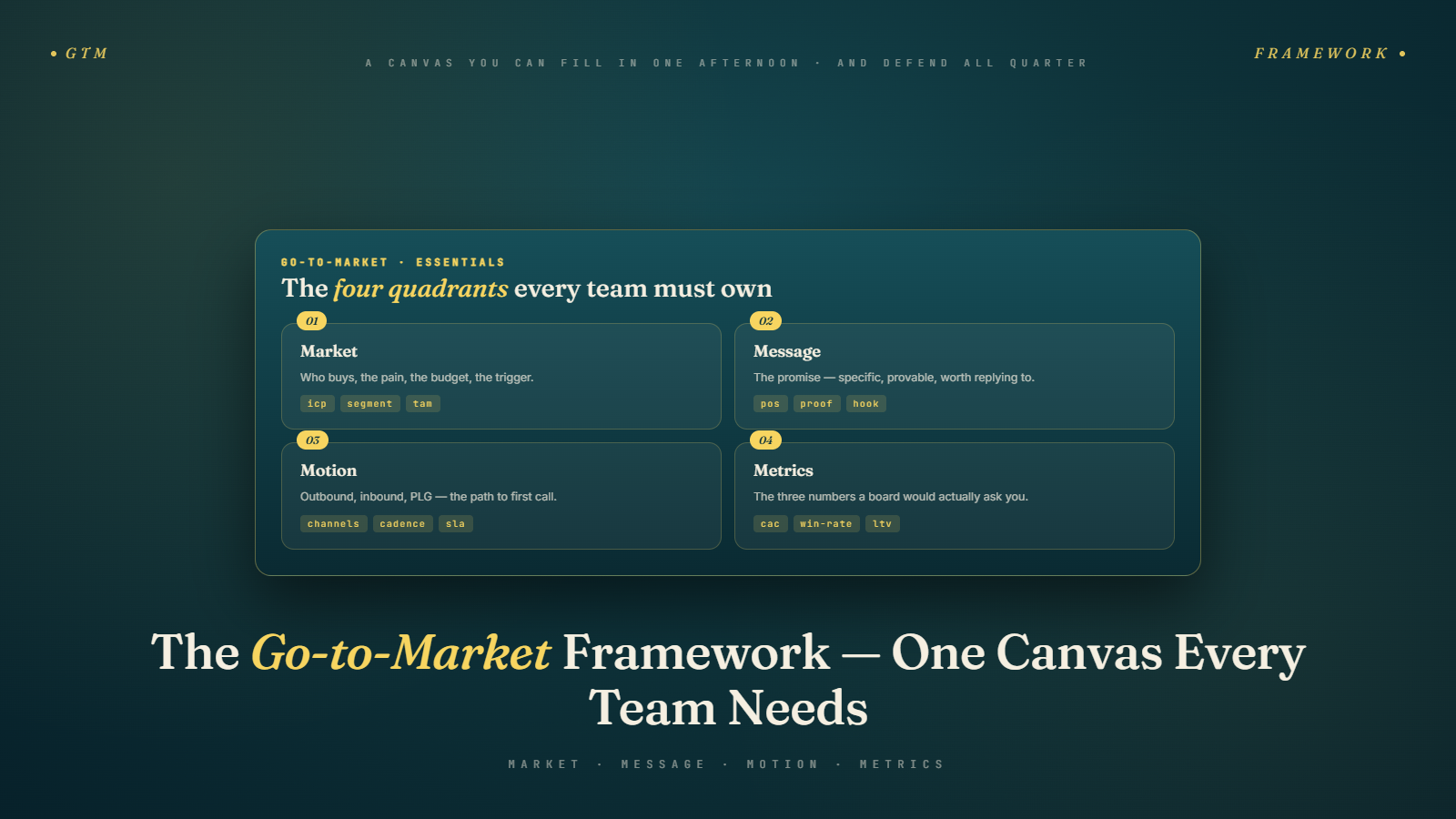
Launching a product without a go-to-market strategy is like navigating without a map — you might eventually arrive, but you'll waste time, money, and momentum along the way. According to Highspot, companies with a strong GTM strategy are 60% more likely to hit their revenue goals within the first year of a product launch.
Whether you're a B2B SaaS startup shipping your first feature set or an established company entering a new market, a well-structured go-to-market (GTM) plan is non-negotiable. This guide breaks down the essential GTM framework — and shows how email marketing fits into every stage.
What Is a Go-to-Market Strategy?
A go-to-market strategy is a step-by-step plan that defines how you'll bring a product or service to market, reach your target customers, and generate sustainable revenue. It aligns your sales, marketing, and product teams around a shared set of goals, channels, and messaging.
A GTM strategy is not a one-time launch checklist. It's an ongoing framework that guides everything from your positioning and pricing to your outreach campaigns and post-launch retention programs.
GTM vs. Marketing Strategy: What's the Difference?
A marketing strategy covers your long-term brand and demand generation approach. A GTM plan is more specific — it's scoped to a particular product launch, new market entry, or growth initiative, with defined timelines, channels, and success metrics.
Think of your marketing strategy as the engine and your GTM strategy as the gear you select for each specific race.
The 7-Component GTM Framework
1. Define Your Ideal Customer Profile (ICP)
Before writing a single line of copy or sending a single email, you need to know exactly who you're selling to. Your Ideal Customer Profile (ICP) defines the type of company or person most likely to buy your product, retain it, and refer others to it.
For B2B teams, a strong ICP goes beyond job title and company size. It incorporates:
- Firmographics: Industry, revenue range, employee count, geography
- Technographics: Tools and platforms they already use
- Behavioral signals: Intent data, content consumption patterns, recent funding rounds
- Pain points: The specific problem your product solves for them
In 2026, the most effective GTM teams build dynamic ICPs that update based on real usage data and engagement signals — not static spreadsheets built at launch and never revisited.
Pro tip: Your ICP directly shapes your email outreach. When you know exactly who you're targeting, you can build a highly targeted B2B email list and personalize every touchpoint.
2. Nail Your Positioning and Messaging
Positioning defines where your product sits in the market relative to competitors. Messaging translates that positioning into language your buyers actually use.
Your GTM messaging should answer three questions clearly:
- Who is this for? (ICP)
- What problem does it solve? (pain point)
- Why is this the best solution? (differentiated value)
Great GTM messaging doesn't just describe features — it speaks directly to outcomes. Instead of "Our tool verifies emails in bulk," the message becomes: "Stop wasting budget on bounced emails. Verify your entire list before every send."
Invest time here. Messaging informed by real customer interviews outperforms messaging written in a vacuum — every time.
3. Choose Your GTM Motion
Not every product goes to market the same way. Your GTM motion defines how you'll acquire and close customers. The three primary models are:
Product-Led Growth (PLG)
The product itself drives acquisition. Users sign up, experience value, and convert — often without ever speaking to a salesperson. Best for products with ACVs under $5,000 and a frictionless onboarding experience.
Sales-Led Growth
A sales team drives pipeline and closes deals. Standard for enterprise products with ACVs above $50,000 where buyers expect human interaction, custom demos, and negotiated pricing.
Hybrid GTM
A combination of PLG and sales-led. The free tier or trial attracts users at scale, while a sales team intercepts and closes high-value accounts. This is the dominant model for mid-market B2B SaaS in 2026, with companies reporting 30–50% lower customer acquisition costs compared to purely sales-led approaches.
Choose the motion that fits your price point, buyer journey, and team capacity.
4. Map Out Your Channel Mix
With your ICP and motion defined, decide where you'll actually reach buyers. Spreading your team across every channel dilutes effort and produces mediocre results everywhere. The winning teams in 2026 focus on two to three channels and execute them exceptionally well.
Common GTM channels for B2B SaaS:
| Channel | Best For | Time to Results |
|---|---|---|
| Email outreach | Direct pipeline, high intent | 2–6 weeks |
| Content marketing | SEO-driven inbound | 6–12 months |
| Paid search/social | Fast top-of-funnel volume | Immediate |
| Partner / co-marketing | New audience access | 3–6 months |
| Product-led virality | Organic word-of-mouth | Ongoing |
Email marketing deserves special mention. It remains one of the highest-ROI GTM channels — both for cold outreach to new prospects and for nurturing leads already in your funnel. The catch: email only performs when your list is clean. Sending to invalid or stale addresses kills your sender reputation and tanks deliverability before your campaign ever gets off the ground.
Before every email campaign in your GTM launch, verify your list with a bulk email verification tool. Deliverability directly impacts your ability to generate pipeline — don't ignore it.
5. Build Your Sales Enablement Assets
Your sales team can't close deals without the right materials. Your GTM plan should include a complete set of launch assets:
- One-pager for each buyer persona
- Pitch deck (10–12 slides)
- Product demo (3–5 minute video)
- Competitive battle cards
- Objection-handling guide
- Email outreach templates for each stage of the funnel
The most overlooked asset? Email sequences. Map out a multi-touch outreach sequence for cold prospects, another for warm leads who've engaged with content, and a post-demo follow-up series. Each sequence should be tailored to your ICP and reflect the messaging you developed in step two.
6. Align Teams with Shared Metrics (RevOps)
The most common GTM failure mode isn't a bad product — it's misaligned teams. Marketing optimizes for MQL volume. Sales wants SQLs that close fast. Customer success focuses on renewals. Without a shared definition of success, everyone is working hard in different directions.
High-performing GTM teams solve this with RevOps: a function (or mindset) that aligns marketing, sales, and customer success around shared revenue metrics, integrated data, and consistent processes.
Key shared metrics for a unified GTM launch:
- Net New ARR generated per month
- Customer Acquisition Cost (CAC) and CAC payback period
- Lead-to-close conversion rate at each funnel stage
- Net Revenue Retention (NRR) — aim for 110%+
- First-month churn rate
Establish these metrics before launch and review them weekly as a cross-functional team. Vanity metrics like open rates and page views feel productive but rarely translate to revenue.
7. Build Your Launch Timeline
A GTM plan without a timeline is just a wish list. Work backward from your launch date:
T-90 days: Finalize ICP, positioning, and messaging. Begin content production.
T-60 days: Complete sales enablement assets. Train your sales and CS teams on the new messaging. Set up your CRM sequences and email warming campaigns if launching new sending domains.
T-30 days: Activate PR outreach. Begin warm email campaigns to existing lists. Launch teaser content. Verify all email lists to protect deliverability.
T-7 days: Conduct a launch readiness review. Confirm all teams are aligned, assets are live, and tracking is in place.
Launch day: Execute simultaneously across all channels. Monitor metrics in real time.
T+30 days: Post-launch review. What worked? What didn't? Where is the funnel leaking? Iterate.
The Role of Email in Your GTM Strategy
Email is not just one channel in your GTM plan — it's the thread that runs through all of them. It's how you:
- Warm up cold prospects before your SDRs make contact
- Nurture leads who download content but aren't ready to buy
- Convert free users into paying customers with targeted upgrade sequences
- Re-engage churned or inactive accounts post-launch
But email only works at scale if your list is healthy. A list with a 15% bounce rate will get your sending domain flagged, your emails routed to spam, and your GTM launch derailed before it begins.
The fix is simple: verify your email list before every major send. Tools like BulkMailVerifier let you upload your entire list, identify invalid addresses, catch catch-all and risky emails, and remove anything that would harm your sender reputation. This directly translates to better deliverability and more revenue from your email campaigns.
Common GTM Mistakes to Avoid
Even well-funded teams stumble on the same avoidable errors:
Skipping ICP validation. Building messaging and campaigns before talking to real customers guarantees misalignment. Run at least 10 customer discovery interviews before finalizing your GTM plan.
Treating the launch as the finish line. Launch day is the starting gun, not the victory lap. The real work — iteration, optimization, and retention — begins after you ship.
Ignoring list hygiene. Sending to unverified or purchased email lists is one of the fastest ways to destroy sender reputation and land in the spam folder. Always verify before you send.
Misaligned teams. If marketing and sales aren't sharing metrics and meeting weekly, your GTM motion will break down at the handoff. RevOps alignment is not optional.
Over-engineering the channel mix. Trying to be everywhere at once spreads your team too thin. Pick your two best channels and master them before expanding.
Measuring GTM Success
Your GTM strategy is only as good as your ability to measure and improve it. Beyond the vanity metrics, track these leading indicators:
- Pipeline coverage ratio: Is there enough qualified pipeline to hit your revenue target?
- Time to first value (TTFV): How quickly do new customers experience the core benefit of your product?
- CAC payback period: How many months of revenue does it take to recover acquisition costs? Best-in-class SaaS teams hit 80 days or fewer.
- Email engagement rate: Open rates, click-through rates, and reply rates on outbound sequences tell you whether your messaging resonates.
Review these metrics weekly and run structured post-mortems monthly. GTM is a continuous process of hypothesis, test, and iteration — not a set-and-forget plan.
Conclusion
A go-to-market strategy is the difference between a product that finds its audience and one that launches into silence. The framework is straightforward: define your ICP, nail your messaging, choose the right motion, select your channels, arm your team, align on metrics, and execute against a timeline.
Email runs through every stage. From pre-launch warming campaigns and cold outreach sequences to post-launch nurture and retention flows, email is your GTM workhorse. Protect it by keeping your lists clean and your sender reputation strong.
Ready to launch? Start by verifying your email list at BulkMailVerifier.com — so that when your GTM engine fires, every message lands in the inbox it deserves.