
Beyond the Basics
Most cold email advice covers the same ground: define your ICP, clean your list, warm up your domains, personalize your subject lines, write a tight value proposition, follow up five times. If you've been through the full series from Phase 2 to Phase 6, you have all of that already.
What that advice doesn't cover is what separates programs generating 1–2% reply rates from programs generating 8–12%. The gap exists, and it's real. The teams and agencies at the top end of cold email performance aren't just doing the basics better. They're doing specific things that most practitioners haven't learned, systematized, or applied consistently.
This article covers those things — the advanced strategies that experienced cold email agencies and high-performing in-house teams use to generate outsized results. None of these require exotic tools or unlimited budgets. They require sharper thinking about targeting, signal identification, copy architecture, and operational discipline.
Strategy 1: Trigger Stacking
Basic cold email personalization uses a single trigger — a LinkedIn post, a funding round, a job posting. Advanced practitioners go further with trigger stacking: identifying multiple overlapping signals that collectively indicate a prospect is in the highest-readiness window for your specific offer.
The logic: a single trigger tells you someone might be relevant. Multiple triggers firing simultaneously tells you they're probably in market right now.
Example — SaaS company selling sales training:
A single trigger approach might target "companies hiring SDRs." That's fine but broad.
A trigger stacking approach targets companies that:
- Are hiring 3+ SDRs right now (job postings)
- Raised a Series A or B in the last 6 months (Crunchbase)
- Don't have an internal Sales Enablement function listed on their team page
- Have a VP of Sales who has been in seat less than 12 months (LinkedIn)
Each of these signals is available publicly. Together, they describe a company that has recently raised capital, is building out an SDR team, lacks internal training resources, and has a new sales leader who likely wants to put their stamp on the process early. That's not a company that might need your product someday — it's a company that almost certainly has this problem right now.
Trigger stacking dramatically improves the relevance of outreach without requiring more personalization per email. The research is harder, but the list is smaller and the reply rates are materially higher.
The tools for trigger stacking at scale: Clay workflows can pull from Crunchbase (funding), LinkedIn (headcount, job postings, recent hires), BuiltWith (tech stack changes), and company news scrapers simultaneously, enriching each contact with multiple signals in one pass. What used to require hours of manual research per company can be reduced to minutes per batch.
Strategy 2: Micro-Segmentation by Problem Stage
Standard segmentation divides a list by industry, company size, or seniority. Micro-segmentation goes a level deeper: it divides by where the prospect is in their awareness or problem-maturity journey.
The insight driving this strategy: prospects at different stages of problem awareness need completely different messages. A prospect who doesn't know they have the problem needs a very different email than a prospect who is actively evaluating solutions.
The four awareness stages and how they map to cold email copy:
Stage 1 — Problem Unaware. The prospect has the problem but doesn't recognize it as such or hasn't prioritized it. The cold email should surface the problem in a way that creates recognition. Lead with a pattern observation: "Most Series B SaaS companies we talk to don't realize their deliverability has been quietly degrading until opens on their warm campaigns start dropping..."
Stage 2 — Problem Aware, Solution Unaware. They know the problem exists and hurts but haven't looked for a solution. The email should validate their pain, demonstrate you understand it deeply, and introduce the possibility that a solution exists: "Teams dealing with this typically assume it's just the nature of cold email — it's not. There are specific infrastructure changes that fix 80% of the problem."
Stage 3 — Solution Aware, Vendor Unaware. They know solutions exist and may be in early evaluation. The email should position your solution specifically against the category: "Most teams in this position default to [common approach] — here's where that tends to fall short and what we do differently."
Stage 4 — Vendor Aware. They know your company name or have been exposed to your brand. The email should be almost completely different — shorter, reference the prior awareness, and ask directly about their current situation.
Identifying which stage a prospect is in requires additional research signals: whether they've published content about the problem, whether they follow competitors or category thought leaders on LinkedIn, whether their company has recently made a hire in a relevant function (which indicates active evaluation). This level of segmentation is operationally intensive but produces significantly better reply rates because the message matches exactly where the prospect is mentally.
Strategy 3: Multi-Threading — Reaching the Full Buying Group
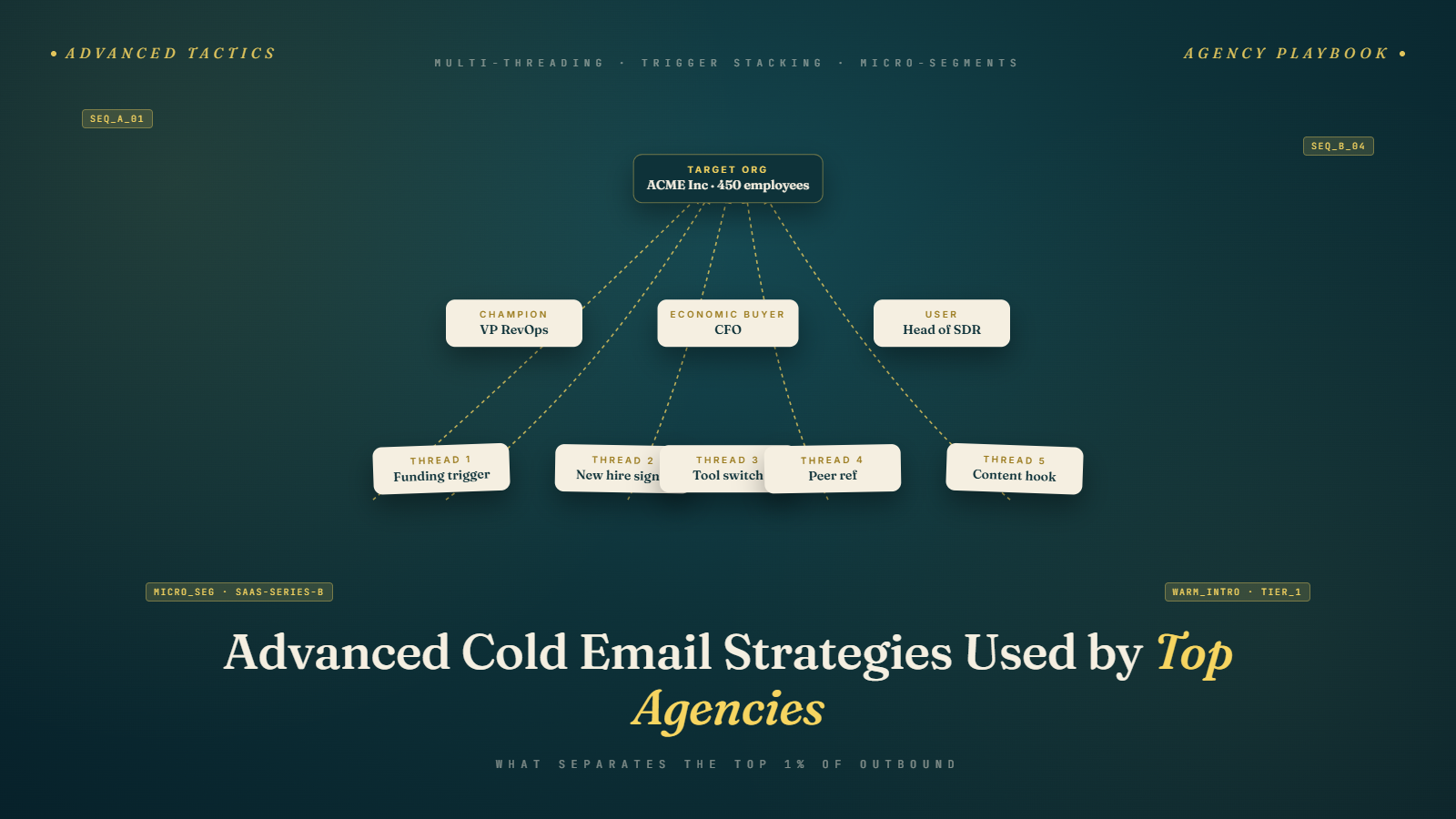
Most cold email targets one person per account: typically the economic buyer or the most senior relevant title. Advanced practitioners multi-thread: they reach multiple stakeholders within the same account simultaneously or in sequence, creating organizational momentum that a single-thread approach can't generate.
The logic is simple. B2B buying decisions, especially above a certain deal size, are rarely made by one person. Gartner data consistently shows that the average B2B purchase involves 6–10 stakeholders. Reaching only one of them and hoping that person can drive internal alignment alone is leaving most of your leverage on the table.
How multi-threading works in practice:
Simultaneous threading: Reach multiple stakeholders at the target account at the same time with different, complementary messages tailored to each role's specific concerns. The VP of Sales cares about revenue impact. The VP of Ops cares about efficiency and integration. The CFO cares about ROI and cost. Each receives a message that speaks to their specific angle on the same problem.
The risk: if the messages aren't carefully coordinated, they can create confusion ("why did three people from this company contact three of us?") or appear disorganized. Simultaneous threading works best when the messages are clearly role-differentiated and the company is large enough that stakeholders don't immediately cross-compare inboxes.
Sequential threading: Start with one stakeholder, use that conversation to identify others, and warm-approach subsequent stakeholders with a reference to the initial conversation. "I've been in conversation with [name] about [topic] — they suggested it might be worth including you in the discussion." This is the more common and usually safer approach.
Top-down threading: Start with the most senior stakeholder. If you get a reply, the conversation has organizational gravity behind it. If you don't, follow with a message to a lower-level champion who can build the case internally and potentially pull in the senior stakeholder later.
The targeting foundation for multi-threading is account-level research — identifying all relevant stakeholders at a target account before any outreach begins. Tools like LinkedIn Sales Navigator's account view make this relatively efficient at scale.
Strategy 4: The Breakup Email as Conversion Tool
Most practitioners treat the breakup email as a closing formality — a polite way to end a sequence. Advanced practitioners treat it as a conversion mechanism designed to trigger replies from prospects who stayed quiet through every previous touch.
The psychology: throughout a sequence, every email is asking the prospect to engage while implicitly assuming a continued relationship. The breakup email removes that pressure entirely by explicitly closing the loop. For prospects who were mildly interested but not interested enough to act, the removal of pressure suddenly makes replying feel easy. There's no commitment implied — they can respond without worrying that it will start a sales process.
The advanced breakup email has three specific structural elements beyond a standard close:
1. Genuine specificity. The breakup email should reference something specific about this prospect or their company — not a generic placeholder. "Good luck with [specific initiative they're working on]" lands differently than "Good luck with everything." The specificity proves the outreach was genuine, not automated.
2. A clearly easy re-entry path. "If the situation ever changes, my direct email is [address] and I'm easy to reach." Make re-engagement feel like a two-second action, not a process.
3. The permission frame. "I don't want to keep taking up space in your inbox if the timing isn't right." Explicitly acknowledging their right to not engage — without bitterness — is paradoxically one of the most effective ways to generate a response.
Top agencies often see their breakup email perform as well as their first email in raw response rate. The prospects who respond to breakup emails are also often higher-quality than average — they've spent several weeks with your sequence in their inbox, which means they have more context and have likely done some quiet evaluation already.
Strategy 5: Channel Sequencing — Email as One Layer of a Multichannel Play
Cold email works well. Cold email as one coordinated layer of a multichannel outreach approach works significantly better — when the channels are sequenced thoughtfully rather than blasted simultaneously.
The mistake most teams make with multichannel: treating it as doing the same thing on multiple platforms at the same time. Sending the same pitch via email, LinkedIn DM, and cold call on day one isn't multichannel — it's multi-harassment.
The advanced approach treats each channel as having a specific role in a coordinated sequence:
Phase 1 — Awareness (Day 1–3): Connect on LinkedIn without a pitch note. Like or genuinely comment on one of their recent posts. The goal is to be a name they've seen before the email arrives.
Phase 2 — Email outreach (Day 4–5): Cold email lands with a reference to the LinkedIn connection. "I connected with you on LinkedIn earlier this week — reached out because..." The LinkedIn activity provides social proof that you're a real person and have taken the time to understand their work.
Phase 3 — LinkedIn follow-up (Day 10–12): A LinkedIn DM that's shorter and more conversational than the email, references that you've been in touch via email, and offers a slightly different angle. LinkedIn DMs have a different psychological weight than email — they feel more personal and less automated.
Phase 4 — Email continuation (Day 14–20): Standard sequence follow-ups, now with the LinkedIn interaction as social context.
Phase 5 — Voice touchpoint for high-value targets only (Day 21+): A brief, non-pushy voicemail or cold call for prospects who've opened multiple emails but not replied. "I've sent you a few notes over the past few weeks — just wanted to put a voice to the name. Happy to chat if any of it resonated."
The sequencing matters as much as the channels themselves. Each touch adds context to the previous one, rather than repeating the same ask via different mediums.
Strategy 6: The Account-Based Warm-Up
For the highest-priority target accounts — the ones where a single closed deal would materially change your business — leading with cold email is often the wrong move. Advanced practitioners do account-level warming before cold email enters the picture.
Account-based warm-up is the practice of creating multiple positive touchpoints with a target account before any direct outreach, so that when the email arrives, it lands as a slightly warm contact rather than a completely cold one.
Tactics:
Content engagement: Comment substantively on LinkedIn posts from target account employees. Not "Great insight!" — a specific observation that adds to the conversation. Do this for 2–4 weeks before emailing.
Referral signals: If you have any mutual connection with anyone at the target account, a warm introduction from that person — even a brief LinkedIn message saying "you two should meet" — is worth more than 10 cold emails.
Content distribution: If the prospect publishes content, share it in relevant communities where you're active. A target who sees their blog post shared by a relevant person in a community they care about has a positive prior association when your name appears in their inbox.
Event intersections: Attending the same industry conference, commenting on the same LinkedIn thread, participating in the same online community — any context where your name appears in their world before you directly approach creates familiarity.
None of these is a hard requirement before cold email. But for Tier 1 accounts where the deal economics justify 10–20 hours of account-level investment, the account-based warm-up makes every subsequent touch meaningfully more likely to convert.
Strategy 7: Dynamic Template Architecture
Basic cold email uses static templates: write one email, adjust two or three variables (name, company, one personalization hook), send to the segment. Advanced practitioners use dynamic template architecture: templates that have multiple conditional components that render differently based on prospect attributes, creating meaningfully different emails from a single template framework.
How it works in practice:
A template for reaching VP Sales prospects might have:
- 3 different opening line variations triggered by which LinkedIn signal fired (recent post, recent hire, recent funding)
- 2 different value proposition framings triggered by company size (under 50 employees vs. 50–200 vs. 200+)
- 2 different proof point options triggered by the industry vertical
- A conditional case study reference that only includes client name if the client is in the same industry vertical as the prospect
The result is a template that produces materially different emails depending on who receives it — but requires writing and maintaining only one template framework rather than dozens of segment-specific versions.
Clay is currently the leading tool for this approach. Its conditional logic allows complex attribute-based rendering. Combined with AI-generated first lines (reviewed by humans before sending), it enables genuinely differentiated outreach at scale without the linear scaling of time required to write individual emails.
Strategy 8: Learning from Lost Deals and Dead Threads
The most underused source of cold email improvement is the data sitting in deals that didn't close and email threads that went cold.
Advanced programs conduct regular post-mortems on non-converting sequences and lost deals, looking specifically for patterns that inform future cold email strategy:
Why did a warm prospect go cold after booking a meeting? Was it targeting — they turned out to be a worse fit than the email response suggested? Was it the first call — something about how the meeting was handled broke the momentum? Was it the offer — the pricing or scope wasn't right for where they are?
Which industries consistently generate replies that don't convert to pipeline? If you're getting reply rates from a specific vertical but meeting-to-opportunity rates are poor from that same vertical, the ICP definition for that segment may be off.
What specific language did non-buyers use in their objection replies that was different from buyers? Looking at the actual words in the negative replies reveals patterns. "Not the right time" from Series B SaaS companies might correlate with stage — you're reaching them too early. "We already have a solution" from a specific vertical might mean the incumbent is genuinely strong there and you need to compete differently.
The teams that get systematically better at cold email aren't just running A/B tests on subject lines. They're learning from the full funnel — including and especially the parts that didn't work.
Putting It Together: The Agency Mindset
The common thread across all of these strategies is a systems mindset. Top agencies don't just run good campaigns — they run good systems that produce good campaigns reliably, improve over time, and generate learnings that compound.
That means documented processes for trigger identification, copy development, and quality review. It means rigorous tracking at every funnel stage. It means a testing culture that treats every campaign as a data point, not just a result. And it means investing in the research and tooling that lets advanced strategies operate at volume without sacrificing the quality that actually generates replies.
The gap between average cold email programs and exceptional ones isn't talent. It's discipline, systems, and the willingness to invest in the details that most practitioners skip because they seem like overhead.
Next up: Real Case Study: From 0 to 100 Leads with Cold Email — a ground-level walkthrough of building and running a cold email program from scratch.