
The Service Almost Every Marketer Has Quietly Funded At Some Point
If you have ever offered a free trial, a downloadable PDF, a webinar registration, or any other thing in exchange for an email address, there is a good chance you have given that thing to someone using EmailOnDeck. You did not know it. They did not particularly try to hide it. They just opened a tab, generated an inbox, and used it for the thirty seconds they needed it before closing the tab and moving on with their day.
EmailOnDeck is one of the most popular disposable email services in the world, sitting alongside Mailinator, Temp Mail, GuerrillaMail, 10MinuteMail, and a handful of others as the standard tools for people who want an email inbox without committing to one. It has been around since 2013. It works without registration. It is free. And from a marketer's point of view, it sits in a frustrating middle place: not malicious, not exactly your friend either.
This piece is the working version of what we tell clients when EmailOnDeck shows up on their list. It covers what the service is, why people use it, what its presence on your list actually means, and the small set of decisions you need to make if you want to handle it without overreacting.
What EmailOnDeck Actually Is
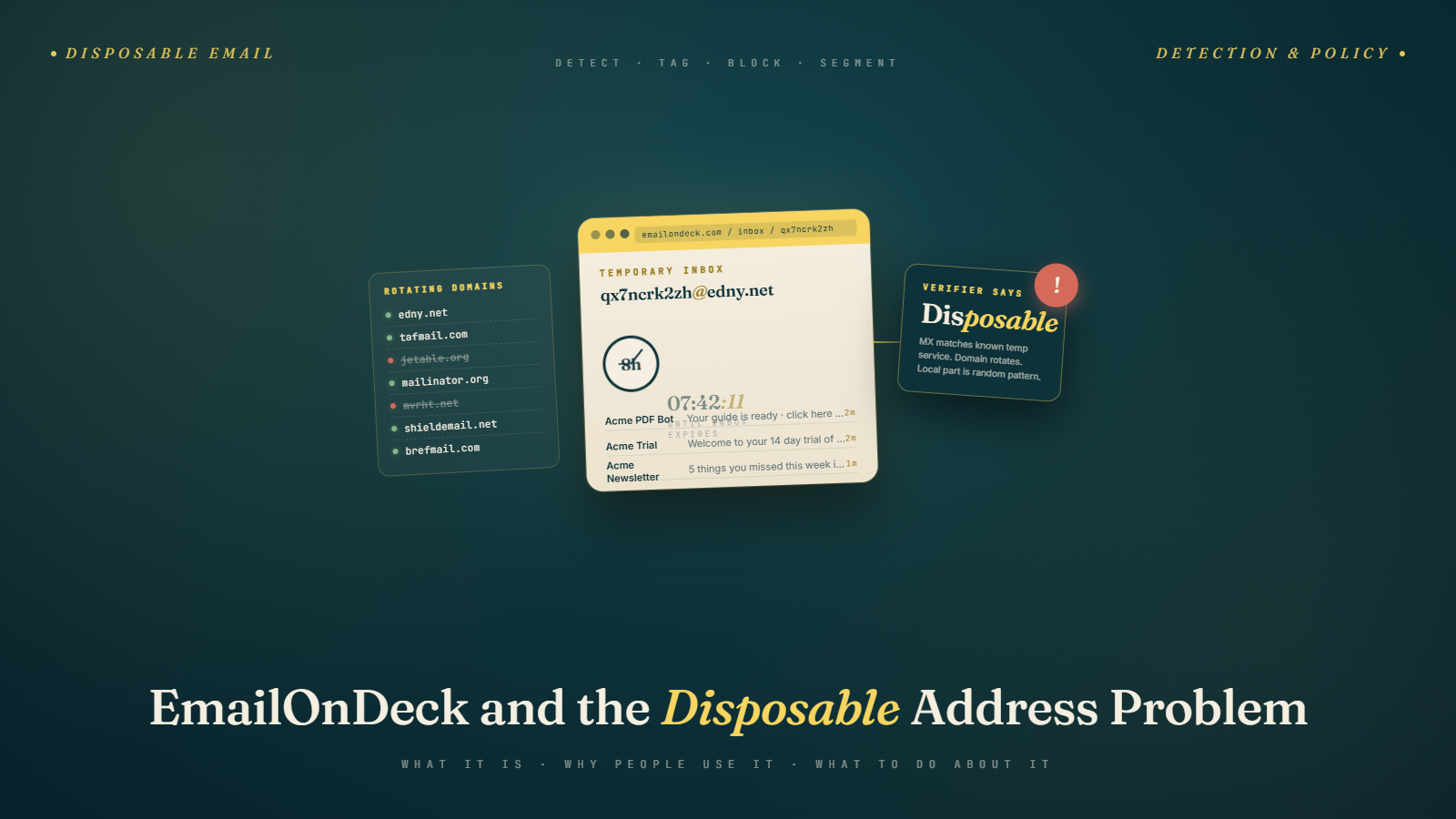
EmailOnDeck is a free service that lets anyone generate a temporary inbox in two clicks. You go to the site, click a button, and you have an inbox with a randomly generated address you can use for the next several hours. Mail sent to that address shows up on the page. When you close the tab, the inbox is forgotten. There is no account, no login, no recovery, and no archive.
A few specifics worth knowing if you are evaluating its impact on your sending program:
The addresses come from a rotating set of domains. The service uses several hundred domains it controls, and they cycle in and out as some get blocked and others come online. This is one of the things that makes simple block lists ineffective.
Inboxes persist for about eight hours by default, with options to extend. Long enough to confirm a registration, click a verification link, and access whatever the user was after.
The service is genuinely free for end users. They monetize through ads on the site and a small premium tier for people who want longer retention or specific addresses. Nothing about the user experience pushes you toward paying.
It is not a privacy tool in the same sense as ProtonMail or Tutanota. It does not encrypt anything. It is meant for one off uses, not ongoing communication.
There is no harm in using EmailOnDeck for what it was built for. The harm to your business comes from a much narrower question: do you want addresses generated this way to count as subscribers, leads, or trial users.
Why Real People Actually Use It
It is tempting to assume that anyone using a disposable inbox is up to something shady. That is not what we see in the data. The biggest user groups for services like EmailOnDeck are doing things that are perfectly reasonable from their side, even if they are inconvenient from yours.
The first group is people who want the gated content but not the followup sequence. They are giving you an address that works long enough to receive your PDF or your webinar link, and then closing the tab so they never see another message. They were never going to convert. They were also never going to mark you as spam, because they will not see your future sends at all.
The second group is people testing your product. Engineers signing up to evaluate your tool for their team. Designers spinning up an account to try a workflow. They want to see what the product does without committing to a real address. Many of them, if the product impresses them, sign up properly with their work address afterwards. Blocking them at signup costs you the evaluation entirely.
The third group is people who have been burned by signup forms that turned into permanent newsletter subscriptions they could not unsubscribe from. After a few of those experiences, using a disposable inbox for any signup that smells optional becomes a sensible default. This group is larger than most marketers want to admit.
The fourth group, smaller than the others, is people doing things you would not want them to do. Repeated trial abuse. Account farming. Bypassing one per customer offers. This is the group that gets all the attention, but they are a minority of the disposable address volume.
Understanding which group is using your form matters because the right response is different for each one. Blanket blocking everyone is rarely the right call.
What An EmailOnDeck Address Does To Your List
When a disposable address ends up on your list, three things happen, in order.
First, the address is real and accepts mail. Your sends to it land in the EmailOnDeck inbox. They get auto opened or auto checked or just sit unread, depending on what the recipient is doing. None of this counts as engagement. Filters notice the lack of replies, clicks, and stars.
Second, after a few hours, the inbox is gone. The address itself often still accepts mail for a while because the domain is still live, but no one is reading what you send. Your messages effectively land in a void.
Third, after a longer window, the address starts hard bouncing. The service rotates domains, and old domains get retired. At that point you are stacking hard bounces, which is the heaviest avoidable negative signal in your sender reputation.
The order matters because it explains why disposable addresses do not show up as a problem on day one. They look like normal addresses for the first few sends. The problem accumulates over weeks. By the time you notice your bounce rate creeping up, the disposable addresses have already done their damage.
This is why the senders who care about placement treat disposable detection as a real line item, not as something to handle later.
Should You Block EmailOnDeck And The Rest?
Probably yes for some forms. Definitely no for others. The decision is per form, not per company.
Block aggressively on signup forms where the cost of a fake account is high. Free trials of expensive products. Forms that grant access to limited resources or seats. Anywhere that disposable signups dilute the engagement metrics your team is graded on.
Allow disposable addresses on low value, high volume forms where the goal is reach. Blog newsletter signups. Lead magnet downloads. Top of funnel content. Yes, some of those signups will not engage. They were never going to. Blocking them does not save you anything, and the false positive rate of disposable detection is real enough that you will reject some legitimate addresses too.
When you do block, do it transparently. A clear message that says the form does not accept temporary email addresses, please use a permanent one. Do not silently fail. The fastest way to lose a real prospect who used a disposable inbox out of habit is to show them a generic error page with no explanation.
A more interesting middle ground than block or allow is to flag and segment. Accept the disposable address into your CRM, mark it with a tag like disposable_email, and send the requested content but exclude the contact from your nurture sequences. The contact gets what they asked for. Your nurture metrics stay clean. If the contact ever updates their address to a real one, they upgrade to the full sequence automatically.
We have a fuller take on segmenting list quality at hyper segmentation for email in 2026 and the broader engagement playbook at why use Bulk Mail Verifier, benefits and tips.
How To Detect Disposable Addresses Reliably
The simple block list approach was good enough in 2018. It is no longer good enough. Services like EmailOnDeck rotate domains often enough that any block list more than a few weeks old will miss real disposable addresses while flagging some legitimate ones. The right detection looks at signals beyond the domain.
A modern verification API checks several things in parallel:
The domain itself, against a continuously updated list that includes the major disposable services and their rotating domains. EmailOnDeck publishes most of theirs but rotates faster than a static list can keep up.
The MX records of the domain. Most disposable services point their domains at a small number of mail servers that are themselves identifiable. Even when the domain rotates, the underlying mail infrastructure often does not.
The pattern of the local part. Disposable services tend to generate addresses with predictable patterns. Random alphanumeric strings of a specific length. Visible timestamps. Sequence numbers. These patterns leak.
The age of the domain. Domains registered in the last few weeks are statistically much more likely to be disposable than domains registered years ago.
A real time SMTP check that confirms the address actually accepts mail, but with extra logic for the kinds of catch all responses disposable services use to mask their behavior.
The API call returns a status that combines all of these into a single judgment. We use this as the basis for Bulk Mail Verifier and walk through the practical setup at how to verify emails and reduce bounce rate.
The reason this matters: a verifier that only checks against a public block list will miss two thirds of EmailOnDeck signups. A verifier that uses the full signal stack catches close to all of them, plus the addresses from competitors, plus the rotating one off domains some users spin up themselves.
A Few Practical Notes For Different Sending Programs
If you run a SaaS with a free trial, treat disposable signups as a real cost. Each trial seat consumes onboarding emails, possibly seat capacity, and engineering hours of customer success attention. Block at signup with a clear message. Offer a path forward for users on company domains that look unusual but legitimate.
If you run a B2B newsletter, treat disposable signups as harmless noise that should not be allowed to skew your metrics. Allow them in, tag them, exclude from nurture, and clean them out on your quarterly verification pass.
If you run an ecommerce promotional list, you are mostly fine. Disposable signups for a one time discount code are a known cost of doing business and the cleanup happens naturally on your bounce log within a couple of months. Do not over engineer this.
If you run cold outreach, you should not be encountering EmailOnDeck addresses at all. Cold outreach goes to addresses you sourced, not addresses people gave you. If you are seeing disposable addresses on your cold list, your data source is corrupt and that is the actual problem to fix. We covered the data source question at the best data sources for cold email outreach.
The Three Things To Do This Week
Audit your existing list for disposable addresses. Run an export through Bulk Mail Verifier and look at the disposable bucket. The number is usually larger than people expect. Suppress those addresses or move them to a separate, lower priority segment.
Add real time verification to your highest cost signup form. Free trial signups, sales demo requests, anywhere a fake address costs you real time or money. The API call costs a tiny fraction of a cent. The disposable signup it prevents costs more.
Decide your policy for the rest of your forms and write it down. Allow with a tag, block with a message, or block silently. There is no universal right answer, but having a written policy means your forms behave consistently and your team is not relitigating it every quarter.
EmailOnDeck is not going away. Neither are the people using it. The senders who handle it well are not the ones with the longest block lists. They are the ones who decided, deliberately and per form, what they wanted to happen and built the form to do that.
If your list has been quietly accumulating disposable addresses for a while, the cleanest place to start is one verification pass over the active list. Free trial at Bulk Mail Verifier, no credit card, real credits in the trial. The disposable count alone usually pays for the work.